Drum machine

BOSS DR-550 MkII

The DR-550 MkII arrived with the original model still in shops, giving the Dr. Rhythm line an expanded option in the budget market.

Workstations & grooveboxes →
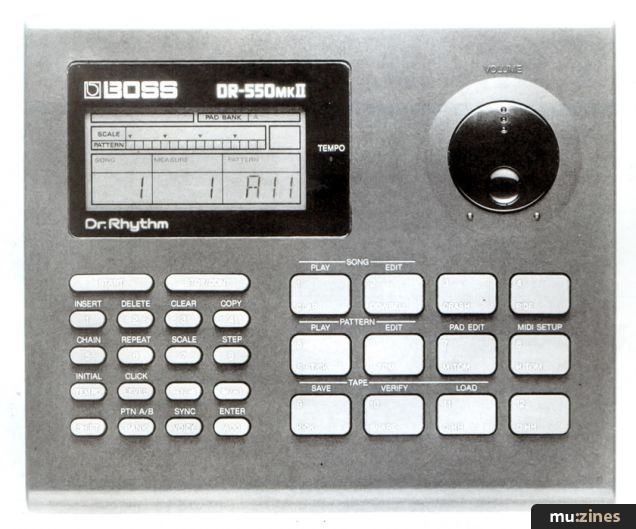
Monochrome close view of the DR-550 MkII display, rotary dial and performance pads; original archive watermark retained.View full scan ↗
Boss DR-550 MkII period photographAugust 1992 · Sound On SoundSource & credit ↗

BOSS dates the DR-550 MkII from 1992 to 2001. An October 1992 comparison found it still sold alongside the original DR-550, at £26 more than the earlier £199 machine.

Sources (5)
  1. Open source 1 ↗
  2. Open source 2 ↗
  3. Open source 3 ↗
  4. Open source 4 ↗
  5. Open source 5 ↗

Source-led exhibition chapter

BOSS DR-550 MkII — The budget machine returns

The second DR-550 looked familiar enough to be mistaken for the first. Its face still gathered a display, small buttons, pads and a large control in a compact body. But a 1992 photograph labels it DR-550 MkII, and the difference is more than a badge. BOSS offered this machine while the original was still being sold. Buyers could look at two related boxes and decide what a broader sound set was worth to them.

Silent shelf comparison

More sounds, the same small-panel discipline.

The MkII’s 91-tone, four-bank, sixteen-step workflow is shown as an explanatory comparison with the original’s 48 tones. It does not simulate the panel or play substitute audio.

Two versions on the shelf

In August 1992, Sound On Sound reviewed the MkII as a new option at £225 including VAT. A later October Music Technology comparison placed it £26 above the original DR-550, which was still in production according to that period report. These are dated UK market observations, not a worldwide price policy. They make a better opening than an unverified date of first shipment: the public could see both versions at once.

The MkII’s key numerical change was ninety-one sounds instead of the original’s forty-eight. The later machine still had twelve-note polyphony, sixty-four preset and sixty-four user patterns, and twelve non-dynamic pads arranged in four banks. It was an expansion of choices within a familiar way of working, not a jump to the sixteen pressure-sensitive pads of the DR-660. The MkII and DR-660 offered distinct ways of working, despite appearing together in the same review.

The image can teach the distinction at a glance. On the MkII’s front panel, the model name is visible above a display with a rhythm grid; a large volume knob sits to the right. Beneath the screen, several buttons do double duty for performance, pattern editing and tape functions. This density is part of the design. It gave a player a small portable surface and made each press of SHIFT or a mode key matter.

More sounds, the same kind of discipline

Simon Trask’s October review compared the MkII with Yamaha’s RY10 and Alesis’s SR-16. He noted the larger sound inventory but also its restrictions: sixteen-step maximum pattern length, non-dynamic pads, no MIDI Out and tape-based data saving. The MkII could run on six AA batteries. It could be a rhythm notebook on the move, then brought into a larger setup through MIDI In, but its sequencing and storage still asked for planning.

The pad edit functions brought more control than the small case suggested. The period comparison lists sound assignment, level, decay, pan, assign type, tone colour and accent follow. A player could shape individual sounds and their place in the pattern, even though the pads themselves did not respond to playing force.

The MkII also had a sharply different scope from the larger DR-660 launched in the same market moment. The DR-660 had sixteen velocity- and aftertouch-sensitive pads, longer patterns and a more expansive arrangement system. That contrast explains BOSS’s line better than calling the MkII “the improved DR-550.” It served the person who wanted a small, battery-powered sampled drummer with a wider sound palette, not the same workstation in a cheaper case.

A trace in a band's toolkit

A 1996 Musician feature recorded the DR-550 MkII among Luscious Jackson’s equipment. The source register supports an equipment mention; the full PDF was inaccessible in this review, and it does not establish a named song or an audible part. The mention connects the instrument to a working band’s toolkit without identifying a particular recording.

From the original DR-550 to the MkII, the sound set grew from forty-eight tones to ninety-one while the physical scale and pattern-based workflow remained familiar. The larger DR-660 offered a further choice: expressive pads and more room to arrange. The MkII’s appeal lay in how much could still fit into a small, portable box.

The machine in the record

Luscious Jackson / one-of-a-kind equipment.

A 1996 Musician feature lists a BOSS DR-550 MkII among Luscious Jackson’s distinctive equipment. It is a contemporary group association, without a song-by-song claim, and a useful reminder that a modest programmable box could sit in an idiosyncratic band setup.

Read Luscious Jackson feature, Musician ↗

More records in the archive

The machine keeps turning up.

Cover artwork for Gary Flanagan — From the Vaults Volume 3.
Gary Flanagan — From the Vaults Volume 3: retained artwork identifies the release or source-recording context, not a machine, session or sound allocation.

Gary Flanagan / From the Vaults Volume 3

Gary Flanagan calls the DR-550 MkII his trusty machine within a long-running analogue-synth home-recording practice, a small dependable rhythm partner rather than an effect of nostalgia.

Read Gary Flanagan — From the Vaults Volume 3 ↗
01 // Standard

The sequel has more to say

The DR-550 MkII arrived with the original model still in shops, giving the Dr. Rhythm line an expanded option in the budget market. Simon Trask placed it among increasingly capable small drum machines, where the question was how much sound and control a player could take home for the money.

Source (1)
  1. Open source 1 ↗

02 // Standard

Ninety-one internal tones

The MkII’s service notes list 91 internal tones and 12-note polyphony. The original DR-550 lists 48 tones at the same polyphony, so the second machine’s character begins with its broader sound inventory: more colours available before a player reaches for external equipment.

Sources (2)
  1. Open source 1 ↗
  2. Open source 2 ↗

03 // Standard

A Dr. Rhythm in its own right

BOSS maintains separate owner-manual entries for the DR-550 and DR-550 MkII. That simple distinction matters in use and in collecting: the MkII is a later instrument with its own sound set, period context and long production run, rather than a label casually applied to every small 550.

Sources (2)
  1. Open source 1 ↗
  2. Open source 2 ↗

04 // Standard

Luscious Jackson’s compact Dr. Rhythm

A 1996 *Musician* feature names a DR-550 MkII among Luscious Jackson’s distinctive equipment. The mention stops short of a song credit, but it places this economical little machine in the orbit of a band whose records made room for hip-hop technique, live playing and found texture.

Source (1)
  1. Open source 1 ↗

MUSIC HISTORY

On record

  • BT — favoured machines, reported. A gear index quotes BT naming the BOSS DR-550 MkII among machines he still liked. Source ↗
  • Direct Hit Productionz — beat-making source library. Direct Hit Productionz lists BOSS DR-550 MkII sounds among the drum-machine sources used for its beat-making work. Source ↗
  • Gary Flanagan — From the Vaults Volume 3. Gary Flanagan calls the DR-550 MkII his trusty machine within a long-running analogue-synth home-recording practice, a small dependable rhythm partner rather than an effect of nostalgia. Source ↗

In the studio and on stage

  • Luscious Jackson — Studio and performance setup; individual recording not named. A 1996 Musician feature identifies a BOSS DR-550 MkII among the group’s one-of-a-kind equipment. Source ↗

Sources

  1. Model age and repair support table
  2. Boss DR550 MkII & DR660 Drum Machines
  3. BOSS Manual Archive — DR-550 and DR-550MKII
  4. BOSS DR-550MKII Service Notes
  5. Luscious Jackson feature, Musician
  6. BOSS DR-550 Service Notes

The visual archive

Further visual evidence.

Sources for images shown earlier (2)
Additional visual sources (2)

Original publications and related image sources.

Machine Museum image viewer

Period image shown in the dossier.

Further sources (1)