
Roland dates the R-8 Mk II to 1992–97. A 1992 Japanese catalogue listed it at ¥108,000 before tax and presented it as a substantially expanded Human Rhythm Composer.
Silent comparison study
A larger internal library, a different memory map.
First R-8
68 internal instruments and 100 user patterns.
R-8 Mk II
200 internal instruments and 200 user patterns.
Transfer boundary
Bulk SysEx does not move directly between models. Roland documents individual MIDI patterns or an M-256E card as routes.
This is a source-labelled workflow comparison, not a data-transfer app or audio emulator.
The machine in the record
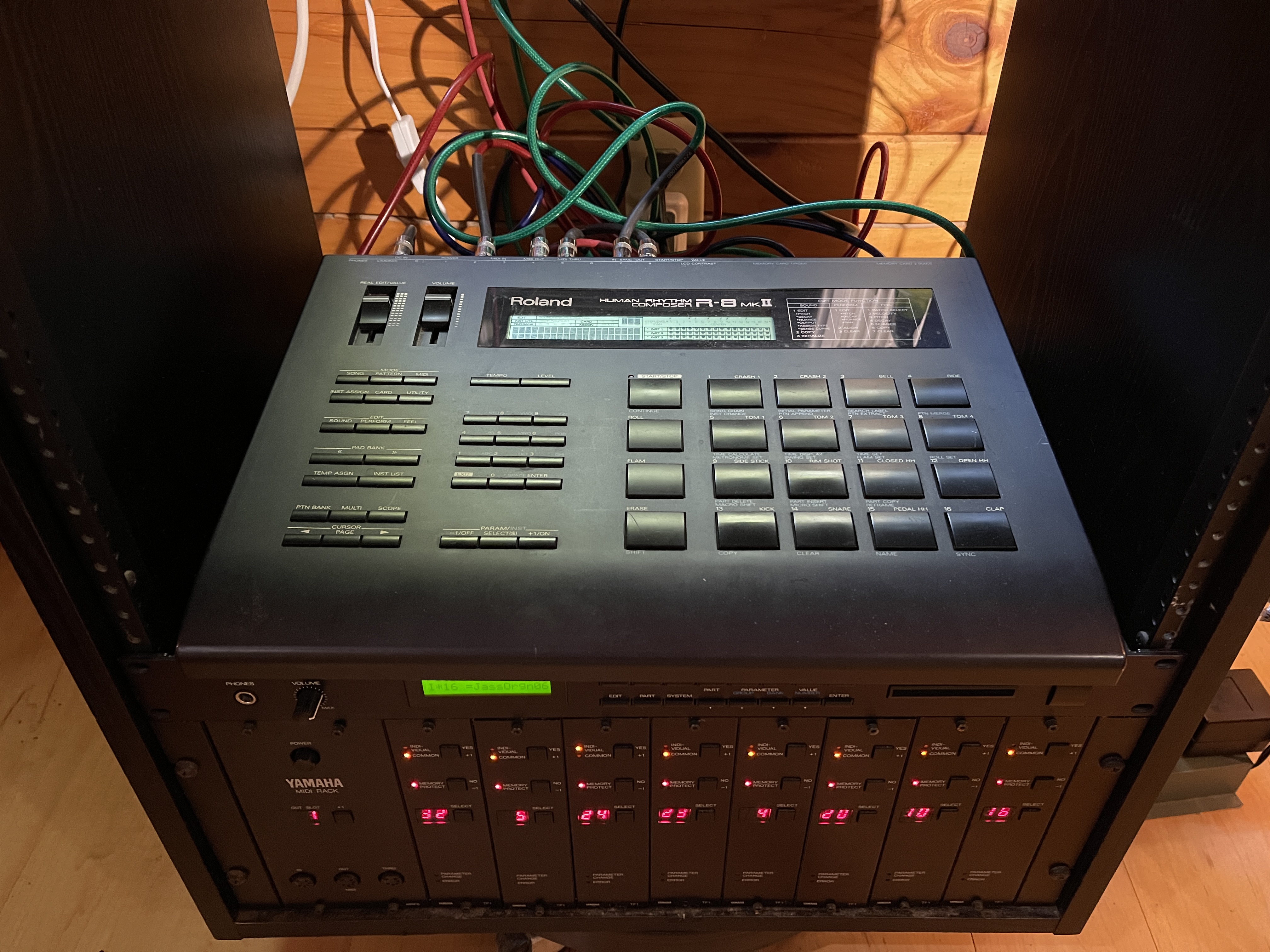
Eris Drew / Quivering in Time.
Eris Drew identifies the R-8 MKII as a go-to machine in the working setup for Quivering in Time, valuing its built-in 808 and 909 material and adjustable samples. The machine is not credited to every drum sound; it is part of the album’s active toolbox.
Read Eris Drew on the Making of Quivering in Time ↗More records in the archive
The machine keeps turning up.
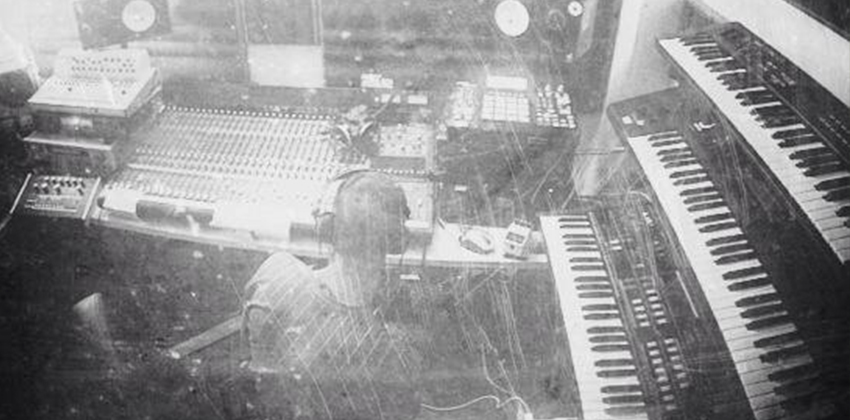
Fabio Monesi / “All Star” and early releases
Fabio Monesi says his Roland R-8 Mk II was heard on his first production, “All Star”, and used extensively on earlier releases.
Read The Ransom Note / Studio Confessions With Fabio Monesi ↗A bigger score for the Human Rhythm Composer
The R-8 Mk II arrived as a distinct revision of Roland’s expressive rhythm-composer idea. Its catalogue announced three times the sound count of the earlier R-8 and double the pattern memory, turning a familiar instrument into something with a much wider internal world.Sources (2)
Two hundred instruments, room to write
Roland specifies 200 instruments, 26 copy-instrument locations, 32 preset patterns, 200 user patterns of up to 99 bars and ten songs. Those figures describe an instrument for sustained work: a player can begin with a rhythm, reshape its voices, then carry the result through a longer arrangement without leaving the machine.Source (1)
The connections of a studio instrument
Stereo outs, eight multi outputs, MIDI In/Out/Thru, tape sync and card expansion place the R-8 Mk II in the middle of a larger studio. Real-time and step editing let it work at two speeds — immediate when inspiration strikes, exact when an arrangement needs to be refined.Source (1)
A catalogue price, a modular future
Roland’s 1992 catalogue lists the machine at ¥108,000 before tax, alongside SN-R8 sound cards at ¥6,000 and an M-256E memory card at ¥8,500. The arrangement makes the R-8 Mk II feel less like a sealed drum box and more like a composer’s instrument that could grow with its owner.Source (1)
A model with its own identity
Roland’s support documentation keeps the R-8 and R-8 Mk II as separate systems, with different internal architectures and their own data relationship. For players and collectors, that distinction is practical: the Mk II carries its own expanded instrument list, pattern space and way of holding a rhythm.Source (1)
On record
- Eris Drew — Quivering in Time. Eris Drew identifies the Roland R-8 MKII as a go-to machine in her Quivering in Time working setup, praising its built-in 808/909 material and adjustable samples. Source ↗
- Fabio Monesi — “All Star” and early releases. Fabio Monesi says his Roland R-8 Mk II was heard on his first production, “All Star”, and used extensively on earlier releases. Source ↗
Sources
The visual archive
Further visual evidence.
These displayed records are labelled by their documented role, date and source; source-only records are listed separately below.
Sources for images shown earlier (3)
- Roland R8 Rhythm Composer; Roland R-8 MKII; Roland R8 ↗
- Eris Drew’s Roland R-8 MKII ↗
- Fabio Monesi — Studio Confessions / The Ransom Note ↗
2021-08 · The Ransom Note (photographer uncredited on source page) · Lead studio photograph for “Studio Confessions With Fabio Monesi”.