
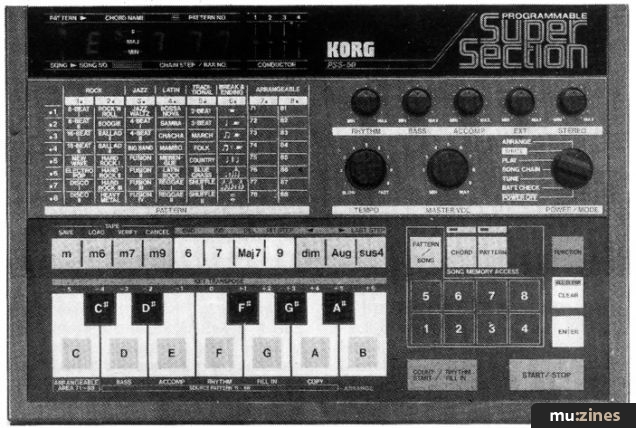
Korg’s PSS-50 Programmable Super Section reached British reviewers in July 1984 after an April advance notice. It was a self-contained arranger for building backing from rhythm, bass, accompaniment and fill-in parts, then storing songs and chains on cassette data.
The machine in the record
Martin Rushent / the arrangement tool.
Martin Rushent’s 1985 endorsement presents Korg’s PSS-50 as an arrangement tool valued for digital percussion and programmable backing parts. It is advertising testimony rather than a named record credit, but it captures how a leading producer was asked to frame the machine for working musicians.
Read Martin Rushent on the Korg PSS-50, Electronics & Music Maker advertisement ↗More records in the archive
The machine keeps turning up.
Reported association
David A. Stewart / Eurythmics / period-press equipment report
An equipment index reports that a 1985 feature places David A. Stewart with Korg’s PSS-50.
Read David A. Stewart / Korg PSS-50, reported period-press attribution ↗On record
- Martin Rushent — Korg PSS-50 public endorsement. Rushent’s period endorsement presents the PSS-50 as an arrangement tool he valued for its digital percussion and programmable backing parts. Source ↗
In the studio and on stage
- David A. Stewart / Eurythmics — period-press equipment report. An equipment index reports that a 1985 feature places David A. Stewart with Korg’s PSS-50. Source ↗
Write the chords, choose the backing
The PSS-50 puts rhythm, bass, accompaniment and fill-in phrases into a small arranger. To write a song, choose a numbered backing pattern from the printed panel chart, enter a root and chord type, then press Enter for each half-bar. A fill-in is requested before committing that step. The player writes the chord progression and arrangement; the machine supplies the notes and drum phrases inside the selected patterns.
PSS-50 Owner’s Manual, specifications printed p.43 ↗ Korg PSS50 Programmable Super Section, E&MM pp.10–11 ↗
Recombine the four parts
Arrange mode stores sixteen new combinations drawn from existing rhythm, bass, accompaniment and fill-in parts. The manual's example pairs Electro Pop accompaniment with New Wave bass, Fusion IV rhythm and Hard Rock I fill-in. Copy can bring over a whole pattern before replacing one component. Break 61 can silence selected parts, leaving drums or a fill on their own. Choosing a triple-time rhythm also puts the other components into triple time. This is phrase-level arranging, not unrestricted note-by-note programming.
Two reviewers meet the supplied band
Paul White's July 1984 review welcomed the PCM drums and varied accompaniment voices, but warned that the composer remained tied to someone else's rhythms and phrasing. Gunther Carstensen, reviewing it that August/September, likewise enjoyed its chord and song facilities while finding the accompaniment sounds less varied than he expected. These are distinct listening judgments. The shared practical limit is clearer: new combinations still use the supplied musical vocabulary.
Korg PSS50 Programmable Super Section, E&MM pp.10–11 ↗ PS. I Love You, Electronic Soundmaker & Computer Music pp.22–23 ↗
Save the arrangement, then check the tape
The cassette interface saves the complete memory: songs, chains and arrangeable patterns. That is program data, not a recording of the backing band's sound. After Save, rewind and use Verify to compare the tape with the data still in the PSS-50. The manual describes adjusting the recorder's playback level until the display reports Gd for a match; loading later restores the data for the machine to play. A library of arrangements therefore depends on a checked data transfer, not merely on having recorded something onto a cassette.
A backing tool offered to working players
The April 1984 advance notice expected the PSS-50 in Britain within the following months; July's review establishes a working review unit, not an exact first-sale date. A registered Unicord advertisement offered a demonstration record and brochure and promoted practice, composition, recording and performance. Those are the manufacturer's proposed uses, not proof of a recording session or an independently tested replacement for a live band.
PSS-50 Super Section advertisement, Musician August 1984, PDF p.3 ↗ New Products: Korg Super Section PSS-50, E&MM April 1984 ↗
Sources
The visual archive
Further visual evidence.
Sources for images shown earlier (1)
Additional visual sources (2)
Original publications and related image sources.
- Korg PSS-50 factory owner manual ↗
Original date · Korg · 44-page PDF; specifications p.43 - Unicord PSS-50 accompaniment campaign ↗
August 1984 · Unicord · PDF p.3, no printed page number visible