
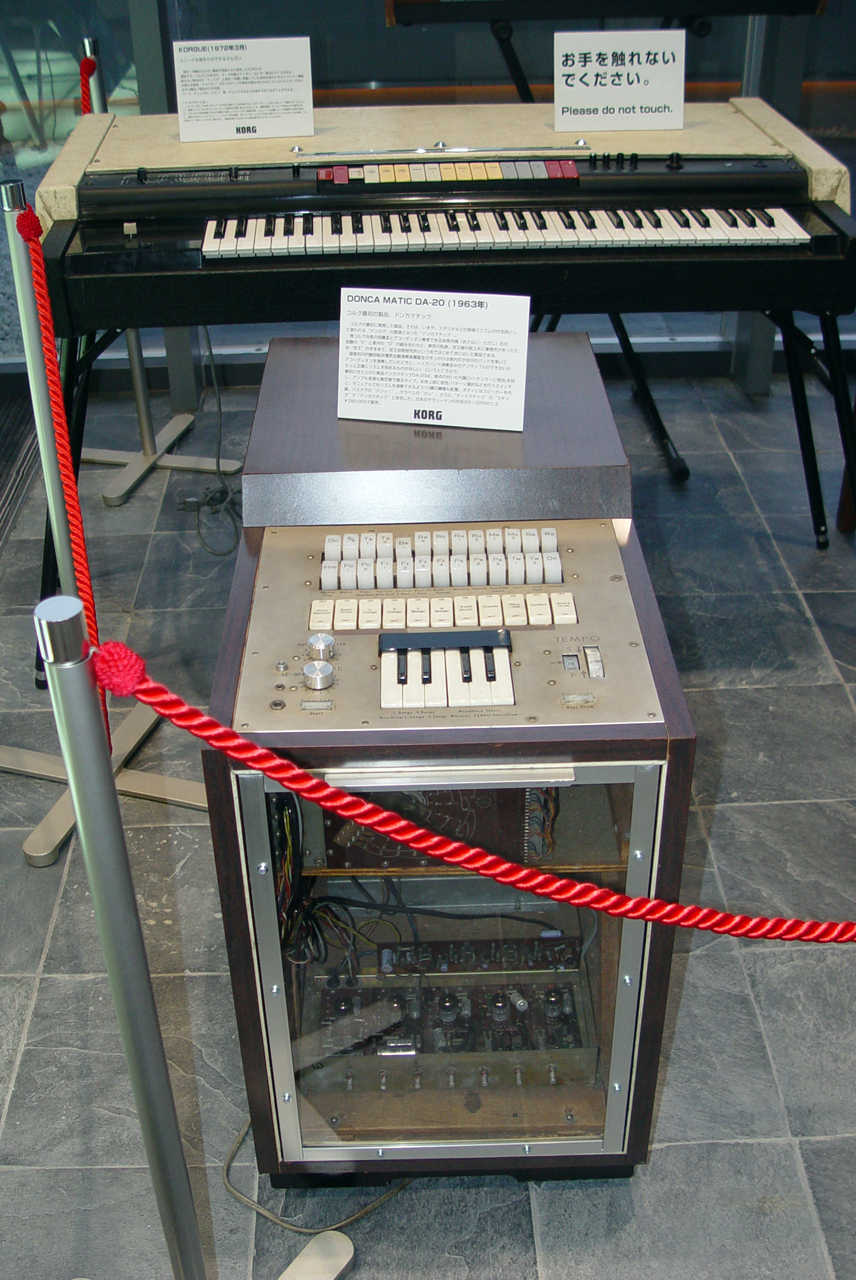
Keio Electronic Laboratories' DA-20 DoncaMatic appeared in 1963, before the Korg name became familiar on instruments, as Japan's first commercially produced domestic disc-based rhythm machine. An institutional technology-heritage record identifies 11 percussion instruments and 25 preset rhythms; Korg's own corporate history confirms the Doncamatic as its formative rhythm-machine project.
The machine in the record
Tadashi Osanai / the nightclub problem.
Accordionist Tadashi Osanai wanted something better than the Wurlitzer Sideman that kept time for his Tokyo nightclub performances. The disc-driven DoncaMatic was the answer and became Keio’s first product. No surviving nightclub recording is claimed; the performing need itself made the machine.
Read History Of Korg Part 1 ↗The furniture-sized origin story
The DA-20 is an unlikely ancestor to the compact boxes that followed it. The surviving museum-display photograph shows a warm, cabinet-like object with separate rhythm, amplifier and loudspeaker elements, made to live alongside an organ or accordion rather than underneath a drum pad. It was not yet a Korg-branded synth accessory: the maker was Keio Electronic Laboratories, the company that would become Korg, and the product belonged to the early-1960s world of domestic accompaniment. Its scale is part of the historical argument. Before a rhythm machine became a portable compositional object, it could be a piece of room furniture whose job was to make a solo player sound accompanied.Sources (2)
A disc, brushes and a repeating pulse
Its rhythm was visibly mechanical. Later restoration reporting describes a motor turning a patterned contact disc beneath brushes; the electrical contacts generated the pulses that called the percussion sounds. That mechanism makes the DA-20 a very different proposition from a later step sequencer. The rhythm existed as a physical geometry: contacts recurring under a brush, cycle after cycle, while the rest of the system amplified the result. The institutional record confirms the commercial machine's 11 percussion instruments and 25 preset rhythms; the restoration account helps a visitor understand how a preset could be stored before digital memory, EPROM or a row of illuminated steps.Sources (2)
Twenty-five choices, not an empty loop
The National Museum of Nature and Science records 25 preset rhythm patterns, a figure that corrects the temptation to imagine the DoncaMatic as no more than a primitive click track. The machine was designed to supply a repertoire of accompaniment for organ and accordion players: a rhythm section in repeatable forms, ready to be selected rather than programmed note by note. Its product name itself entered Japanese musical language. The museum explains that “donkama” came from Doncamatic and later described the use of a rhythm machine or click for keeping shared tempo. An object designed to fill in for absent players left behind a word for rhythmic coordination.Source (1)
The problem Tadashi Osanai wanted to solve
The retrospective Sound On Sound history gives the DA-20 a specific human starting point: Keio co-founder and accordionist Tadashi Osanai wanted an alternative to the Wurlitzer Side Man that accompanied his work. Korg's corporate history, less detailed but primary to the company, calls the Doncamatic Japan's first disc-based rhythm machine. Together they make a careful account possible. Osanai's personal motivation is a later historical report, while the machine's place in Korg's origin story is corporate testimony; neither should be used to invent a scene beyond the sources. What survives is already vivid enough: a working musician and a small company trying to make accompaniment more dependable.Sources (2)
A national first, with terms worth keeping precise
The 2020 technology-heritage record calls the DA-20 Japan's first commercially produced domestic rhythm machine, while Korg's corporate account uses the phrase Japan's first disc-based rhythm machine. Both descriptions are meaningful, but they are not interchangeable with every claim one might make about the world's first rhythm device or every prior mechanical accompaniment system. The Museum keeps the wording close to its sources: a 1963 Keio product, commercially made in Japan, using a disc-based mechanism, made for accompaniment. Precision allows the DoncaMatic to remain extraordinary without being made falsely solitary.Sources (2)
A surviving DoncaMatic
The surviving DoncaMatic photograph makes the scale of this early rhythm machine immediately clear: it is furniture-sized, with its mechanical rhythm system housed as a serious domestic instrument. The image gives the page an object to meet alongside the corporate and institutional histories.Source (1)
On record
- Tadashi Osanai — Nightclub solo-performance accompaniment. The DA20 began with an accompanist’s complaint. Accordionist Tadashi Osanai wanted something better than the Wurlitzer Sideman that kept time for his Tokyo nightclub performances, then designed the disc-driven DoncaMatic that became Keio’s first product. Source ↗
Sources
The visual archive