
The KR-55 and KR-55B belong to Korg’s Rhyth-55 family of preset rhythm machines. Each has its own operating manual; the B suffix identifies a particular instrument, not another spelling of the original KR-55.
The machine in the record
Jean-Michel Jarre / Équinoxe.
An album-equipment entry says the Équinoxe booklet names a Korg Rhythm 55 KR-55. The dossier covers the Rhyth-55/KR-55 family and does not assign it to a particular passage. It is a reported booklet connection, awaiting the original scan.
Read Jean-Michel Jarre — Korg KR-55 on Équinoxe ↗More records in the archive
The machine keeps turning up.
Shahrooz Raoofi / 2016 studio inventory
A filmed FACT studio visit lists a Korg Rhyth-55B among Shahrooz Raoofi’s working drum machines.
Read Shahrooz Raoofi studio visit ↗A rhythm section within reach
Rows of dance names turn these small Korg boxes into accompaniment instruments: choose a rhythm, set a pace and play along. Their appeal is in the controls a musician can reach during a song, from starting the beat to changing its swing or bringing in a fill.
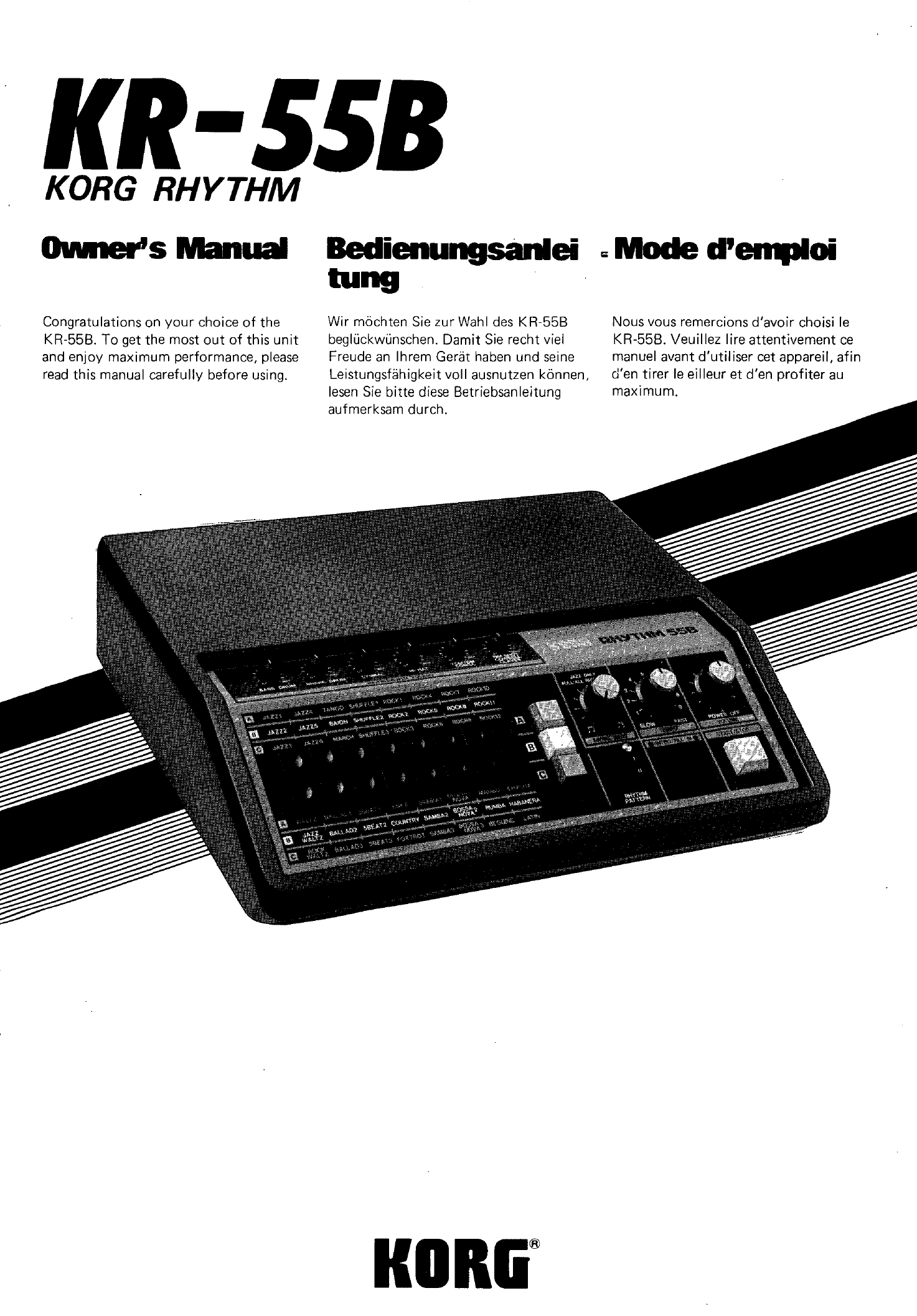
Rhyth-55 is the family doorway here. Korg’s separate KR-55 and KR-55B manuals keep the two instruments distinct, and the photograph shows the KR-55B. A credit naming the original KR-55 should not quietly become a KR-55B credit.
Korg Rhythm KR-55 Owner’s Manual ↗ KR-55B Korg Rhythm owner’s manual (English/German/French) ↗
Read the rows, then change the beat
On the KR-55B, the coloured A, B and C selectors work with the printed rhythm rows. Jazz, shuffle and rock sit above the keys; waltz, bossa nova and other accompaniment figures run below. Tempo and Swing Beat have their own knobs, with Start/Stop and Intro/Fill In close beside them. The panel makes rhythm selection part of the performance rather than a programming session.
The original KR-55 manual also describes intro-start, adjustable swing and rhythm combinations. These are documented features of that model; its manual remains the guide when identifying a control or operation on an original KR-55.
KR-55B Korg Rhythm owner’s manual (English/German/French) ↗ Korg Rhythm KR-55 Owner’s Manual ↗
Leave the hands on the instrument
The KR-55B provides a footswitch connection for remote start/stop and intro/fill-in control. High and low audio outputs let it join the rest of a playing setup, while a separate trigger output offers selectable timing for compatible Korg synthesizers and sequencers. These connections take the rhythm box beyond accompaniment through its own front-panel buttons.
Which Korg is on the record?
The name on a sleeve, equipment list or studio account matters. KR-55 and KR-55B are close relatives, but their histories need not be interchangeable. The accounts below retain the model each source actually names, so the family page can connect them without turning every Rhyth-55 mention into the same machine.
Korg Rhythm KR-55 Owner’s Manual ↗ KR-55B Korg Rhythm owner’s manual (English/German/French) ↗
On record
- Jean-Michel Jarre — Équinoxe. An album-equipment entry says the Équinoxe booklet names a Korg Rhythm 55 KR-55. Source ↗
In the studio and on stage
- Shahrooz Raoofi — 2016 studio inventory. A filmed FACT studio visit lists a Korg Rhyth-55B among Shahrooz Raoofi’s working drum machines. Source ↗
Sources
The visual archive
Further visual evidence.
Sources for images shown earlier (2)
- KR-55B Korg Rhythm owner’s manual ↗
- Korg Rhythm KR-55B — ESTECHO instrument account ↗
2016 · ESTECHO (photographer uncredited on source page) · Lead machine photograph on ESTECHO’s Korg Rhythm 55B post.