
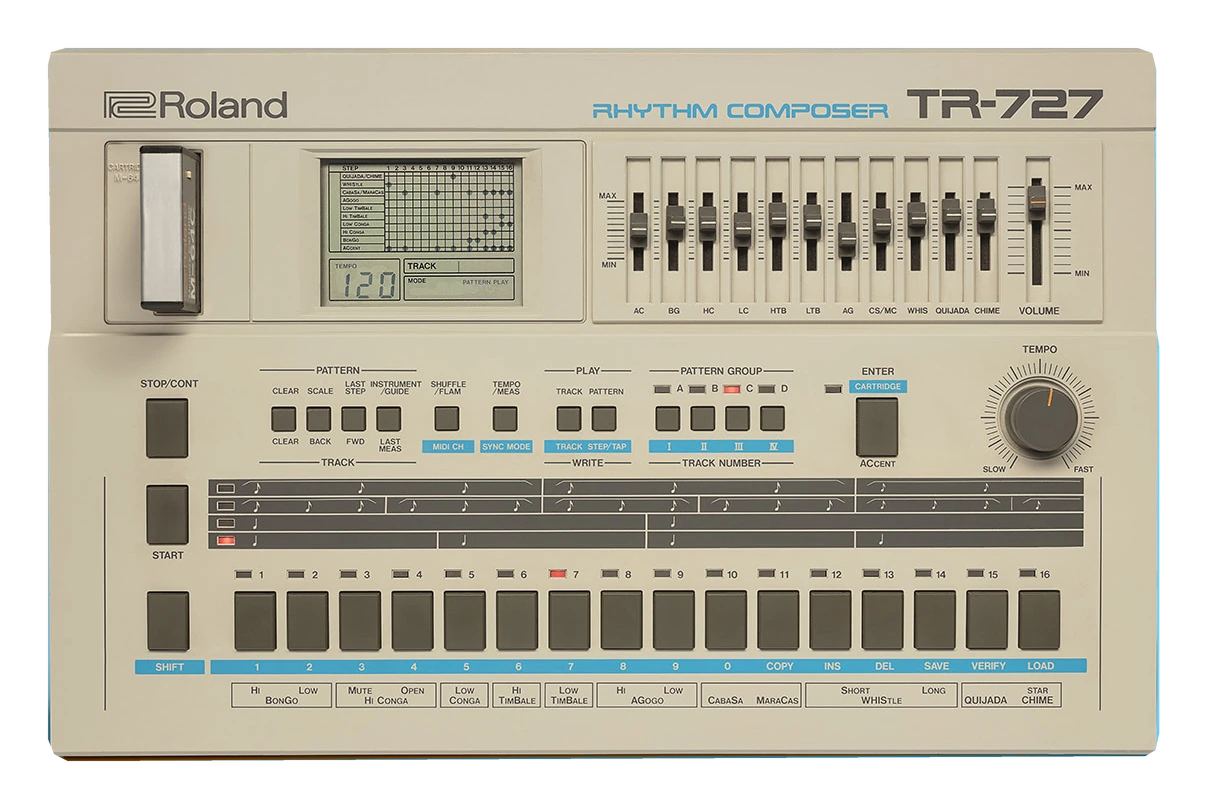
Dan Goldstein reviewed the TR-727 in the August 1985 issue of Electronics & Music Maker, which listed a UK recommended retail price of £550.Sources (2)
The machine in the record
Phuture / “Acid Tracks”.
The documented Phuture history identifies the paired TR-707/TR-727 system around “Acid Tracks”. It does not assign every voice to one machine, but it places the Latin-voiced 727 beside one of acid house’s foundational records without overstating its share.
Read Lifetime Achievement: DJ Pierre and Phuture ↗More records in the archive
The machine keeps turning up.
Reported association
Mark Bell / LFO / the 1991 LFO setup
A secondary index reports Bell discussing the TR-727’s Latin percussion in a 1991 interview.
Read Mark Bell / TR-727, reported from a 1991 interview ↗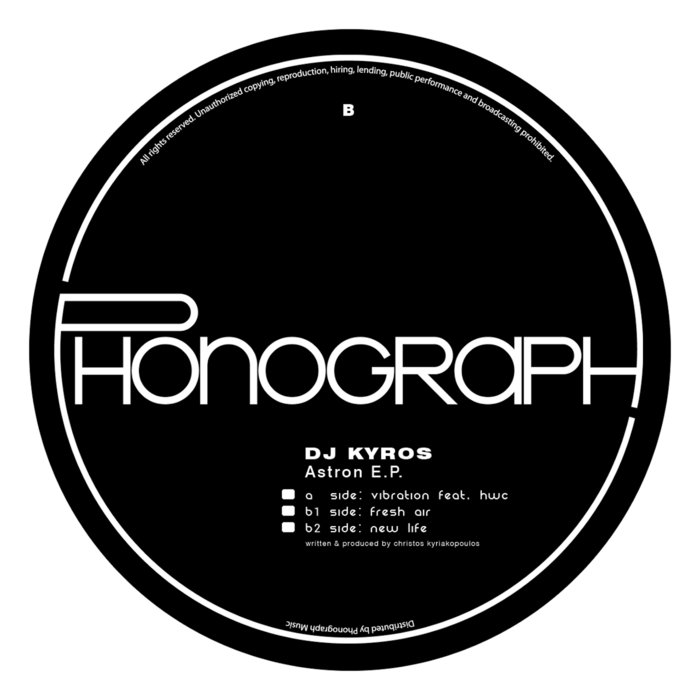
DJ Kyros / “New Life”
The Phonograph Music track note credits a Roland TR-727 alongside an Alpha Juno-2 for DJ Kyros’s “New Life”.
Read Phonograph Music / Astron EP ↗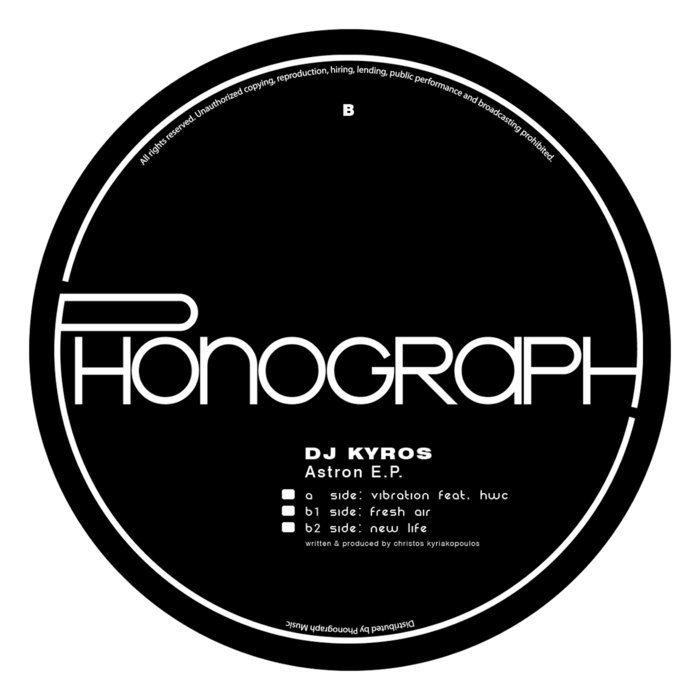
DJ Kyros / New Life
Phonograph Music describes DJ Kyros’s “New Life” as a deep break groove made with a vintage TR-727, a precise track-level credit for Roland’s Latin-percussion box.
Read DJ Kyros — New Life ↗Archive source
SysEx Emporium / 2,081 Ultimate Vintage Drum Samples
SysEx Emporium lists Roland TR-727 samples in 2,081 Ultimate Vintage Drum Samples.
Read SysEx Emporium / 2,081 Ultimate Vintage Drum Samples ↗
Hunter Complex / Lars Meijer / Dead Calm and Zero Degrees
Hunter Complex credits a Roland TR-727 on tracks a4 and b3.
Read Hunter Complex — Dead Calm and Zero Degrees ↗Phuture / DJ Pierre / Acid Tracks
The history identifies the paired TR-707/TR-727 system around Acid Tracks.
Read Lifetime Achievement: DJ Pierre and Phuture ↗A sister machine with another percussion vocabulary
The TR-727 used the TR-707’s approachable programming language to put fifteen digitally sampled Latin percussion voices under the fingers. Dan Goldstein described it in 1985 as the 707’s sister machine: the same broad pattern, track, display and storage logic, but with congas, timbales, agogô and other percussion where a conventional kick-and-snare kit might usually lead.Source (1)
Starting somewhere else
That change of vocabulary altered the work of programming. Goldstein liked the sound of the congas and the machine’s flexibility, but observed that building a rhythm without the familiar kick-and-snare anchor asks the player to think differently about where a bar begins. Step and real-time entry, the LCD grid, MIDI, tape sync and Roland’s Sync24 made those experiments part of a familiar Roland workflow.Source (1)
Made for the mixer
At £550, the 727 sat above Korg’s cheaper DDM220 in Goldstein’s comparison. Separate outputs, cartridge storage and broad connectivity helped explain the difference. He still wished for individual pitch control and accent by voice, useful reminders that its sampled sounds were chosen for the player rather than endlessly variable. The TR-727’s appeal was the combination: a defined set of percussion colours and enough routing to give them a place in a larger arrangement.Source (1)
The percussion box beside Acid Tracks
Roland’s DJ Pierre and Phuture history places the TR-727 alongside the TR-707 around “Acid Tracks”. The source does not allocate individual voices, yet it gives the supposedly marginal Latin-percussion machine a vivid role in the equipment ecology around one of house music’s formative records.Source (1)
On record
- Phuture / DJ Pierre — Acid Tracks. The history identifies the paired TR-707/TR-727 system around Acid Tracks. Source ↗
- DJ Kyros — “New Life”. The Phonograph Music track note credits a Roland TR-727 alongside an Alpha Juno-2 for DJ Kyros’s “New Life”. Source ↗
- DJ Kyros — New Life. Phonograph Music describes DJ Kyros’s “New Life” as a deep break groove made with a vintage TR-727, a precise track-level credit for Roland’s Latin-percussion box. Source ↗
- SysEx Emporium — 2,081 Ultimate Vintage Drum Samples. SysEx Emporium lists Roland TR-727 samples in 2,081 Ultimate Vintage Drum Samples. Source ↗
- Hunter Complex / Lars Meijer — Dead Calm and Zero Degrees. Hunter Complex credits a Roland TR-727 on tracks a4 and b3. Source ↗
In the studio and on stage
- Mark Bell / LFO — the 1991 LFO setup. A secondary index reports Bell discussing the TR-727’s Latin percussion in a 1991 interview. Source ↗
Sources
The visual archive
Further visual evidence.
These displayed records are labelled by their documented role, date and source; source-only records are listed separately below.
Sources for images shown earlier (4)
- DJ Kyros — “New Life” ↗
Release date not stated on source page · DJ Kyros / release artwork via Bandcamp · Official Bandcamp release-page artwork (Open Graph image) - SysEx Emporium — 2,081 Ultimate Vintage Drum Samples ↗
2023-02-20 · SysEx Emporium / release artwork via Bandcamp · Official Bandcamp release-page artwork (Open Graph image) - Hunter Complex / Lars Meijer — Dead Calm and Zero Degrees ↗
2020-03-20 · Hunter Complex / Lars Meijer / release artwork via Bandcamp · Official Bandcamp release-page artwork (Open Graph image) - Phuture / DJ Pierre — Acid Tracks ↗
1987-01-01T00:00:00Z · Phuture / DJ Pierre / release artwork via Cover Art Archive · MusicBrainz release record and Cover Art Archive front artwork
Additional visual sources (2)
Original publications and related image sources.
- It's Latin for Rhythm ↗
Apr 1985 · International Musician & Recording World · Roland TR-727 in a studio setting from the advertisement feature It’s Latin for Rhythm; the TR-727 model marking is visible. - Roland TR727 Rhythm Composer ↗
Dec 1985 · In Tune · Roland TR-727 product photograph from Nick Graham’s December 1985 In Tune review; the filename’s 86_06 token is not the publication date.