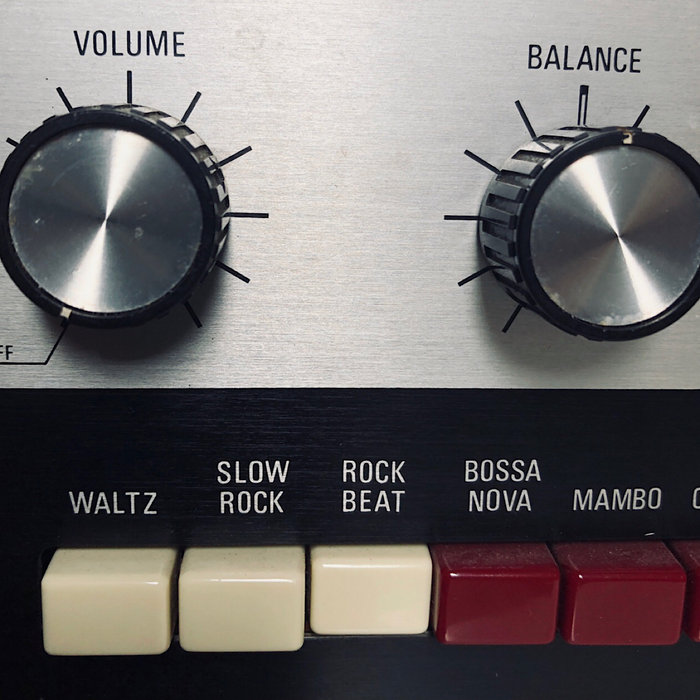
Preset analogue rhythm and MIDI piano-accompaniment unit

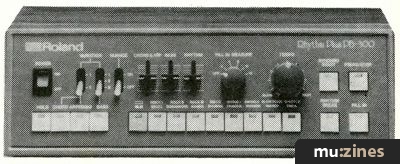
Roland PB-300 Rhythm Plus

Choose a rhythm and play a left-hand chord: the PB-300 could supply percussion and bass while the connected HP-300 or HP-400 supplied chord or arpeggio sounds.

Rhythm takes control →
Music Maker Equipment SceneView full scan ↗
Roland PB-300. Electronics & Music Maker, November 1983.Nov 1983 · Electronics & Music MakerSource & credit ↗

Shown at the June 1983 Chicago NAMM show; the owner’s manual carries a July 1983 imprint.

Source-led exhibition chapter

Roland PB-300 — the band beside the piano

In the 1983 Chicago trade-show photograph, the PB-300 sits among the instruments it was built to accompany: Roland's Piano Plus 100 and PR-800 recorder. Together they formed the Piano Plus system. The rhythm box offered the pianist a practical proposition. Choose a beat, put the left hand on a chord, and the accompaniment could follow.

The Piano Plus system

Hands, rhythm, recorder.

The player supplies the keyboard information; PB-300 sounds the rhythm and bass; the connected HP piano sounds the chords or arpeggios; PR-800 records the keyboard performance. Open each part to see its role in the accompaniment.

Left hand

Lower keys anchor bass and accompaniment.

Rhythm

Choose a preset, set pace, then request a fill.

Recorder

PR-800 belongs to the wider Piano Plus system as the arrangement recorder.

Sixteen choices, one player

Eight rhythm buttons and a bank selector gave the PB-300 sixteen starting points, from Rock and Disco to Waltz, Bossa Nova and Enka. Beside them sat a large tempo knob and separate level sliders for rhythm, bass and chord or arpeggio accompaniment. The controls brought the decisions close to the musician's hands.

The fill button gave those preset rhythms a little room to breathe. Press it during playback and the fill arrived in the following measure. Press it before starting and it supplied a one-measure introduction. For regular changes, a selector could insert a fill every two, four, eight, twelve or sixteen measures. Rhythm Break let the player drop the percussion out and bring it back.

These were ways of shaping a performance while it was happening. The patterns were already there; the pianist decided when they should enter, change or leave.

The rear panel offered another way to make those decisions: separate pedal sockets for Play/Stop and Fill In. Roland's manual shows the HP-300/400's soft pedal connected to the rhythm box and also lists the optional DP-2. A pianist could call for a fill without taking a hand off the keys. A rear-panel Accent Level control adjusted the emphasis of the rhythm's accents.

Two instruments making one accompaniment

The PB-300 supplied its own percussion and bass sounds. The chords and arpeggios sounded through the connected HP-300 or HP-400 piano. MIDI carried the musical instructions between them, while the audio connections brought their sounds together.

That division is central to understanding the instrument. On the HP-300/400, the keyboard split between F-sharp and G below middle C. The lower section supplied the notes that guided the automatic accompaniment; the upper section remained available for the pianist to play. The manual specifies chords of up to four notes and places the generated chord or arpeggio two octaves above the keys pressed. The held keys served as instructions rather than sounding that chord directly. With HOLD engaged, the accompaniment continued after release, until a new chord replaced it.

Chord and arpeggio were alternative modes. One supplied the accompanying chords; the other broke them into moving notes. Their variation switch offered two patterns, while the bass had three, matched to the selected rhythm. The Nuance switch added another connection to the performance: the force of the pianist's key attack could influence the bass and chord or arpeggio levels. It was not a facility for individually programming the drum sounds.

Synchro Start made the first entrance part of the keyboard performance too. Once armed, the PB-300 waited for playing in the lower section before starting its rhythm and selected accompaniment.

The recorder joins in

Adding the PR-800 changed who led the system. With the PB-300 set to external clock, the recorder's tempo and transport took charge. The rhythm box's own tempo knob, Play/Stop and Synchro Start no longer controlled playback in that arrangement.

The rear-panel connections reveal how carefully these companions were meant to fit together. MIDI carried control information. A separate MIX IN could accept an external sound—the manual illustrates the PR-800's metronome—and combine it with the PB-300's rhythm and bass at the output.

A contemporary listener

In his August 1984 review, Geoff Twigg judged the PB-300 within the Piano Plus system and against his own expectations of a drum machine. He found it useful beside the piano, but wanted more programming freedom. Its tempo knob also lacked a numerical BPM display.

That response gives the machine a useful contemporary perspective. Its appeal depended on what the player wanted to do: sit at the piano with a responsive accompaniment, or construct a drum part from individual decisions.

Other ears for an old companion

The PB-300 later found listeners outside its original piano setting. CORAL D released a collection of recordings of its rhythms in 2021. Solvent identified one in his studio. Those accounts extend its musical life beyond the home-keyboard system pictured in the early press.

Other owners went further. ESTECHO documented a four-output modification: bass drum, snare, a toms-and-clave group, and cymbals and hi-hats. It repurposed the pedal and MIX IN sockets; the author had not tested the bass accompaniment. Zack's separate CPU project added individual MIDI triggers, but his December 2020 account says it had no pattern support and that the code could no longer be found. These were altered instruments, with different capabilities and compromises—not features waiting to be discovered on a stock PB-300.

The PB-300's particular charm lies in that original relationship with a player. A left-hand chord, a fill queued for the next measure, a rhythm brought in under the melody: small actions that let a preset accompaniment take part in a performance.

The machine in the record

Cover artwork for CORAL D — Rhythm Box Sample Pack — PB-300 loops.
CORAL D’s PB-300 loop collection is the record of this machine being captured at several tempos; the sleeve identifies the release, not a recording session.

CORAL D / Rhythm Box Sample Pack.

CORAL D recorded PB-300 loops at several tempos for a modern sample pack. The small Roland survives here as usable sound material, ready to be written into somebody else’s rhythm.

Read Rhythm Box Sample Pack ↗

More records in the archive

The machine keeps turning up.

CORAL D / Rhythm Box Sample Pack — PB-300 loops

Artist identifies PB-300 as source of dry loops recorded at multiple tempos.

Read Rhythm Box Sample Pack ↗
MUSIC HISTORY

In the market

  • 1984-08: GBP 320 — UK contemporary review price. PB-300 rhythm unit caption; companion piano and PR-800 priced separately Source ↗
  • 1983-11: GBP 299 — British equipment-news announcement price. PB-300; accompanying PR-800 priced separately Source ↗

On record

  • CORAL D — Rhythm Box Sample Pack — PB-300 loops. Artist identifies PB-300 as source of dry loops recorded at multiple tempos. Source ↗

In the studio and on stage

  • Solvent — studio composition practice. Solvent identifies the Roland PB-300 in his studio as a rare, compact drum-machine and auto-accompaniment unit. Source ↗
01 // Roland’s Rhythm Plus: a rhythm-and-bass partner for the Piano Plus home MIDI system.

A rhythm companion for the piano system

Choose a rhythm and play a left-hand chord: the PB-300 could supply percussion and bass while the connected HP-300 or HP-400 supplied chord or arpeggio sounds. Roland's manual describes that division of work, with the upper keyboard still available for live playing. The PR-800 recorder could join the same MIDI system and lead its tempo and transport.

PB-300 Rhythm Plus Owner’s Manual ↗ Music Maker Equipment Scene, p.10 ↗ NAMM Report, pp.80–90 ↗

02 // Roland’s Rhythm Plus: a rhythm-and-bass partner for the Piano Plus home MIDI system.

Sixteen rhythms and a practical panel

Eight buttons and two banks selected sixteen preset rhythms. The player could queue a fill for the next measure, arrange recurring fills, or mute and restore the rhythm with Rhythm Break. Separate rhythm, bass and chord/arpeggio sliders balanced the accompaniment; the pedal sockets brought start/stop and fills within reach of a foot. These controls shaped the preset performance rather than writing new drum patterns.

PB-300 Rhythm Plus Owner’s Manual ↗

03 // Roland’s Rhythm Plus: a rhythm-and-bass partner for the Piano Plus home MIDI system.

A contemporary listener’s view

Geoff Twigg's August 1984 review considered the complete Piano Plus system. He judged the PB-300 adequate beside the piano, but preferred a programmable rhythm machine for his own work. Much of its percussion pleased him; the ride cymbal did not. That is a contemporary listener's assessment, with different expectations for home accompaniment and independent drum programming.

Roland HP300/400, PB300, PR800 ↗

04 // Roland’s Rhythm Plus: a rhythm-and-bass partner for the Piano Plus home MIDI system.

A later second life

CORAL D's 2021 Rhythm Box Sample Pack includes PB-300 rhythm recordings, while Solvent named the instrument in his 2014 studio feature without assigning it to a particular track. Later output and CPU modifications gave owners other ways to use its sounds, with their own compromises. Those accounts belong alongside the original piano accompaniment, not in its factory specification.

Roland Rhythm Plus PB-300 — separate outputs modification ↗ Rhythm Box Sample Pack ↗ Roland PB-300 Schematic and author follow-up comments ↗ Solvent and the Roland PB-300 ↗

Sources

  1. PB-300 Rhythm Plus Owner’s Manual
  2. Roland HP300/400, PB300, PR800
  3. Roland Rhythm Plus PB-300 — separate outputs modification
  4. Rhythm Box Sample Pack
  5. PB-300 service notes inventory
  6. Music Maker Equipment Scene, p.10
  7. NAMM Report, pp.80–90
  8. Roland PB-300 Schematic and author follow-up comments
  9. PB-300-CPU repository
  10. Solvent and the Roland PB-300

The visual archive

Further visual evidence.

Sources for images shown earlier (4)
Additional visual sources (5)

Original publications and related image sources.

Machine Museum image viewer

Period image shown in the dossier.