
Korg’s DRM-1 Digital Rhythm Module was announced in British music press by August 1987, appeared at that year’s British Music Fair and reached reviewers in early 1988. It put a bank of digital percussion and performance-friendly connections into a compact module.
The machine in the record
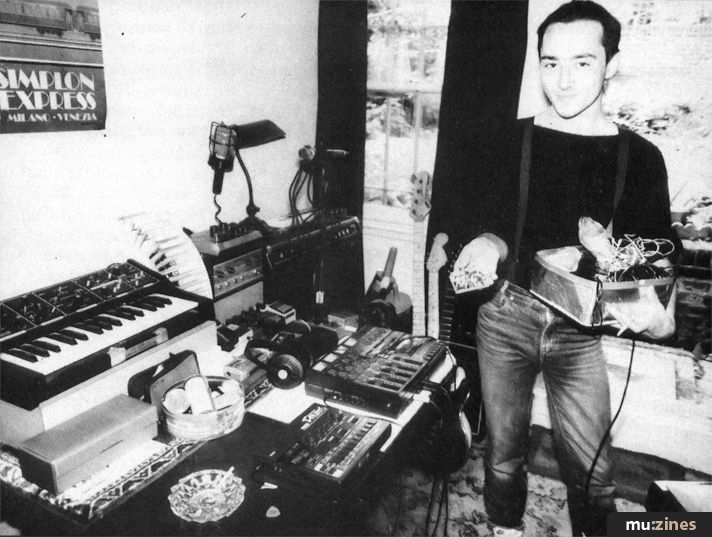
Sam-I-Am / four-track demos.
Mike Church describes replacing an earlier Soundmaster with a Korg DRM-1 for Sam-I-Am’s home recordings, then compressing, reverberating and sometimes flanging its rhythms for four-track punch. The story lives in the demos, before any demand for a finished-record mythology.
Read Home Taping: Sam-I-Am, International Musician pp.124–125 ↗More records in the archive
The machine keeps turning up.
Hooks / Electronic-percussion composing setup
A 1995 profile places a Korg DRM-1 in Hooks’s electronic-percussion rack and quotes his use of its Moroccan patch for composing.
Read Jim Hooks electronic-percussion profile ↗A rhythm module awaiting its rig
Korg’s DRM-1 arrived when a player could build a drum setup from separate pieces: a controller here, a sequencer there, a mixer and effects somewhere else. Contemporary British coverage introduced it as a digital rhythm module ready to take its place in that expanding MIDI-era system.
The Shape of Things to Come: Korg ↗ Fair Affairs: British Music Fair report pp67–69 ↗
A palette rather than a preset companion
The owner’s manual and a 1988 review describe stored percussion voices that could be selected and triggered in a user-built setup. The DRM-1 was not trying to supply a complete automatic arrangement; it gave the musician a focused set of electronic drum sounds to place where they wanted.
DRM-1 Digital Rhythm Module Owner’s Manual ↗ Korg DRM1, Music Technology pp86–90 ↗
The value of leaving things open
Its module format lets the user choose the controller, sequencer and mixer around it. That freedom was the design: the DRM-1 becomes a dedicated rhythm voice inside a larger instrument, able to follow the system rather than dictate it.
DRM-1 Digital Rhythm Module Owner’s Manual ↗ The Missing Link: DRM-1 advertisement, Electronic Musician PDF p3 ↗
The modular late eighties
By 1987–88, electronic percussion was becoming smaller, more digital and more willing to live in a modular rig. The DRM-1 carries that moment clearly—a compact sound source for the musician who had begun to imagine a drum part as something to route, trigger and shape.
The Shape of Things to Come: Korg ↗ Fair Affairs: British Music Fair report pp67–69 ↗ Korg DRM1, Music Technology pp86–90 ↗
Sources
The visual archive
Further visual evidence.
Sources for images shown earlier (2)
Additional visual sources (5)
Original publications and related image sources.
- DRM-1 Digital Rhythm Module Owner’s Manual ↗
Undated edition · Korg · PDF2–5,17–22,36; printed1–2,14–19,33 plus inserted addenda - The Missing Link: DRM-1 advertisement, Electronic Musician PDF p3 ↗
February1988 issue · Korg USA · PDF p3; cover PDF1 - Korg DRM1 — Matt Isaacson, Music Technology February 1988 ↗
1988-02 · Matt Isaacson · Printed pp.86, 88, 90 = PDF pp.88, 90, 92 - Korg DRM1 ↗
Feb 1988 · Music Technology · Korg DRM-1 remote-control unit with the DRM-1 marking visible in the dedicated February 1988 review. - Korg DRM1 ↗
Feb 1988 · Music Technology · Korg DRM-1 rack unit front panel with Korg and DRM-1 markings visible.