BIG BEAT MACHINE FILE // 002

66

The Roland TR-66 Rhythm Arranger

Roland TR-66 Rhythm Arranger1973 / 1975Rhythm arranger

Ten analogue voices, twenty-seven factory programmes and a deceptively deep arrangement system: the substantial wooden box that taught fixed rhythm how to move.

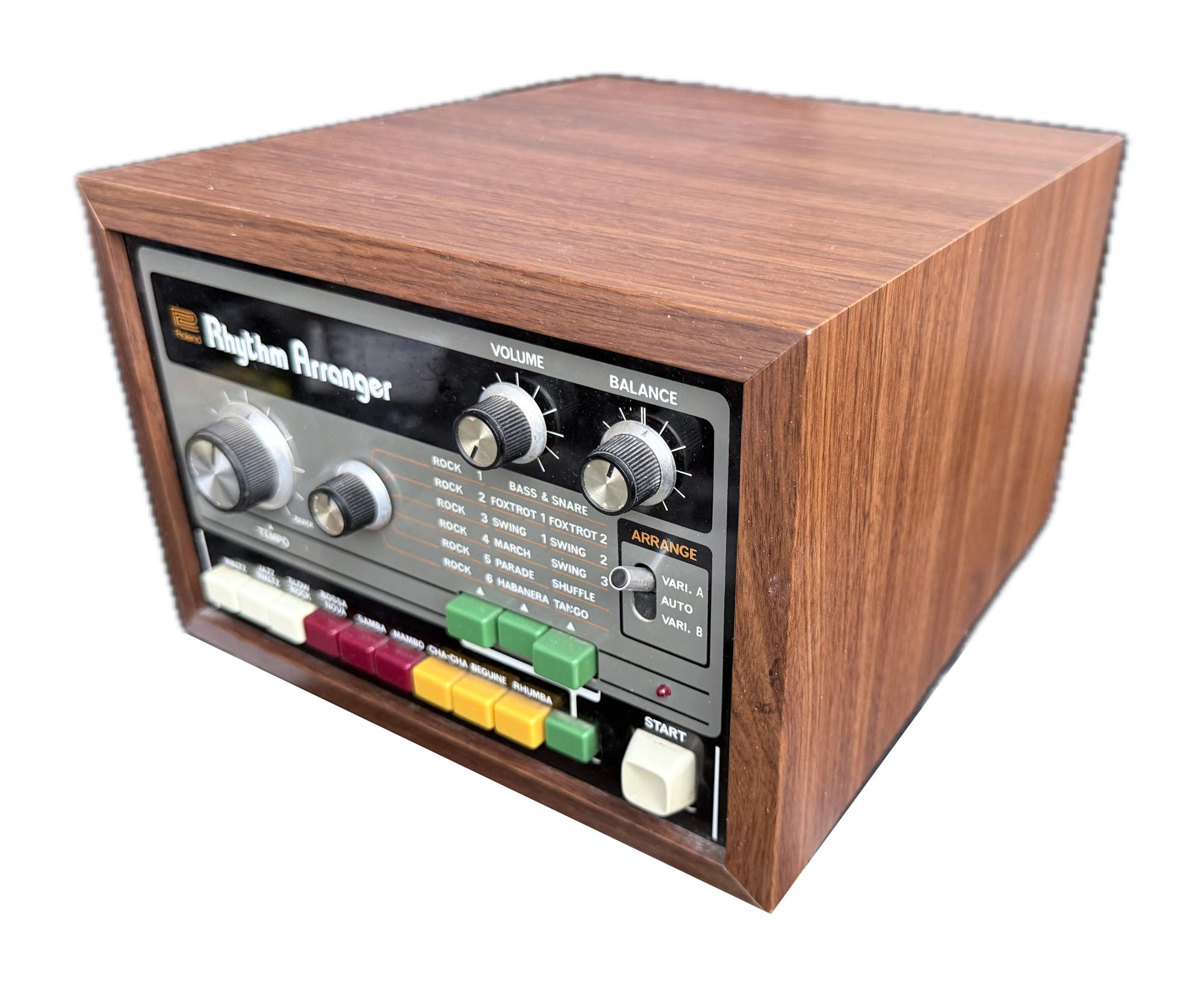
Big Beat Collection Roland TR-66, complete isolated view
BIG BEAT COLLECTION // TR-66BIG BEAT ARCHIVE
PRODUCTIONOfficial Roland sources differ: 1973 retrospective; 1975–1982 service register
SOUND ENGINE10 analogue voices: tuned resonators and shaped noise
RHYTHM MEMORY27 programmes × A/B arrangement states; paper registration notes
More facts, listening references & sources
PERIOD PRICE¥48,000 Japan (1977); £156.44 UK list (August 1976)
LINEAGE ADVANCERoland compresses the arranger idea into a smaller tabletop machine and turns compatible preset buttons into combination controls.
WHAT THE PLAYER GAINSPressing two rhythms together can produce a third arrangement; foot control and dual outputs make the preset box easier to perform with other equipment.
START LISTENINGFactory Cha-Cha / Roxy Music — Dance Away comparison
Sources for the artists and listening references

Artist accounts, historical attributions and performance films establish different things. These notes explain the basis for each reference.

  • Factory Cha-Cha / Roxy Music — Dance Away comparison — editorial comparison. A listening exercise, explicitly not evidence that Roxy Music recorded a TR-66.

THE BIG BEAT COLLECTION // ROLAND TR-66

THE CABINET IS PART OF THE INSTRUMENT.

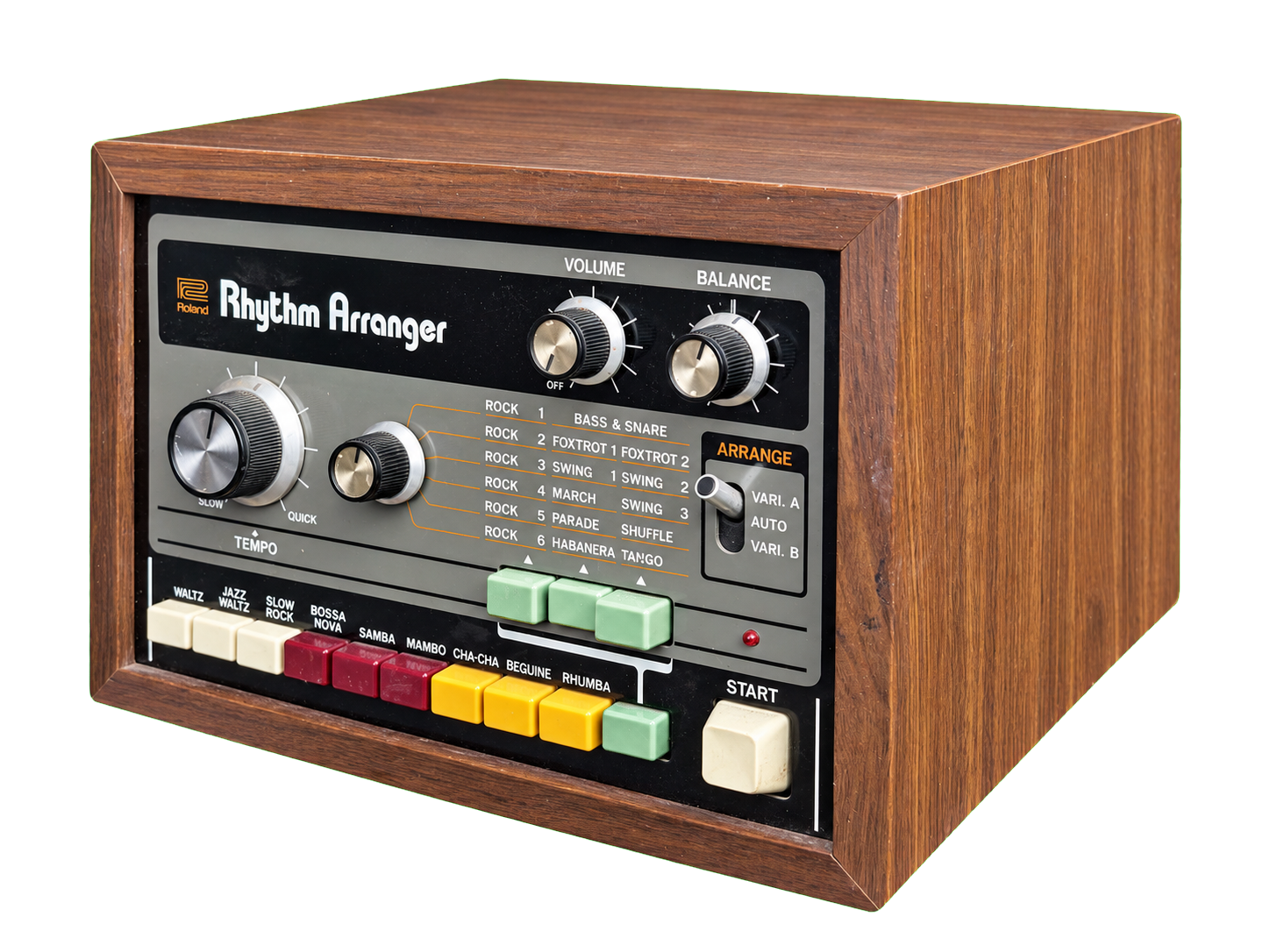
The three-quarter view reveals what a straight front photograph cannot: a deep wooden case, a recessed control panel and the substantial proportions of a rhythm arranger made to sit beside a keyboard, amplifier or mixer.

PAGE 01 // OBJECT // CATALOGUE RECORD

A rhythm arranger, not a pocket machine

The Roland TR-66 is independent enough to leave the organ, but its 4-kilogram wooden cabinet still expects a table, a keyboard stand or a serious road case.

Roland’s own records do not agree on a single introduction year. Its drum-machine retrospective places the TR-66 in 1973, while Roland Japan’s discontinued-product register gives 1975 as the launch year and 1982 as the end of production. The archive therefore shows both dates instead of converting either later source into false certainty. The earliest period evidence currently held here—a UK price listing from August 1976, second-edition service notes from November 1976 and an English owner’s manual from January 1977—proves the machine was in circulation by 1976 but does not settle the two-year conflict.

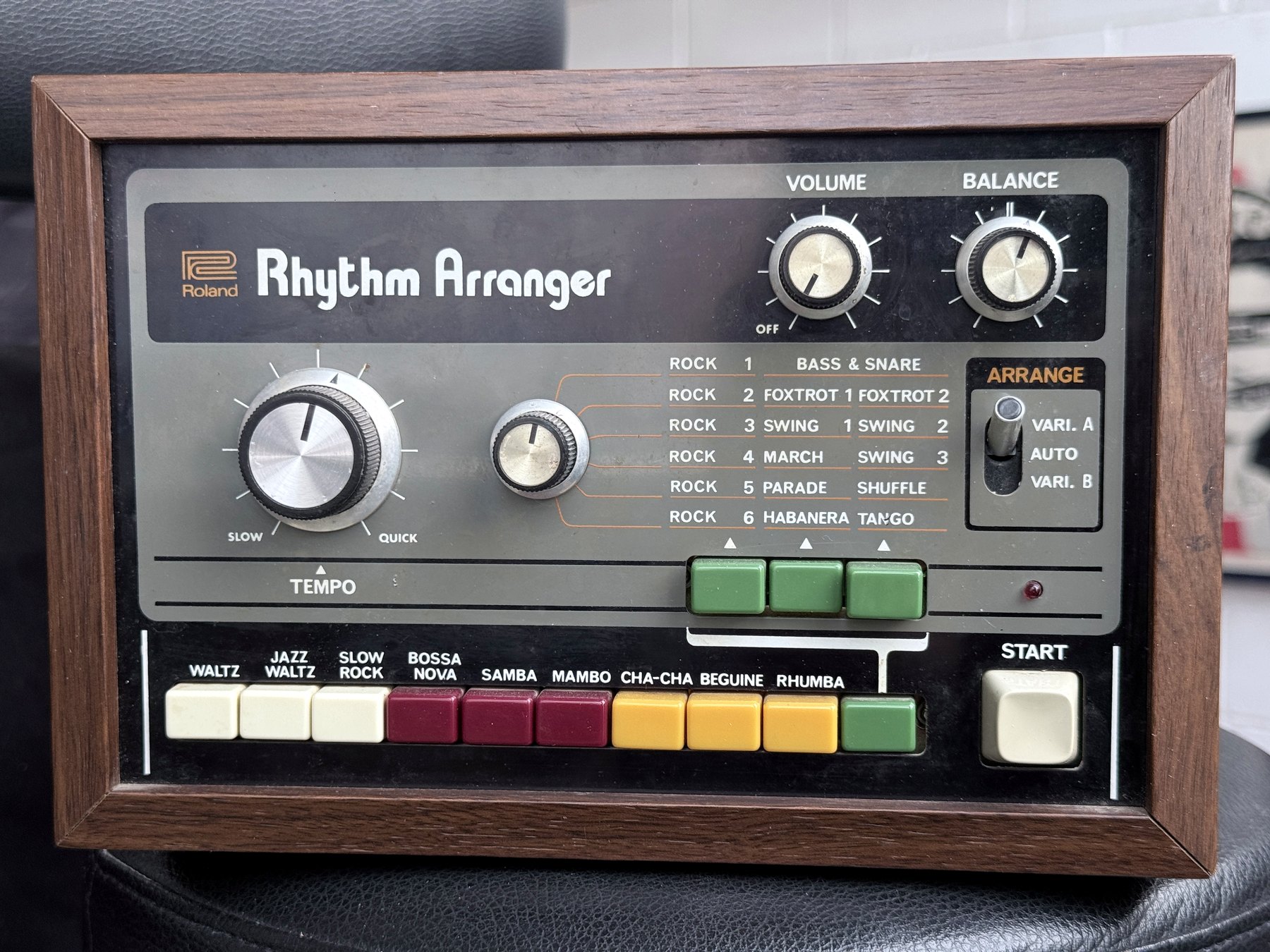
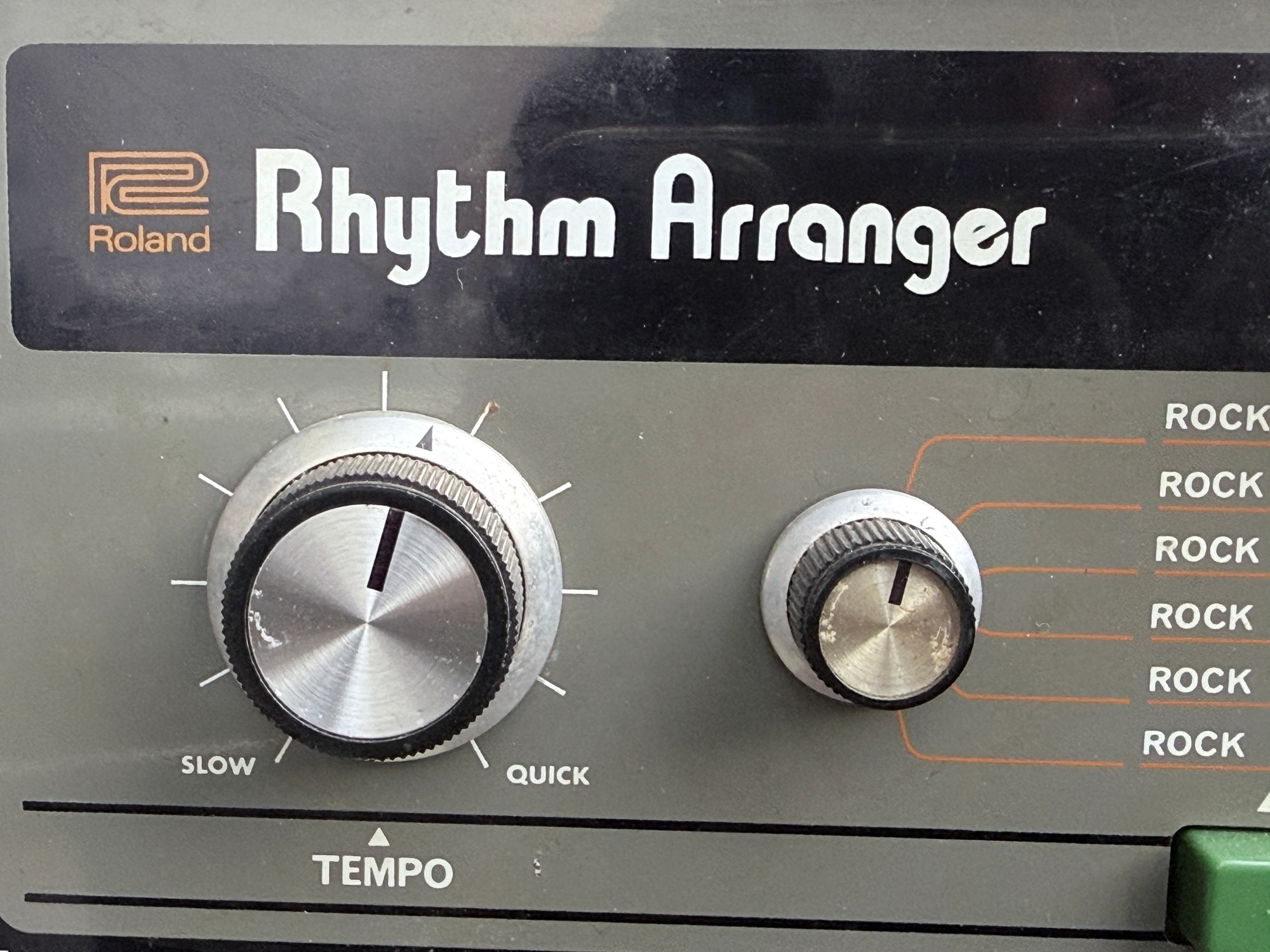
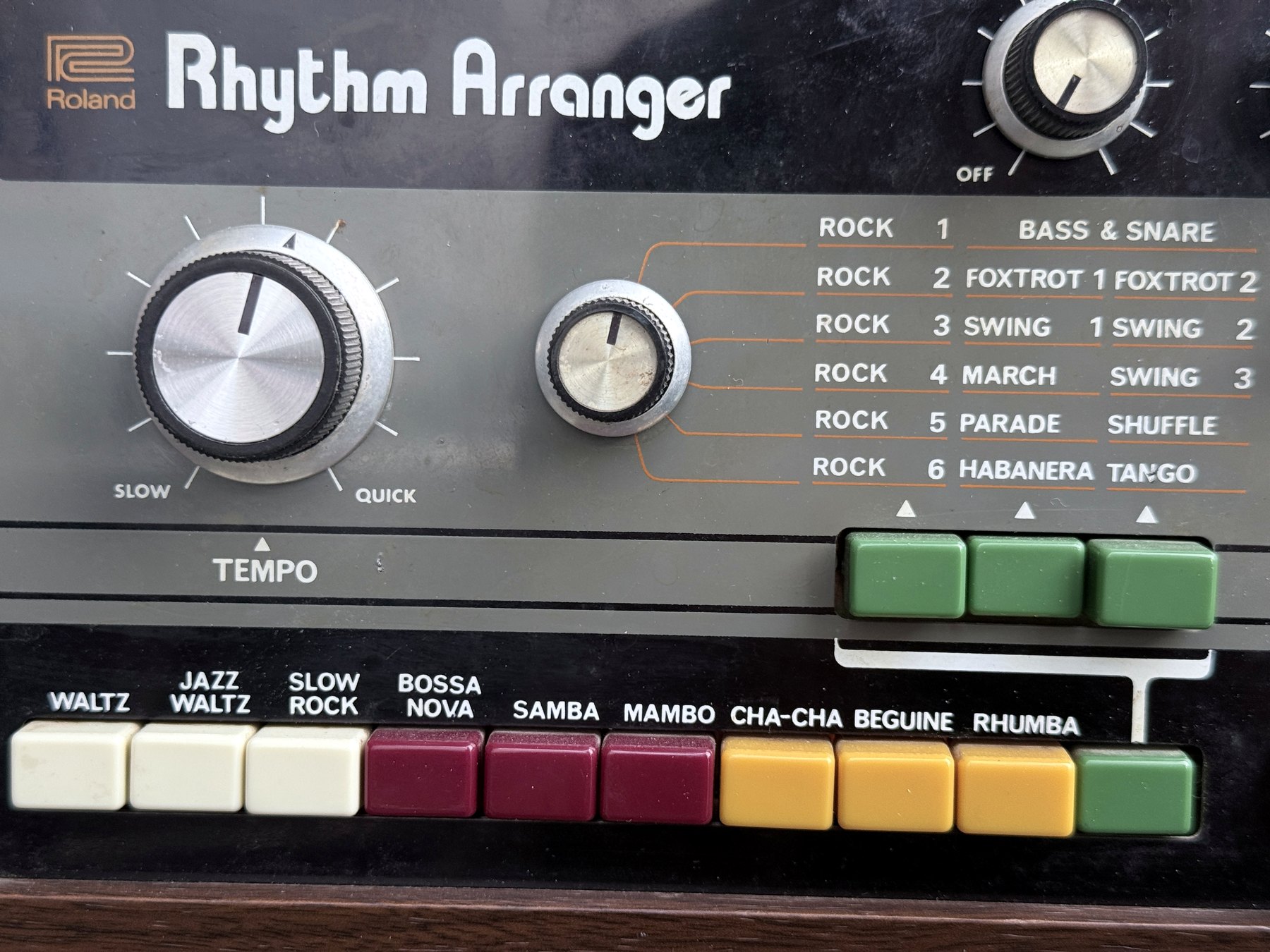
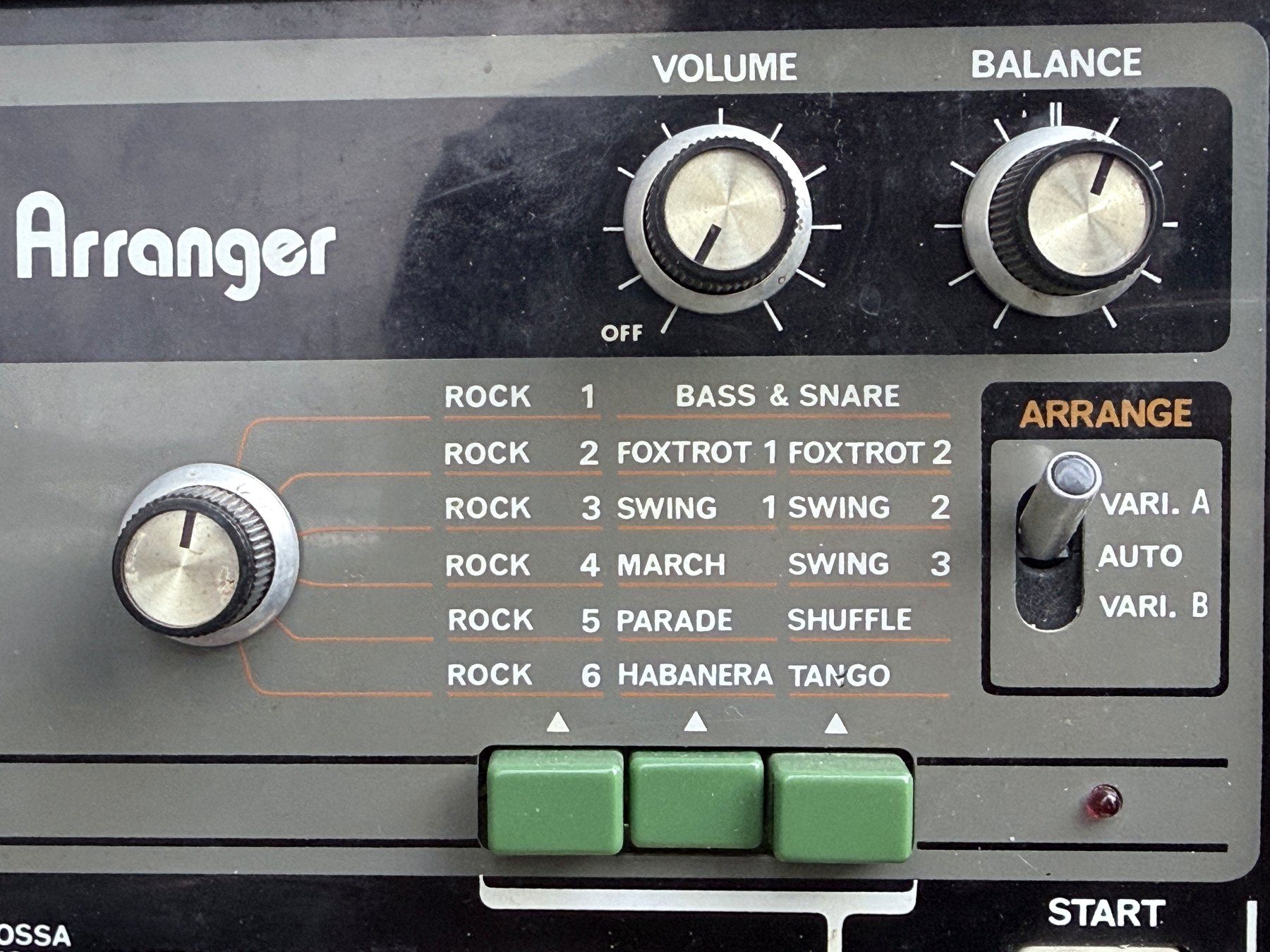
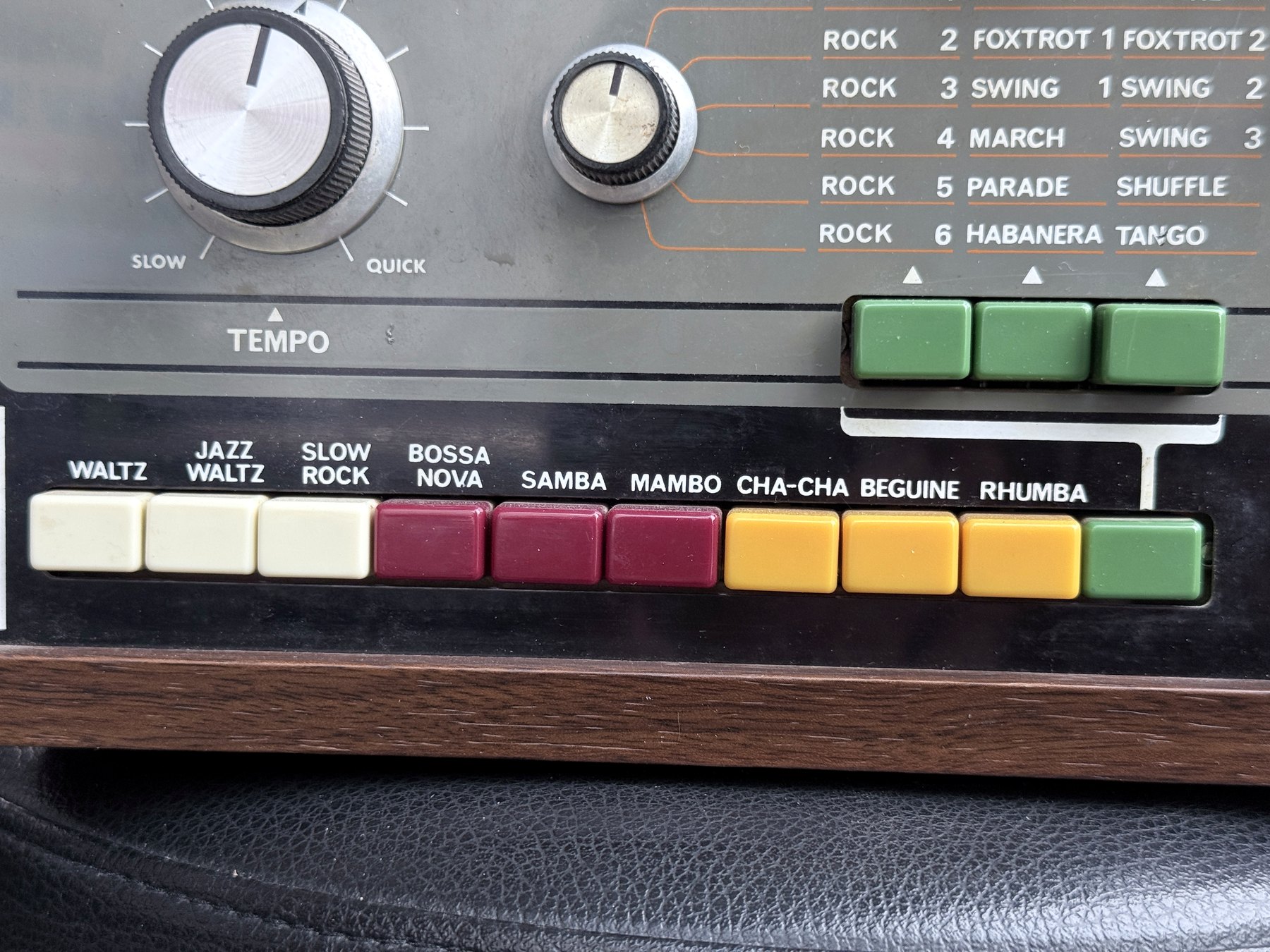
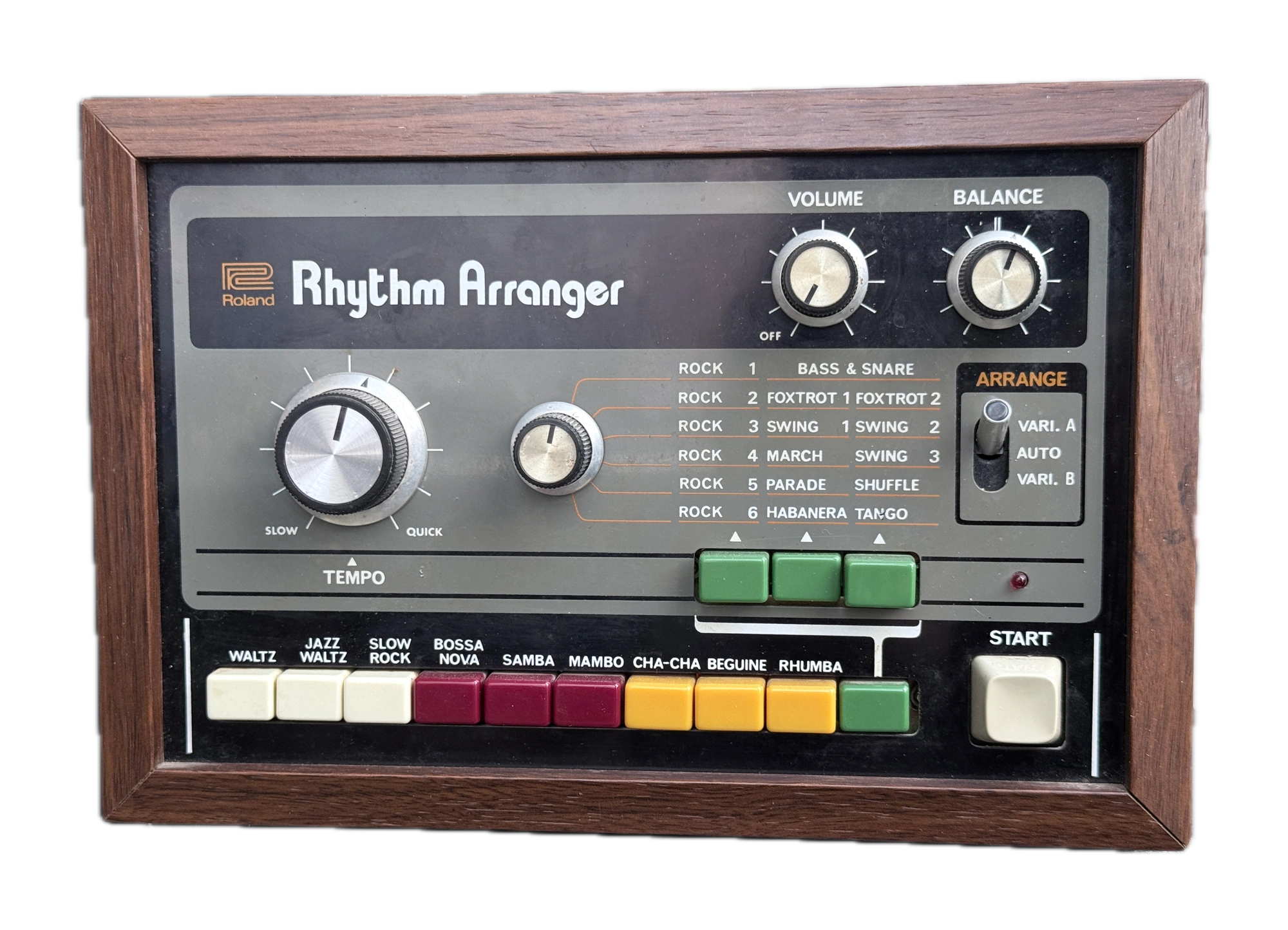
The front panel tells the working method at a glance. Nine genre selectors form the lower row; six ROCK buttons sit above them; VOLUME, BALANCE, ARRANGE and TEMPO remain available while the rhythm runs. There is no display, patch memory or step programming. The performance is the setting of the controls and the timing of the player’s decisions.

Its dimensions—230 × 267 × 162 millimetres—explain the unusual proportions. The TR-66 is narrower than the wide TR-77, but deep and tall. The printed-plywood cabinet and recessed panel make it feel closer to a compact piece of furniture than the low plastic boxes that followed.

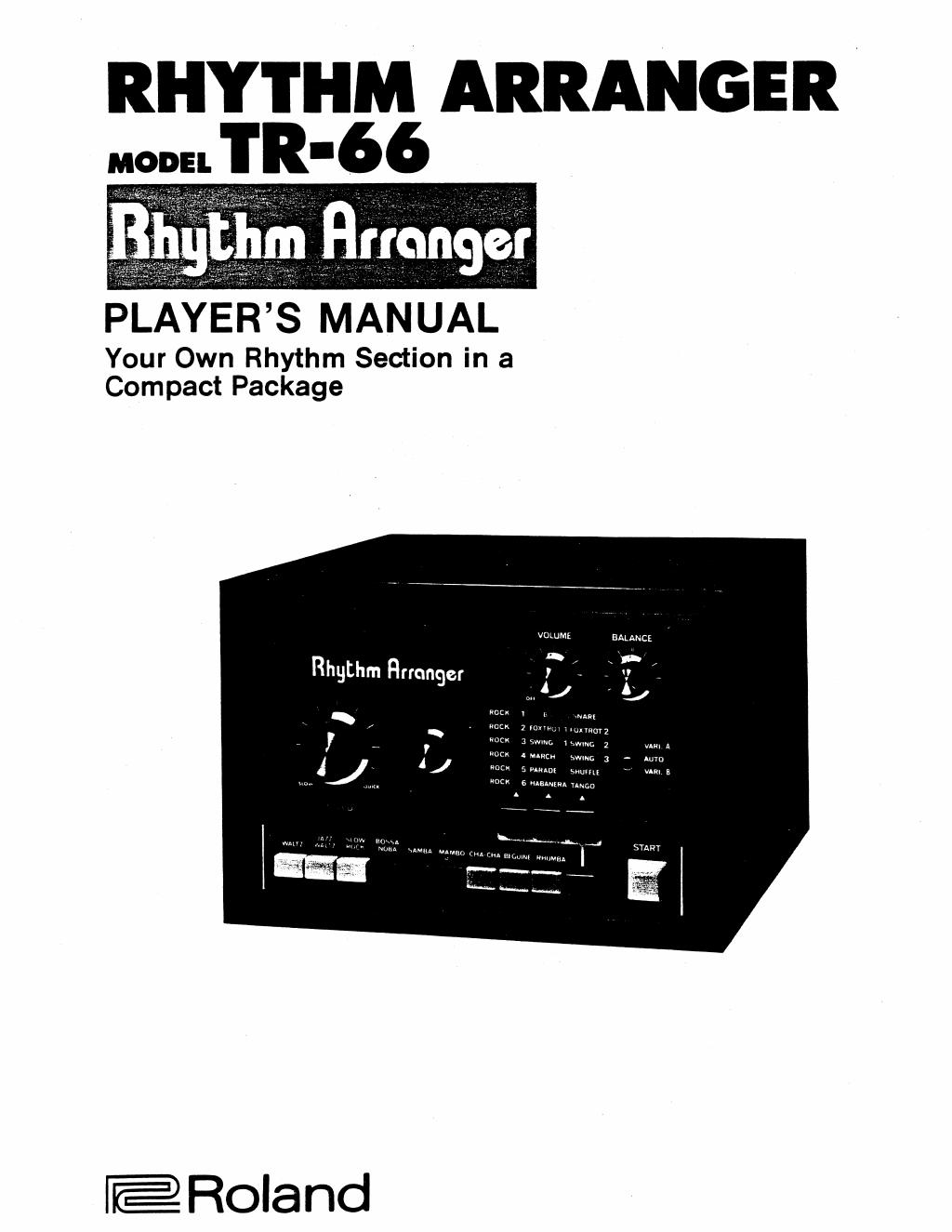
January 1977 Roland TR-66 owner’s manual cover with a front view of the instrument
OWNER’S MANUAL // ENGLISH EDITION E-2 // JANUARY 1977
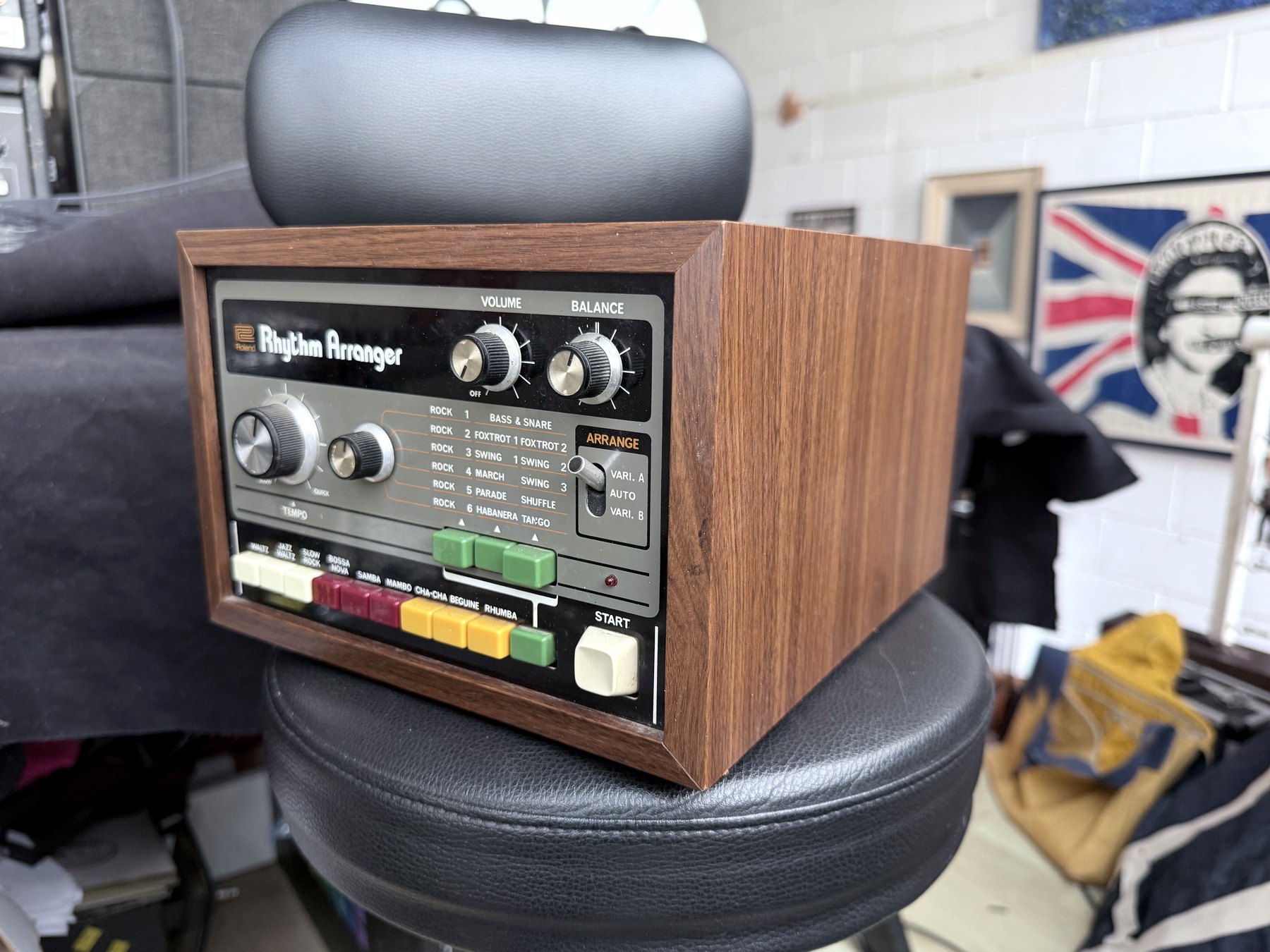
Big Beat Collection TR-66 seen three-quarter-on in the working studio
TR-66 IN THE WORKING ROOM // BIG BEAT COLLECTION
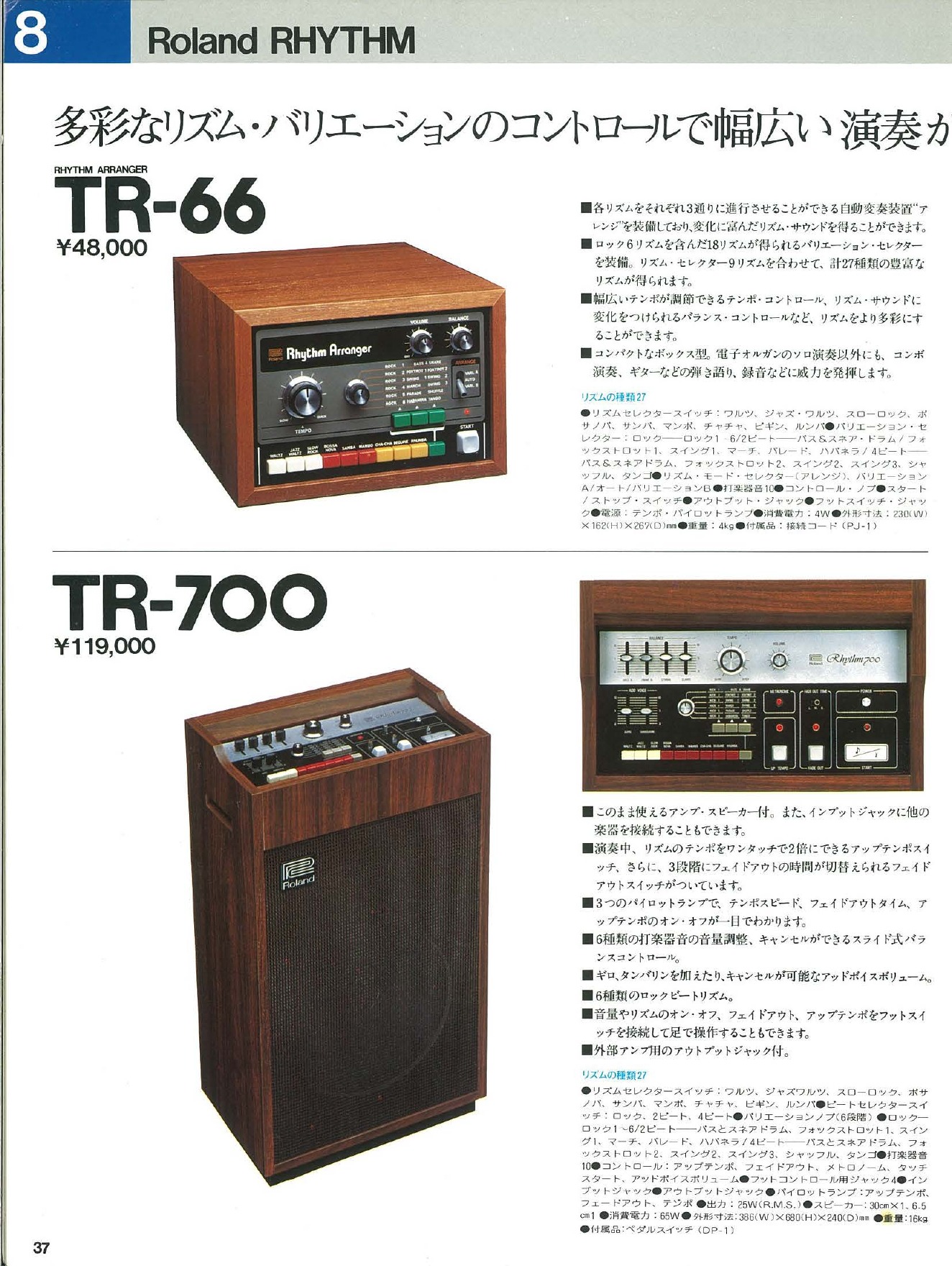
Official March 1977 Roland catalogue page presenting the TR-66 and TR-700 rhythm arrangers in colour
ROLAND ELECTRONIC MUSICAL INSTRUMENTS VOL. 1 // TR-66 ¥48,000 / TR-700 ¥119,000 // MARCH 1977DOCUMENTARY SOURCE

PAGE 02 // CONTEXT // THE KEYBOARD SYSTEM

Roland sold it as the rhythm beside the piano

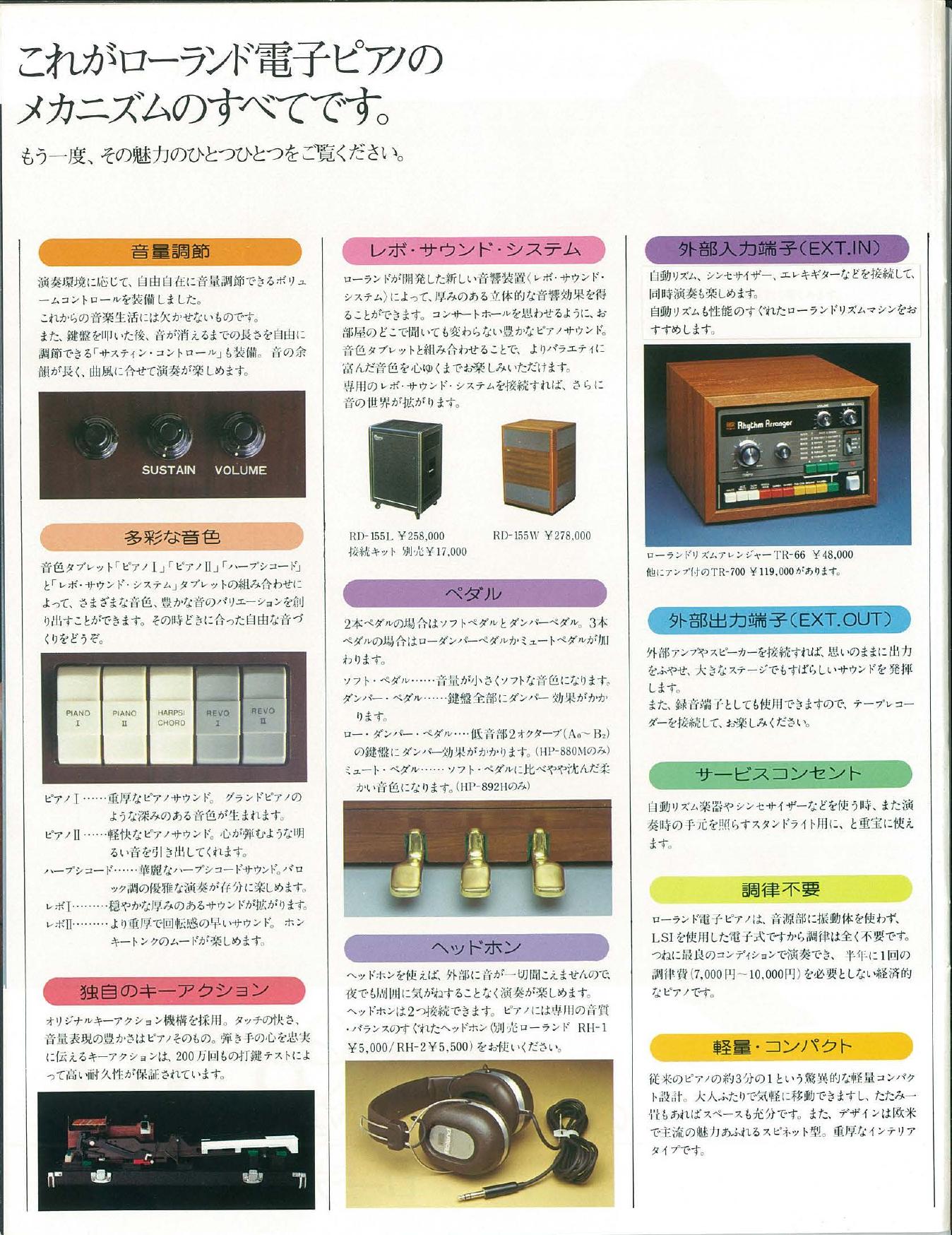
A 1977 HP-series catalogue shows the TR-66 as an external partner for Roland’s electronic pianos, not as a self-contained entertainment console.

The catalogue page places an external rhythm input among the piano’s practical features, then offers two boxes to fill it: the TR-66 at ¥48,000 and the speaker-equipped TR-700 at ¥119,000. The photograph is useful because it reveals the intended ecosystem rather than isolating the drum machine as a later collector’s object.

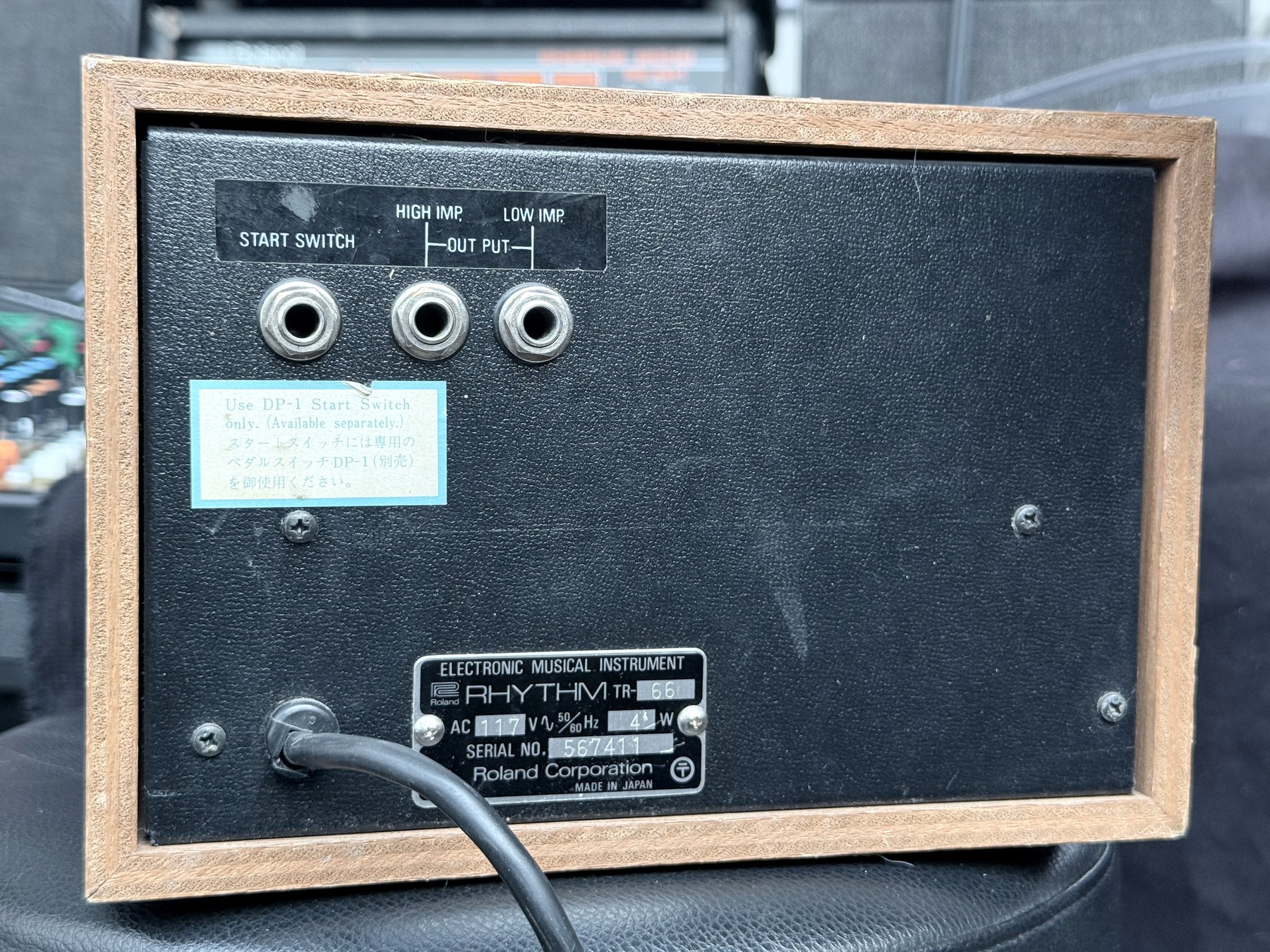
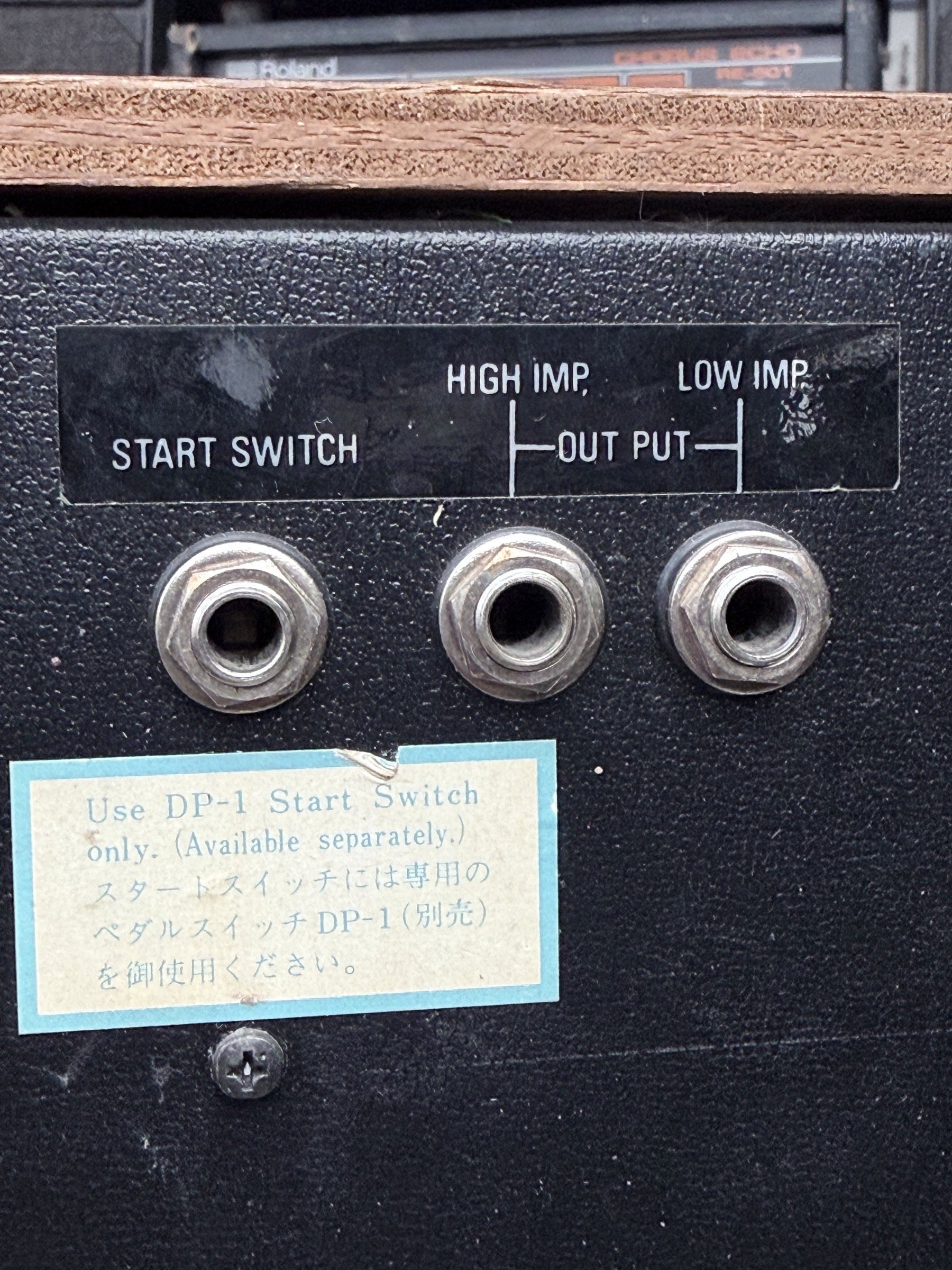
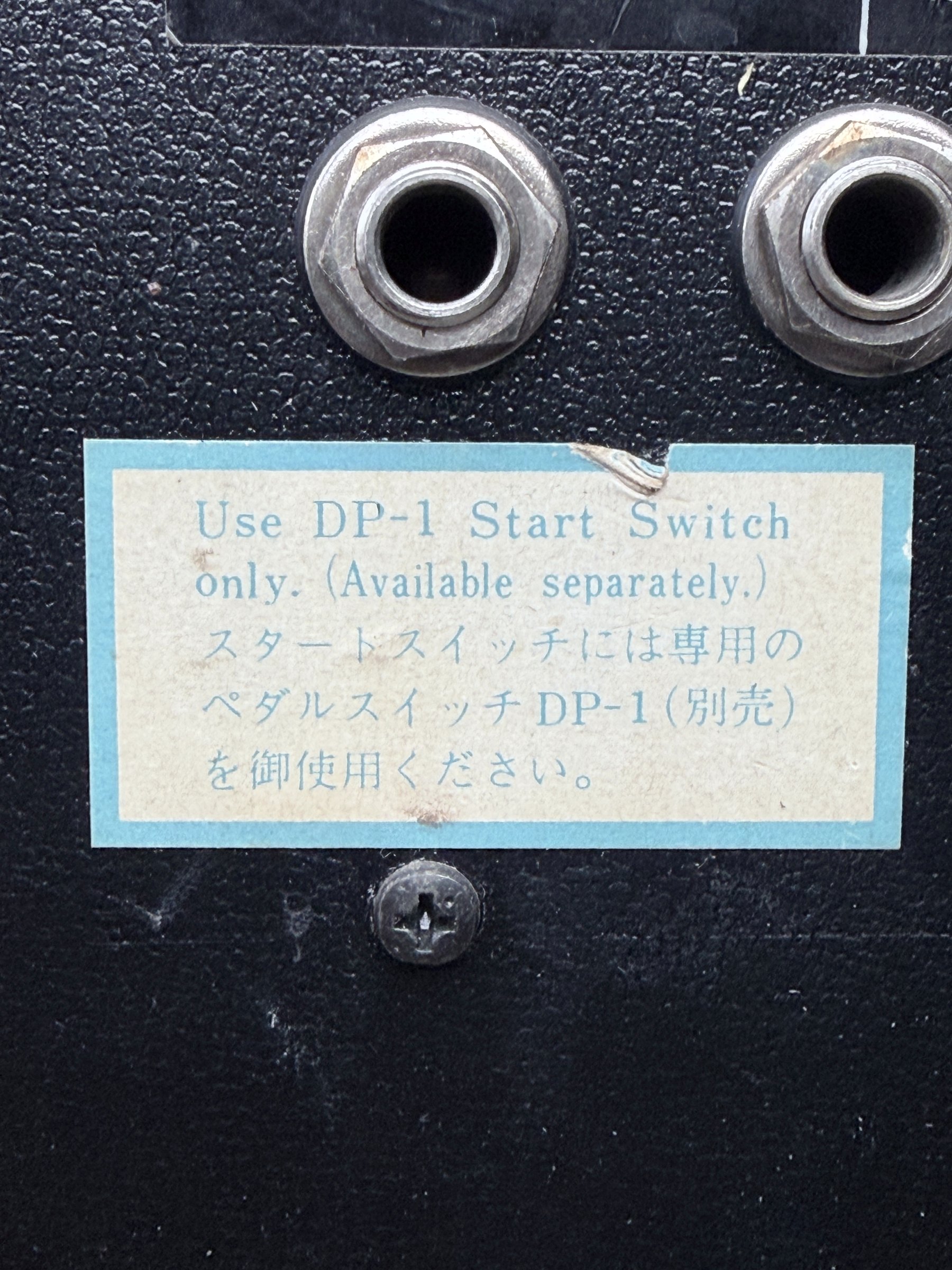
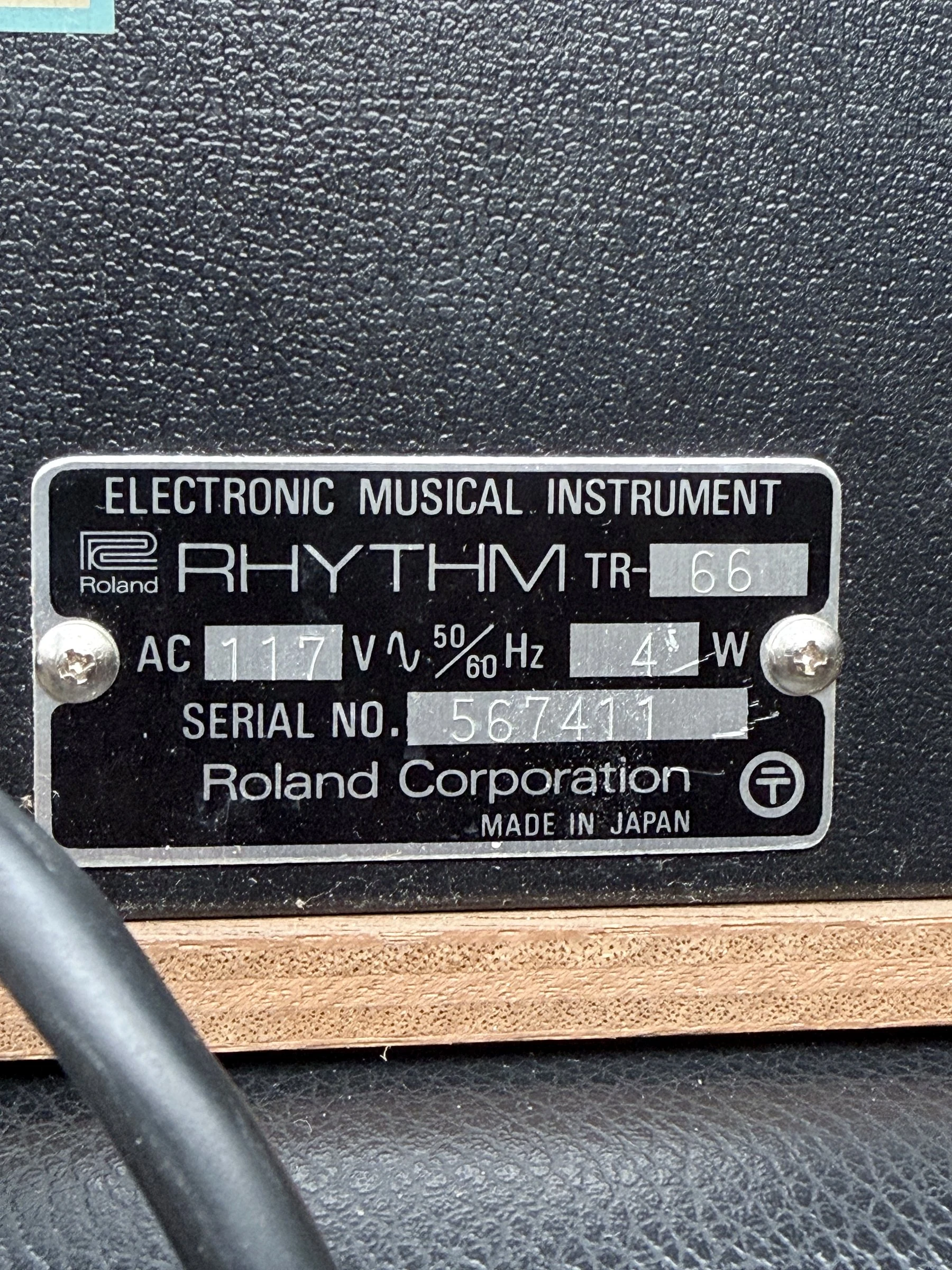
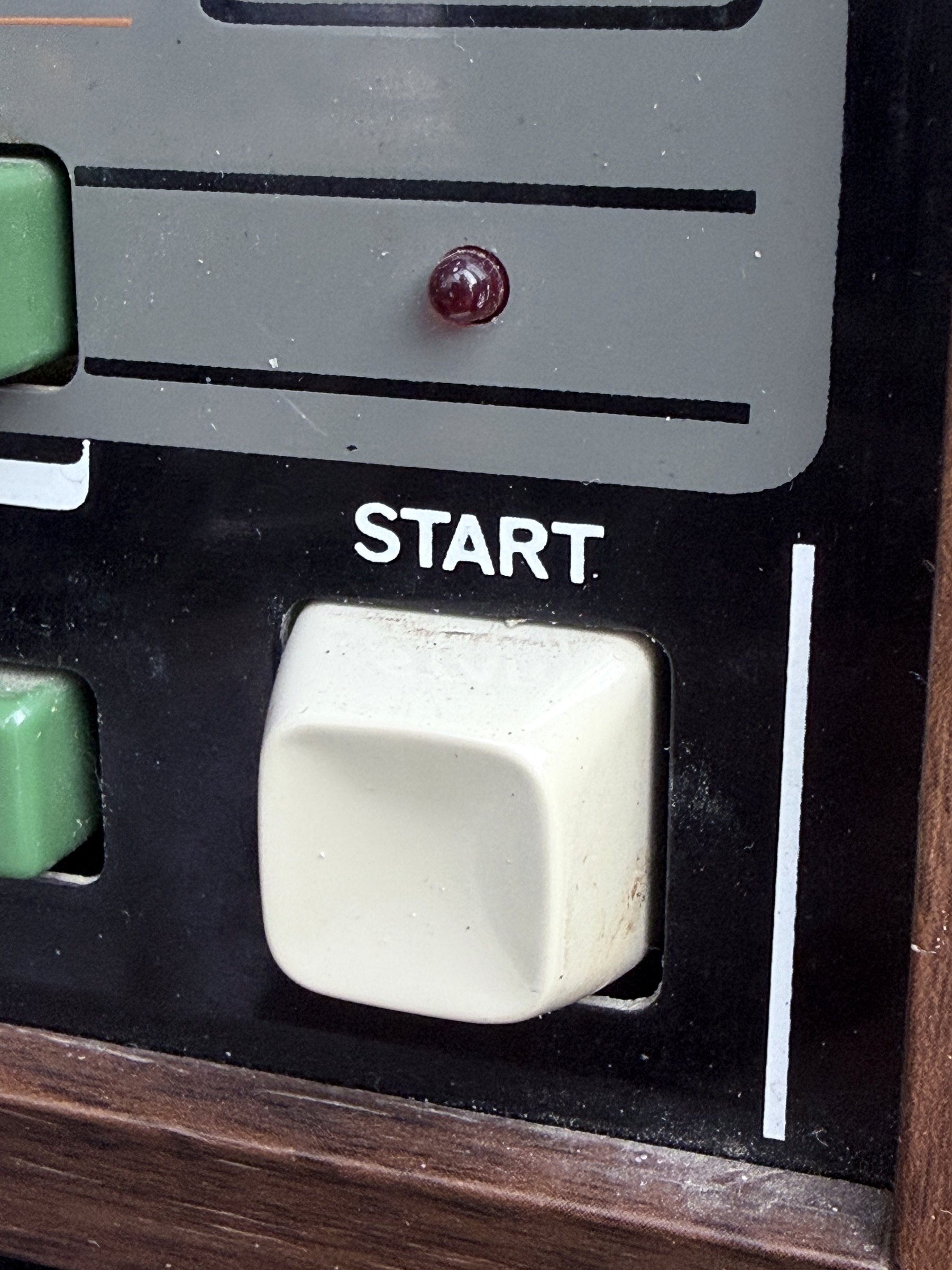
For a player, that context explains the rear panel. The DP-1 start-switch jack starts and stops rhythm without leaving the keyboard. High- and low-impedance outputs accommodate different amplification. A two-metre cable can carry the mono signal to the host instrument or another sound system. On the collection machine, the surviving labels identify those three connections plainly: START SWITCH, HIGH IMP. OUTPUT and LOW IMP. OUTPUT.

This is the bridge the TR-66 actually makes: not from heavy to lightweight, but from accompaniment built inside an organ to accompaniment that can be positioned, connected, balanced and performed as separate equipment.

1977 Roland HP-series catalogue page showing the TR-66 as an external rhythm partner for an electronic piano
ROLAND HP SERIES // TR-66 RECOMMENDED AS EXTERNAL RHYTHM // 1977
Open the deeper story +

Read the 1977 system page

The piano and rhythm arranger remain separate products, which keeps each replaceable. The piano can be used without rhythm; the TR-66 can be moved to an organ, amplifier or recording chain. That modularity becomes central to later electronic studios.

Roland’s wording presents rhythm as an expansion of the piano’s function. From a modern perspective the relationship can be reversed: the keyboard supplies harmony around a machine whose repeating pulse determines the arrangement.

Open the complete Roland HP-series catalogue ↗

PAGE 03 // OPERATION // ARRANGE

A and B are patterns. AUTO is a performance rule.

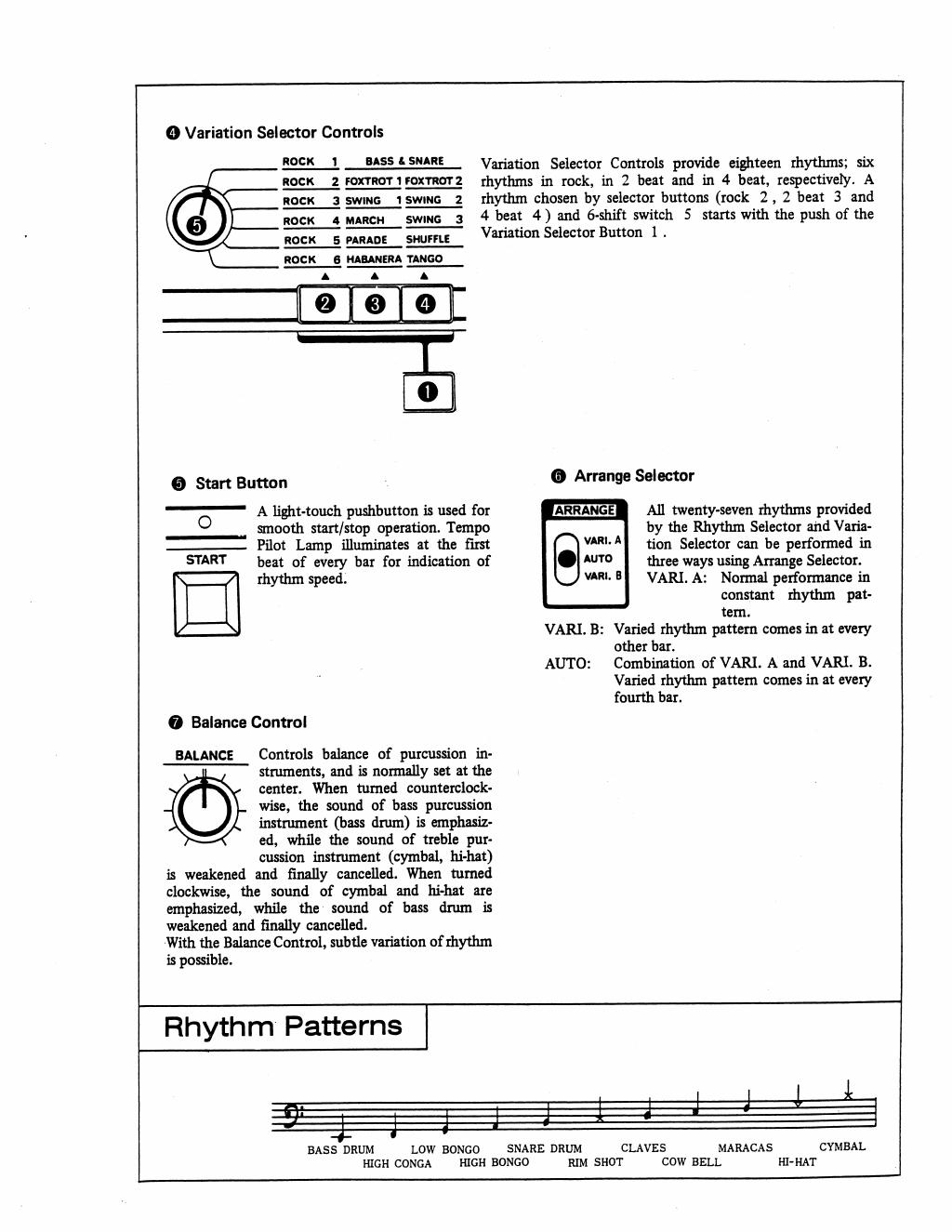
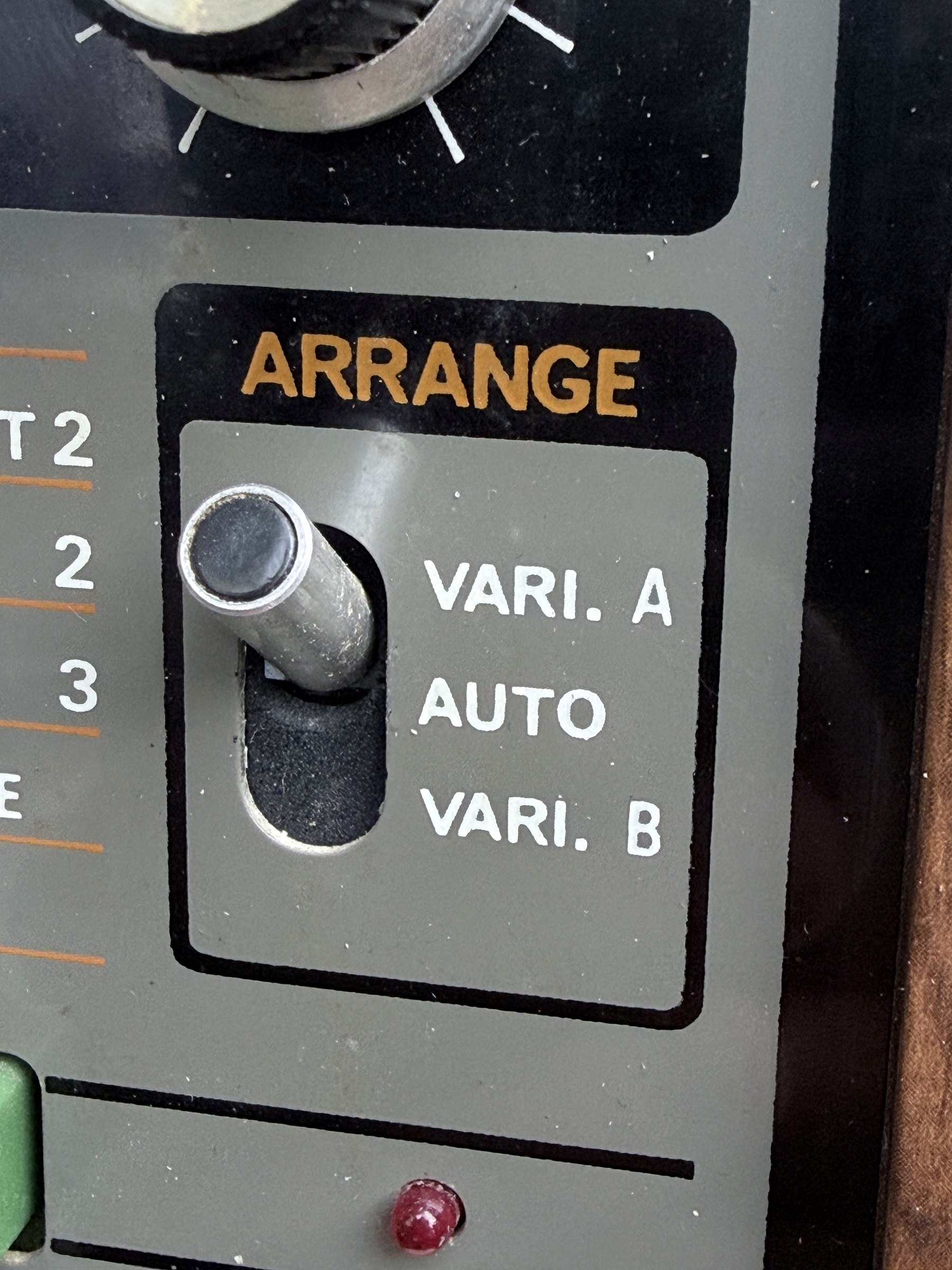
The three-position ARRANGE switch does something precise: repeat A, repeat B, or let B arrive every fourth bar.

The owner’s manual defines the modes without mystery. VARI A continuously repeats the A arrangement. VARI B continuously repeats B. AUTO plays the A arrangement and substitutes B every fourth measure. B is therefore both a pattern state and a fill source, depending on how the switch is set.

The same page explains BALANCE. Turned counter-clockwise, the control favours bass drum and snare; turned clockwise, it favours cymbal and hi-hat. At the centre, the groups are approximately balanced. This is not left-right placement, and it is not a tone control. It changes which family leads the mono rhythm.

Compatible rhythm buttons can be pressed together. The circuits do not calculate a new programme: their trigger routes overlap. In practice, the combination behaves like a third rhythm because the listener hears a new density and accent structure that is not printed on a single key.

TR-66 owner’s manual page explaining Arrange A, Auto, Arrange B, Balance and combined rhythm buttons
OWNER’S MANUAL // ARRANGE, BALANCE AND COMBINATION OPERATION

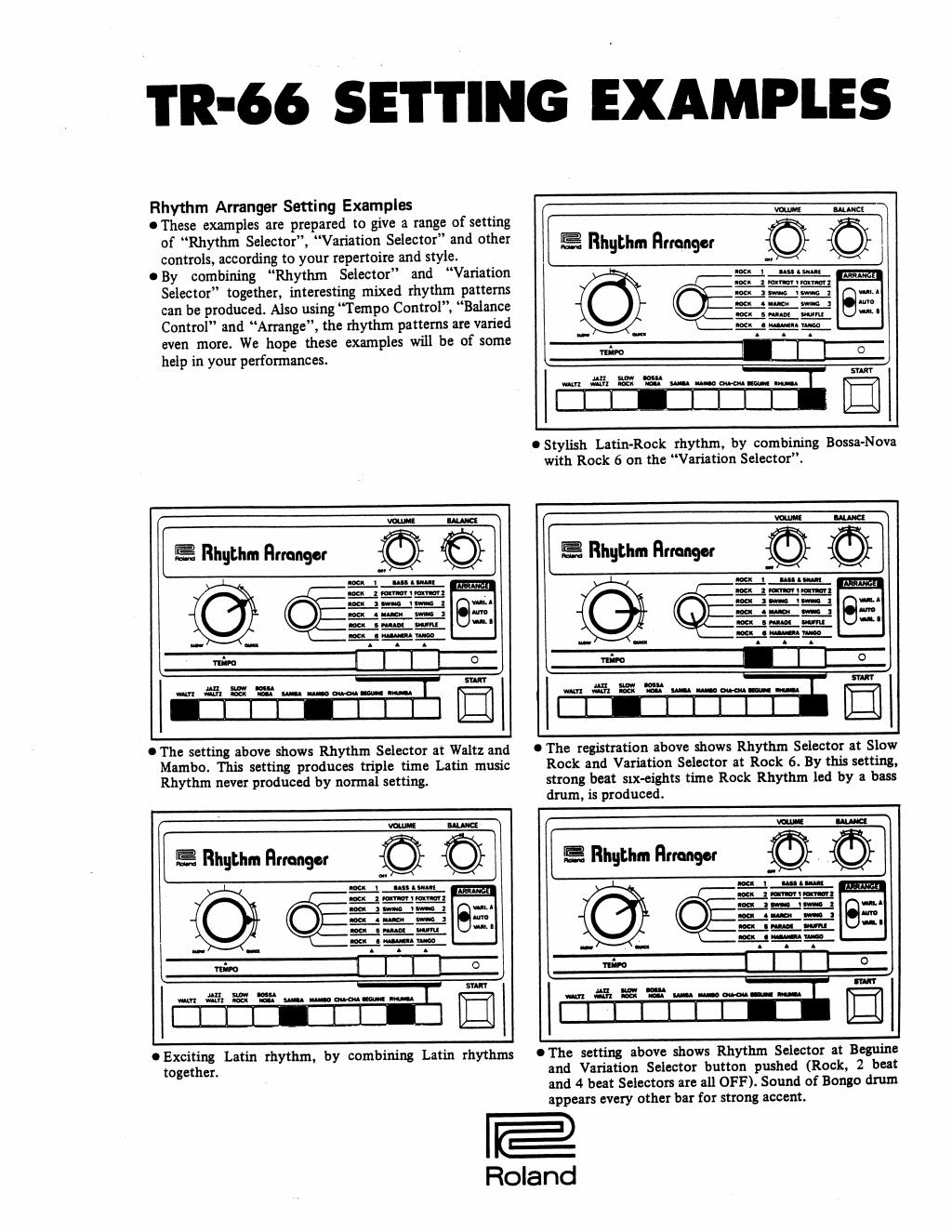
Three combinations from the manual—and what to listen for

BOSSA NOVA + ROCK 6. Roland’s setting example places Bossa Nova beside Rock 6. The Latin bass and rim pattern gains the straighter upper-row backbeat; use BALANCE to decide whether the combination reads as rock with syncopation or Latin rhythm with added weight.

WALTZ + MAMBO. This apparently incompatible pair is printed in the manual as a combination example. Listen for a three-beat phrase acquiring a second percussion cycle; the point is not genre purity but the new periodic relationship created when two matrices are active.

SLOW ROCK + ROCK 6. The slower programme supplies space and long cymbal placement while Rock 6 adds a more insistent drum skeleton. Compare VARI A and B, then AUTO: the fourth-bar substitution reveals which of the added events belong specifically to B.

The manual also suggests Latin combinations and Beguine with variation. Treat each as a listening experiment: choose one control to change, keep tempo constant and identify whether the difference comes from trigger placement, voice balance or the A/B arrangement state.

PAGE 04 // PAPER MEMORY // REGISTRATION NOTES

Before the machine could remember, the player wrote the arrangement down

The Japanese manual gives the TR-66 a practical form of song memory: printed front panels on which a player can preserve rhythm buttons, tempo, balance and ARRANGE positions.

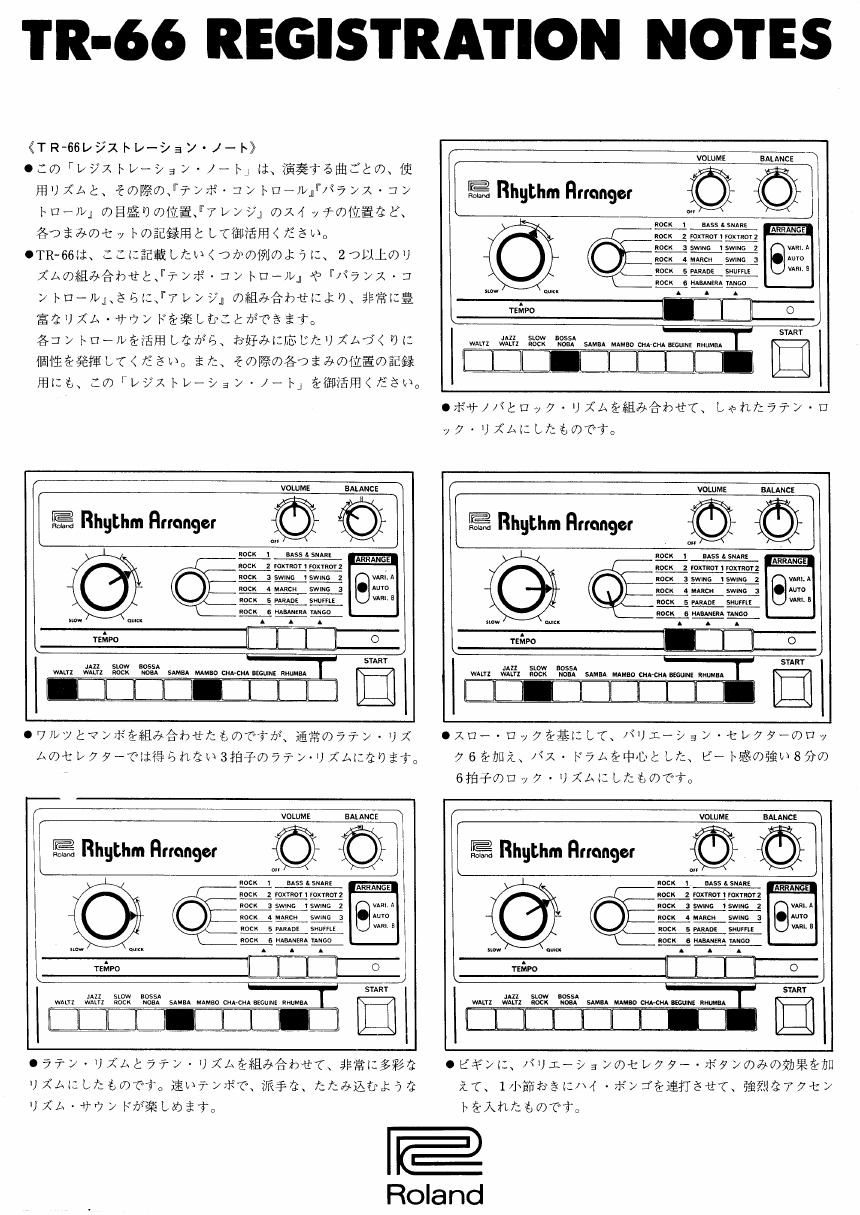
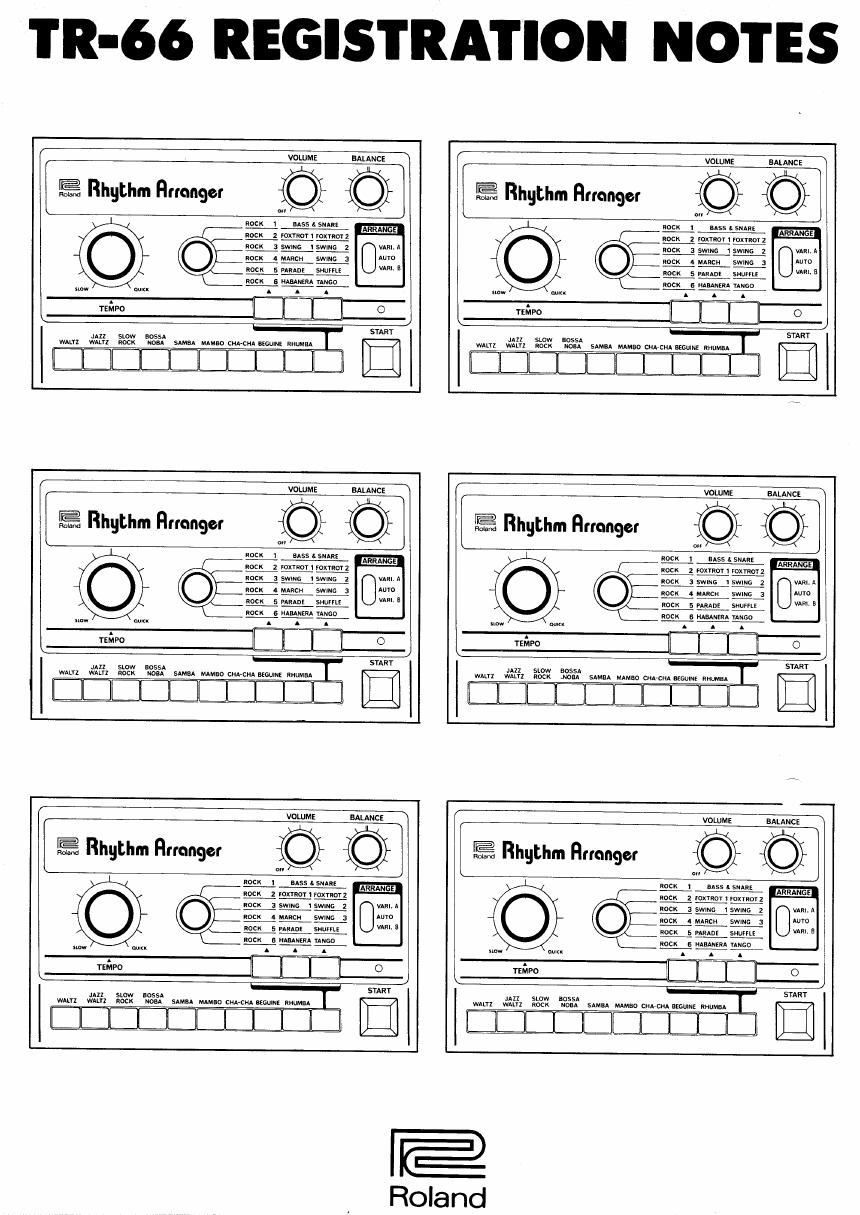
A TR-66 cannot store a setting electronically. Roland’s Japanese manual answers that limitation with two pages headed TR-66 REGISTRATION NOTES. The first supplies worked examples; the second repeats blank panel drawings to be completed for individual songs.

A registration is more than a rhythm name. It records the selected lower-row rhythm, upper-row programme or combination, the tempo position, BALANCE and the A, B or AUTO arrangement state. The document preserves a performance decision that the electronics cannot remember.

The worked registrations also make combination a compositional method rather than a novelty. Roland shows multiple keys held together, different balance positions and different arrangement states. The blank forms then hand authorship to the player: find a useful relationship, give it a place in a song and write down enough information to recover it.

Japanese Roland TR-66 owner’s manual page with worked registration-note settings for individual songs
JAPANESE OWNER’S MANUAL // WORKED REGISTRATION NOTES
Japanese Roland TR-66 owner’s manual page with blank front-panel diagrams for recording song settings
JAPANESE OWNER’S MANUAL // BLANK SONG REGISTRATIONS

Use the sheet as a repeatable session record

1. Name the song and mark the lower-row rhythm first. If the setting uses one of the six upper ROCK programmes as well, mark every button that must be held; the combination is part of the arrangement, not an optional decoration.

2. Copy TEMPO, BALANCE and ARRANGE positions. Those three controls determine speed, which voice family leads the mono mix and whether the machine repeats A, repeats B or inserts B every fourth bar.

3. Add the connection path. Note the high- or low-impedance output, destination input and any footswitch connection. The same panel registration can behave differently when level, amplification or control routing changes.

4. Make a short reference recording and date the sheet. The drawing restores the controls; the audio preserves the resulting sound and exposes later clock, pitch or decay drift in the surviving machine.

Open the complete Japanese owner’s manual ↗
01020304050607080910111213141516

PAGE 05 // PATTERN ATLAS // ALL 54 STATES

The entire factory score, reconstructed pulse by pulse

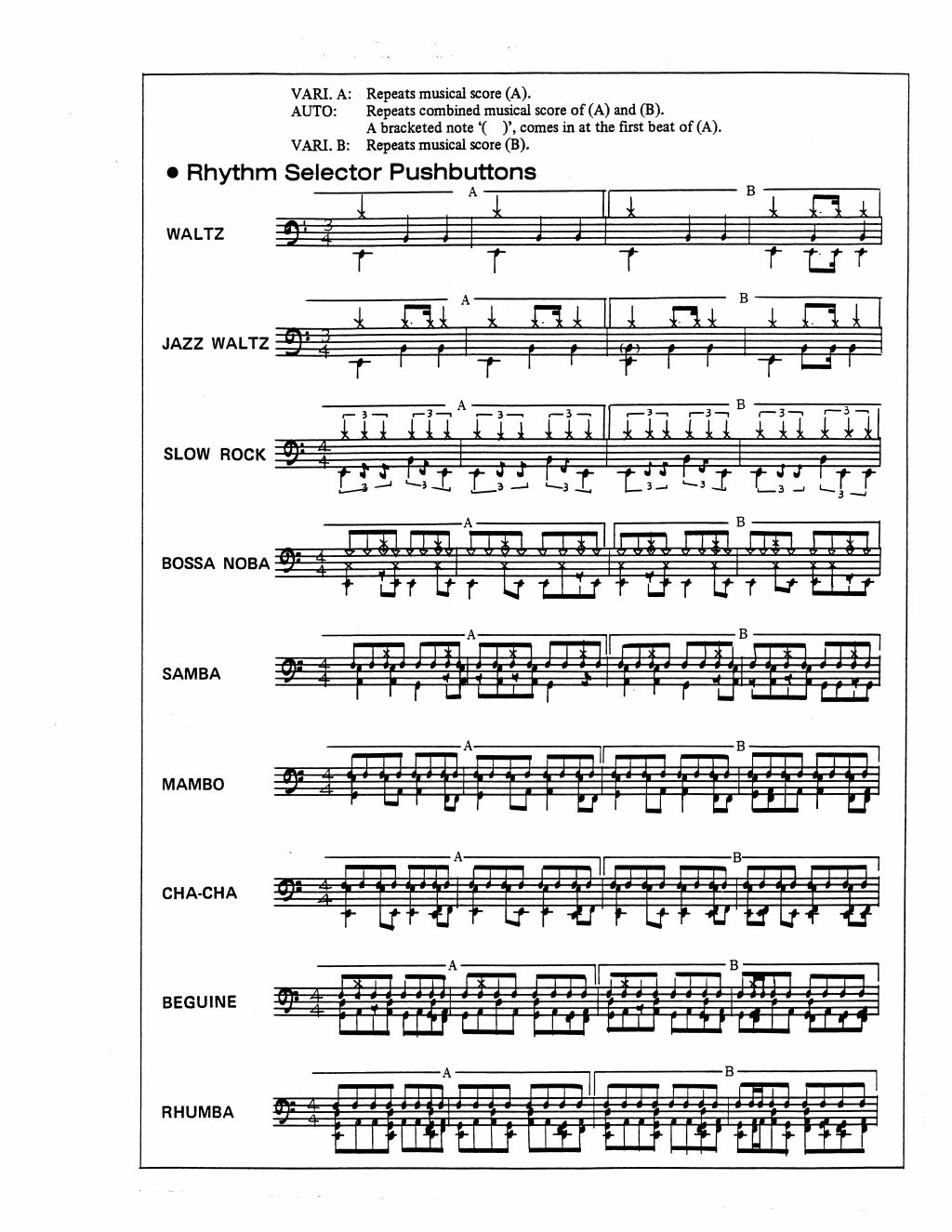
Twenty-seven programmes each contain an A and B state. The reconciled corpus below preserves all 32 native timing cells—including 84 off-beat events that disappear in a simplified 16-step transcription.

This is not a pattern guessed from a modern sample pack. Every state was reconciled across the dedicated service matrices, the AUTO matrix witness and the owner’s-manual notation. The audit found no unresolved disagreements and added no inferred hits.

Select any programme, then switch between A and B. Each numbered position contains two cells: the main pulse and the intervening “+” pulse. Red marks a hit on the main pulse; yellow marks a hit on the off-beat subdivision. The display keeps the source’s native timing rather than forcing every event onto a coarser grid.

The atlas also makes the instrument’s architecture visible. Some B states alter only one voice or one late event; others change the density of several rows. AUTO’s musical effect comes from withholding those differences for three bars, then revealing them together on the fourth.

TR-66 owner’s manual notation showing factory rhythms and their percussion rows
OWNER’S MANUAL // FACTORY PATTERN NOTATION // PAGE 6
TR-66 owner’s manual page showing recommended combined-rhythm settings
OWNER’S MANUAL // COMBINATION SETTING EXAMPLES // PAGE 10

ROLAND TR-66 // EXPLORE THE FACTORY RHYTHMS

Every factory rhythm, down to the half-step.

Programmes
27
A/B states
54
Native pulses
32
Inferred hits
0
Arrange state

CONTINUOUS STATE ABrowser audio explains the printed events. It is not a recording or circuit emulation of the TR-66.

PROGRAMME 01

Waltz — state A

A is the repeating base arrangement.

SWIPE OR USE ARROW KEYS TO READ EVERY STEP →

CY
SD
BD

Audio: starts after your first press.

How to read it: each numbered position is split into the manual’s even pulse and its intervening “+” pulse. The smaller right-hand cell preserves syncopation that a simple 16-step redraw would erase.

AUTO: A / A / A / B. It is an arrangement rule, not a hidden third pattern.

Open the deeper story +

How the archive locked the pattern corpus

First witness: the dedicated matrices in the service notes. These pages preserve separate A and B diode routes for each rhythm family and remain the primary source for the 32-pulse event positions.

Second witness: the AUTO matrices. Because AUTO repeats A and inserts B every fourth bar, its diagrams provide an independent check on the same state changes. The corpus records that evidence as confirmation, not as a third programme.

Third witness: the owner’s-manual notation. The staff-like diagrams are less electrically explicit but confirm voice participation and musical placement from the player’s side of the instrument.

Combined and prime-qualified source rows were preserved verbatim in the research layer. The playable view expands only explicit simultaneous rows and maps the manual’s M designation to the hi-hat/maracas voice. It does not manufacture missing events or quantise odd pulses away.

Open the service matrices ↗Open the owner’s-manual notation ↗

LISTEN FOR YOURSELF

Put the factory Cha-Cha beside “Dance Away.”

The opening of Roxy Music’s 1979 single has long been heard against the TR-66’s Cha-Cha preset. The useful test is immediate: select Cha-Cha, set a comparable tempo and listen to the placement of the low drum, metallic pulse and Latin percussion against the record.

What matters here is not a machine name in isolation. It is the way a modest repeating figure leaves room for piano, bass, guitar and Bryan Ferry’s vocal. A factory rhythm can be small in the mix and still determine the character of an introduction.

Continue the story +

What the comparison teaches

Start with the complete pattern rather than a single drum sound. The resemblance lives in the relationship between pulses: where the bass voice anchors the bar, where the upper percussion answers it and how the cycle turns over.

Then move the TR-66 BALANCE control. Turning toward the bass-and-snare group or toward the metallic-percussion group changes which part of the same preset appears to lead. That is the kind of performance decision a record can preserve even when the underlying sequence remains fixed.

Finally compare the unprocessed machine with the mastered single. Equalisation, compression, room sound and the other instruments can make a narrow mono rhythm box feel much larger. The exercise is a practical lesson in hearing a machine through a production, not merely identifying a timbre.

Open the official Roxy Music video ↗
01CHA-CHA02DANCE AWAY031979
Watch directly on YouTube ↗
ROXY MUSIC // DANCE AWAY // OFFICIAL VIDEO

PAGE 06 // SOUND // TEN VOICES

A small percussion orchestra built from ringing and noise

The TR-66 does not store recordings. Triggers excite tuned networks or release shaped noise, and each voice is defined by the relationship among pitch, decay and level.

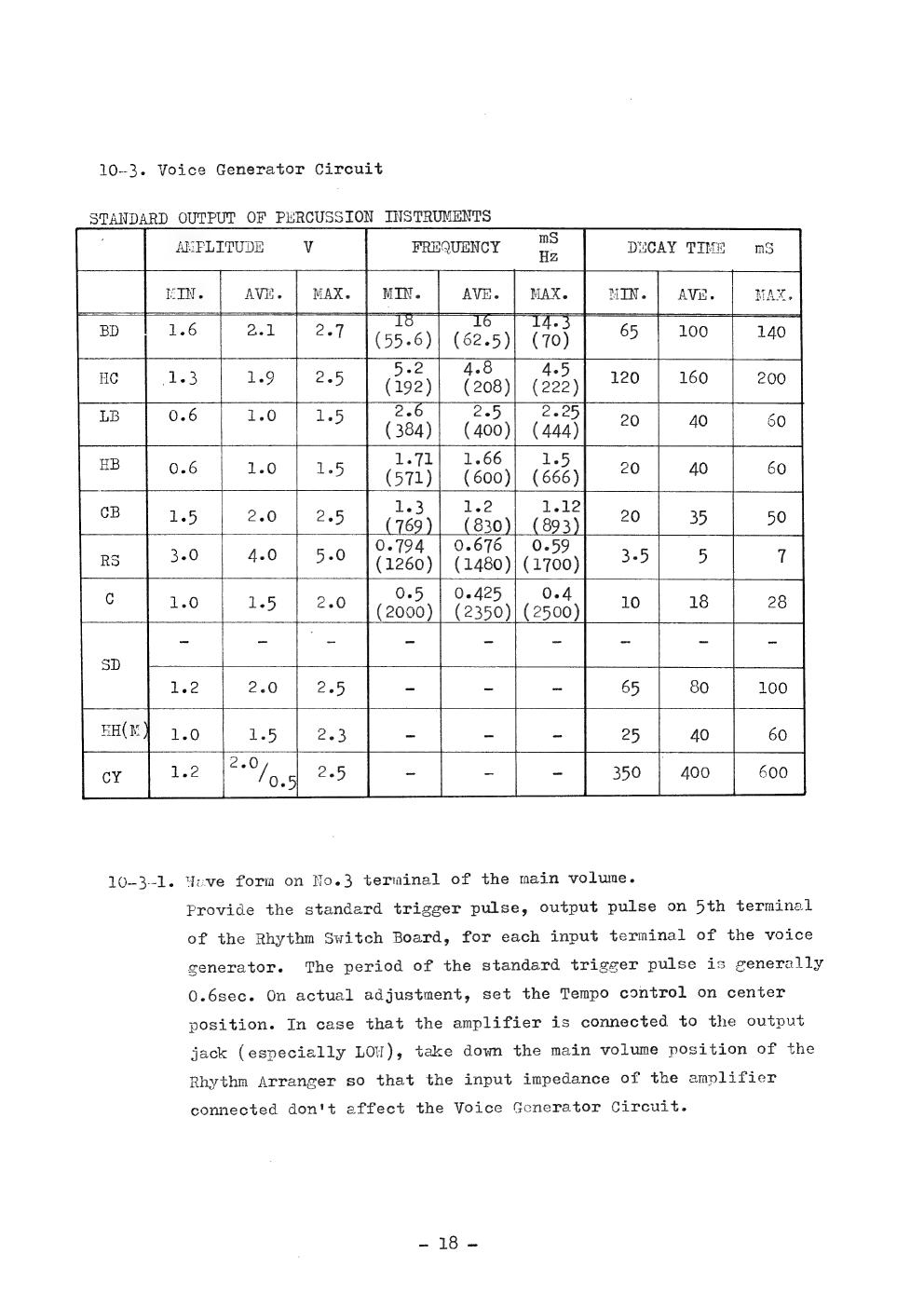
Bass drum is the lowest resonant voice. Roland’s table gives a 62.5 Hz average and 100 ms average decay, with a broad acceptable range around both values. High conga averages 208 Hz and lasts longer at 160 ms. Low and high bongos rise to 400 and 600 Hz while shortening to 40 ms, producing a deliberate ladder of pitch and envelope.

Cowbell, rim shot and claves occupy the bright resonant end. Their averages are approximately 830, 1480 and 2350 Hz; the decays shorten from 35 to 5 to 18 ms. They are not miniature acoustic models. They are tuned electrical gestures whose identities come from frequency, transient and repetition.

Snare, hi-hat/maracas and cymbal use noise. The snare’s 80 ms average envelope includes a quieter low-bongo component for body. Hi-hat/maracas averages 40 ms; cymbal extends the same broad family of noisy material to roughly 400 ms. Pattern placement and envelope length make one source read as three instruments.

TR-66 service-notes table listing the standard amplitude, frequency and decay ranges of all ten percussion voices
SERVICE NOTES // STANDARD OUTPUT OF PERCUSSION INSTRUMENTS // PRINTED PAGE 18
Open the deeper story +

Voice by voice: what the service figures mean

Bass drum — 55.6–70 Hz, 65–140 ms. The lowest voice is deliberately allowed the widest-feeling envelope range. Frequency sets the body; decay decides whether it reads as a short thud or a more audible tone.

High conga — 192–222 Hz, 120–200 ms. It is the longest tuned hand drum, so its pitch remains audible after the attack. That sustained ring separates it from the two bongos even before their frequencies are compared.

Low bongo — 384–444 Hz, 20–60 ms. High bongo — 571–666 Hz, 20–60 ms. Matching decay ranges make their pitch interval do most of the identifying work.

Cowbell — 769–893 Hz, 20–50 ms. Rim shot — 1260–1700 Hz, 3.5–7 ms. Claves — 2000–2500 Hz, 10–28 ms. These voices become progressively brighter, but envelope length prevents frequency alone from deciding their identity.

Snare — 65–100 ms. Hi-hat/maracas — 25–60 ms. Cymbal — 350–600 ms. Because broad noise does not yield one useful pitch figure, Roland specifies amplitude and decay. The circuit and filter shape the spectrum; the table measures how forcefully and how long it reaches the mix.

Averages are documentary centre points, not creative targets to impose blindly. The minimum and maximum columns define Roland’s accepted production window and make clear that two correctly operating machines can still differ audibly.

ENGINEERING PAPER // COMPLETE SIGNAL ROUTE

One clock, a hard-wired score and ten analogue voices.

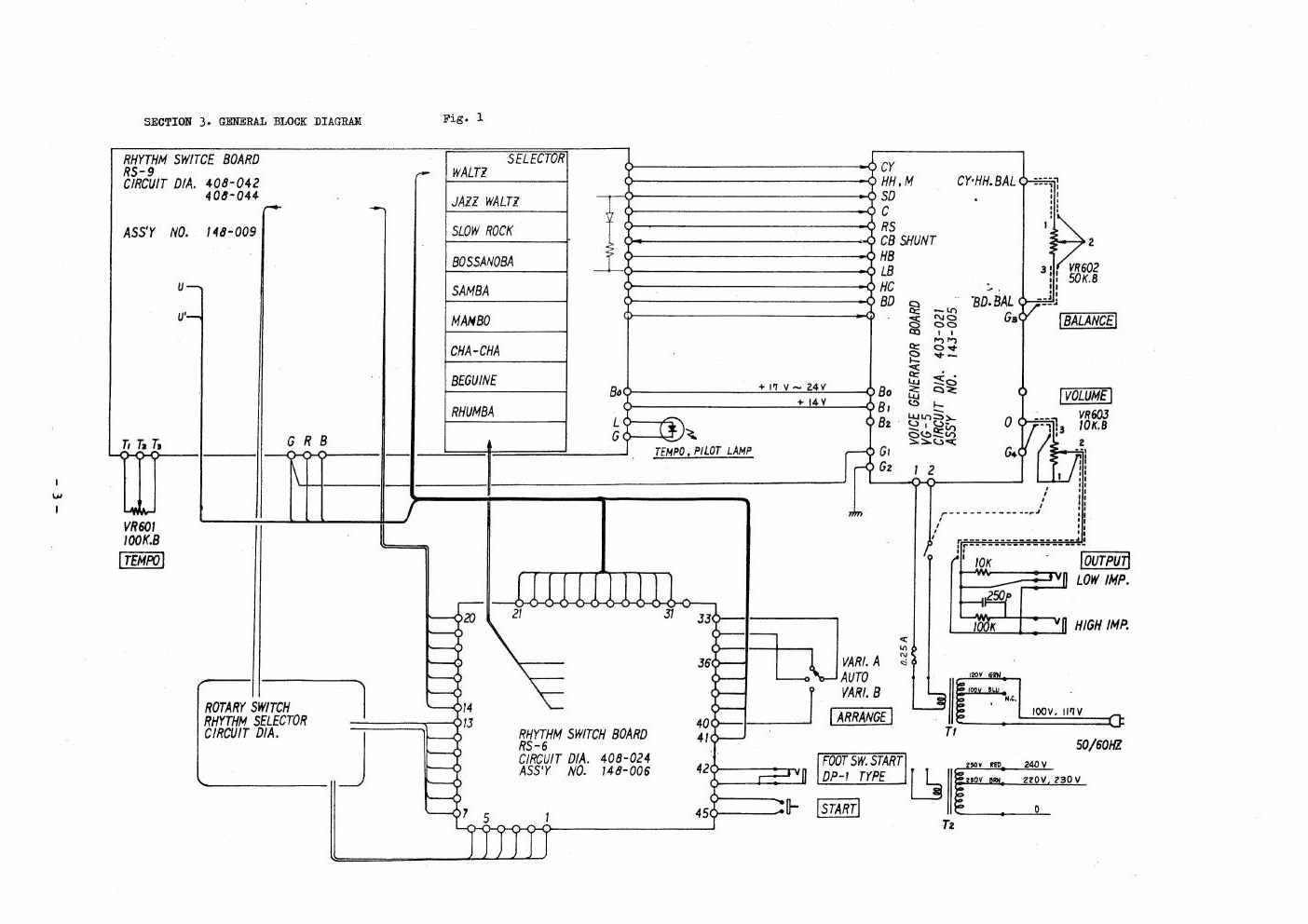
The November 1976 service notes expose the whole instrument on one page: a tempo oscillator feeds a divider and rhythm-switch assembly; the selected matrix distributes timed triggers; separate voice circuits create percussion; BALANCE, VOLUME and the dual outputs finish the route.

Roland TR-66 service-notes block diagram from tempo oscillator and rhythm selector to voice generator, balance control and outputs
ROLAND TR-66 SERVICE NOTES // GENERAL BLOCK DIAGRAM // SECOND EDITION, NOVEMBER 1976PRIMARY TECHNICAL EVIDENCE
Read the circuit in depth +

Trace the TR-66 from tempo knob to loudspeaker

1. Master clock. Q1 and Q2 form the free-running oscillator controlled by TEMPO. Roland specifies 37.5 milliseconds at QUICK and 300 milliseconds at SLOW. Q5 and Q6 form the first flip-flop, doubling those periods to 75 and 600 milliseconds before the timing chain continues.

2. Position in the bar. Further flip-flop stages divide the clock into a repeating field of 32 native pulse cells. These cells are not audio. They are addresses: electrical statements that the machine has reached a particular point in the pattern.

3. Programme selection. The rhythm-switch boards contain the hard-wired score. Diodes connect chosen timing positions to named voice trigger lines. Pressing a rhythm button selects one route through that matrix; combining compatible buttons allows trigger routes to coexist.

4. Arrangement state. VARI A repeats the A matrix and VARI B repeats B. AUTO is a four-bar instruction—A, A, A, B—not a third set of patterns. That distinction is confirmed by the owner’s manual, the dedicated A/B matrices and the service manual’s AUTO witness.

5. Tuned voices. Bass drum, high conga, low bongo and high bongo are brief resonant events. A trigger injects energy into a frequency-selective network; the network rings and then decays. Frequency determines perceived pitch, while the envelope determines how long the drum remains audible.

6. Metallic and short resonant voices. Cowbell, rim shot and claves use higher-frequency networks and short envelopes. Cowbell and rim share the KS route; grounding CB SHUNT selects cowbell while leaving it open produces rim shot. Claves has no factory trimmer and depends on fixed component values.

7. Noise family. Hi-hat or maracas, cymbal and snare begin with broadband electrical noise. Filters restrict its spectrum and envelope circuits set duration. The snare also includes a quieter low-bongo component, adding a pitched body beneath the noise burst.

8. Mix and outputs. The voice generator presents groups to the BALANCE control, then the main VOLUME control feeds high- and low-impedance outputs. BALANCE is not stereo pan: it changes the relative weight of the bass-and-snare side and the cymbal/hi-hat side of the mono mix.

9. Calibration hierarchy. Clock, pattern logic, voice frequency, decay and level are separate measurements. The service table gives a range as well as an average because a working analogue voice is a relationship among waveform, time and amplitude, not a single trimmer position.

10. Surviving machines. Capacitor ageing, resistor tolerance, repairs and previous calibration can move pitch and decay while leaving the machine apparently functional. The service targets provide the reference; comparison recordings and full-pattern tests reveal whether a correction preserved the instrument’s musical balance.

Open the complete 1976 service notes ↗Open the 1977 owner’s manual ↗

PAGE 07 // SURVIVAL // COLLECTION BIOGRAPHY

The bridge survives because it still performs

The TR-66’s place in history is not only between two product families. It remains a playable arrangement instrument with connections, controls and limits that later machines changed rather than simply improved.

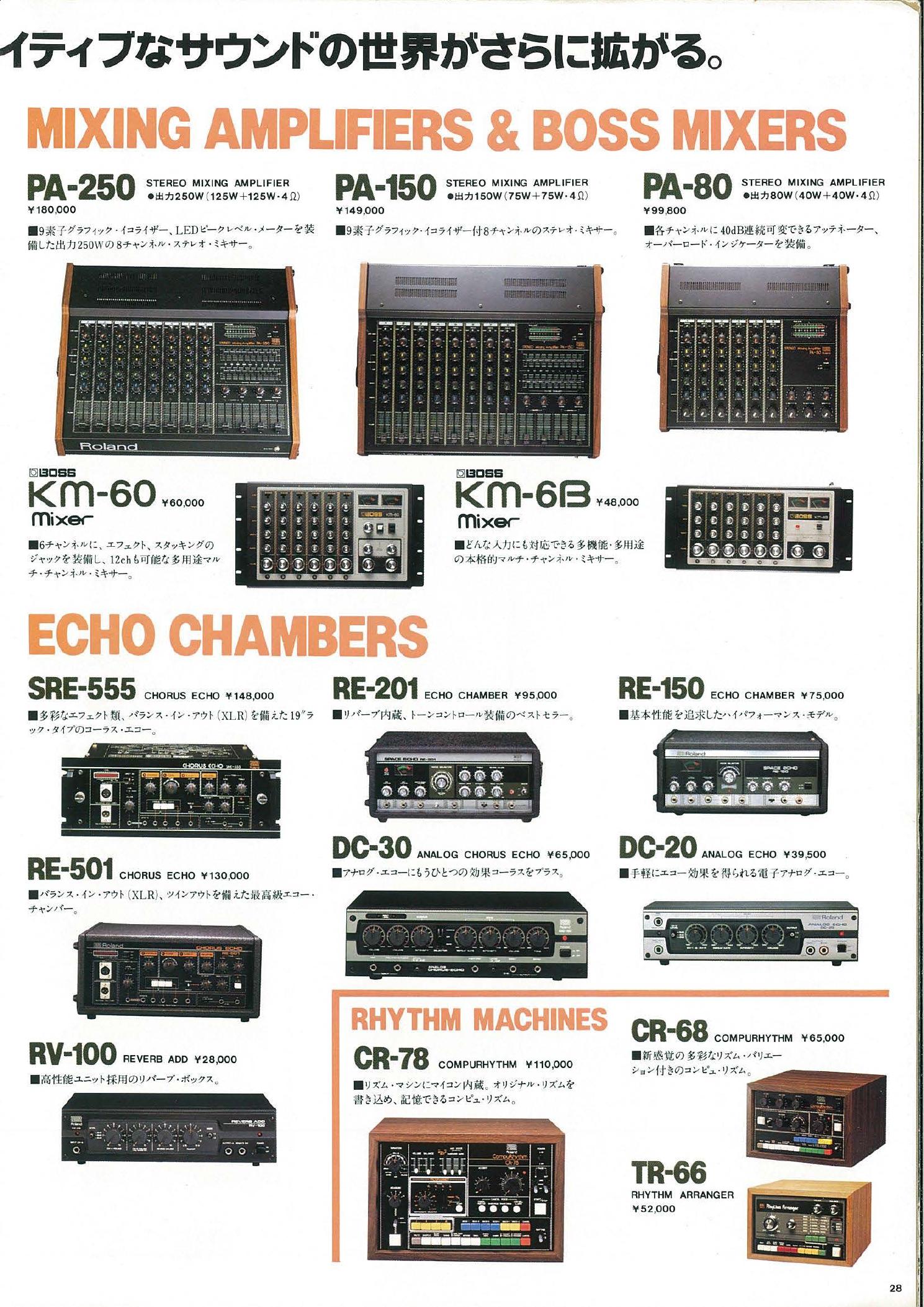
The CR-68 retained preset immediacy but added microcomputer control, fill choices and a more deliberate performance panel. The programmable CR-78 added writable memory. The TR-808 eventually placed a visible 16-step programme under the player’s hands. Seen from that later grid, the TR-66 reveals what Roland chose to preserve: tempo, variation, accents of arrangement and the feeling of changing a rhythm while it runs.

It also reveals what disappeared. The A/B state is not a row of editable steps; it is part of the factory composition. Combining buttons produces density through overlapping matrices rather than copying a pattern into memory. BALANCE reshapes families rather than offering individual voice faders. Those restrictions are the instrument’s working method, not missing modern features.

This TR-66 was the first Roland rhythm machine acquired for the Big Beat collection. It then appeared at the first three Texas Radio and the Big Beat performances opening for Charley Crockett. The archive begins here with an object that moved from domestic accompaniment to a contemporary stage and remained recognisably itself.

Later Roland keyboard catalogue showing the TR-66 retained beside the CR-68 and CR-78
ROLAND KEYBOARD CATALOGUE // TR-66 BESIDE THE COMPURHYTHM GENERATION
Open the deeper story +

A practical listening and condition record

Before comparing a surviving machine with another example, record every rhythm in A and B at one stable tempo, then repeat in AUTO. This separates differences in the fixed matrices from differences caused by tempo drift or performance timing.

Record the BALANCE control at both extremes and centre. A voice that appears missing in one position may simply belong to the attenuated group; a voice absent throughout points to the switch, matrix, trigger route or generator itself.

Photograph the front, rear, serial plate and interior before service. Record the master clock at QUICK and SLOW, then capture the frequency, decay and level of every voice. That evidence turns maintenance into a dated condition history rather than an undocumented attempt to make the machine sound ‘better.’

Mains-powered service belongs with a qualified technician and the correct regional schematic. The public service notes here are evidence for understanding the instrument; they are not a substitute for safe bench practice.

SOURCES AND FURTHER READING // TR-66

Continue through the original documents.

Owner’s manuals, service notes, period catalogues, contemporary press and first-hand accounts are identified by type so readers can follow the machine beyond this dossier.

R01

Roland TR-66 owner’s manual, English edition E-2

Primary January 1977 source for controls, 27 programmes, A/B/AUTO operation, combined buttons, connection method, setting examples and specifications.

OPEN SOURCE ↗
R02

Roland TR-66 Service Notes, second edition

Primary November 1976 source for system architecture, switch matrices, timing, voice circuits, standard outputs, calibration and parts.

OPEN SOURCE ↗
R03

Roland P.A. Systems Catalogue

Primary October 1977 catalogue showing the TR-66 at ¥48,000 beside the TR-55, TR-77 and TR-700.

OPEN SOURCE ↗
R04

Roland HP Series catalogue

Primary period evidence presenting the TR-66 as an external rhythm partner for Roland electronic pianos.

OPEN SOURCE ↗
R05

Roland Keyboard Catalogue

Official later catalogue retaining the TR-66 beside the CR-68 and CR-78, with a ¥52,000 listed price.

OPEN SOURCE ↗
R06

Roland discontinued-product service record

Official service table listing the TR-66 product period as 1975–1982.

OPEN SOURCE ↗
R07

Roland catalogue museum: rhythm machines

Official index to surviving Roland rhythm-machine catalogues.

OPEN SOURCE ↗
R08

Audiofanzine: Roland TR-66

Independent photographic record of a surviving TR-66, including its front, cabinet and rear connections.

OPEN SOURCE ↗
R09

BendingBus: Roland TR-66 (archived)

Archived independent technical commentary and internal-adjustment study, read as a secondary comparison with the factory service notes.

OPEN SOURCE ↗
R10

Roxy Music — Dance Away

Official video used for the factory Cha-Cha listening comparison.

OPEN SOURCE ↗
R11

Roland Electronic Musical Instruments Vol. 1

Primary March 1977 general catalogue with dedicated colour pages for the TR-66, TR-700, TR-77, TR-55, TR-33 and TR-330.

OPEN SOURCE ↗
R12

Roland TR-66 owner’s manual, Japanese edition

Primary Japanese manual with worked and blank registration-note pages for preserving song-specific button and control settings.

OPEN SOURCE ↗
R13

Beat Instrumental UK price guide, August 1976

Period British market listing for the TR-66 at £156.44.

OPEN SOURCE ↗
R14

Beat Instrumental UK price guide, May 1977

Period British market listing for the TR-66 at £195.22.

OPEN SOURCE ↗
R15

Roland Drum Machine Chronicle: 1964–2016

Official Roland retrospective placing the TR-66 under 1973; published beside the conflicting 1975 launch year in Roland Japan’s service register rather than treated as conclusive primary launch evidence.

OPEN SOURCE ↗

PASS THE FILE ON // CANONICAL TRANSMISSION

SHARE THE ROLAND TR-66 RHYTHM ARRANGER.

Send readers directly to this machine file on Drum Machines Have No Soul.

drummachineshavenosoul.com/machines/tr-66

THE MACHINE LINE // 02 OF 12

FOLLOW THE CHANGE.

Each machine inherits a working idea and moves one musical decision. Continue through the family by what the player can do—not by model number alone.