BIG BEAT MACHINE FILE // 001

77

The preset becomes an instrument

Roland Rhythm 77 (TR-77)1972Rhythm arranger

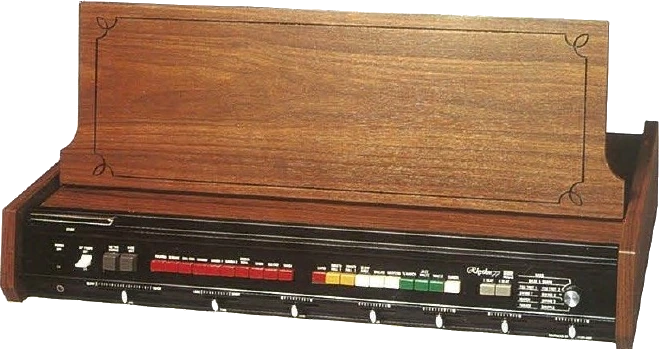
The Roland Rhythm 77 (TR-77) puts thirty factory rhythms, thirteen analogue percussion voices and live arrangement controls into a self-contained wooden cabinet.

Roland TR-77 isolated from its March 1977 Roland Rhythm catalogue photograph
ROLAND RHYTHM 77 // MARCH 1977 CATALOGUE OBJECTBIG BEAT ARCHIVE
PRODUCTIONIntroduced 1972; documented in later Roland catalogues
SOUND ENGINE13 analogue voices: resonators, oscillators and filtered noise
RHYTHM MEMORY30 factory rhythms routed through diode matrices
More facts, listening references & sources
PERIOD PRICE¥79,000 in Roland's period catalogue
LINEAGE ADVANCEA founding-year Roland instrument that carries Ace Tone's preset-rhythm practice into a self-contained performance console.
WHAT THE PLAYER GAINSGrouped voice levels, combinable rhythm banks, variation, touch start/stop and an automatic ending make a fixed pattern playable while it runs.
NOTABLE USERSJohn Foxx · Warren Cann / Ultravox · Rita Braga
START LISTENINGUltravox — My Sex · Ultravox — Hiroshima Mon Amour · Rita Braga — Spooky Mambo
Sources for the artists and listening references

Artist accounts, historical attributions and performance films establish different things. These notes explain the basis for each reference.

PAGE 01 // 01 // ORIGIN // ACE TONE TO ROLAND

A new name, carrying a decade of rhythm-machine knowledge

Roland introduced the Rhythm 77 in its founding year, but the circuits and working habits behind it reach back through Ikutaro Kakehashi's Ace Tone machines.

Kakehashi founded Ace Electronic Industries in 1960 and spent the following decade developing transistor rhythm units for organs and stand-alone use. When Roland began in Osaka in 1972, the TR-33, TR-55 and TR-77 formed its first product group. The badge was new; the underlying practice—analogue voices triggered by hard-wired rhythm matrices—was mature.

The closest product ancestor was Ace Tone's FR-8L. Roland's own history describes it as a furniture-finished rhythm box with a built-in music stand, designed to sit beside an organ, and says that it was later updated and released as the TR-77. The new machine kept that room-scale form while bringing its thirty rhythms, six voice-group levels, variation, up-tempo and automatic fade into a more deliberate performance surface.

That distinction also explains the cabinet. The TR-77 could still live above an electronic organ, but it no longer behaved like a hidden accompaniment module. Its controls face the player, its mixed output can enter another amplification chain, and its ending can be performed from the panel.

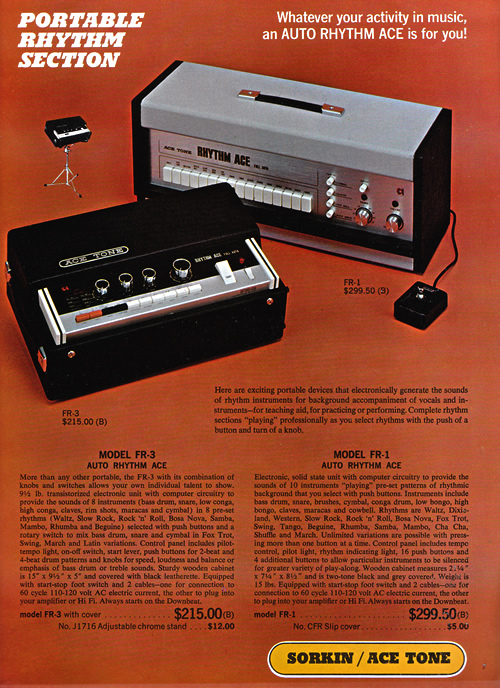
Period Sorkin and Ace Tone advertisement for Rhythm Ace machines
ACE TONE RHYTHM ACE // PERIOD DISTRIBUTOR ADVERTISEMENT
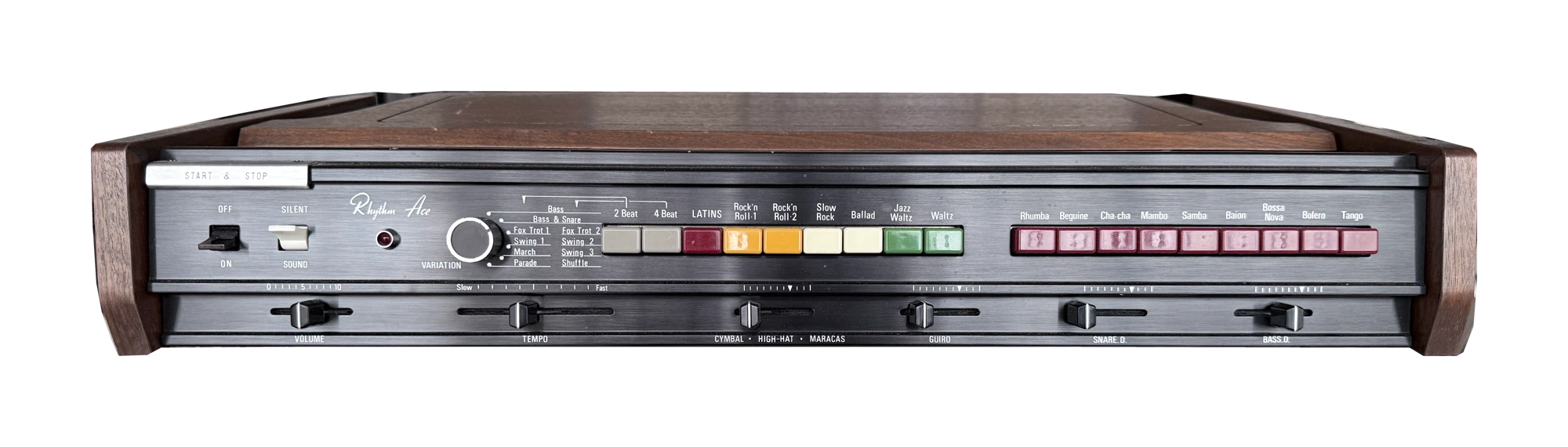
Big Beat Collection Ace Tone Rhythm Ace FR-8L, complete isolated frontal photograph
ACE TONE FR-8L // THE TR-77 PREDECESSOR // BIG BEAT COLLECTION
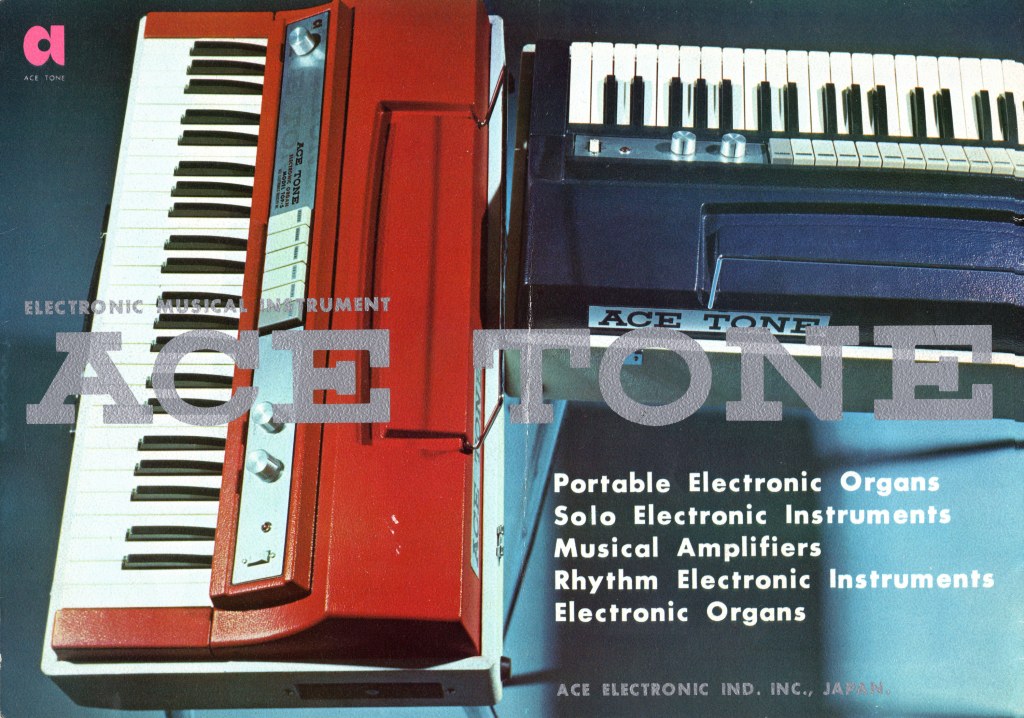
1968 Ace Tone catalogue cover with the period Ace Tone symbol and wordmark
ACE TONE // COMPANY MARK AND CATALOGUE COVER // MARCH 1968
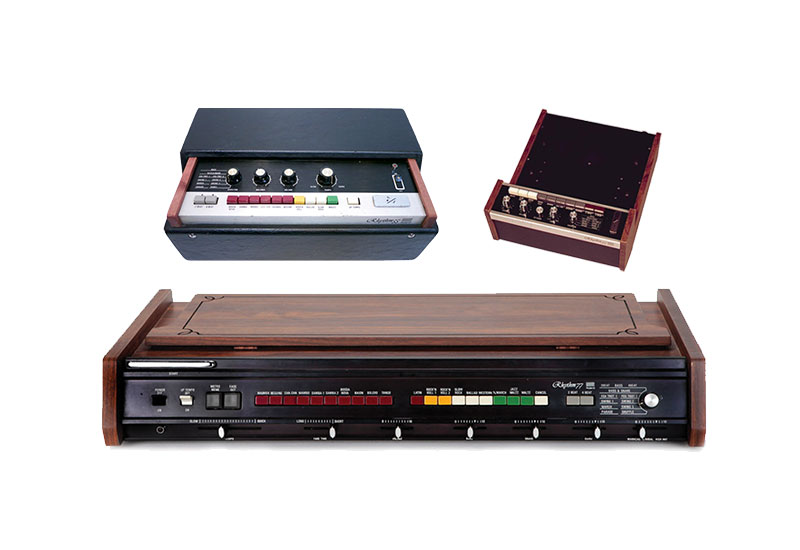
Official Roland image grouping its first 1972 rhythm instruments
ROLAND // FIRST INSTRUMENTS // TR-33, TR-55 AND TR-77 // 1972
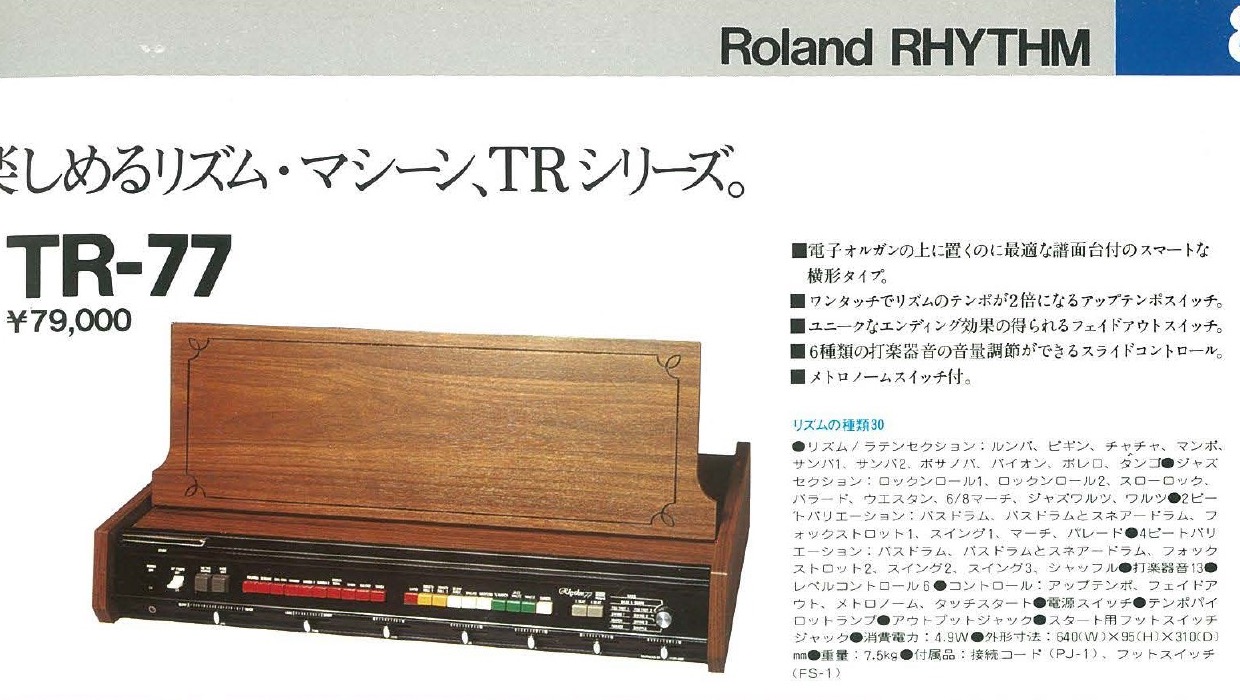
TR-77 product entry extracted from Roland's March 1977 Electronic Musical Instruments catalogue
ROLAND TR-77 // OFFICIAL PRODUCT ENTRY // ¥79,000 // MARCH 1977
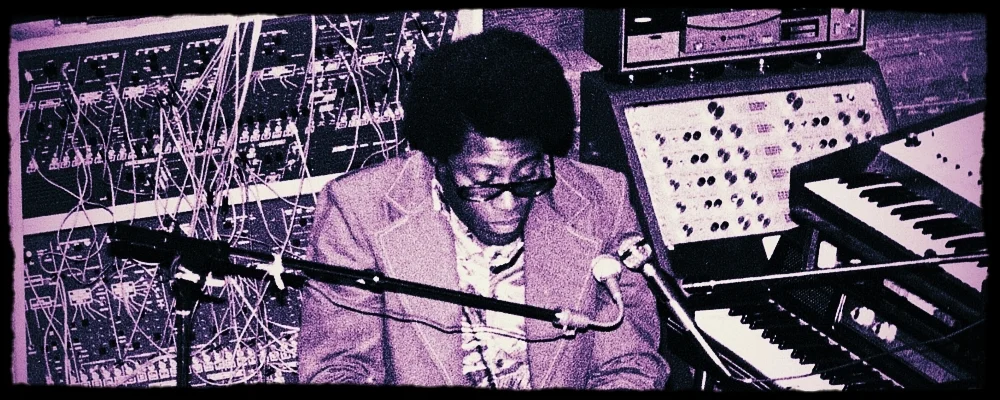
Don Lewis seated within his later Live Electronic Orchestra performance system
DON LEWIS WITH LEO // THE PLAYER-ENGINEER CONTEXT // LATER PERFORMANCE SYSTEM
Open the deeper story +

Two Ace Tone machines—and two different parts of the story

The FR-8L and FR-2L are easy to collapse into one prehistory, but they supply different evidence. The FR-8L is the product line: the furniture-finished, music-stand rhythm box that Roland identifies as the model later updated into the TR-77. Its cabinet, organ placement and self-contained preset method explain what the new Roland inherited.

Don Lewis's famous modifications belong to an Ace Tone FR-2L, not to the FR-8L or the TR-77. His machine supplies the player line. Lewis used a Hammond expression pedal to shape the rhythm dynamically, retuned individual percussion voices, and changed diode connections so the supplied patterns could answer his own music.

Ikutaro Kakehashi encountered Lewis and the altered machine at the 1969 NAMM show. Their later collaboration established a powerful precedent: factory presets were only a starting point, and close observation of musicians could change how instruments were designed.

The TR-77 joins those routes without making them the same claim. From the FR-8L it inherits the large organ-side object. From the wider Ace Tone practice it inherits transistor voices and diode-programmed rhythm. In its six group sliders, variations, up-tempo switch and automatic fade, it gives the player more ways to shape that fixed material while it is running.

This is why the TR-77 matters in the lineage: it is not yet a programmable Rhythm Composer, but neither is it only a preset switchboard. It turns accompaniment into a performance with balances, substitutions, acceleration and an ending.

Read Roland's FR-8L and TR-77 history ↗Open the March 1977 general catalogue ↗
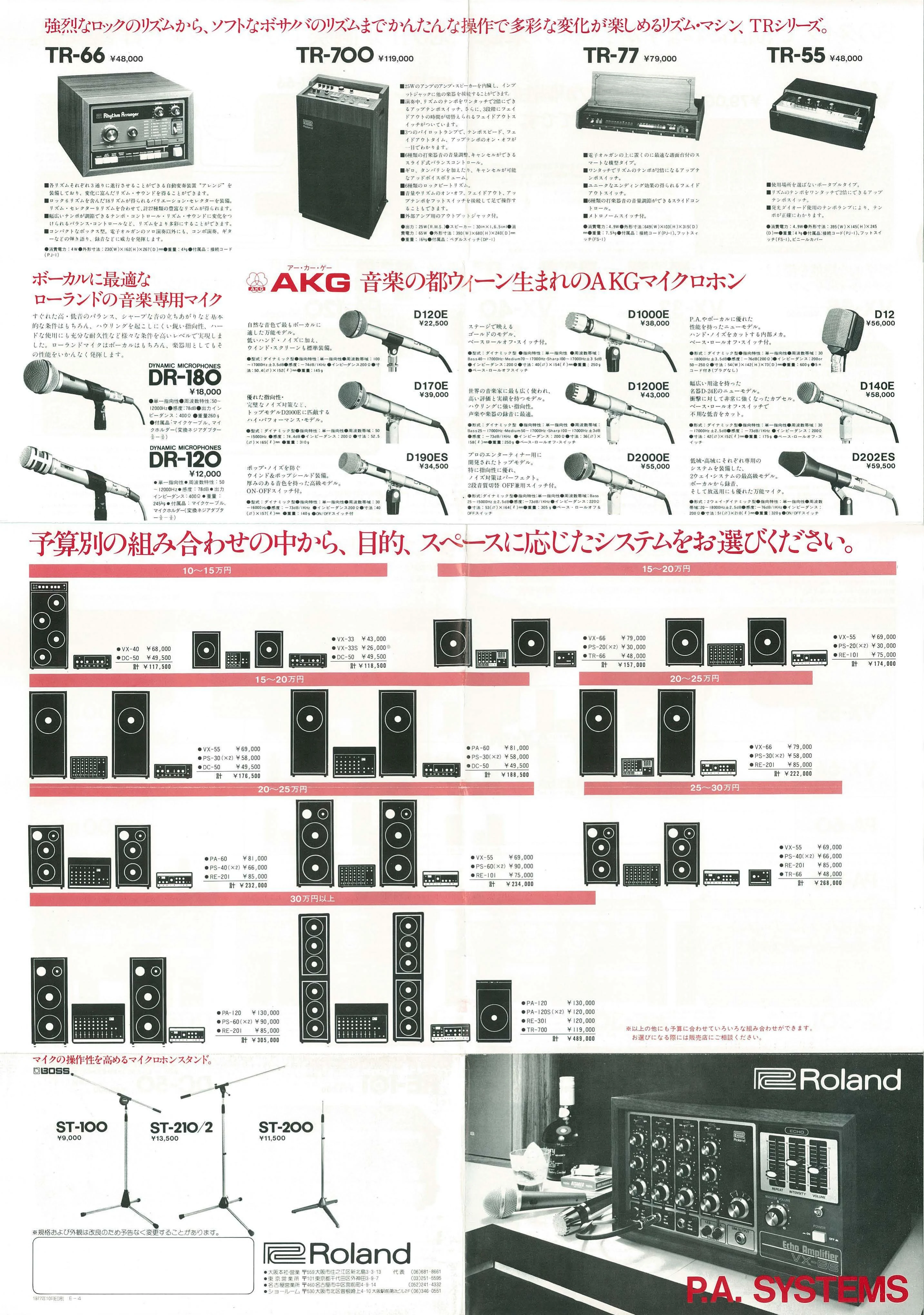
Official 1977 Roland catalogue page showing the TR-66, TR-700, TR-77 and TR-55
ROLAND P.A. SYSTEMS CATALOGUE // TR SERIES // OCTOBER 1977DOCUMENTARY SOURCE
01020304050607080910111213141516

PAGE 02 // 02 // OPERATION // PLAY THE ARRANGEMENT

The controls explain the intended performance

Choose a named rhythm, establish the tempo, rebalance the percussion groups, introduce a variation and let the machine make its own ending.

The lower row contains Latin patterns; the upper row carries Jazz, rock and dance patterns. The two sections can be used independently or, where the switching permits, combined. Six sliders change the balance of bass drum, snare, conga/bongo, cymbal, maracas and the remaining percussion while the pattern continues.

Two-beat and four-beat variation settings change how the selected material turns through the phrase. The FADE button hands the ending to a timed circuit, while UP TEMPO immediately raises the master clock. These are arrangement controls, not settings to be chosen once and ignored.

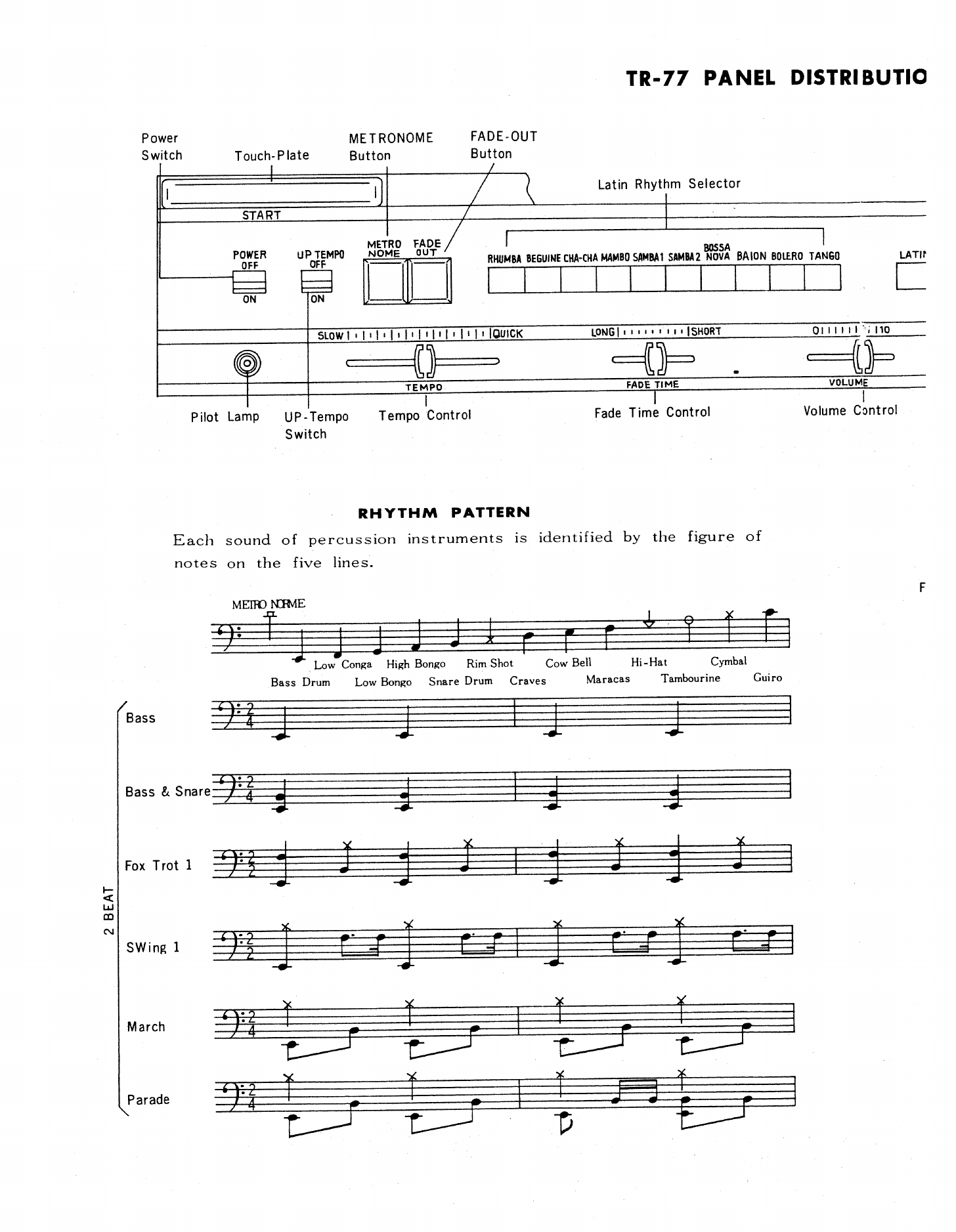
TR-77 operation-manual panel map and examples of the two-beat and four-beat variation settings
TR-77 OPERATION MANUAL // PANEL AND VARIATION CONTROLS // 1975
Open the deeper story +

A practical first performance

Begin with all six group sliders down, choose Rock'n Roll 1, and set the master volume conservatively. Bring up bass drum and snare first: this reveals the pattern's foundation before the brighter voices mask it.

Add maracas or cymbal as a continuous upper layer, then use the conga/bongo group to hear how the preset distributes syncopation around the main beat. The BALANCE control changes the relationship between the machine's lower and upper rhythmic weight.

Switch between the two-beat and four-beat variation programmes while counting complete bars. The change is clearest when it is heard as phrase structure rather than as one extra sound. Finish with SHORT fade, then repeat with LONG: the second decay lasts roughly twice as long and changes when the listener perceives the ending.

Read the illustrated operation manual ↗

PAGE 03 // 03 // PATTERNS // THE PHYSICAL SCORE

Before writable memory, the rhythm was a diode map

A five-stage divider supplies positions in the bar; the selected matrix decides which of those positions will trigger each voice.

The service notes show five flip-flops dividing the master oscillator into a 32-position timing system. Each rhythm switch brings a different field of diodes into the route. Where a diode joins a timing line to a voice bus, that instrument receives a trigger.

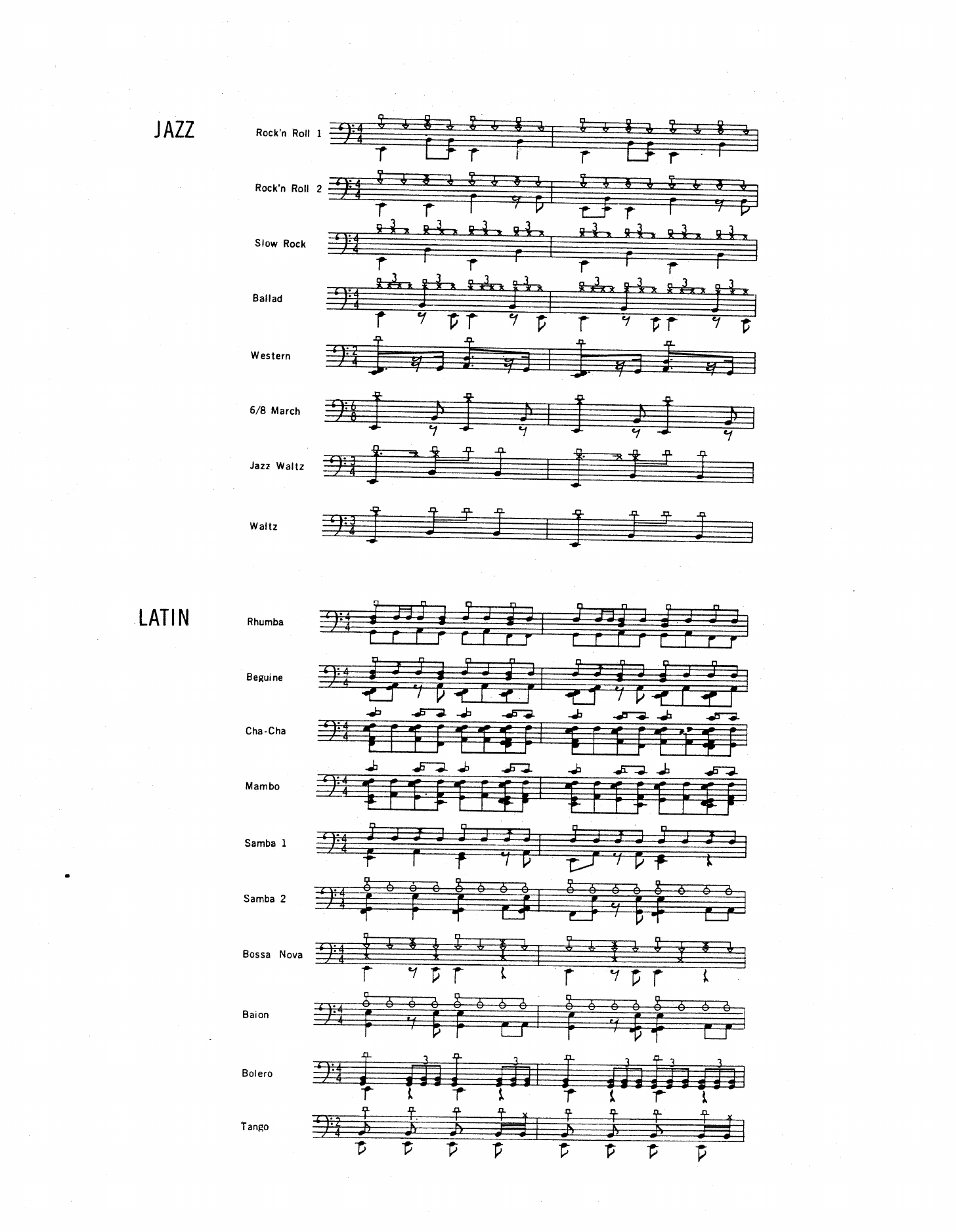
The factory library contains twelve underlying beat structures—six two-beat and six four-beat programmes—distributed across eighteen named Jazz and Latin selections. The front panel makes thirty useful choices from that compact hard-wired vocabulary.

TR-77 operation-manual factory rhythm notation
TR-77 OPERATION MANUAL // FACTORY RHYTHM SCORE
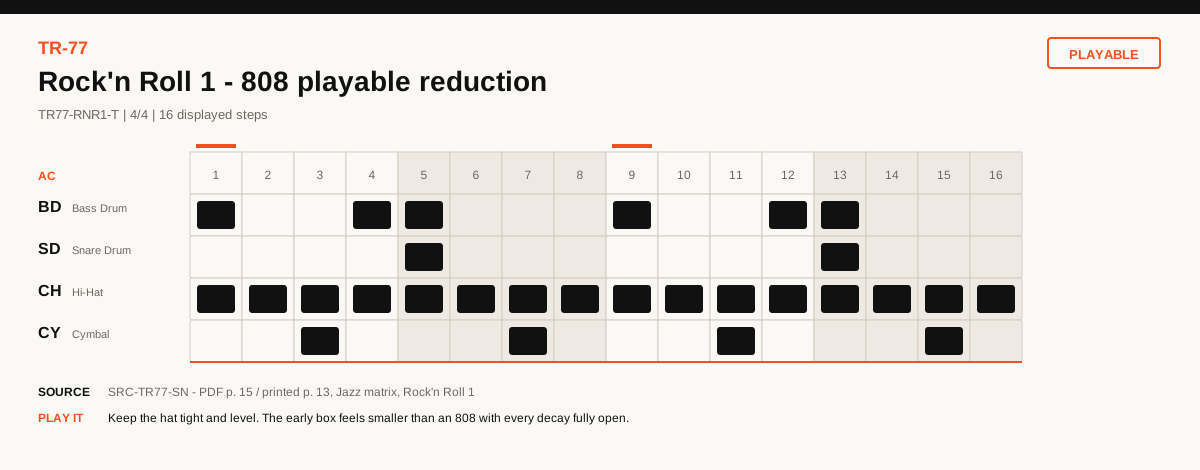
Transcribed TR-77 Rock'n Roll 1 factory rhythm
ROCK'N ROLL 1 // FACTORY-PATTERN TRANSCRIPTION
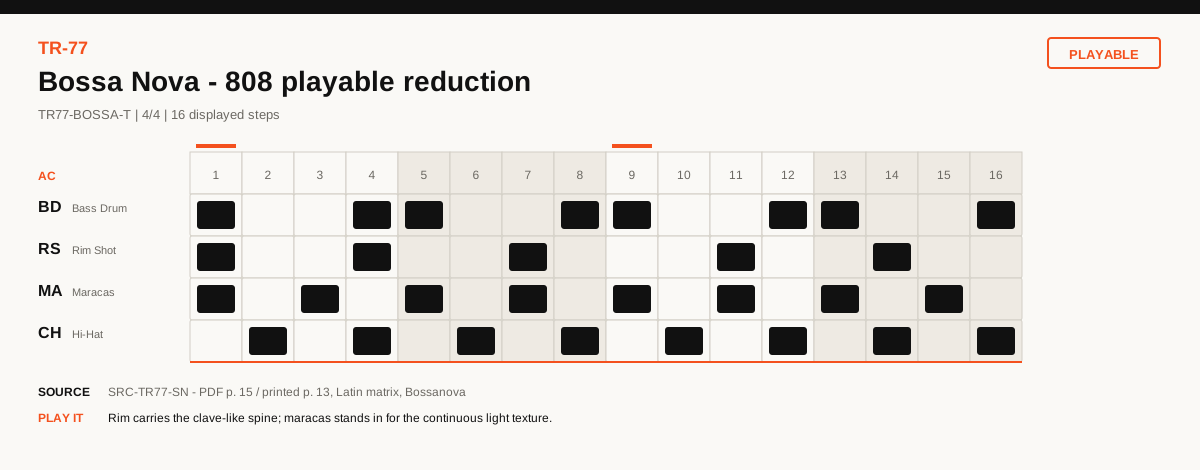
Transcribed TR-77 Bossa Nova factory rhythm
BOSSA NOVA // FACTORY-PATTERN TRANSCRIPTION
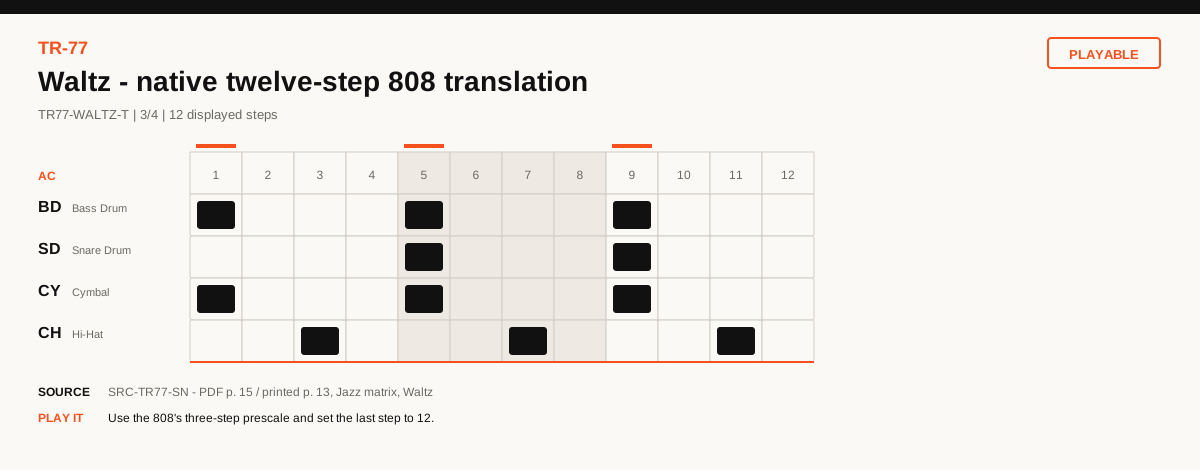
Transcribed TR-77 Waltz factory rhythm
WALTZ // FACTORY-PATTERN TRANSCRIPTION
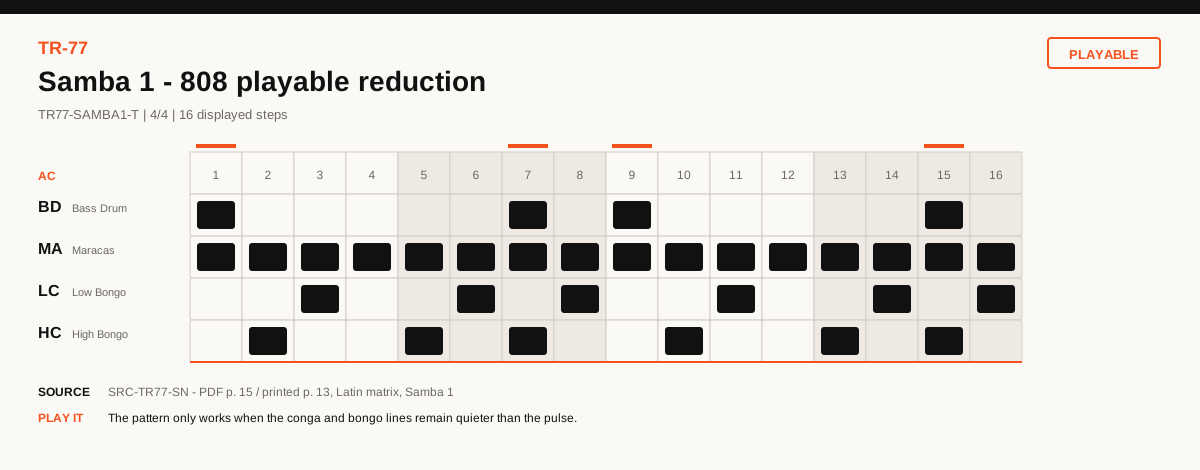
Transcribed TR-77 Samba 1 factory rhythm
SAMBA 1 // FACTORY-PATTERN TRANSCRIPTION

TR-77 FACTORY MATRIX // COMPLETE CONTROLLED CORPUS

Thirty named rhythms. Thirty-two electrical pulses each.

Patterns
30
Sounded events
718
Off-grid pulses
50
Invented guiro hits
0

ROLAND-TR77-001 // JAZZ

Rock'n Roll 1

Each familiar position retains two electrical pulse cells. The narrow second cell is where a conventional sixteen-step redraw would erase syncopation.

SWIPE OR USE ARROW KEYS TO READ EVERY STEP →

CY
HH
SD
BD

Audio: starts after your first press.

What is exact: all 718 sounded marks come from the independently reviewed service-matrix corpus. Pulse 32 repeats the cycle origin rather than adding a thirty-third event.

What is interpreted: browser audio is an accessible synthesis sketch, not a sample or circuit emulation. Cha-Cha and Mambo retain the guiro as a gated waveform and do not make up discrete strikes.

Open the deeper story +

Read one pattern as a circuit

Follow Rock'n Roll 1 from left to right. Each vertical division in the transcription corresponds to a clock-derived opportunity. A filled mark means that the factory matrix connects that moment to a voice trigger; an empty space means no connection is made.

The bass drum establishes the long cycle, snare marks the backbeat, and the upper percussion fills shorter subdivisions. Electrically these parts do not know that they form a style. “Rock'n Roll” is the name Roland gives to one set of simultaneous routing decisions.

The waltz transcription demonstrates the altered count used by the three-beat feedback path. Bossa Nova and Samba reveal how the same small voice set can suggest very different motion when trigger density and placement change.

PAGE 04 // 04 // SOUND // THIRTEEN VOICES

A drum kit assembled from ringing, noise and pulses

The Rhythm 77 does not contain recordings. Its percussion is generated at the instant of each trigger by resonators, oscillators, noise filters and envelope circuits.

Bass drum, low conga and the two bongos are tuned resonant voices: a short electrical strike makes each circuit ring and decay. Cowbell combines two oscillations. Rim and claves are very short pitched events. Snare adds a tuned body to filtered noise.

Maracas, hi-hat, cymbal and tambourine begin with transistor noise but become different instruments through filtering and envelope length. Guiro uses repeating pulses. The result is not acoustic realism; it is a carefully separated electronic ensemble that remains intelligible through one output.

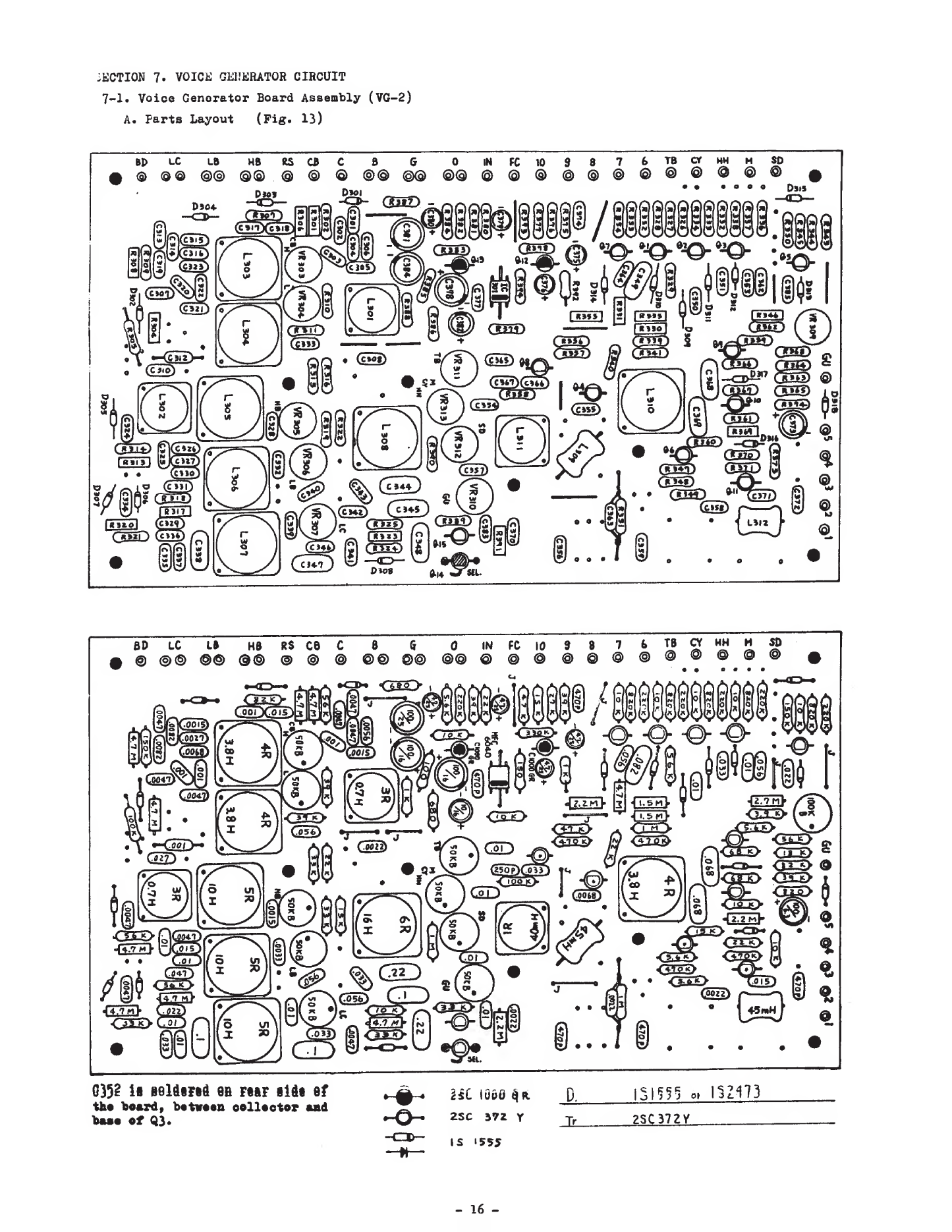
TR-77 service-notes drawings of the voice-generator circuit boards
TR-77 SERVICE NOTES // VOICE-GENERATOR BOARD ASSEMBLIES
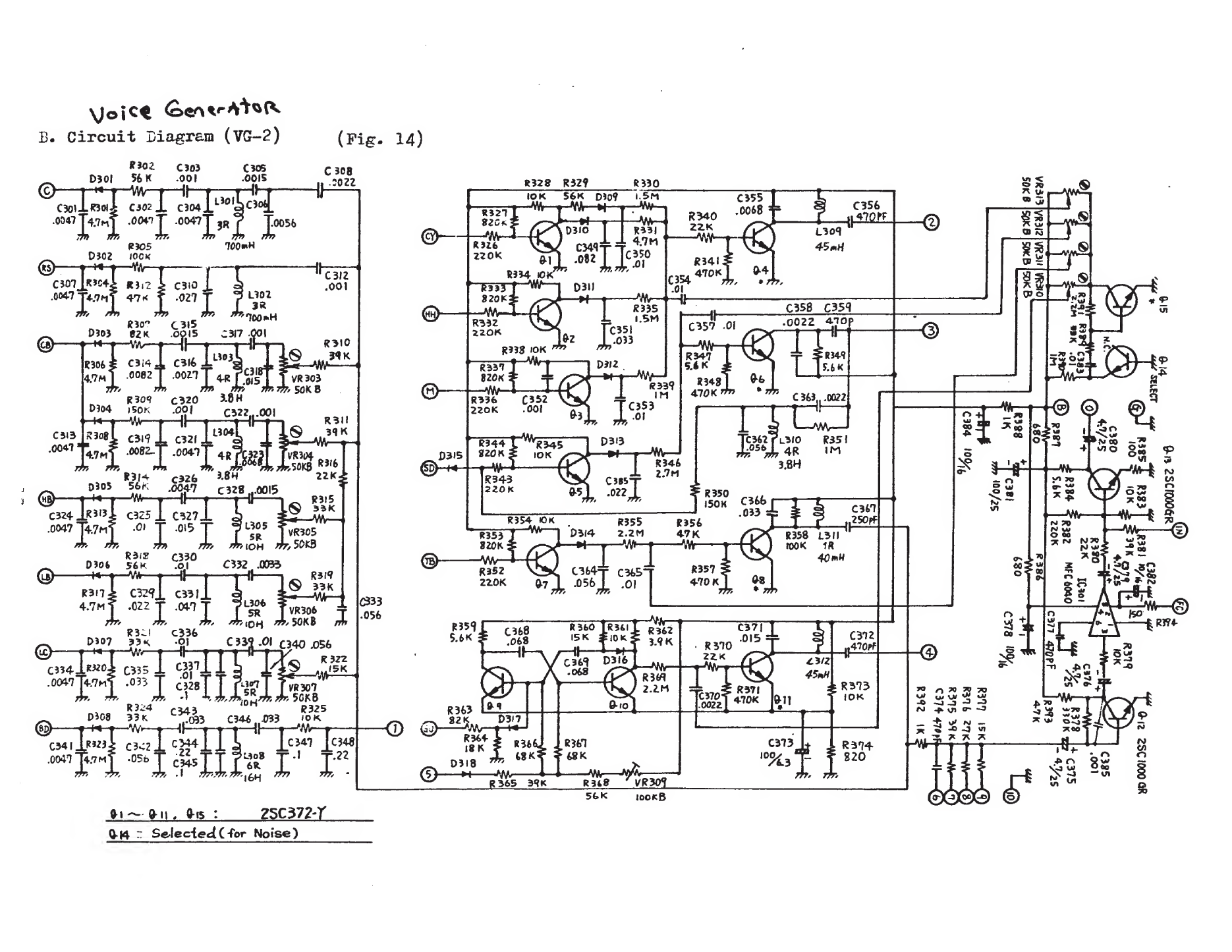
TR-77 voice-generator schematic
VOICE GENERATOR // ORIGINAL SCHEMATIC
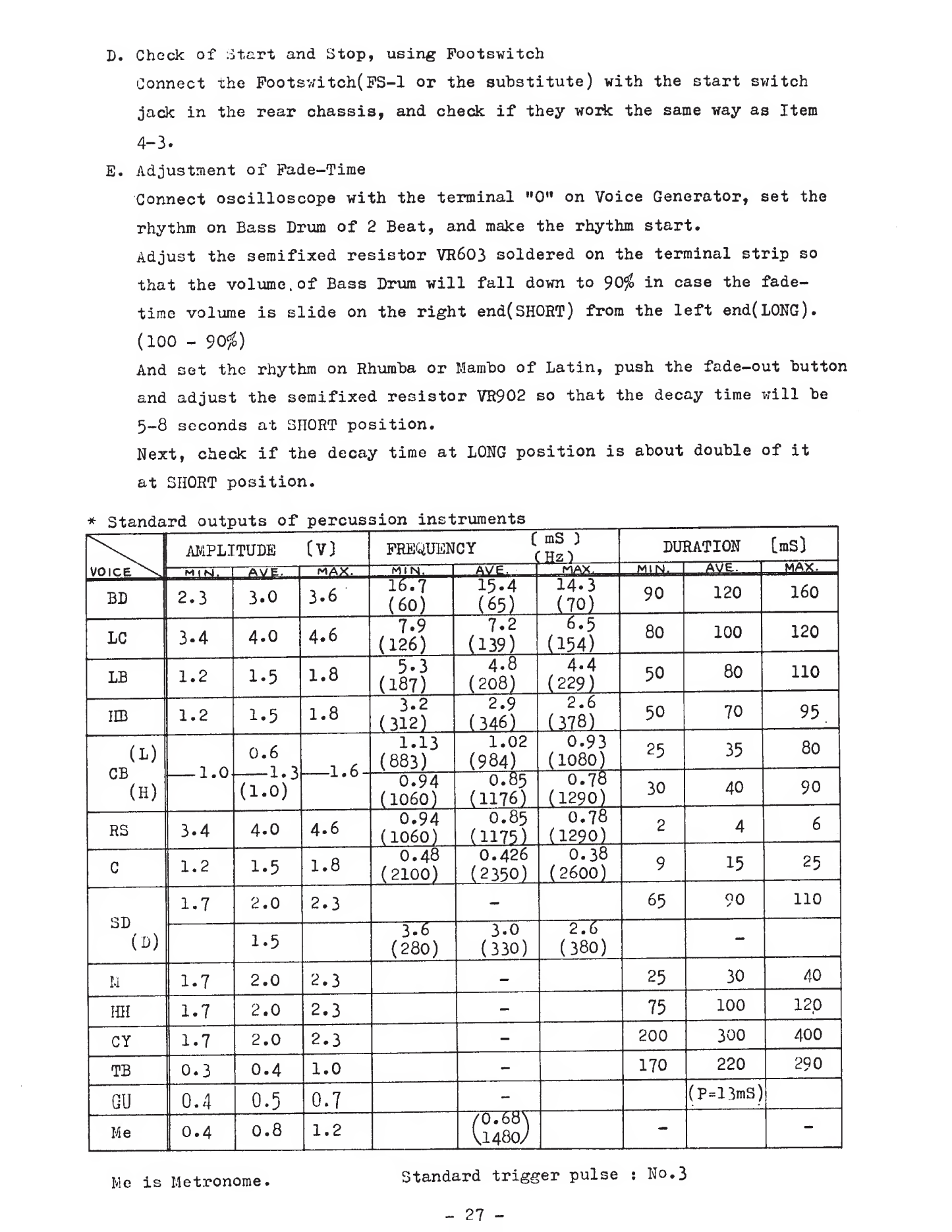
TR-77 service calibration table with voice frequencies, envelope times and output levels
STANDARD OUTPUT // FACTORY CALIBRATION TARGETS
Open the deeper story +

Voice families, in plain language and at the bench

Bass drum is calibrated around 65 hertz with an envelope near 120 milliseconds. Low conga is higher and slightly shorter; low and high bongos rise to about 208 and 346 hertz. In each case resistance and capacitance determine how rapidly the resonator loses energy, while the tuned network determines the perceived pitch.

Cowbell's paired oscillations, approximately 984 and 1176 hertz, create the beating and metallic complexity that a single pure tone would lack. Rim and claves are deliberately brief—about 4 and 15 milliseconds—so their high frequencies read as impacts instead of sustained notes.

The snare combines roughly 90 milliseconds of shaped noise with a resonant body near 330 hertz. Maracas are much shorter; hi-hat, cymbal and tambourine use progressively different envelope times and filtering. The precise figures give a technician a repeatable diagnostic route without reducing the sound to one component value.

A repaired machine should be assessed as a system. Confirm supply and clock first, then trigger routing, then the separate voice outputs, and only then the group controls, summing amplifier and fade. Adjusting a voice before proving that its trigger is correct can disguise the real fault.

ENGINEERING PAPER // SYSTEM ROUTE

From one clock pulse to thirteen percussion voices

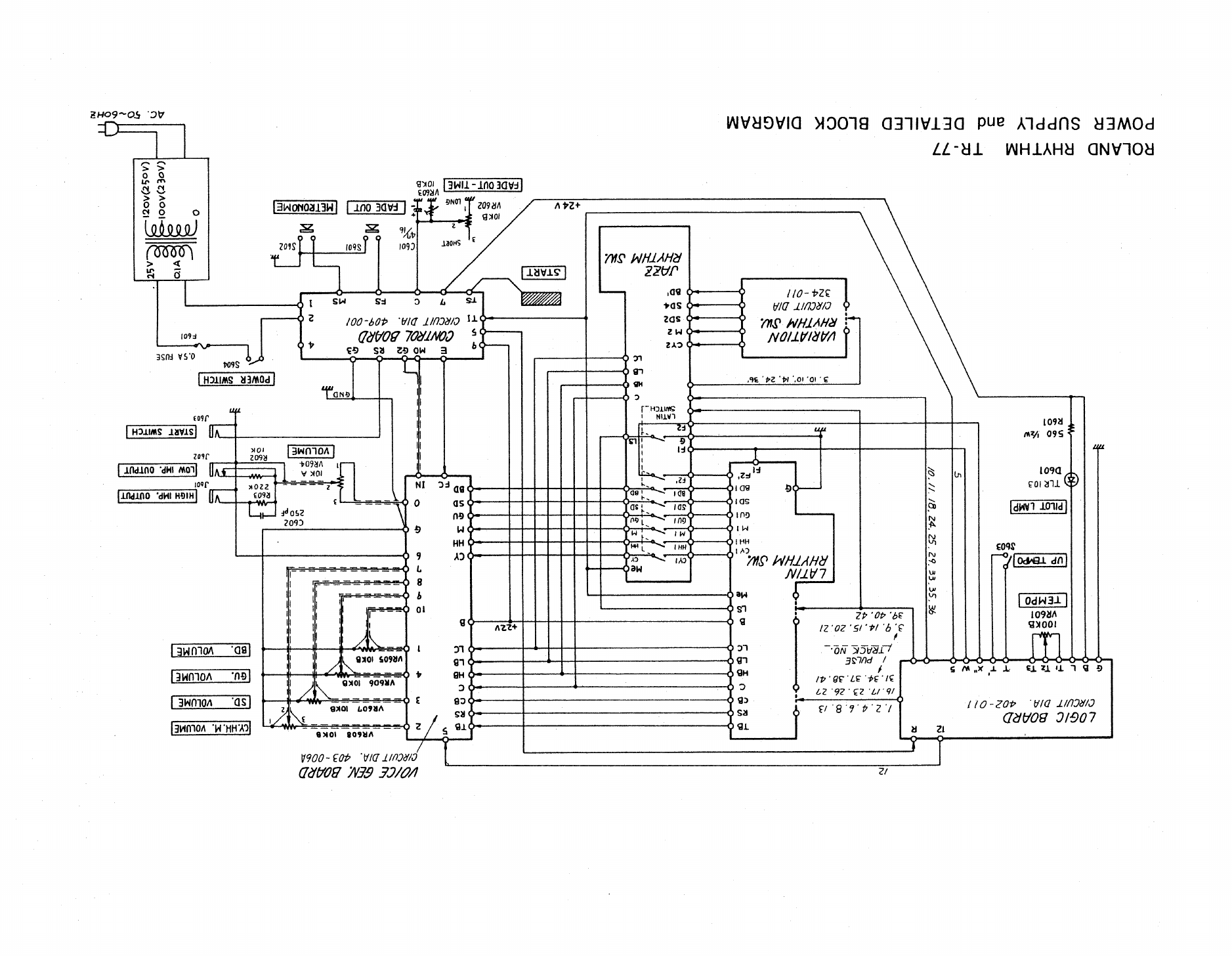
The 1976 service notes divide the Roland Rhythm 77 into four working systems: operation, selector, voice generator and preamplifier. Reading them in order reveals how a named preset becomes timed electrical events, separate percussion circuits and finally one line-level output.

TR-77 service-notes system block diagram from oscillator and selector to voice generators and preamplifier
ROLAND TR-77 SERVICE NOTES // SYSTEM BLOCK DIAGRAM // 7TH EDITION, 1976PRIMARY TECHNICAL EVIDENCE
Read the circuit in depth +

Trace the complete instrument

1. Clock. A two-transistor multivibrator produces the master pulse. The tempo control changes its charge-and-discharge time. The UP TEMPO switch shortens that period, so the complete divider chain runs faster rather than merely changing one preset.

2. Bar position. Five transistor flip-flop stages divide the clock by two repeatedly. Together they describe 32 successive timing positions. A feedback path changes the count for three-beat rhythms, allowing waltz patterns to cycle through a different phrase length.

3. Selection. The coloured keys operate interlocked Jazz and Latin switch assemblies. Their diode matrices connect particular divider positions to particular voice trigger buses. The rhythm is a soldered map: every diode is permission for one voice to sound at one position.

4. Variation. The two-beat and four-beat circuits change the route through the preset material; they do not create a second recording. The player can combine keys because the selector logic gates compatible sections before the trigger buses reach the voices.

5. Starting. The touch plate is sensed by a small radio-frequency oscillator and detector. Touch changes the detected condition, a flip-flop changes state, and the rhythm begins or stops without the plate carrying the percussion audio.

6. Resonant drums. The bass drum, congas and bongos begin with a short trigger that excites a tuned network. The circuit rings briefly and loses energy, producing a decaying pitch. Component values set both the centre frequency and how quickly that ring disappears.

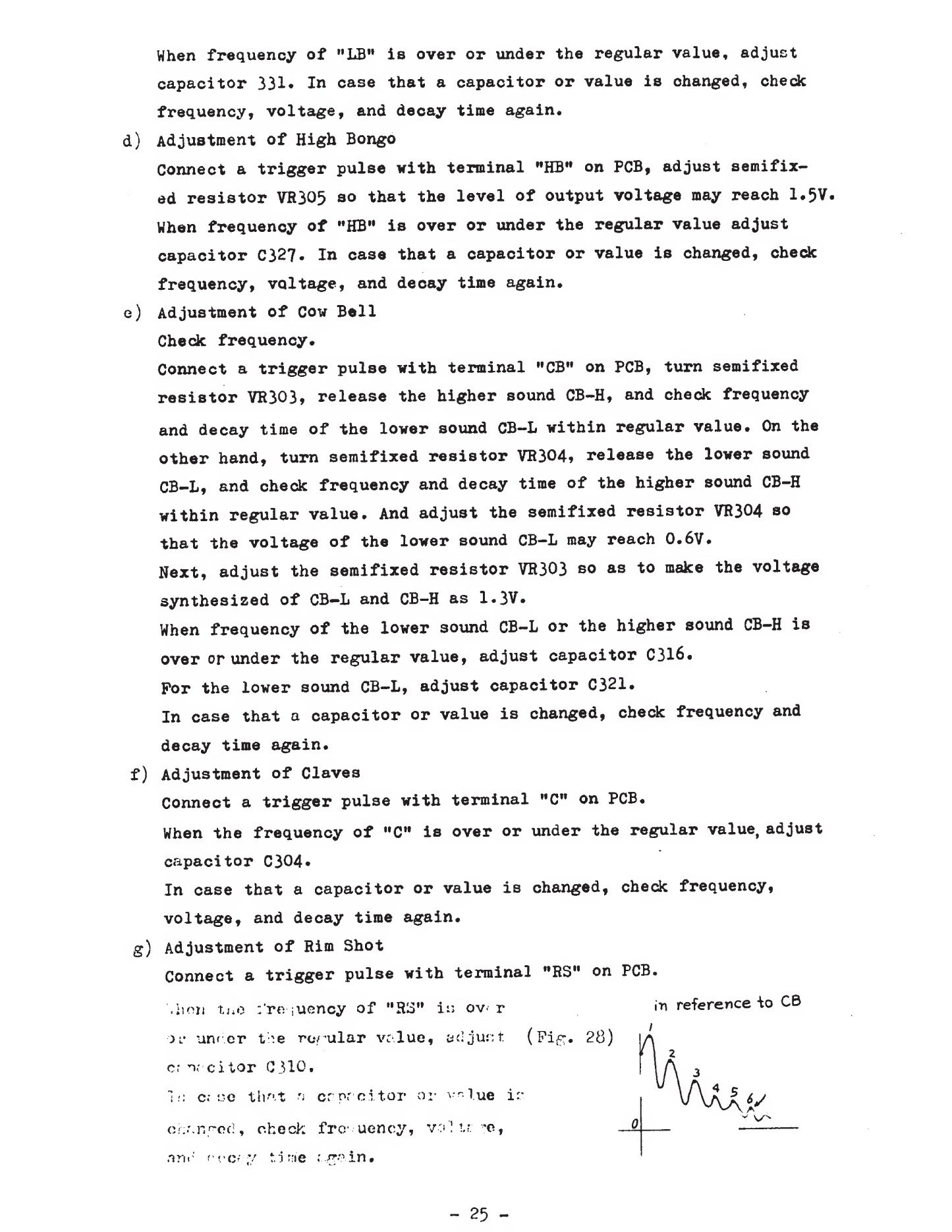
7. Cowbell and rim. The cowbell combines two oscillations near 984 and 1176 hertz before shaping their envelope. Rim and claves use shorter, higher-pitched events: approximately 1175 hertz for the rim and 2350 hertz for claves in the service calibration table.

8. Noise percussion. A reverse-biased transistor supplies broadband noise. Filters and envelope networks cut different regions and durations from it for maracas, hi-hat, cymbal and tambourine. One noisy source can therefore become several distinct instruments.

9. Snare. A resonant body near 330 hertz is mixed with a shaped noise burst. The listener hears the pitched shell and the noisy wires as one event, although the circuit builds them by different methods.

10. Guiro. A dedicated multivibrator produces repeated short pulses, creating the scraped, ratcheting impression without a sample or mechanical surface.

11. Mix and fade. Voice groups are balanced at the front panel and summed through a three-stage preamplifier. The electronic fade circuit reduces that combined signal over roughly five to eight seconds in SHORT mode; LONG is approximately twice that duration.

12. Calibration. Roland specified frequency, envelope time and output level for individual voices. Those figures are not descriptions of a universal ideal; they are bench targets that let a technician distinguish intended character from a fault in one surviving machine.

Open the 1976 service notes ↗Open the 1975 operation manual ↗

PAGE 05 // 05 // SERVICE // CALIBRATION AND SURVIVAL

The manual turns character into measurable evidence

Roland's standard-output table records pitch, duration and level, giving restorers factory targets while leaving room for the audible differences between surviving instruments.

The service sequence begins outside the voices: verify power, oscillator, divider and selection. Once triggers are reaching the correct buses, frequency and envelope checks can distinguish a mistuned resonator, an exhausted noise envelope or a weak output stage.

Age changes capacitors, transistor behaviour, switch contacts and mechanical controls. A sympathetic repair restores stable operation and the relationships between voices; it does not need to erase every difference accumulated by a fifty-year-old instrument.

TR-77 service-note instructions for calibrating bongo, cowbell, claves and rim-shot voices
TR-77 SERVICE NOTES // VOICE CALIBRATION INSTRUCTIONS
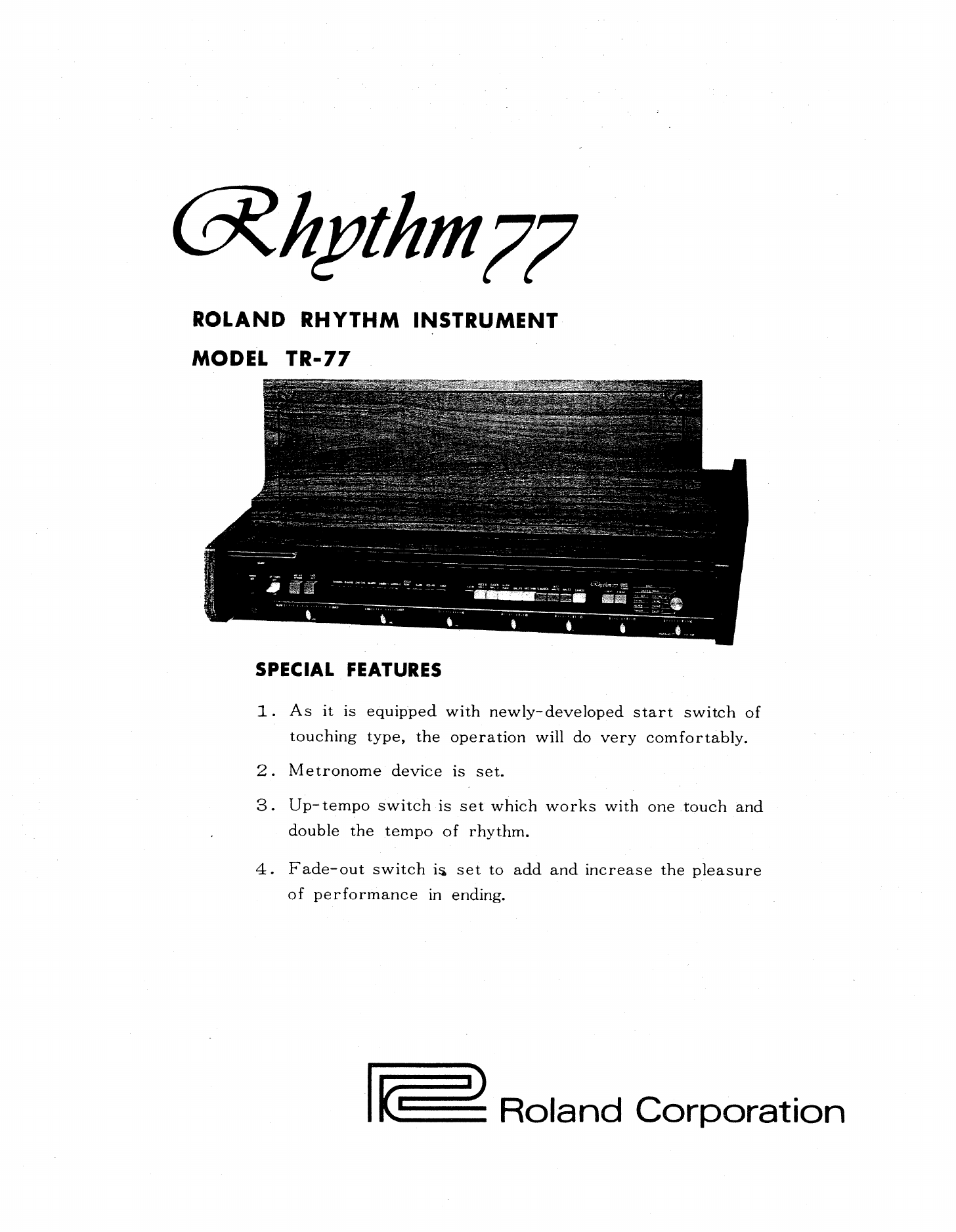
Cover of the Roland Rhythm 77 TR-77 operation manual
RHYTHM 77 // ORIGINAL OPERATION MANUAL COVER
Open the deeper story +

Bench route: do not tune before you diagnose

1. Prove the regulated supply and inspect grounding, connectors and switch contacts. An unstable supply can move several voice pitches at once and make individual adjustment misleading.

2. Measure the master oscillator and step through the divider outputs. Confirm that the three-beat feedback changes the count correctly and that UP TEMPO alters the clock rather than producing intermittent switching.

3. Select one simple pattern and confirm trigger pulses at the matrix outputs. If the wrong instrument fires, follow the switch and diode route before touching the voice board.

4. Measure each voice at its own test point or output. Compare centre frequency, envelope duration and amplitude with the standard-output table, listening alongside the measurement for distortion, double triggering or truncated decay.

5. Only after the individual voices are stable should the group sliders, preamplifier, impedance outputs and electronic fade be assessed. Record all replaced parts and before/after measurements so that restoration becomes part of the object's history.

Download the complete service notes ↗

PAGE 06 // 06 // MODIFICATION // ONE PLAYER'S MACHINE

The factory circuit becomes a stage instrument

Warren Cann's TR-77 shows how a player could extend a fixed rhythm box into a purpose-built stage instrument.

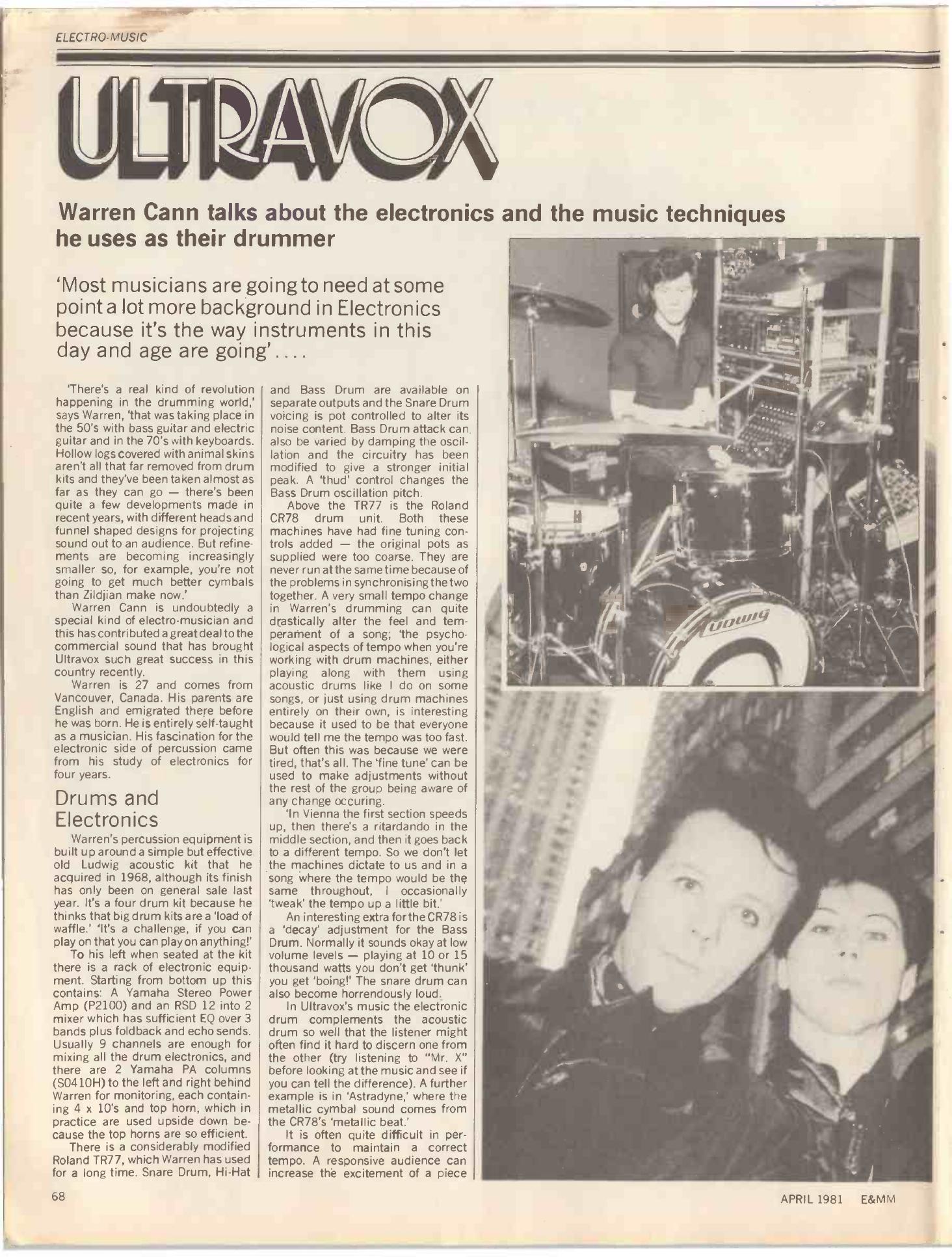
Electronics & Music Maker photographed Cann at his kit in 1981 and described the TR-77 at the centre of his electronic rack. Bass drum, snare and hi-hat had separate outputs. A front-panel control changed the snare's noise content; bass-drum damping and a stronger initial peak hardened its attack; a further control shifted the pitch of the bass-drum oscillation.

Tempo was treated as another performance parameter. Both the TR-77 and CR-78 received finer adjustment because the original controls were too coarse, but the two machines were not run together: they could not be synchronised reliably. Cann instead worked with the limits, recalling starting speeds numerically and making small changes when the song needed to lean forward or relax.

This is not a generic modification guide. It is the documented specification of one musician's working instrument—and evidence that the TR-77's history includes engineering decisions made after it left Roland's factory.

Page 68 of Electronics & Music Maker, April 1981, showing Warren Cann at his drum and electronic percussion system
ELECTRONICS & MUSIC MAKER // WARREN CANN'S ELECTRONIC PERCUSSION SYSTEM // APRIL 1981
Open the deeper story +

Factory TR-77 versus Cann's performance instrument

Factory signal path: thirteen voices are grouped by front-panel level controls and summed to one output. Cann's change: the three voices most likely to need individual stage treatment—bass drum, snare and hi-hat—leave on separate connections.

Factory sound controls: the player balances groups, but the voice circuits themselves remain internally adjusted. Cann's change: snare noise and several bass-drum behaviours become playable controls, turning service-level parameters into arrangement choices.

Factory start and tempo: a touch plate starts the rhythm and one slider sets the clock. Cann's change: a footswitch moves starting to the drummer's feet, a fine control makes small adjustments possible, and a numerical display makes rehearsal settings recoverable.

The period article also records the boundary: Cann's TR-77 and CR-78 were never run together because synchronising them was problematic. A modification should be described by what it demonstrably solved, not by projecting modern clocking onto the system.

Read the searchable period article ↗Open the complete April 1981 issue ↗

A DRUMMER REBUILDS THE PRESET BOX

Warren Cann made one TR-77 answer to the band.

Ultravox drummer Warren Cann did not accept the factory TR-77 as a finished proposition. A 1981 Electronics & Music Maker profile documents a working instrument altered for separate bass-drum, snare and hi-hat outputs, variable snare noise, a harder bass-drum attack, bass-drum pitch and finer tempo control.

The point was musical rather than decorative. Cann needed exact starting tempos, controllable sounds through a large PA and a start switch he could reach while drumming. The modified TR-77 became one element in a larger percussion system, played beside acoustic drums instead of asked to replace them.

Continue the story +

What changed—and why it mattered on stage

The stock machine sends all thirteen voices through one mixed output. Cann's three direct outputs let the bass drum, snare and hi-hat reach the mixer independently, where level, equalisation and effects could be set without changing the rest of the rhythm. The snare control altered the proportion of noise in its voice; the bass-drum modifications changed damping, initial impact and oscillation pitch.

The original tempo slider covered too much range for quick, precise recall. Cann separated rough and fine adjustment and used a numerical electronic readout as a repeatable reference. The displayed value was not beats per minute, but it let the band write down a setting in rehearsal and recover it at a performance.

A footswitch sat beside Cann's hi-hat pedal because the touch plate could misbehave in hot, humid venues. That practical detail explains the whole system: the TR-77 was adapted to a drummer's limbs, a loud stage and a song's changing feel. Cann described making small tempo adjustments by hand so the machine followed the performance instead of dictating it.

Read the 1981 Warren Cann profile ↗
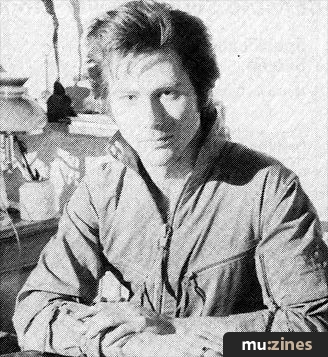
01WARREN CANN02JOHN FOXX03ULTRAVOX
Period portrait of Ultravox drummer Warren Cann
WARREN CANN // ELECTRONICS & MUSIC MAKER // PERIOD PORTRAIT

PAGE 07 // 07 // RECORDS // THE PRESET ESCAPES

A machine sold for accompaniment finds another life

The TR-77 becomes historically vivid when musicians expose its pulse, alter its operation and allow the electronic repetition to shape the whole arrangement.

John Foxx remembers that Ultravox first used a drum machine on “My Sex.” Brian Eno owned an early TR-77 and supplied the bass-drum pattern after an attempted recorded heartbeat failed. Foxx then bought his own machine, wrote “Hiroshima Mon Amour” with it at home and asked Warren Cann to operate it in the band.

Those two recordings show different roles. “My Sex” turns one repeated low pulse into atmosphere; “Hiroshima Mon Amour” leaves the electronic rhythm exposed as a frame around voice and saxophone. The machine is no longer furnishing accompaniment. It is organising emotional space.

Decades later, Rita Braga described using the TR-77 across Illegal Planet. “Spooky Mambo” began as a demo named for a rhythm printed on the machine; slowing the preset changed the music's apparent style and helped the provisional title become the song. Fixed labels supplied a beginning, not a limit.

OFFICIAL AUDIO // ISLAND RECORDS

Ultravox — My Sex

Listen to the low machine pulse as an alternative to the heartbeat the group first tried to record. John Foxx identifies this as Ultravox's first drum-machine use and connects the TR-77 to Brian Eno.

Listen on YouTube ↗
OFFICIAL AUDIO // ISLAND RECORDS

Ultravox — Hiroshima Mon Amour

Listen to the TR-77 as the exposed structural pulse: not an imitation drummer, but a deliberately electronic frame around the performance.

Listen on YouTube ↗
Open the deeper story +

Three ways to author music with a fixed machine

On “My Sex,” the useful fragment is not a complete preset arrangement but the bass-drum figure: one part of the rhythm machine becomes a designed pulse. On “Hiroshima Mon Amour,” machine and live drummer share the performance, and the unchanging electronic rhythm gives the song its withheld tension.

Braga's account describes another form of authorship: select a named Latin rhythm, slow it until the label no longer quite fits, and let that mismatch reshape the composition. The factory name remains visible, but the record decides what the pattern has become.

The TR-77 therefore survives as more than a list of users. Its documented records demonstrate selection, extraction, tempo, balance, modification and ensemble playing—the actual musical work that happens around an unwritable pattern.

Read John Foxx's participant account ↗Read Rita Braga's track-by-track account ↗

SOURCES AND FURTHER READING // TR-77

Continue through the original documents.

Owner’s manuals, service notes, period catalogues, contemporary press and first-hand accounts are identified by type so readers can follow the machine beyond this dossier.

R01

Roland Rhythm 77 operation manual

Primary December 1975 manual for controls, performance method, rhythm programme and specification evidence.

OPEN SOURCE ↗
R02

Roland TR-77 Service Notes, seventh edition

Primary November 1976 engineering source for system architecture, voice circuits, adjustments and standard outputs.

OPEN SOURCE ↗
R03

Roland TR-55 / TR-66 / TR-77 / TR-700 catalogue

Primary October 1977 catalogue placing the machine within Roland's early rhythm line.

OPEN SOURCE ↗
R04

Roland company history: 1972

Official chronology identifying the TR-33, TR-55 and TR-77 as Roland's first products.

OPEN SOURCE ↗
R05

Roland Drum Machine Chronicle: 1964–2016

Official account connecting the TR-77 to the Ace Tone Rhythm Ace lineage.

OPEN SOURCE ↗
R06

Episodes of the Mid-O Series

First-person engineering history from the RC-808 project recounting Don Lewis’s modified Ace Tone unit and meeting with Kakehashi.

OPEN SOURCE ↗
R07

Remembering Don Lewis

NAMM history of Lewis, LEO and his artist-engineer collaboration with Kakehashi.

OPEN SOURCE ↗
R08

John Foxx interview

Participant account of writing “Hiroshima Mon Amour” with the TR-77 and Warren Cann operating it.

OPEN SOURCE ↗
R09

Warren Cann interview

Participant account of the modified TR-77, tempo controls and its use with Ultravox.

OPEN SOURCE ↗
R10

Electronics & Music Maker: Warren Cann

Complete April 1981 issue containing the period technical profile of Cann's rhythm-machine practice and modified TR-77.

OPEN SOURCE ↗
R11

Ultravox — Hiroshima Mon Amour

Official recording used alongside the participant accounts.

OPEN SOURCE ↗
R12

Sorkin / Ace Tone Rhythm Ace advertisement

Period distributor advertisement showing the pre-Roland product language.

OPEN SOURCE ↗
R13

Roland Electronic Musical Instruments Vol. 1

Primary March 1977 general catalogue with a dedicated colour TR-77 entry, ¥79,000 price, controls, dimensions, weight and complete listed rhythm set.

OPEN SOURCE ↗
R14

Electronics & Music Maker: Warren Cann

Searchable transcription of the April 1981 period profile documenting Cann's modified TR-77, individual outputs, voice controls, tempo system and performance practice.

OPEN SOURCE ↗
R15

Ultravox — My Sex

Official recording paired with John Foxx's participant account of Ultravox's first drum-machine use and Brian Eno's early TR-77.

OPEN SOURCE ↗
R16

Rita Braga: Illegal Planet track by track

Artist account identifying the TR-77 across the album and explaining how its slowed preset became “Spooky Mambo.”

OPEN SOURCE ↗

PASS THE FILE ON // CANONICAL TRANSMISSION

SHARE THE ROLAND RHYTHM 77 (TR-77).

Send readers directly to this machine file on Drum Machines Have No Soul.

drummachineshavenosoul.com/machines/tr-77

THE MACHINE LINE // 01 OF 12

FOLLOW THE CHANGE.

Each machine inherits a working idea and moves one musical decision. Continue through the family by what the player can do—not by model number alone.