 THE ELECTRONIC RHYTHM ARCHIVEDRUM MACHINES HAVE NO SOUL
ROLAND / JAPAN / 1978
PRESET RHYTHM / LIVE ARRANGEMENT
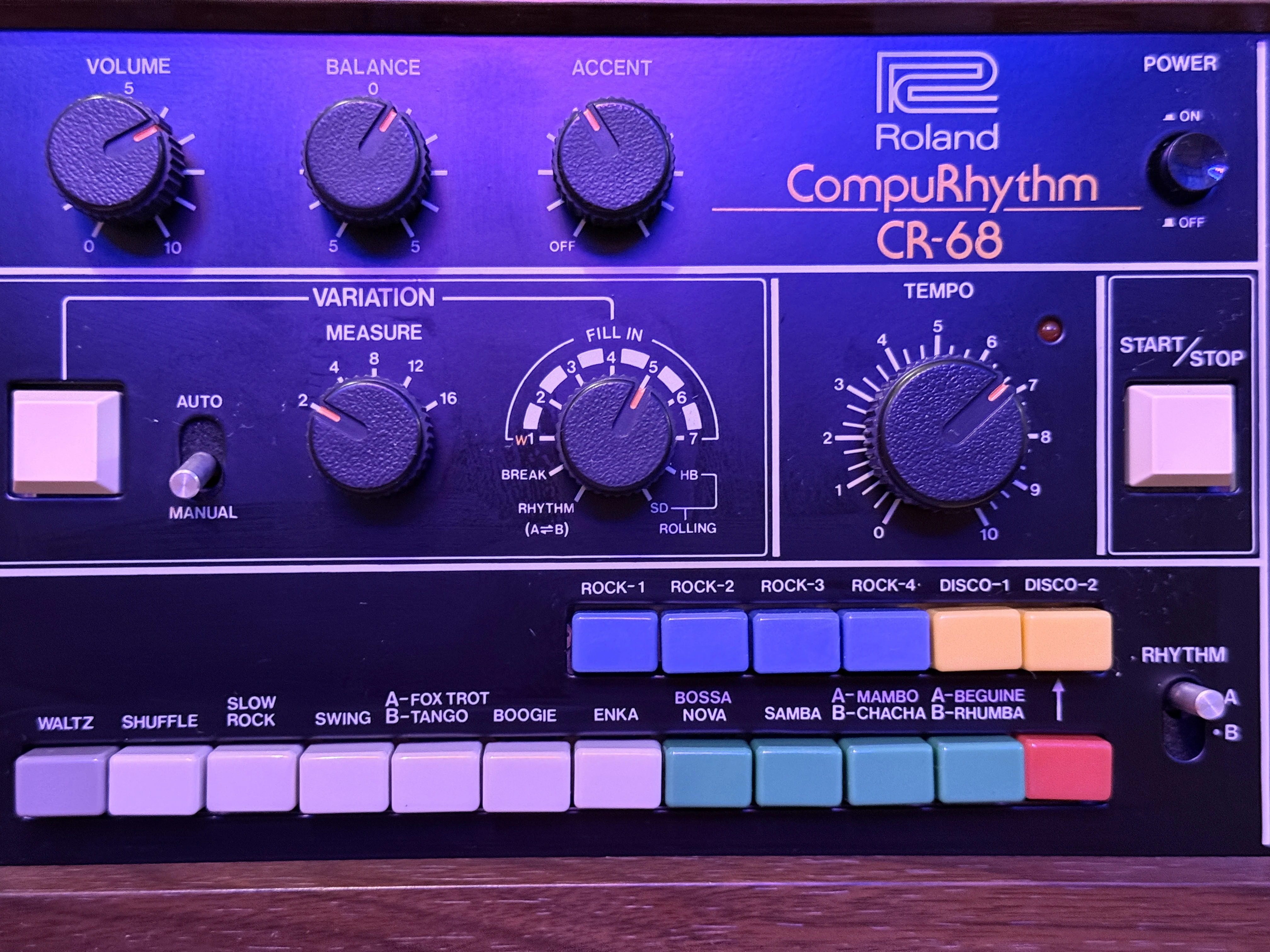
CR–68
A rhythm ready.
A phrase still open.
01 / ROLAND / COMPURHYTHM
The beat is prepared.
The performance is not.
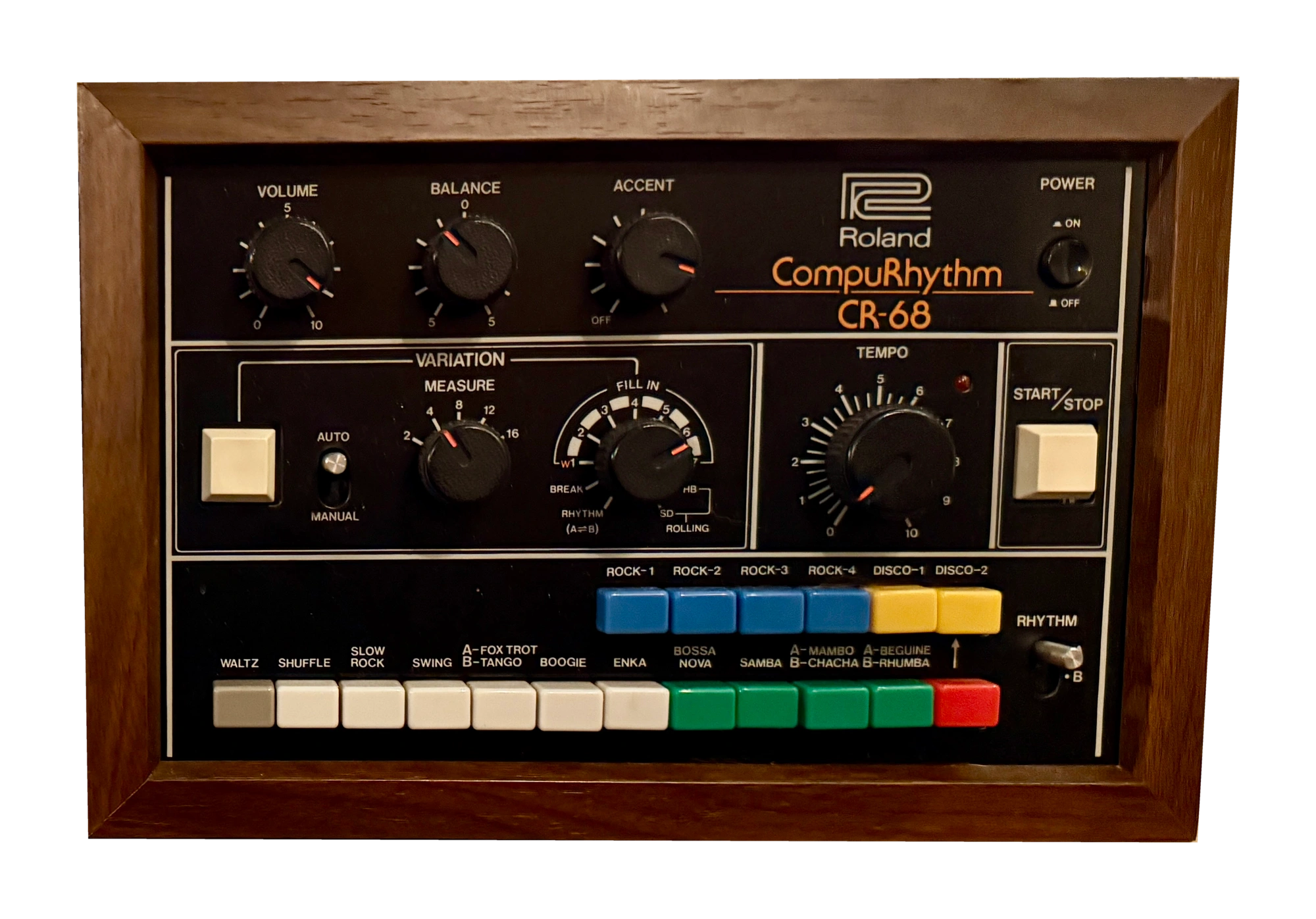
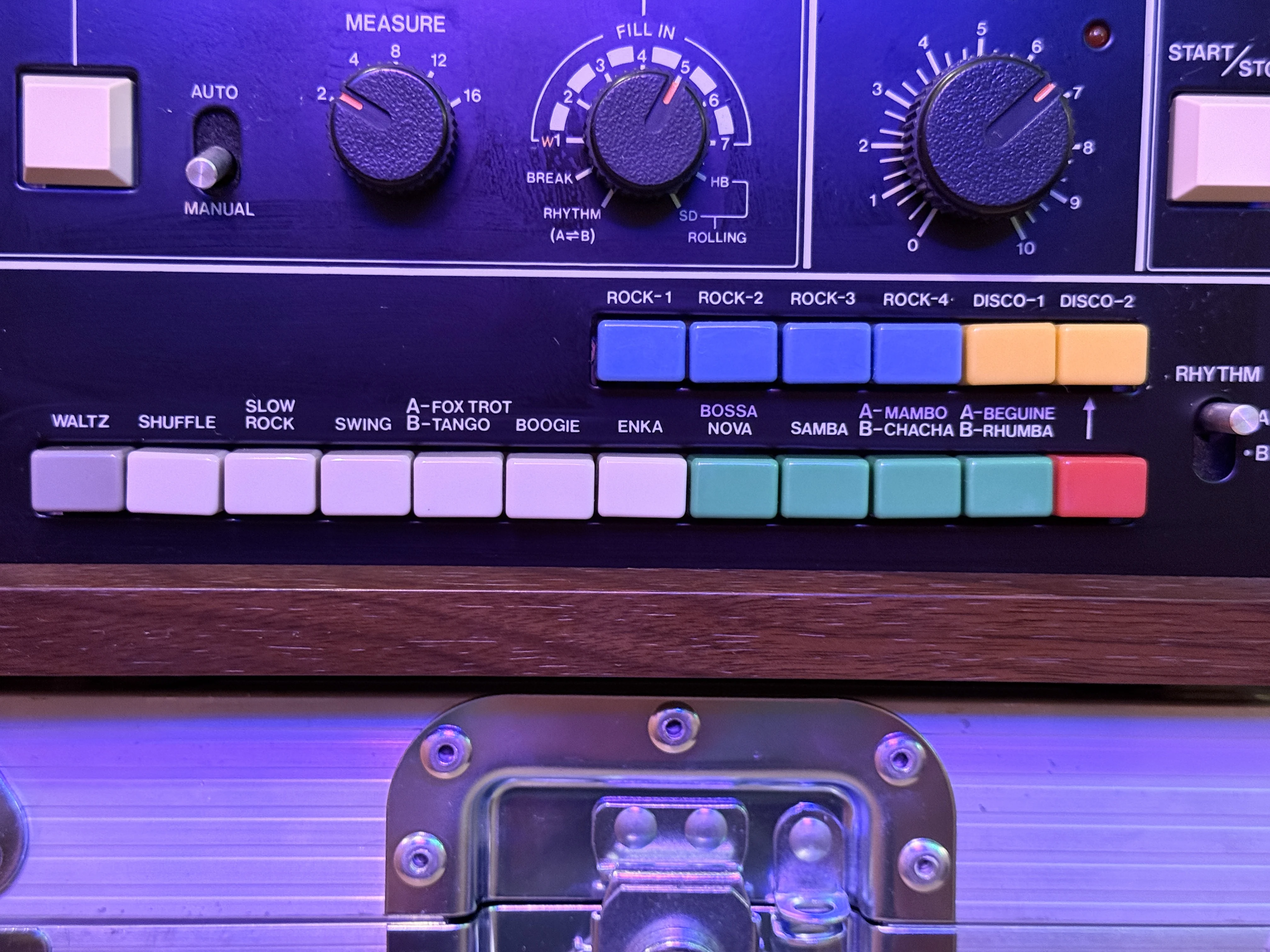
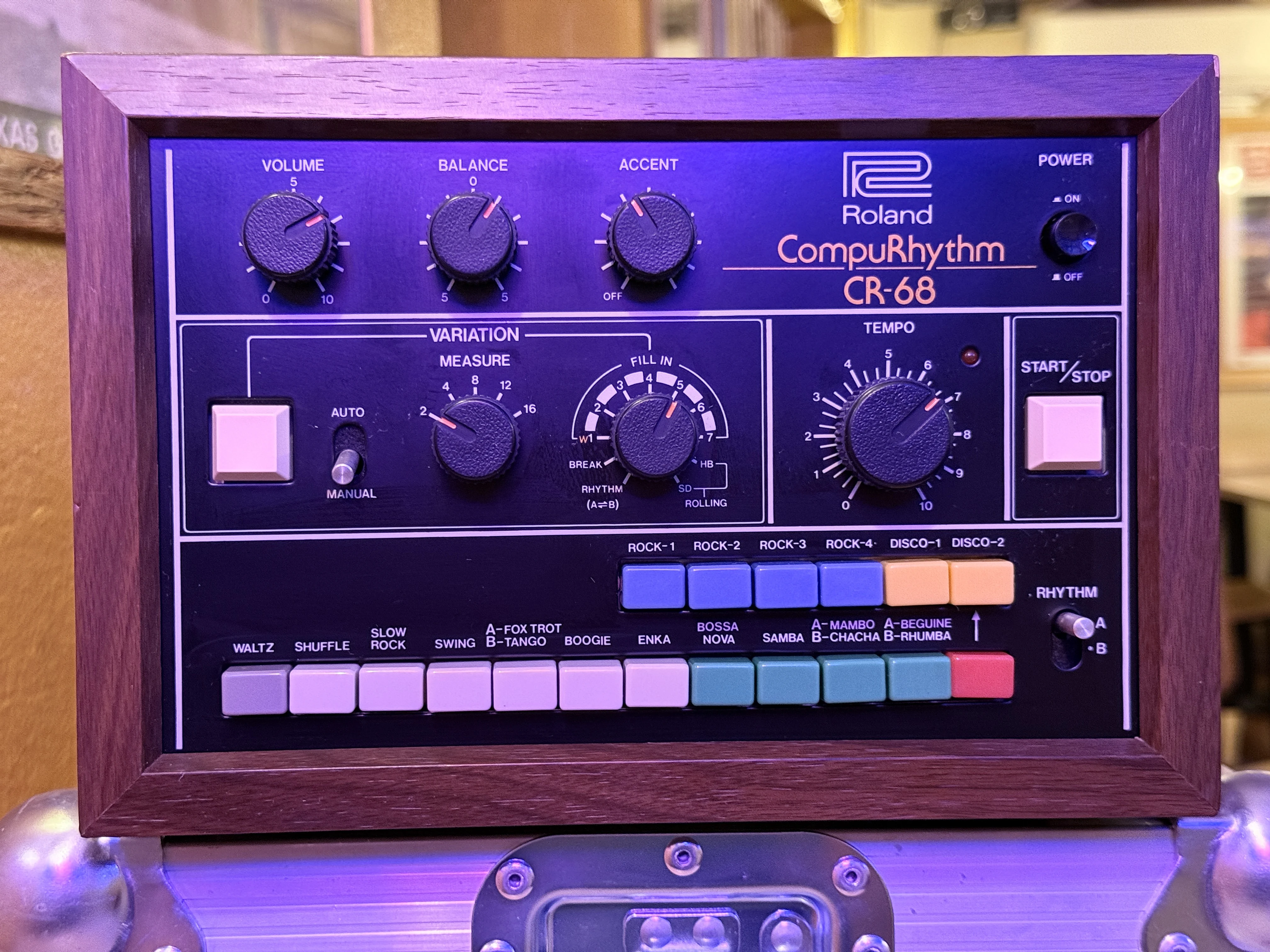
The CR-68 begins with a decision already made. Push a coloured key and a rhythm is waiting. There is no empty pattern to fill, no recording pass to complete before the drummer can start. The work moves elsewhere: into the combination, the balance, the moment a variation arrives and the music played against it.
Roland offered two answers to that working method in 1978. The CR-68 and CR-78 shared the CompuRhythm name, wooden cases, analogue percussion and computer-managed factory rhythms. The wider CR-78 added the means to write and retain four original patterns. The CR-68 concentrated on the prepared rhythm and the controls that could redirect it during a performance.
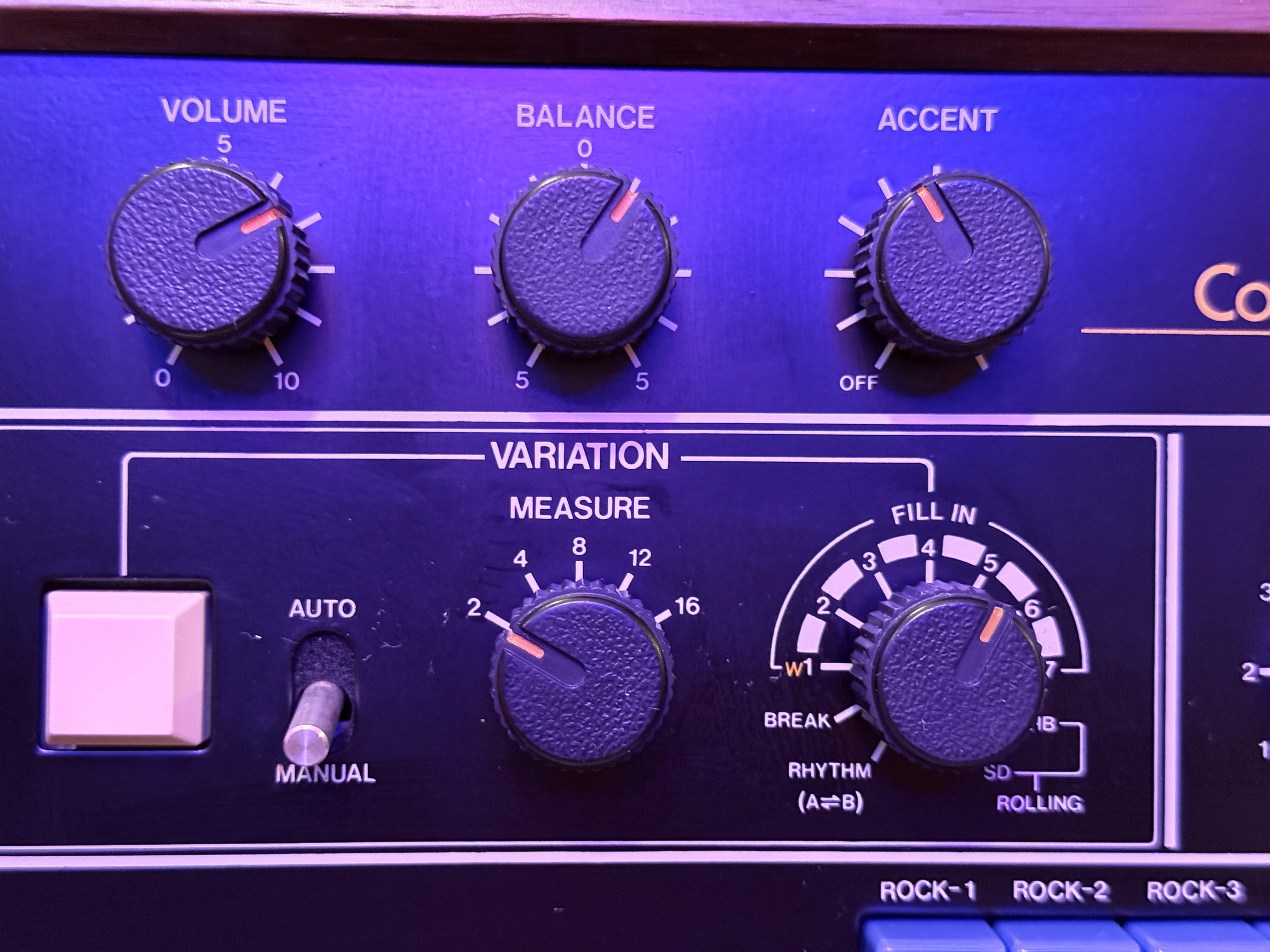
The October 1978 Japanese catalogue put the pair beside one another at ¥62,000 and ¥105,000. Roland’s January 1979 US price list gave $495 and $795. Those are dated market snapshots, but both show the same distinction: keeping the factory arrangement was a substantially less expensive route into the new rhythm system.
That difference does not divide home entertainment from serious music. Both instruments could rehearse a part, keep a recording moving or accompany a performance. The smaller machine left the writing of each strike inside Roland’s factory programme; its owner still had to decide what the whole rhythm would do.
02 / PERFORMANCE / THE CHANGE WAITS
Let the verse run.
Give the next bar a turn.
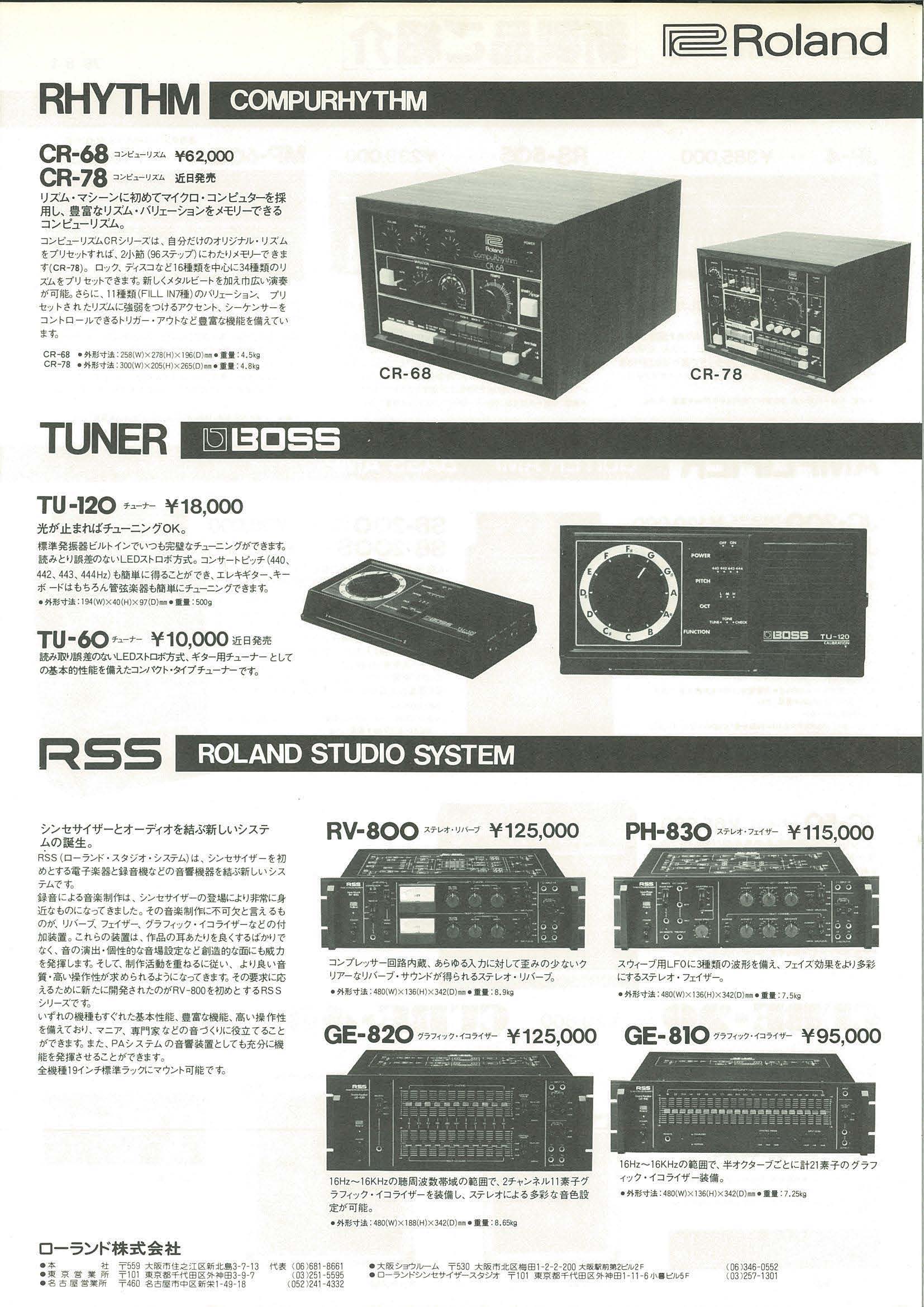
The arrangement controls make the CR-68 more than a box of repeating genres. Its Measure selector can schedule a variation every two, four, eight, twelve or sixteen bars. A twelve-bar form and a longer pop section need different punctuation; the panel leaves both within reach.
Seven Fill In settings offer prepared alternatives. Two Rolling positions bring high-bongo or snare figures into play. Break withdraws the rhythm, while Rhythm A/B changes to the companion bank for the variation. Addition, substitution and interruption are different musical actions; the selector puts them on one performance surface.
AUTO makes the selected gesture arrive in the last measure of the chosen cycle. MANUAL lets a hand or foot call it. The owner’s manual specifies the first beat of the following measure for that manual change, so a player can make the request before the boundary rather than land a switch at an exact instant.
The service circuit explains that courtesy. A latch holds the manual request until the controller reads it, then clears after the action. Human timing meets a musical boundary through a remembered electrical state: the organisation of one change within a continuing performance.
03 / PRINTED SCORE / CONTROLLED CORPUS
Follow one instrument.
Then hear the whole phrase.
Behind a style name is a score. The archive’s controlled set contains nineteen CR-68 score objects witnessed in Roland’s CR-68 and CR-78 documents. That is a selected source corpus, not a claim that all thirty-four factory rhythms have been transcribed.
Read a bass-drum lane first, then switch to the snare or upper percussion. Accent belongs to the control layer rather than an extra drum. Some diagrams occupy twelve positions, most sixteen, and Fox Trot and Tango retain thirty-two. The source grid stays with the pattern instead of being squeezed into a universal sixteen-key picture.
The physical panel can combine two rhythm selections. With three buttons held, the manual’s priority order decides which two take effect. That makes combination a bounded operation rather than permission to pile every style into a newly invented factory rhythm.
The phrase conductor schedules the documented Fill-In 1 score or calls it at a boundary. Its browser sound is an explanatory analogue sketch. Printed events, teaching synthesis and a recording of an actual machine remain different kinds of evidence, even when they describe the same musical idea.
PRINTED RHYTHM / SILENT SOURCE READER
Read one lane.
Keep the printed grid.
This reader selects from the 19 controlled CR-68 score objects: 373 sounded marks and 59 accent-control marks. It is a source view, not a replacement for the complete audible phrase laboratory below.
Rock 1 A // ACCENT // 4/4 // 16 printed positions
SWIPE OR USE ARROW KEYS TO READ EVERY STEP →
ACC12345678910111213141516
BIG BEAT PATTERN ARCHIVE // CR-68
Open the preset and read what the machine plays.
- Verified scores
- 19
- Pattern families
- 10
- Native grids
- 12–32
- Invented hits
- 0
ROLAND-CR68-001
Rock 1 A
4/4 // 16 native sixteenth-note positions
SWIPE OR USE ARROW KEYS TO READ EVERY STEP →
ACC
HH
SD
BD
CR-68 PHRASE CONDUCTOR // FACTORY-SCORE STUDY
Hear the fill arrive.
The CR-68’s decisive addition is time at the scale of a phrase. Choose a factory rhythm, schedule the documented Fill-In 1 score, or call it by hand. The browser sound is an explanatory analogue sketch; the event positions come from Roland’s printed scores.
Mode
SWIPE OR USE ARROW KEYS TO READ EVERY STEP →
PLAY12345678910111213141516
04 / CIRCUIT / ELEVEN VOICES
Eleven voices.
One percussion mix.
The computer decides when a sound begins. The sound itself comes from analogue circuits. Lower drums and hand percussion use short resonant events; brighter voices draw on shaped noise. Their pitches and durations are spaced so several instruments can remain distinct when they meet in the same output.
Roland’s service targets make that spacing concrete. Bass drum is checked at 62.5 Hz with a decay around 100 milliseconds. Low conga is higher at 208 Hz; the two bongos rise to 400 and 600 Hz with shorter decays. These are factory calibration relationships, not new measurements from the photographed collection unit.
Maracas, hi-hat, cymbal and snare share a noise source but receive different envelopes and spectral paths. A grain, a short tick and a longer wash can begin with the same irregular voltage. Voice identity emerges from the way that material is released and shaped.
Balance weights the percussion mix rather than supplying eleven independent faders. Accent gives designated events more force. Changing those relationships can move a rhythm beneath a guitar or keyboard without changing the event sequence the ROM is reading.
05 / REAR PANEL / AUDIO AND PULSE
Turn it around.
The rhythm leaves the cabinet.
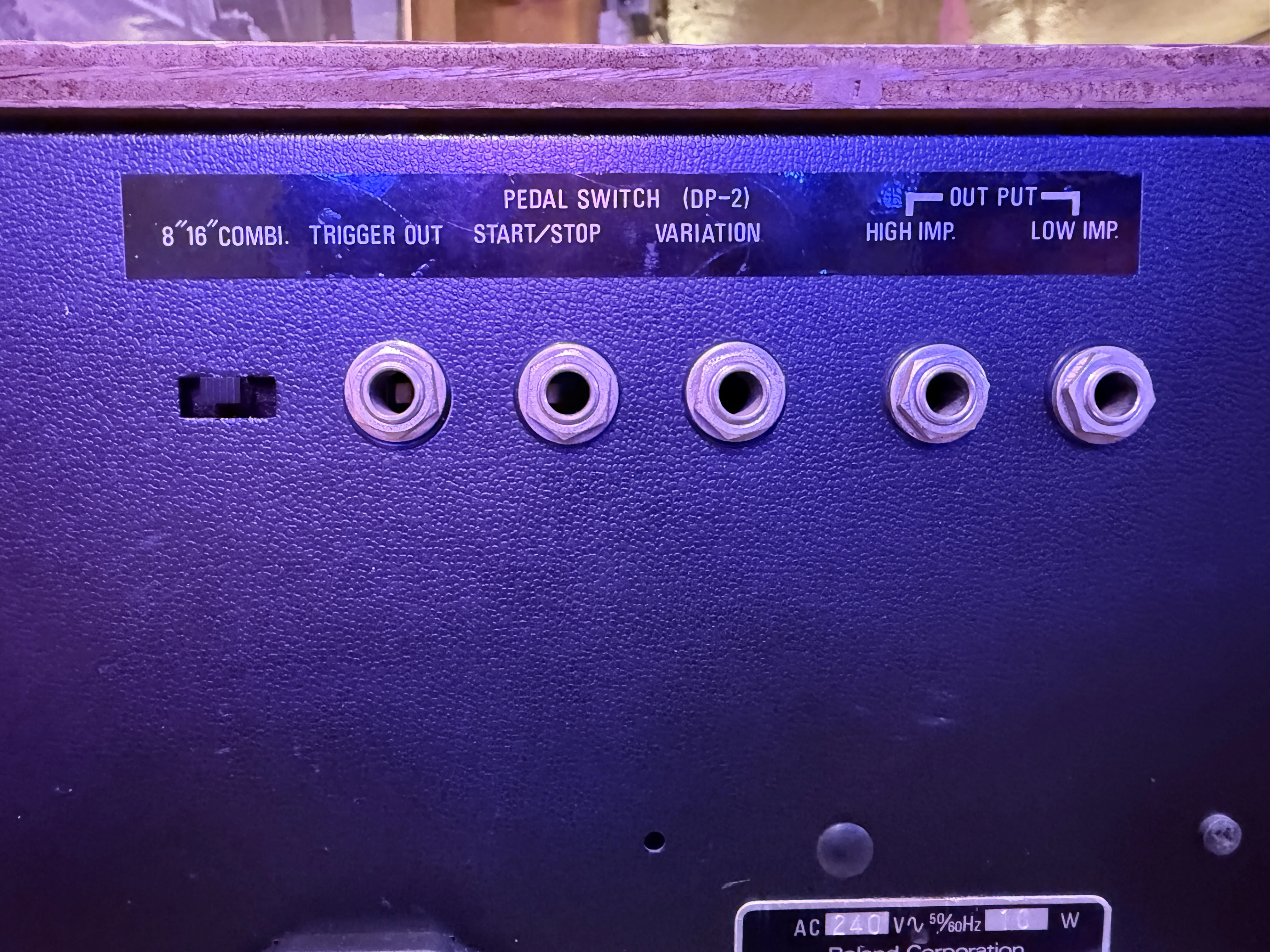
The rear panel separates three jobs. High Impedance and Low Impedance are connection choices for the same mixed audio. Two pedal sockets call start/stop and variation. Trigger Out carries timing to compatible external equipment; a cable from that socket is not a second percussion recording.
The neighbouring trigger selector matters. The manual offers eight pulses per measure, sixteen pulses per measure, or a combination following bass-drum, snare-drum and high-bongo events. The stock instrument therefore offers three modes, not just the combined one.
Roland’s operating illustration links the rhythm machine to a sequencer or Jupiter-4 as well as amplification. The box can establish a repeating control relationship while its audio goes elsewhere. The connected instrument has its own sound; the pulse tells it when to act.
A rear-panel socket can show what the stock machine permits. It cannot reconstruct how an undocumented modification was wired or allocate a band’s complete recording method to one output arrangement.
06 / MUSICIANS / MIXES AND LIMITS
One mixed output.
A studio asks for more.
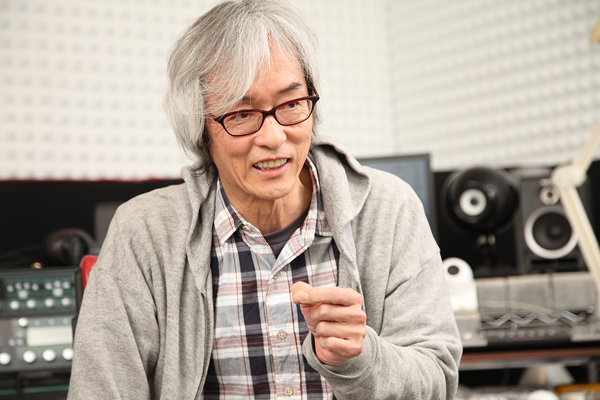
Masahide Sakuma joined Plastics in 1978, bringing programmed parts and keyboards into the group’s new-wave language. In his BARKS retrospective he recalled using both the CR-68 and CR-78 and the band’s close relationship with Roland. The machines were current working tools, not later props for a vintage aesthetic.
Sakuma wanted the CR-68’s kick and snare on separate recording tracks. The factory audio sockets could not provide that separation: both carried the percussion mix. He described building a sync box for the job, recording a musician finding a route around the product’s boundary without supplying a schematic that can be reconstructed today.
Separate tracks changed the decisions available after performance. A drum could have its own level, processing or absence in the arrangement. The preset machine was entering a recording method more flexible than its mixed output.
The testimony establishes group-level use and a specific studio problem. It does not assign every Plastics song to the CR-68 or distinguish all the parts played by the CR-78. Those particular decisions can remain particular.

07 / LATER / XIU XIU
Keep the preset.
Make the record around it.
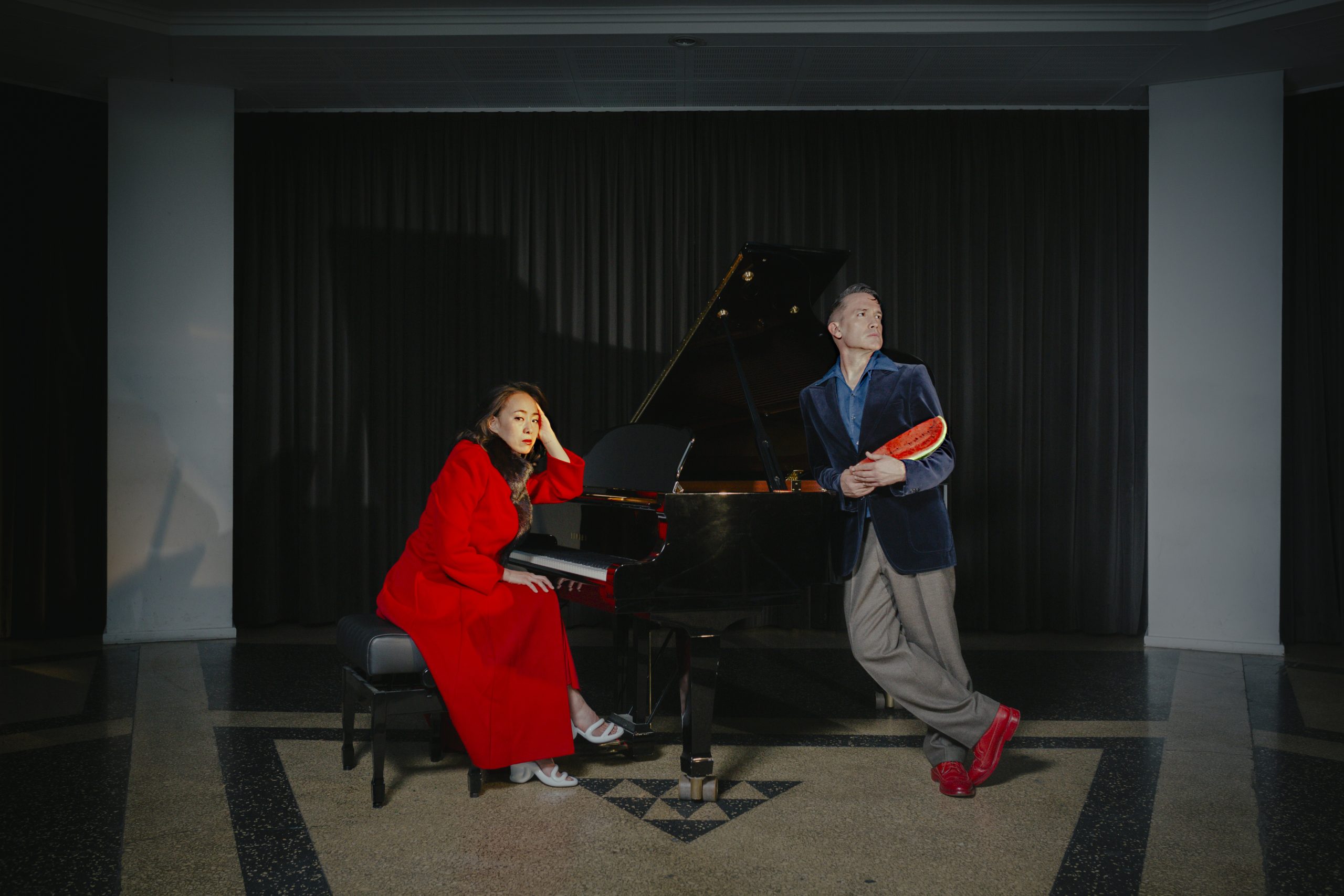
Jamie Stewart’s account of Xiu Xiu gives the machine another kind of agency. The CR-68 is a favourite because there is so little to programme. A fixed rhythm removes one set of decisions and makes the choices surrounding it more exposed.
Asked about “Pina, Coconut & Cherry” in Roland’s 2024 interview, Stewart places the CR-68 beside guitars, vintage organs and synthesizers, bass, bongos and sheet metal. The closing track of 13" Frank Beltrame Italian Stiletto with Bison Horn Grips brings the prepared rhythm into a mixed acoustic and electronic arrangement. His account identifies the track without assigning every drum part or processing decision.
Stewart also describes a small expansion and contraction in tempo. It is his account of the instrument in use, not a measurement of every surviving CR-68 or a claim that a teaching player reproduces its clock. Working against that behaviour is part of the attraction he describes.
A preset does not remove the musician. It supplies something the musician can accept, resist, process or place beside another performance. The same prepared rhythm can become a different musical proposition when the rest of the room changes.
08 / AFTERLIFE / THE PRESET REMAINS
The model moves on.
The method remains.
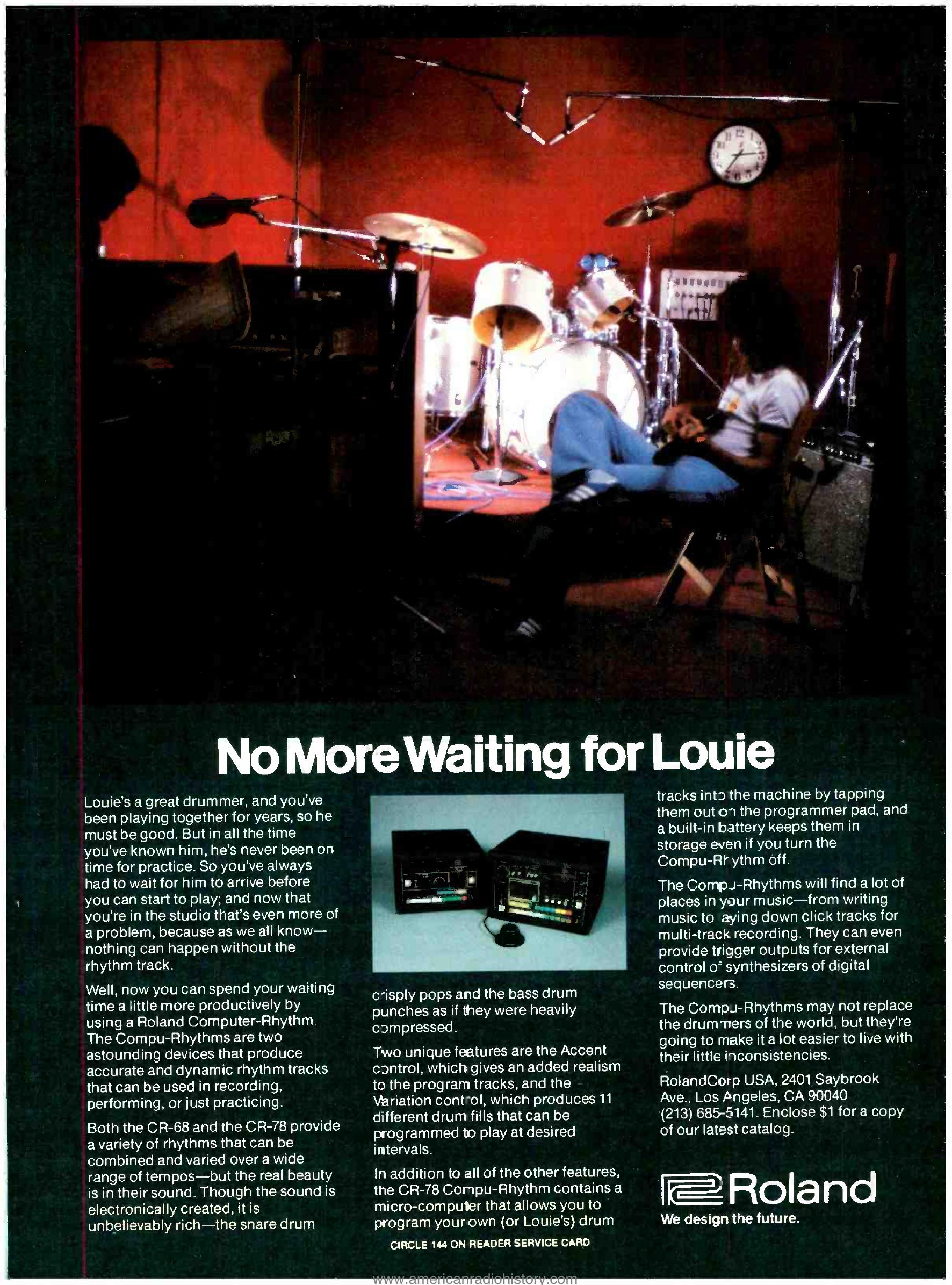
In its November 1979 advertisement, Roland placed both CompuRhythms beside a drum kit in a studio waiting for its drummer. Writing, click tracks, rehearsal and performance were all offered as uses. The scene is a staged sales argument, but it shows how the company wanted a musician to imagine the instrument at work.
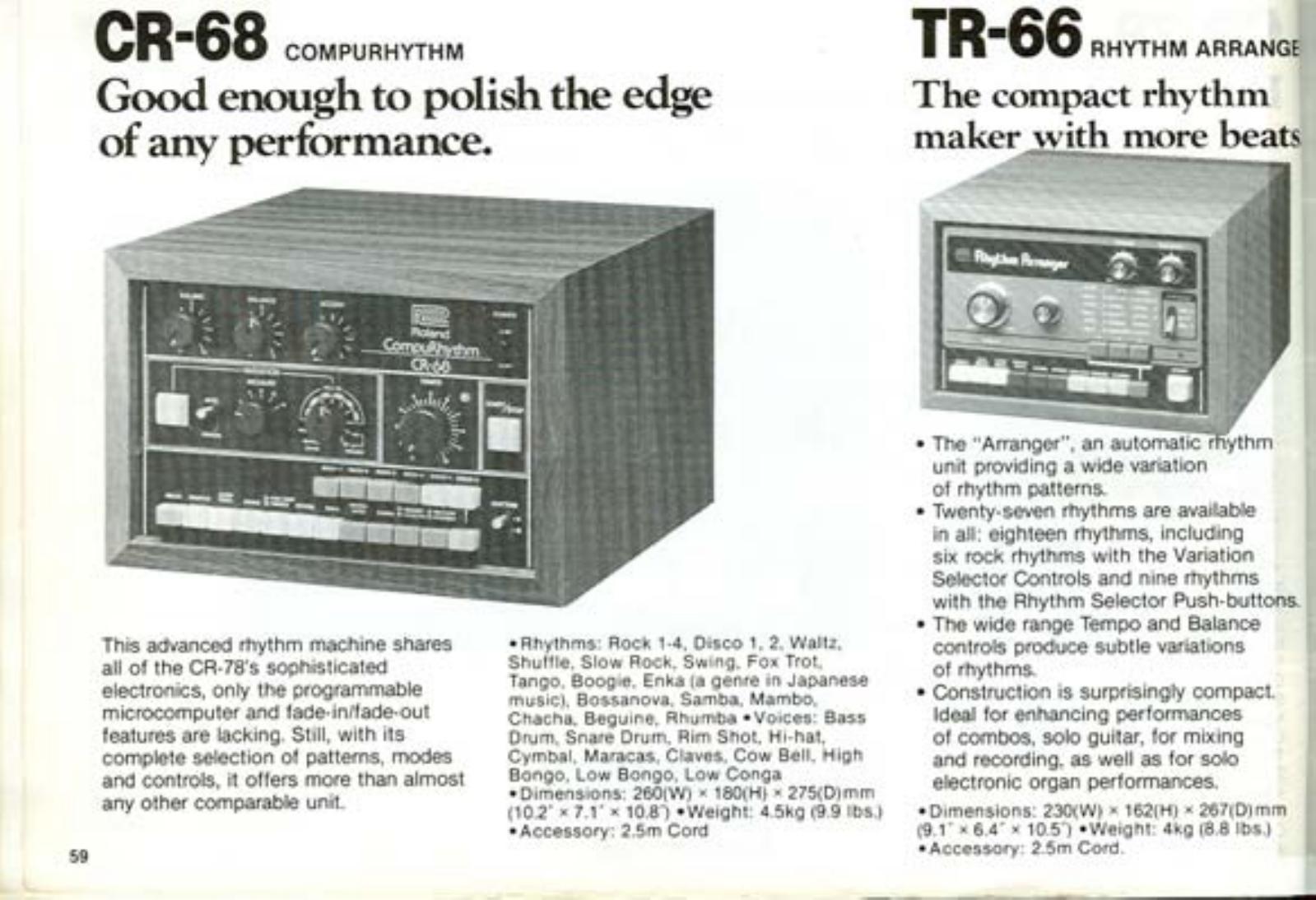
By 1981 the CR-68 still appeared beside the older TR-66 in Roland’s catalogue. The prepared rhythm had not been swept away by programming. Different levels of performance control remained on sale together.
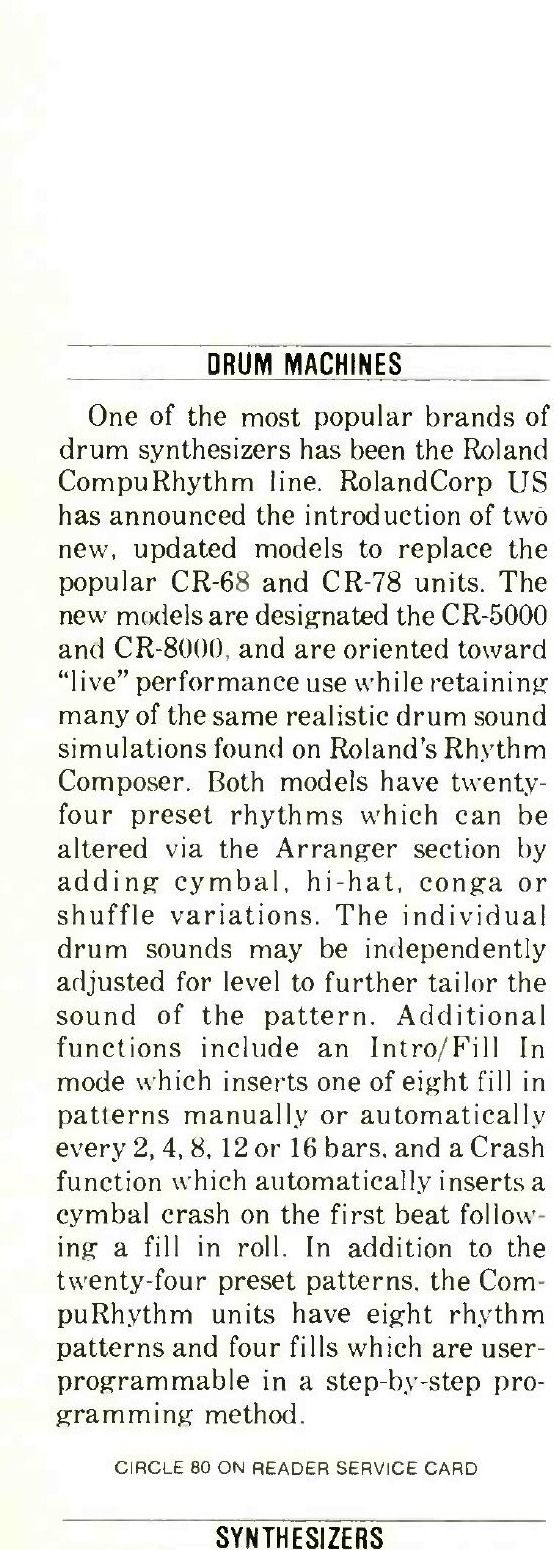
A September 1982 product-news notice described the CR-5000 and CR-8000 as replacements for the CR-68 and CR-78. The next generation expanded the arranger’s vocabulary, while later revivals chiefly carried the CR-78 name. The quieter sibling retained its identity in hardware and in the ways musicians continued to use it.
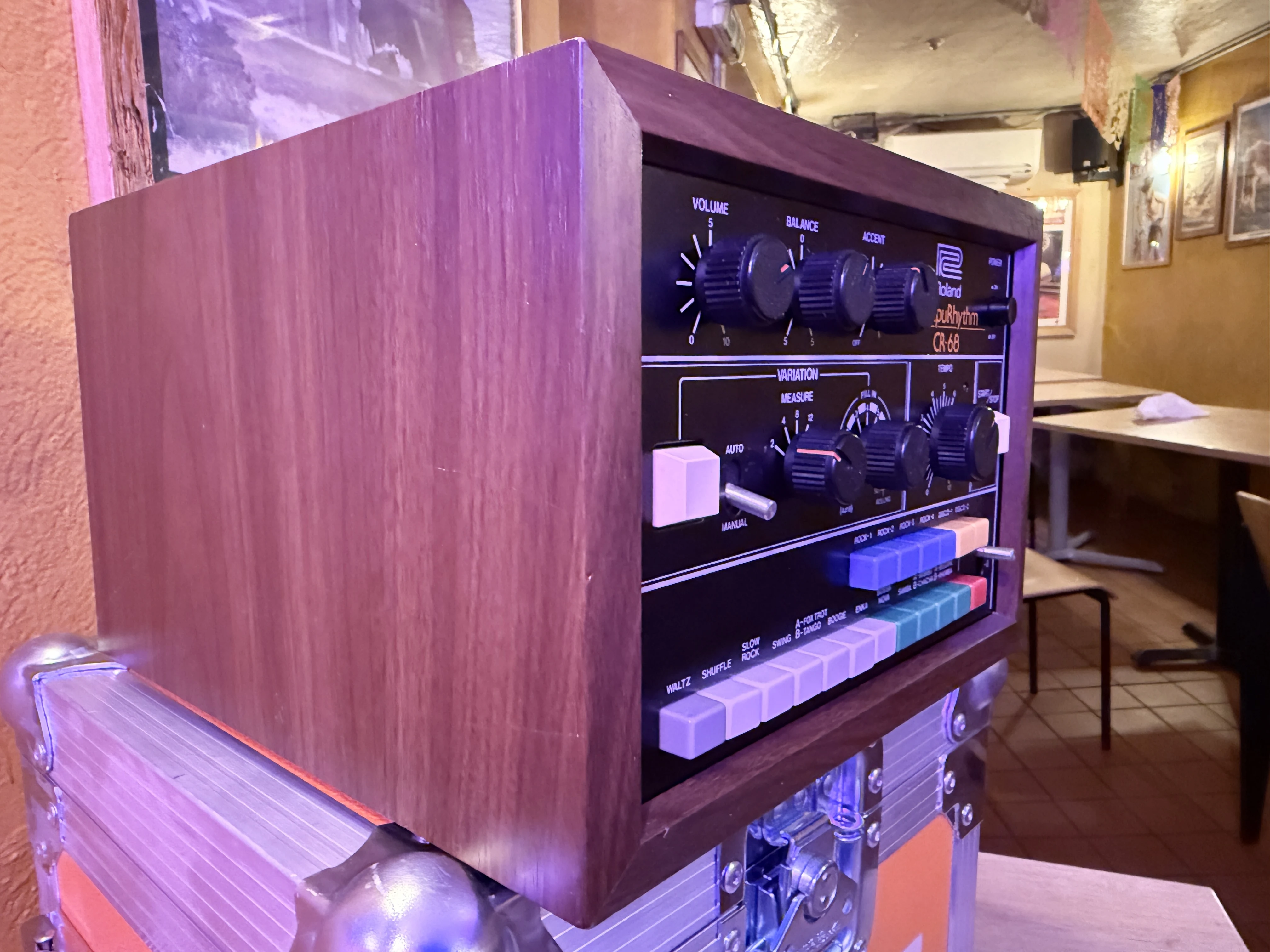
The wooden cabinet can make the CR-68 look settled. The controls tell a less settled story: a rhythm ready to start, a phrase waiting to change and a musician deciding what will happen around it.
09 / OBJECT / SYSTEM / PRINT
Keep looking.
Open the complete field guide, source desk and historical machine file +
BIG BEAT MACHINE FILE // 003
68
The preset branch stays alive
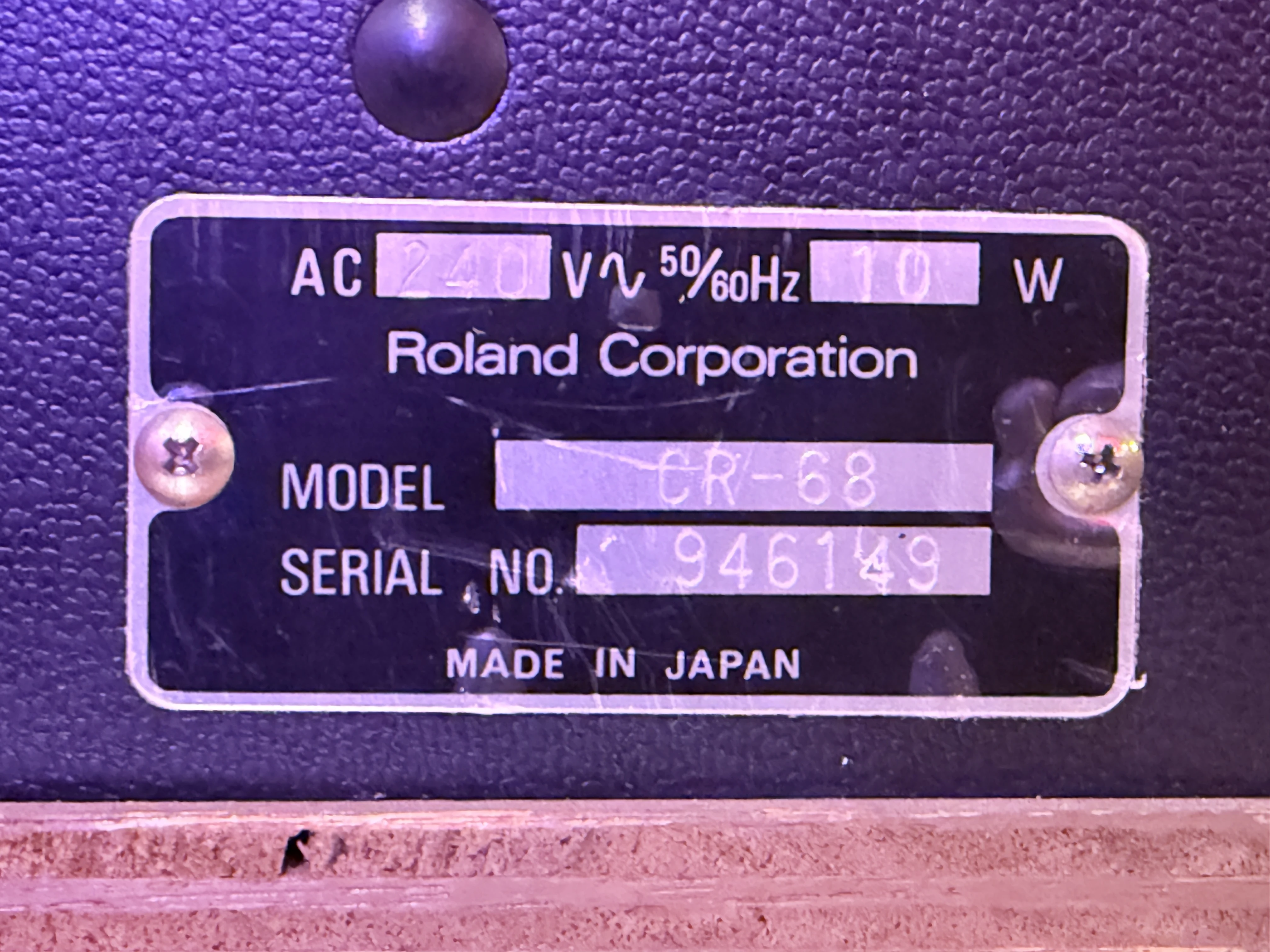
The Roland CompuRhythm CR-68 puts eleven analogue percussion voices under microcomputer control: the immediate, preset half of Roland’s first CompuRhythm pair.
PRODUCTIONFrom 1978
SOUND ENGINE11 analogue voices; microcomputer control
RHYTHM MEMORY34 ROM patterns; no user memory
More facts, listening references & sources
PERIOD PRICE¥62,000 in Roland's 1978 launch sheet
LINEAGE ADVANCEA microcomputer replaces the earlier divider-and-diode rhythm matrix while Roland retains immediate preset selection.
WHAT THE PLAYER GAINSAutomatic or manual fills, selectable fill phrases and two pattern variants let the player shape a larger phrase without programming a rhythm from scratch.
NOTABLE USERSXiu Xiu
START LISTENINGXiu Xiu — 13" Frank Beltrame Italian Stiletto with Bison Horn Grips
Sources for the artists and listening references
Artist accounts, historical attributions and performance films establish different things. These notes explain the basis for each reference.
- Xiu Xiu — participant interview. Jamie Stewart identifies CR-68 use on the discussed album project; does not certify every track. Read source for Xiu Xiu ↗
- Xiu Xiu — 13" Frank Beltrame Italian Stiletto with Bison Horn Grips — participant interview. Jamie Stewart identifies CR-68 use on the discussed album project; does not certify every track. Read source for Xiu Xiu — 13" Frank Beltrame Italian Stiletto with Bison Horn Grips ↗
PAGE 01 // ORIGIN // 1978
Two siblings, two ideas of control
The CR-68 and CR-78 share a family sound and physical language, but only one carries user memory.
Roland launched the CR-68 as the preset member of the new CompuRhythm pair. It retains coloured style buttons and wood casing while putting a microcomputer behind the panel to organise rhythm selection, fills and variation.
The model is sometimes treated as merely the cheaper CR-78. That misses its identity. With no programming ritual between the player and the beat, the CR-68 is an immediate arranger: choose a rhythm, add variation, cancel or rebalance voices, and play.
Open the deeper story +
The 1978 pair
Roland announced the CR-68 and CR-78 together on 1 August 1978. The October Japanese catalogue priced the CR-68 at ¥62,000 and the CR-78 at ¥105,000. In Roland’s January 1979 US list the same separation was $495 against $795. The preset model was therefore roughly two-fifths cheaper without being presented as a toy or a different class of sound source.
Both machines offered 34 factory rhythms, A/B choices, fills, rolling variations, break, accent and trigger output. Both used microcomputer control and analogue percussion. The CR-68 was the smaller machine—260 × 275 × 180 mm and 4.5 kg in its service notes—while the CR-78 was wider, heavier and carried the denser programmer panel.
The decisive difference was writable memory. The CR-78 could store four original rhythms entered with its WS-1 write switch and retain them through a rechargeable backup system. It also added fade controls and extra instrument functions. The CR-68 removed that whole programming and retention layer while preserving the immediate rhythm-arranger controls.
Roland’s catalogues place the two machines side by side in the same CompuRhythm range; they do not label the CR-68 as a home model and the CR-78 as a professional one. The visible distinction is simpler: the CR-68 cost less and omitted the CR-78’s write-and-retain system. It offered the same new family of analogue sounds and performance variations to players who did not need user memory.
That choice also reduced practical complexity. There was no write procedure to remember, no user pattern to protect and no backup battery whose failure could erase work or leak onto the board. Selecting a rhythm and pressing START produced the intended result immediately.
The cheaper sibling was therefore not simply an incomplete CR-78. It was Roland’s second answer to the same 1978 question: should a rhythm machine begin with a blank pattern, or should it begin with a useful arrangement that the player can redirect in real time?
Roland’s 1981 catalogue makes the lineage unusually visible by placing the CR-68 directly beside the older TR-66. The TR-66 is described as a compact rhythm maker; the CR-68 is offered as the more fully equipped performance machine. Roland was still selling both approaches together, but the newer model added a computer-managed phrase vocabulary rather than merely shrinking or replacing the preset box.
PAGE 02 // CONTROL // THE FILL ARRIVES
The machine can now shape the phrase
After the TR-66’s combined presets and simple variation, the CR-68 adds a real vocabulary of fills, rolls and breaks—called by hand or scheduled by measure.
This is the practical leap a TR-66 player notices first. The older machine can combine rhythms and switch between variation states, but the CR-68 can organise change across a whole phrase. Its MEASURE control schedules an event every 2, 4, 8, 12 or 16 bars, so repetition acquires punctuation without the player counting every cycle.
The event itself can take several forms. Seven FILL IN patterns substitute a prepared variation; ROLLING adds repeated high-bongo or snare figures; BREAK interrupts the rhythm; and RHYTHM A/B reverses the current pattern bank for the variation measure. These are different kinds of musical gesture, not eleven cosmetic versions of one fill.
Set the machine to AUTO and it performs the chosen gesture at the selected interval. Set it to MANUAL and the front-panel button or footswitch requests the change. Internal latch circuitry remembers a human button press until the next valid boundary, allowing the machine to finish the current bar cleanly.
For the Big Beat collection, this was the decisive difference after beginning with the TR-66. The constraints and immediacy remained familiar, but the CR-68 could now answer the shape of a performance: hold the groove, mark the end of a verse, roll into a chorus or create a deliberate hole before the band returned.
Open the deeper story +
Use every variation mode as an arrangement tool
Each coloured rhythm button addresses two factory patterns, selected by the A/B switch. Press two buttons together and the processor combines two patterns. If three are held, the manual’s priority order decides which two survive, so combination is structured rather than an unlimited pile-up.
Begin with one rhythm and listen to its density before adding anything. The BALANCE control does not crossfade between complete patterns; it changes the emphasis between lower percussion and brighter cymbal/hi-hat material. ACCENT changes the force of programmed accented events. Those two controls can make the same ROM pattern sit very differently beneath another instrument.
Automatic variation is counted in measures. The MEASURE selector can call a variation every 2, 4, 8, 12 or 16 bars, allowing the CR-68 to articulate a phrase without user memory. In MANUAL mode, the front-panel button or footswitch requests the variation; an internal latch holds that request until the processor reaches the correct measure boundary.
FILL IN offers seven stored alternatives. ROLLING adds repeated high-bongo or snare events, while BREAK substitutes a measure of interruption. The A/B variation position can also be reversed for the variation measure, so change can come from density, repeated percussion, silence or an alternate factory pattern.
FILL IN 1–7 should be auditioned against the selected base rhythm rather than treated as a ranked list. A fill that sounds crowded over Disco may provide exactly the right syncopation over a sparse ballad; another may preserve the bass-drum footing while changing only the upper percussion. The relationship is the feature.
ROLLING HB and ROLLING SD impose two very different kinds of energy. High bongo occupies the upper-middle register and can lead into a section without imitating a conventional rock fill. Snare roll is more declarative and can dominate the mono output, so its usefulness depends strongly on ACCENT and BALANCE.
BREAK is arrangement by subtraction. Because the CR-68 normally supplies an unbroken grid, withdrawing that grid for a measure can produce more drama than adding further percussion. A band can sustain through the gap, stop with the machine or use the empty bar to expose a pickup into the next section.
RHYTHM A/B makes the variation measure borrow the partner pattern behind the same front-panel selection. This keeps the genre family stable while changing its internal event map. It is often the least conspicuous option and therefore one of the most useful for long performances.
The 12-measure interval is especially revealing. It is not a conventional power-of-two phrase length, and it lets the arranger support blues-derived or asymmetrical forms without a player manually calling every turn. The 16-measure position suits longer pop sections; 2 and 4 measures make the machine noticeably busier.
The processor reads control settings at the measure boundary after START. This is why a well-timed request feels orderly rather than chopping the current bar in half: the player asks for a change and the control logic places it into the next valid musical position.
TRIGGER OUT carries a +15 V pulse derived from the combined bass-drum, snare-drum and high-bongo timing. It can coordinate a compatible sequencer or synthesizer, but it is not MIDI and it is not a neutral metronome output. The receiving device must tolerate the voltage and will follow the rhythmic pulse selected by the machine.
A practical arrangement might begin with a sparse A pattern, introduce a second button for the chorus, use an eight-measure fill cycle, call BREAK by foot for the bridge and rebalance toward high percussion for the final section. None of those decisions is stored, which makes the performance itself the missing memory layer.
That is the user-facing lineage from TR-66 to CR-68: the first machine lets a player choose and combine the groove; the second can also negotiate musical form. It does not yet remember a new beat like the CR-78, but it can behave differently at the boundary between one phrase and the next.
Read Roland's CR-68 operating instructions ↗PAGE 03 // SOUND // ANALOGUE
Eleven voices, two ways of making a drum
Tuned circuits supply body; filtered noise supplies grain. Short envelopes make both read as percussion.
A trigger briefly disturbs a tuned circuit to make bass drum, conga or bongo ring. The pitch tells the ear how large the imagined drum is; the decay determines whether it feels tight or resonant. Cowbell, rim shot and claves use brighter fixed frequencies to cut through the mix.
Maracas, hi-hat, cymbal and snare begin with a noise transistor. Filters and envelopes carve that broad hiss into different colours and lengths. The snare adds a short noisy body; the cymbal is allowed to remain much longer than the hi-hat.
The voices do not leave the board independently. They are grouped through shared level adjustments, accent and the front-panel balance network before reaching the output amplifier. That economy is part of the instrument: eleven identities are created with relatively few generators and a carefully ordered mix.
The service notes turn those identities into measurable relationships. Bass drum sits at 62.5 Hz and lasts about 100 ms; conga and bongos climb through 208, 400 and 600 Hz while their envelopes shorten. Bright percussion is separated less by musical pitch than by spectrum and duration.
The result is not a recording of a kit. It is a carefully spaced set of pitches, bursts and decays designed to stay distinct through one mono output. Open the circuit analysis for the measured relationships between the voices.
Listen first for contrast rather than realism: the low drum establishes weight, the hand drums divide the middle, and the short noisy voices draw the grid. That arrangement of frequency and time is the CR-68’s actual sound design.
Open the deeper story +
Inside the VG-12 voice board
The service documentation divides the CR-68 into three physical domains. GL-10 contains the µPD8048 computer and its scanning, decoding and variation logic. VG-12 contains the analogue percussion generators. RS-16A carries power-supply and output functions. Following those board boundaries prevents a control fault from being mistaken for a sound fault.
The bass drum is a triggered, damped oscillator adjusted by VR7 for a 62.5 Hz centre frequency and VR8 for a 100 ms decay. Its factory amplitude is checked separately. A trigger initiates the event; positive feedback sustains a short low-frequency ring; losses in the network make that ring collapse. Pitch, duration and level can therefore drift independently.
Low conga, low bongo and high bongo repeat the resonant principle at progressively higher frequencies. Roland specifies 208 Hz / 100 ms, 400 Hz / 40 ms and 600 Hz / 40 ms. The long, lower conga carries body; the two short bongos supply quicker punctuation. VR5/VR6, VR3/VR4 and VR1/VR2 separate frequency from decay for each voice.
Cowbell builds an intentionally non-acoustic metallic interval from two components around 800 and 555 Hz, adjusted independently at VR9 and VR10. Because the frequencies are not treated as a conventional musical chord and the envelope is short, the ear groups them as a struck object. A fault in either branch leaves a thinner, more obviously pitched remainder.
Rim shot and claves occupy the high resonant end of the board at approximately 1.48 and 2.63 kHz. Their very short events provide edges rather than bodies. The front-panel selection and shared trigger routing must be separated from the generators themselves during diagnosis: a missing label does not automatically mean its oscillator has failed.
A selected 2SC828 transistor operates as the noise source for maracas, hi-hat, cymbal and snare. Noise is a continuously irregular voltage containing a broad range of frequencies. Each voice filters and gates a different portion of it, which is far more economical than building four unrelated random sources.
Maracas uses the briefest noisy envelope, about 18 ms, so it reads as a dry grain. Hi-hat extends to roughly 50 ms. Cymbal lasts around 250 ms and exposes more of the metallic/noise spectrum. Snare occupies about 60 ms and shapes its noise to leave a stronger central attack rather than a wash.
VR11 and VR12 participate in shared amplitude setting across voice groups. This is why Roland’s check order matters: moving a common level control while examining one voice can change several voices that were already correct. Factory amplitude is a relationship across the mono mix, not eleven independent fader settings.
Accent changes the level of events designated by the pattern data. The balance network then weights low and high percussion before the main VOLUME control and the 220 kΩ high-impedance / 10 kΩ low-impedance outputs. A dull machine may therefore have healthy generators but a fault or loading problem later in the shared mix path.
For diagnosis, trace one event completely: confirm the processor issues its trigger, observe the pulse at the VG-12 input, inspect oscillation or noise after the generator, follow the envelope, then check the shared level and output stages. Only then compare its frequency, decay and amplitude with Roland’s table.
01020304050607080910111213141516
ONE PAGE, THE WHOLE MACHINE
Computer timing, analogue sound.
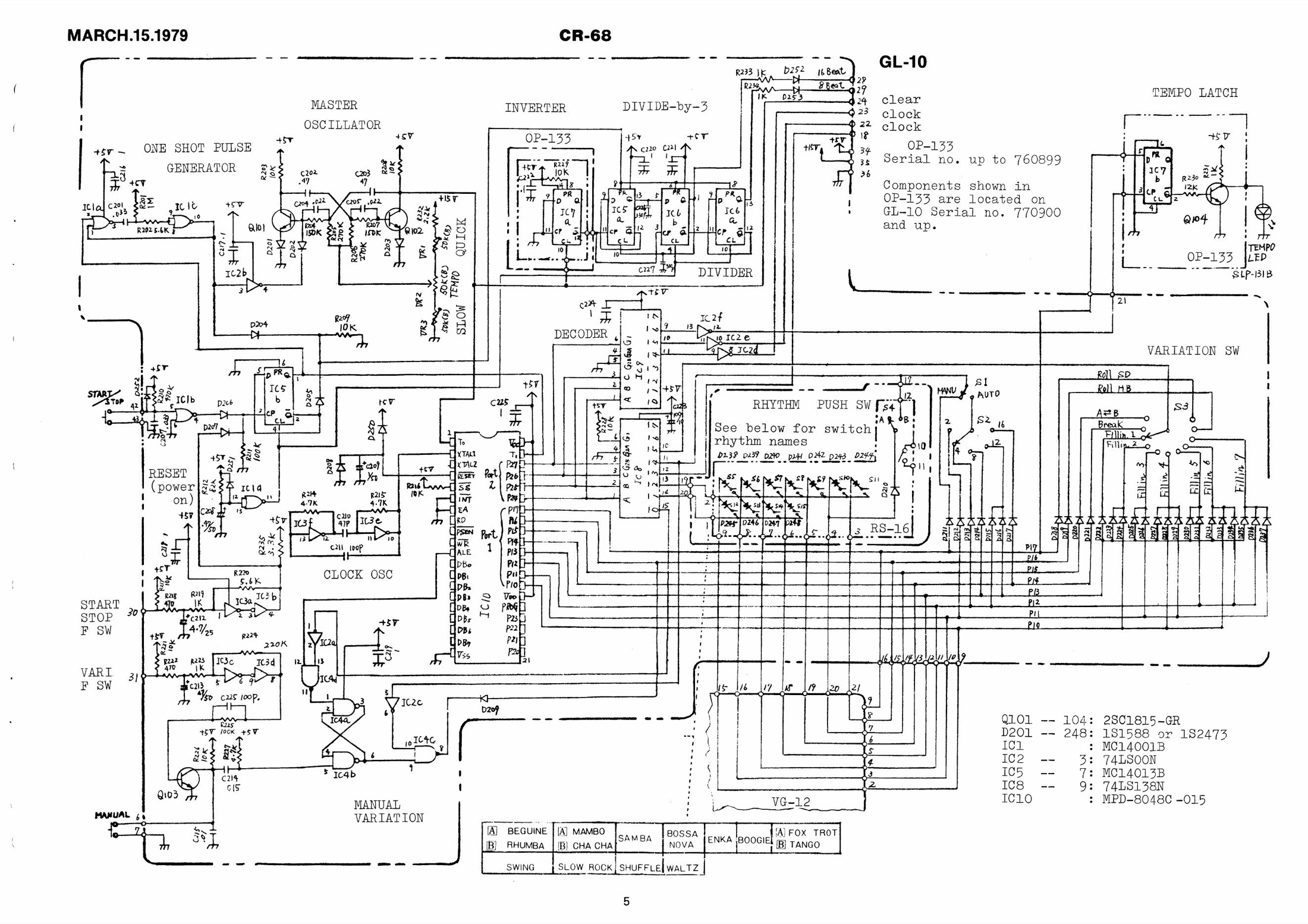
The master schematic separates the two halves of the instrument. A µPD8048 microcomputer reads the controls and issues rhythm triggers; eleven analogue voice circuits turn those instructions into drums, then meet at the balance and output stages.
Read the circuit in depth +
Follow one beat through the CR-68 schematic
The tempo oscillator supplies the musical clock, but the rhythm pattern is not wired as a diode matrix. Roland’s GL-10 control board carries a µPD8048C-015: an eight-bit microcomputer whose internal ROM contains the CR-68’s program and factory pattern data.
Inside that single chip are 1K × 8 bits of ROM, 64 × 8 bits of RAM, 27 input/output lines and an eight-bit timer/counter. The ROM is factory program storage rather than writable musical memory: it holds the logic and pattern information that make this particular processor revision a CR-68 controller.
While stopped, the processor scans the control panel continuously. Once START is pressed it reads the relevant settings once per measure, selects the corresponding rhythm data from ROM and sends trigger decisions through its output ports and decoder logic. Manual variation is briefly held in a flip-flop so a button press between scans is not lost.
Two 74LS138 decoder ICs expand the processor’s limited port lines into the control and instrument selections the machine needs. During a panel scan, one set of lines identifies which switch is closed; during playback, related lines are repurposed to distribute the stored pattern decisions toward the voices. The surrounding logic is therefore both an input scanner and an output router.
The MANUAL button cannot rely on the player pressing at the exact instant the processor scans it. IC4a and IC4b form an RS flip-flop that remembers the request. At the next valid measure decision the processor reads the held state, performs the variation and clears the latch. That small circuit is the bridge between untidy human timing and orderly machine phrasing.
A separate one-shot pulse generator shapes timing events into trigger pulses suitable for the analogue board. This matters because a processor logic level held high is not the same electrical event as the short pulse needed to excite a resonator or start a percussion envelope.
A trigger still contains timing rather than sound. On the VG-12 voice board it excites a tuned circuit or releases a shaped burst of noise. Those eleven analogue results pass through accent and balance circuitry before the high- and low-impedance outputs.
The service notes document an early and later implementation around serial number 770900, with parts formerly on OP-133 relocated to GL-10. A technician must identify the installed revision before tracing a board reference; the musical function remains the same even when the physical location changes.
That division makes fault-finding intelligible. One silent voice across every pattern suggests its generator or mix path; several wrong voices in one pattern suggest control data, switching or trigger distribution; unstable overall speed points back toward the tempo oscillator.
Open the factory CR-68 service notes ↗Open the factory CR-68 owner's manual ↗PAGE 04 // SERVICE // BENCH GUIDE
Eleven voices, checked one at a time
The service notes provide a test gate because the processor does not expose individual trigger pulses conveniently during calibration.
Begin by recording how the machine behaves before touching a trimmer: test every rhythm, both A and B banks, all fill modes, accent, balance, footswitch and both outputs. Then verify power and timing before treating a musical symptom as a failed voice.
The detailed procedure belongs behind the panel below. It is there for technicians and owners who need measured targets, while the main chapter remains readable without test equipment.
Open the deeper story +
Bench sequence and factory targets
Use the correct service notes for the serial revision and observe mains-isolation precautions. Record every trimmer’s existing position before adjustment. Roland’s test arrangement uses an external negative-going pulse to trigger voices individually because the computer does not make each internal pulse conveniently available at the bench.
Confirm the supply rails and the tempo generator first. Next check that the processor scans controls, advances through a measure and issues valid triggers. Only then move to VG-12: measure each voice at the specified point with a high-impedance oscilloscope, separating frequency, decay and peak-to-peak amplitude.
The adjustable resonant targets are 62.5 Hz / 100 ms for bass drum, 208 Hz / 100 ms for low conga, 400 Hz / 40 ms for low bongo and 600 Hz / 40 ms for high bongo. Cowbell’s two components are checked around 800 and 555 Hz. Do not use an amplitude adjustment to disguise a wrong decay or tune a healthy circuit merely to match another aged machine.
For the noise family, confirm the noise source before chasing four apparent failures independently. Roland specifies approximately 18 ms for maracas, 50 ms for hi-hat, 250 ms for cymbal and 60 ms for snare. Shared level circuitry means one adjustment can affect several voices, so repeat the group in order after any change.
Finish musically as well as electrically. A scope can confirm a waveform but not a dirty selector, intermittent jack, noisy balance pot or variation switch that fails only in performance. Re-run the complete front-panel test at slow, medium and fast tempos and preserve the before-and-after measurements with the machine’s service record.
PAGE 05 // STUDIO // ONE OUTPUT, NEW ROUTE
Masahide Sakuma built around the CR-68’s limits
Plastics used the CR-68 and CR-78. When the CR-68’s mixed output would not give Sakuma the kick and snare separately, he made another route into the recorder.
Masahide Sakuma was the Japanese musician, arranger and producer who joined the new-wave group Plastics in 1978. He handled programmed parts and keyboards as the band developed its spare, electronic language, and later became one of Japan’s most prolific record producers.
In a long-form BARKS interview, Sakuma recalled that Plastics used both the CR-68 and CR-78 and had a close relationship with Roland. The machines were not retrospective curiosities in that account. They were current tools inside a band deciding how new-wave music could be assembled.
The CR-68 gives the studio one percussion mix. Its HIGH IMP. and LOW IMP. sockets offer different ways to connect that same mix; they are not separate instrument outputs. Sakuma wanted the kick and snare on different recording tracks, so he built a sync box for the job.
That response is as important as the factory specification. He did not wait for a later drum machine with individual outputs. He treated the CR-68 as one part of a larger recording system and built around the boundary Roland had left in place.
Open the deeper story +
Why one mixed output changed the recording method
The two audio sockets on the rear panel are parallel connection choices for the complete percussion mix: a 220 kΩ high-impedance output and a 10 kΩ low-impedance output. Selecting the low-impedance socket does not reveal a second voice. Bass drum, snare, bongos, cymbal and the rest have already met in the machine’s balance and output stages.
The adjacent TRIGGER OUT is different again. Roland describes it as a nominal +15 V timing pulse derived from the combined bass-drum, snare-drum and high-bongo events. It carries rhythmic events rather than recorded percussion, and its combined pulse does not behave like isolated kick and snare audio.
Sakuma’s recollection is therefore a practical response to a real interface limit. To record the two drums separately, the studio needed more than a cable from the CR-68’s rear panel. His custom sync box let the rhythm system participate in a recording method the stock machine did not expose on its own.
Separate recording tracks change what can happen after the performance. Kick and snare can be balanced, equalised, compressed, muted or sent to effects independently instead of being committed to the CR-68’s internal mono relationship. The rhythm remains machine-timed, but the record no longer has to preserve the factory mix.
This is the bridge between a self-contained rhythm box and the networked studio instruments that followed. Roland’s later TR-808 supplied individual audio outputs directly; Sakuma’s CR-68 practice shows why a musician would want them before the feature arrived on the product itself.
Read Sakuma on Plastics, Roland and the CompuRhythms ↗Read Sakuma on building the CR-68 sync box ↗Open the factory CR-68 owner's manual ↗A FAVOURITE, NOT A COMPROMISE
Xiu Xiu chose the limits of the CR-68.
Xiu Xiu is an American experimental group formed in 2002 by singer, songwriter and multi-instrumentalist Jamie Stewart. The band moves between abrasive electronics, rock instrumentation and unusually exposed songwriting; the CR-68 appears as one deliberately limited voice inside that much larger sound world.
Stewart calls the CR-68 a favourite drum machine precisely because there is so little to programme. The rhythm itself is already decided; the musician chooses it, controls the fill and starts building around it.
Stewart also hears a slight expansion and contraction in its tempo. It is not human swing, and it is not the locked grid of later software. Playing against that small movement gives the preset an unsettled life of its own.
Continue the story +
How a preset becomes a writing partner
For the album 13" Frank Beltrame Italian Stiletto with Bison Horn Grips, Xiu Xiu combined the CR-68 with guitars, vintage organs and synthesizers, bass, bongos and sheet metal. The machine was one colour in a deliberately mixed acoustic and electronic arrangement.
That use clarifies what the CR-68 offers today. It removes the blank-page decision of programming every hit, but it does not remove authorship. The musician still chooses the rhythm, decides when a fill should arrive, balances the voices, processes the output and determines what the rest of the arrangement will do against it.
Read Roland’s interview with Xiu Xiu ↗01XIU XIU02JAMIE STEWART03LIMITATION AS METHOD
PAGE 06 // AFTERLIFE // THE DORMANT BRANCH
The CR-68 survives outside the software canon
Roland carried the family’s sounds forward chiefly under the CR-78 name. The CR-68 itself became a quieter branch, preserved by the physical machines and by the way people still play them.
The CR-78 became the famous sibling, and later Roland instruments and software usually preserve this sound world under the CR-78 name rather than the CR-68’s. There is no comparable modern CR-68 platform. In that sense the model has become dormant: its distinct identity now lives mainly in surviving hardware.
The irony is that many surviving CR-78s are also used chiefly for their factory rhythms because the separate WS-1 write switch is uncommon. The supposedly secondary CR-68 therefore describes a practice that outlived its model number: start with a prepared rhythm, then make it personal through combinations, fill timing, balance, processing and the arrangement played around it.
That is why the CR-68 remains useful rather than merely transitional. Its limitations shorten the distance between switching on and making an arrangement, while its slightly unsettled clock and analogue voices keep the result from feeling anonymous. Xiu Xiu’s later use shows the preset route surviving as a deliberate creative choice.
By September 1982, Roland was describing the CR-5000 and CR-8000 as replacements for the CR-68 and CR-78. The newer CompuRhythms turned the same idea toward live performance with separate voice levels, arranger controls, programmable material and a crash after the fill. The CR-68 disappeared as a model, but its central lesson—factory rhythm made responsive through fills, variation and performance control—moved directly into the next generation.
SOURCES AND FURTHER READING // CR-68
Continue through the original documents.
Owner’s manuals, service notes, period catalogues, contemporary press and first-hand accounts are identified by type so readers can follow the machine beyond this dossier.
R01
Roland CR-68 owner's manual
Archive copy of the primary operating source for 34 rhythms, combination priority, variation, accent and trigger output.
OPEN SOURCE ↗R02Roland CR-68 service notes
Archive copy of the primary architecture, microcomputer, schematic, revision and voice-calibration source.
OPEN SOURCE ↗R03Roland: A Few Minutes with Xiu Xiu
Direct artist testimony about CR-68 use, its limits and its tempo behaviour.
OPEN SOURCE ↗R04Roland Drum Machine Chronicle
Corporate chronology and model context.
OPEN SOURCE ↗R05Roland CR-78 Software Rhythm Composer
Official evidence that Roland’s modern software revival carries the CR-78 identity and extends its sounds and sequencing rather than reviving the CR-68 as a separate product.
OPEN SOURCE ↗R06BARKS: Masahide Sakuma retrospective, part 3
Direct participant interview in which Sakuma states that Plastics used the CR-68 and CR-78 and describes the group's relationship with Roland; also the source of the interview portrait and reproduced period Plastics photograph.
OPEN SOURCE ↗R07BARKS: Masahide Sakuma retrospective, part 4
Direct participant interview in which Sakuma says he built a sync box because he wanted to record the CR-68 kick and snare separately.
OPEN SOURCE ↗P01Roland: No More Waiting for Louie
Full-page November 1979 display advertisement positioning the CR-68 and CR-78 for writing, recording, rehearsal, performance and external triggering.
OPEN SOURCE ↗P02Roland General Catalogue, October 1978
Primary Japanese comparison: CR-68 ¥62,000, CR-78 ¥105,000, dimensions and product positioning.
OPEN SOURCE ↗P03Roland US retail price list, January 1979
Period US list pricing the CR-68 at $495 and CR-78 at $795.
OPEN SOURCE ↗P04Roland Electronic Musical Instruments catalogue, 1981
Period catalogue page placing the CR-68 beside the TR-66 and describing the two surviving preset approaches in Roland's range.
OPEN SOURCE ↗P05Sound Arts dealer column, May 1979
Contemporary dealer-facing coverage distinguishing the CR-68 from the programmable CR-78 and publishing their US prices.
OPEN SOURCE ↗P06Modern Recording Musical Newsicals, September 1982
Contemporary product-news notice identifying the CR-5000 and CR-8000 as replacements for the CR-68 and CR-78.
OPEN SOURCE ↗THE MACHINE LINE // 03 OF 12
FOLLOW THE CHANGE.
Each machine inherits a working idea and moves one musical decision. Continue through the family by what the player can do—not by model number alone.
BEFORE // 1973 / 1975HERE // 1978 PAIRED RELEASE // 1978
Roland TR-66 Rhythm Arranger
Pressing two rhythms together can produce a third arrangement; foot control and dual outputs make the preset box easier to perform with other equipment.
← OPEN PREVIOUS MACHINERoland CompuRhythm CR-68
A microcomputer replaces the earlier divider-and-diode rhythm matrix while Roland retains immediate preset selection.
WHAT CHANGES HERERoland CompuRhythm CR-78
Four two-measure rhythm memories, step or real-time entry and external WS-1 write control let the owner preserve a rhythm of their own.
OPEN NEXT MACHINE →