BIG BEAT MACHINE FILE // 004

78

Memory enters the rhythm box

Roland CompuRhythm CR-781978CompuRhythm

The Roland CompuRhythm CR-78 let musicians keep factory accompaniment and write something of their own beside it.

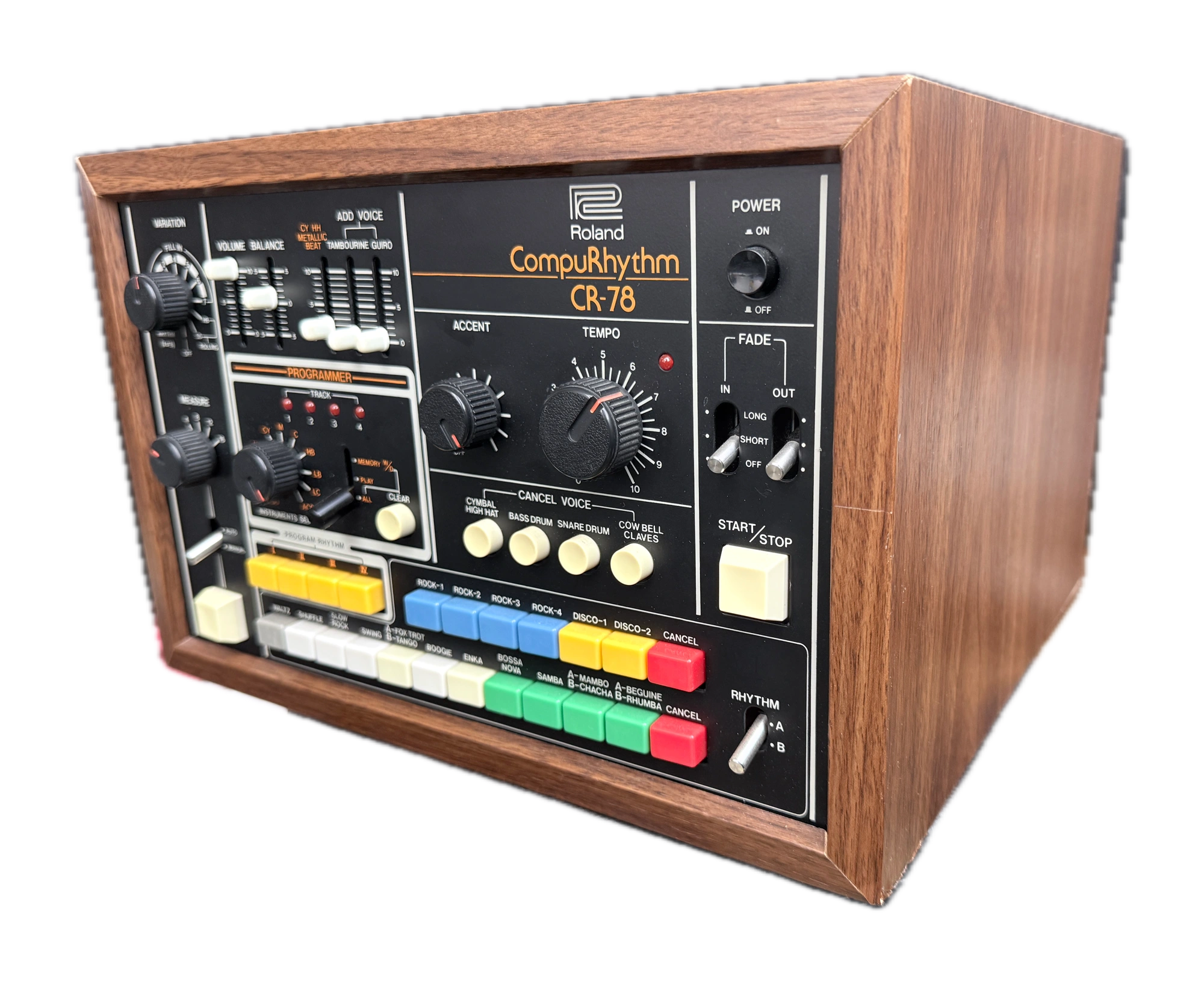
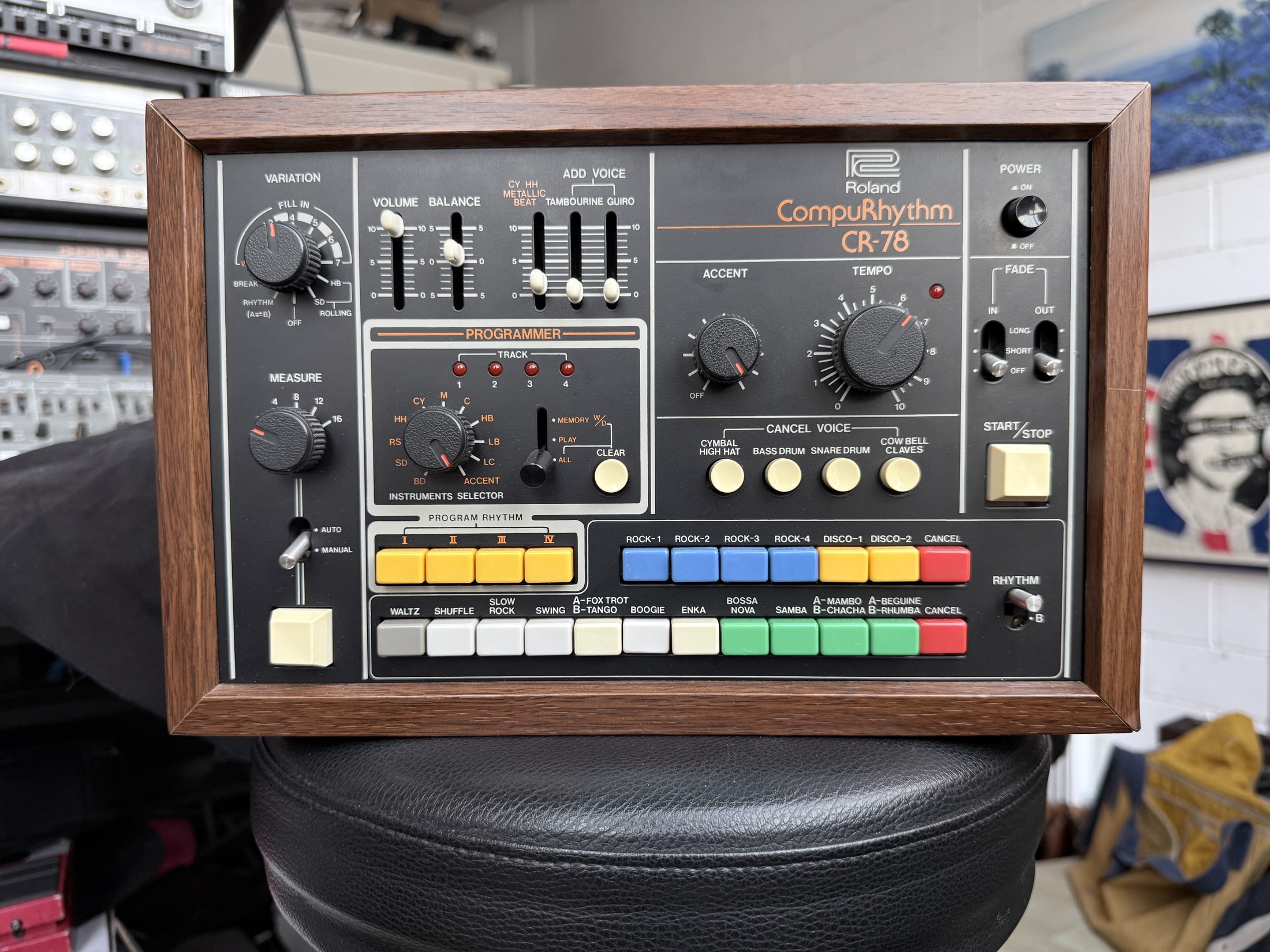
Big Beat Collection Roland CR-78, complete isolated view
PRODUCTIONIntroduced 1978; period production into 1981
SOUND ENGINE11 analogue sound sources; µPD8048 control
RHYTHM MEMORY34 presets; four two-measure user rhythms
More facts, listening references & sources
PERIOD PRICE¥105,000 in Roland's October 1978 catalogue
LINEAGE ADVANCEThe CR-68's computer-controlled preset system gains writable memory, making the CompuRhythm pair split into immediate and programmable instruments.
WHAT THE PLAYER GAINSFour two-measure rhythm memories, step or real-time entry and external WS-1 write control let the owner preserve a rhythm of their own.
NOTABLE USERSBlondie · OMD · Phil Collins · Daryl Hall
START LISTENINGBlondie — Heart of Glass · OMD — Enola Gay · Phil Collins — In the Air Tonight · Daryl Hall & John Oates — I Can't Go for That
Sources for the artists and listening references

Artist accounts, historical attributions and performance films establish different things. These notes explain the basis for each reference.

THE BIG BEAT COLLECTION // ROLAND COMPURHYTHM CR-78

MEMORY ARRIVES INSIDE A WOODEN RHYTHM BOX.

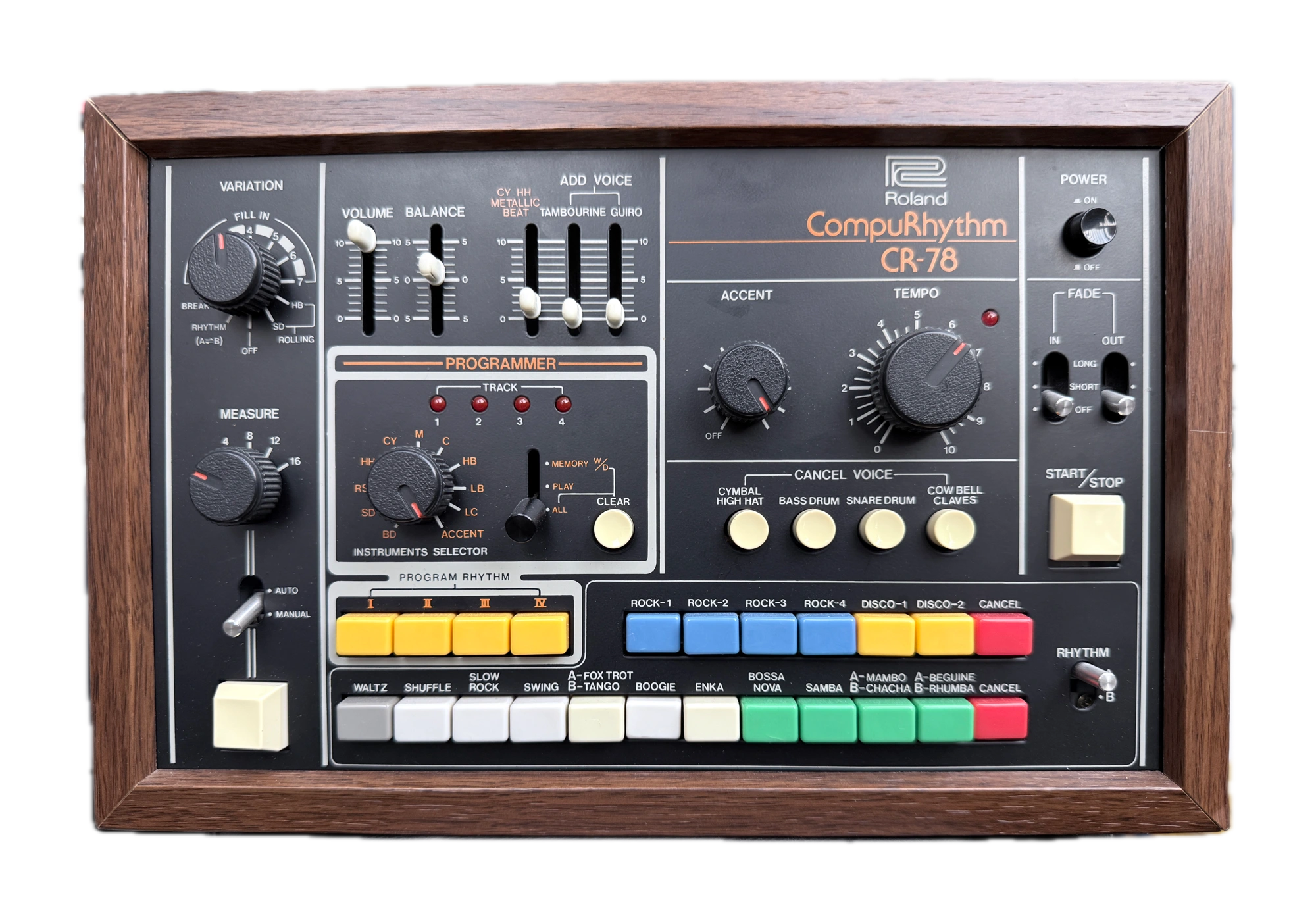
The complete three-quarter object shows the CR-78's central tension clearly: a familiar furniture cabinet surrounds a front panel built for writing, cancelling, balancing and varying a rhythm while it runs.

PAGE 01 // ORIGIN // 1978

A domestic machine with writable memory

The Roland CompuRhythm CR-78 joins 34 ready-made rhythms to a microprocessor-controlled programmer and four user rhythm locations.

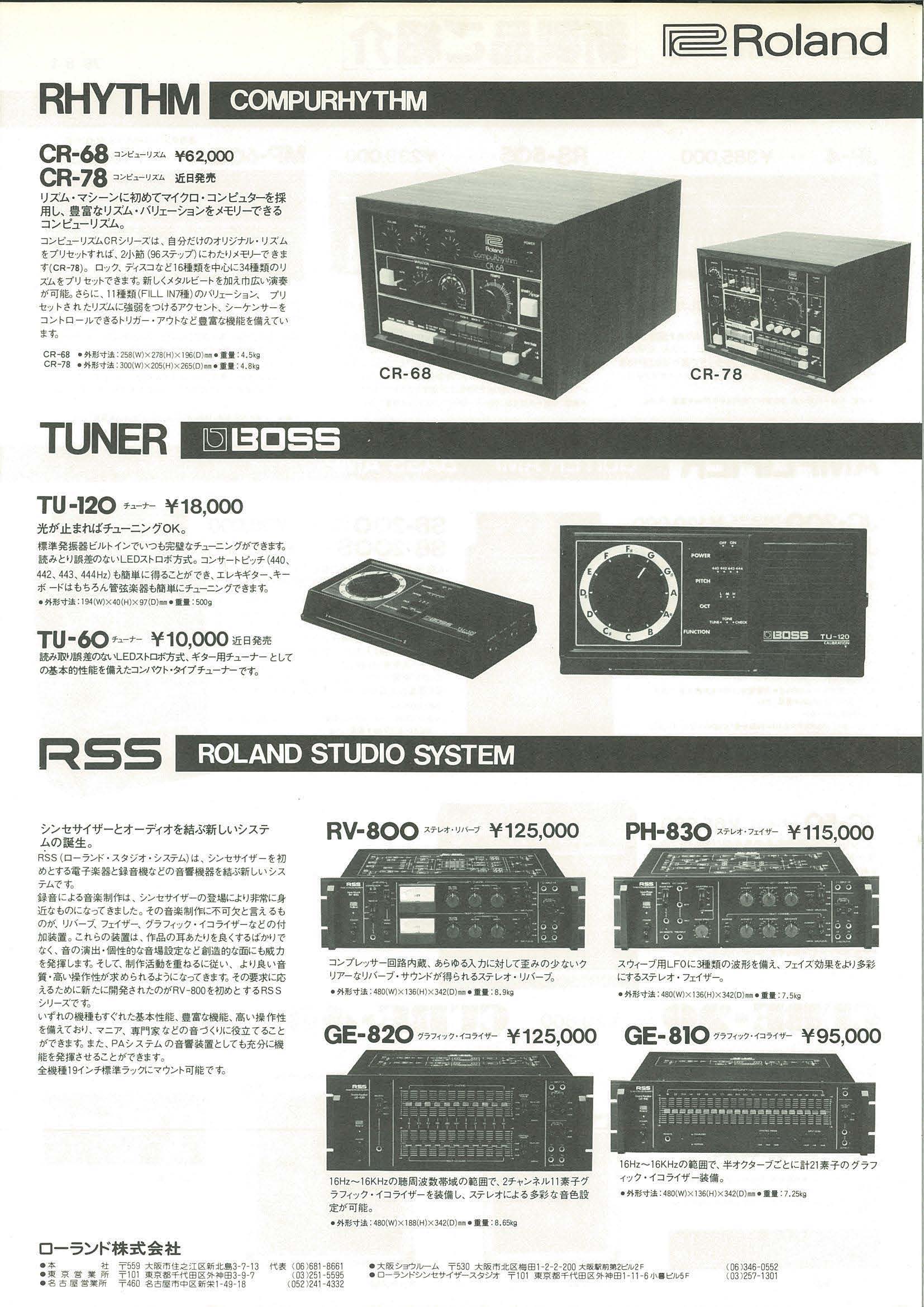
Roland announced the CR-68 and CR-78 together in August 1978. The October catalogue priced them at ¥62,000 and ¥105,000 respectively. Both retained the approachable wood cabinet, coloured rhythm keys, fills and variations; the more expensive CR-78 added the circuitry, controls and backup power needed to remember original patterns.

The lower row still offers named styles and the panel still provides tempo, balance, fade and variation. The programmer opens another route: select one of four memories, choose a voice, enter its events, and repeat the process for the remaining voices and accent. The machine can now preserve a rhythm that did not exist at the factory.

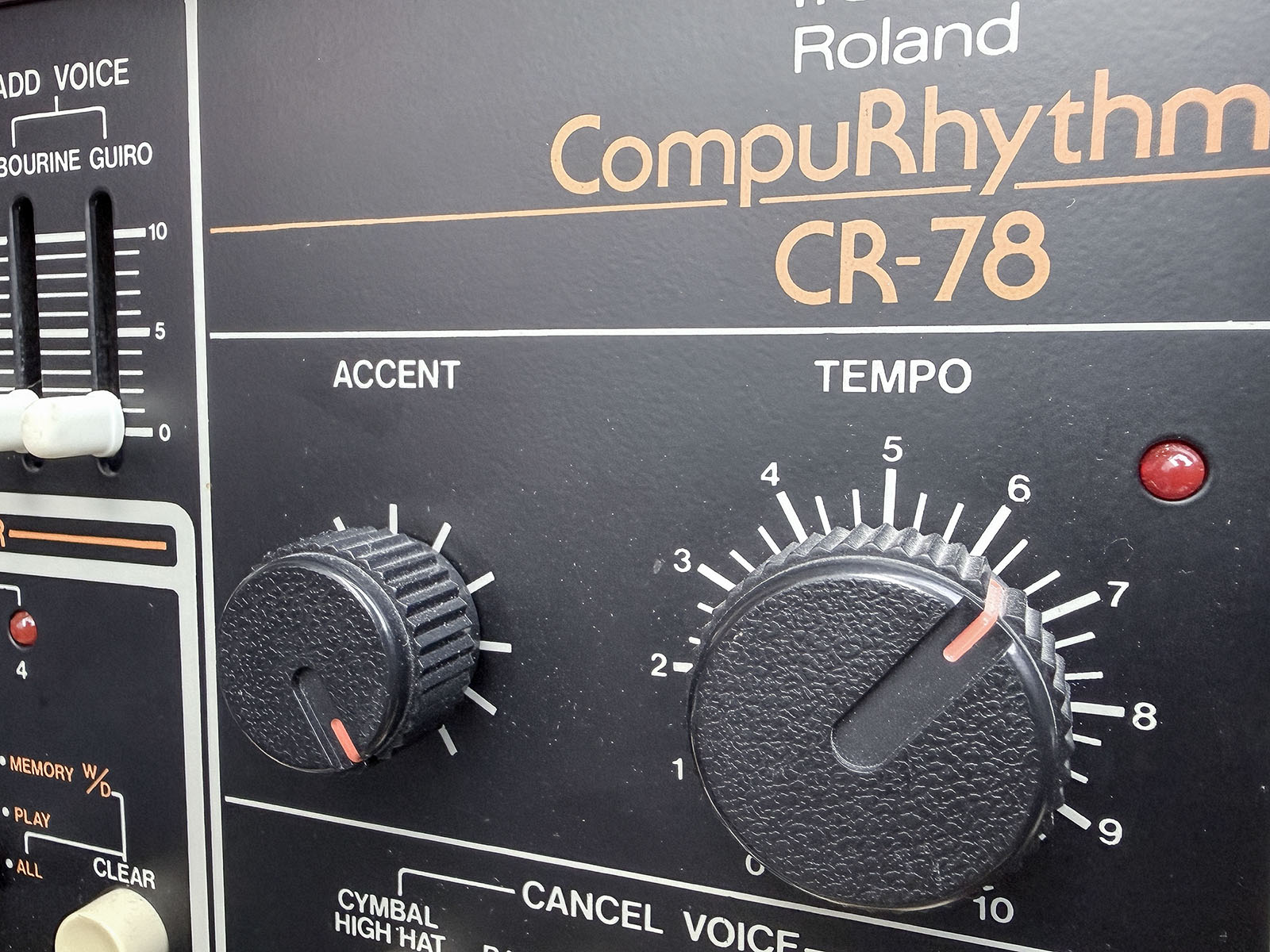
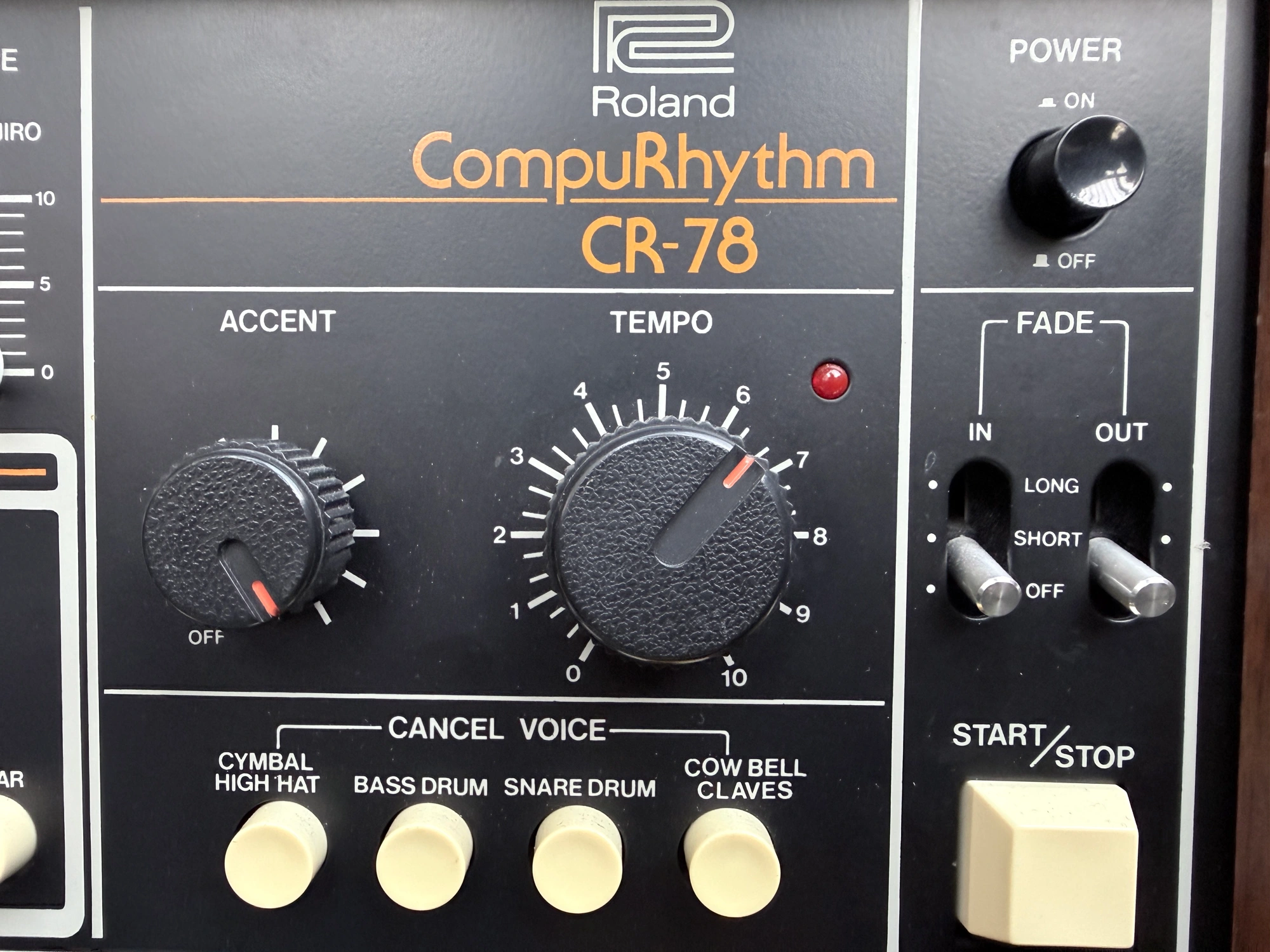
Close view of the Roland CompuRhythm CR-78 name, accent and tempo controls
BIG BEAT COLLECTION // ROLAND COMPURHYTHM CR-78
Official 1978 Japanese Roland catalogue page presenting the CompuRhythm CR-68 and CR-78 together
ROLAND GENERAL CATALOGUE // CR-68 AND CR-78 // OCTOBER 1978
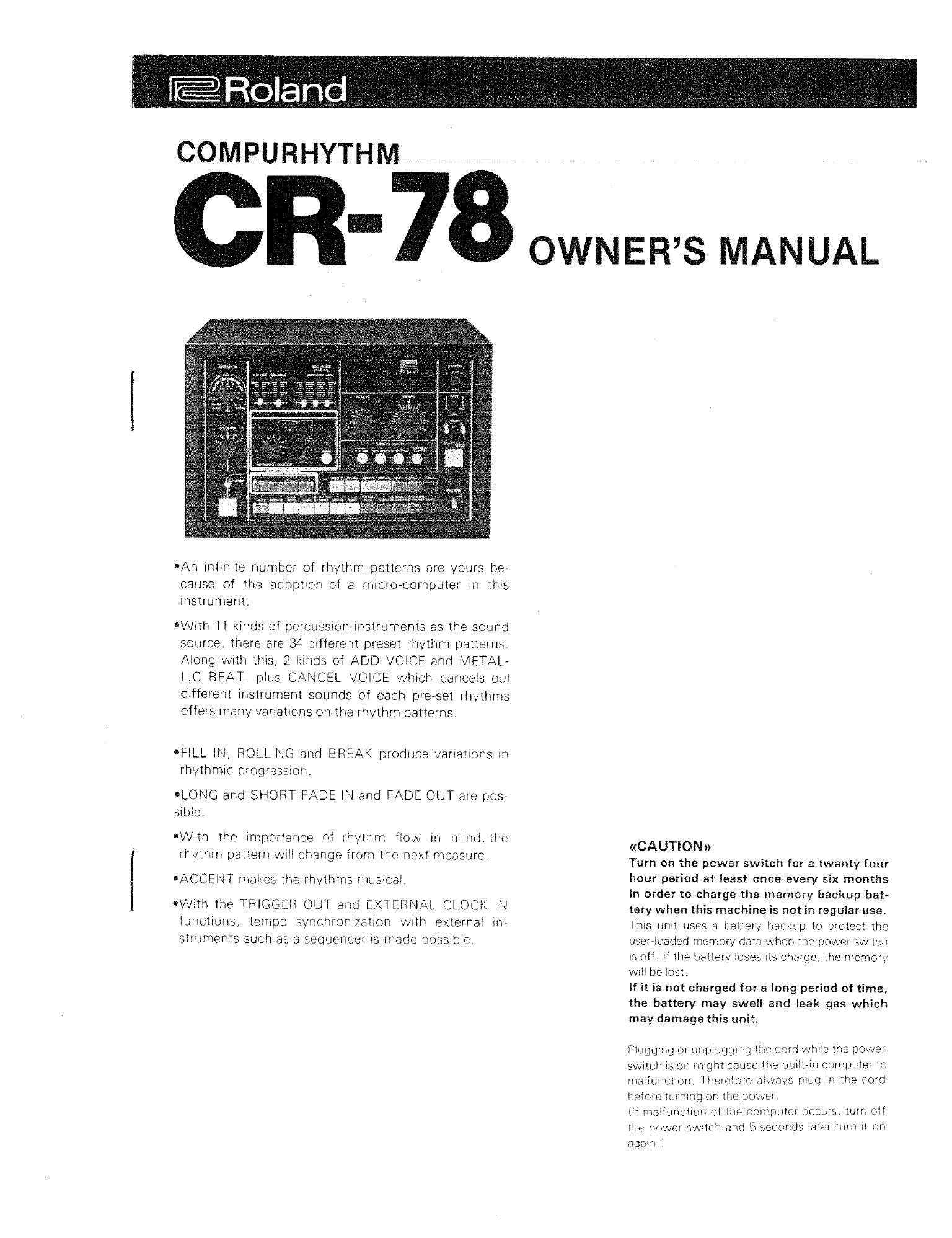
Cover of the original Roland CompuRhythm CR-78 owner's manual
ROLAND COMPURHYTHM CR-78 // OWNER'S MANUAL // PERIOD DOCUMENT
Open the deeper story +

What changed between the CR-68 and CR-78

The CR-68 had already placed a microcomputer behind factory rhythms, fill timing and variation. The CR-78 uses that control system to cross a new boundary: two RAM devices retain four two-measure patterns when the machine is switched off. This is why the larger cabinet and higher price matter; the second member of the pair carries an authoring system, not simply more sounds.

The user does not receive an empty modern grid. Four instrument parts and accent can be entered in each memory, while the machine's presets, combinations, add voices, voice cancellation, rolling variations, manual fills and fades remain available around them. New and factory-authored rhythm therefore coexist on one panel.

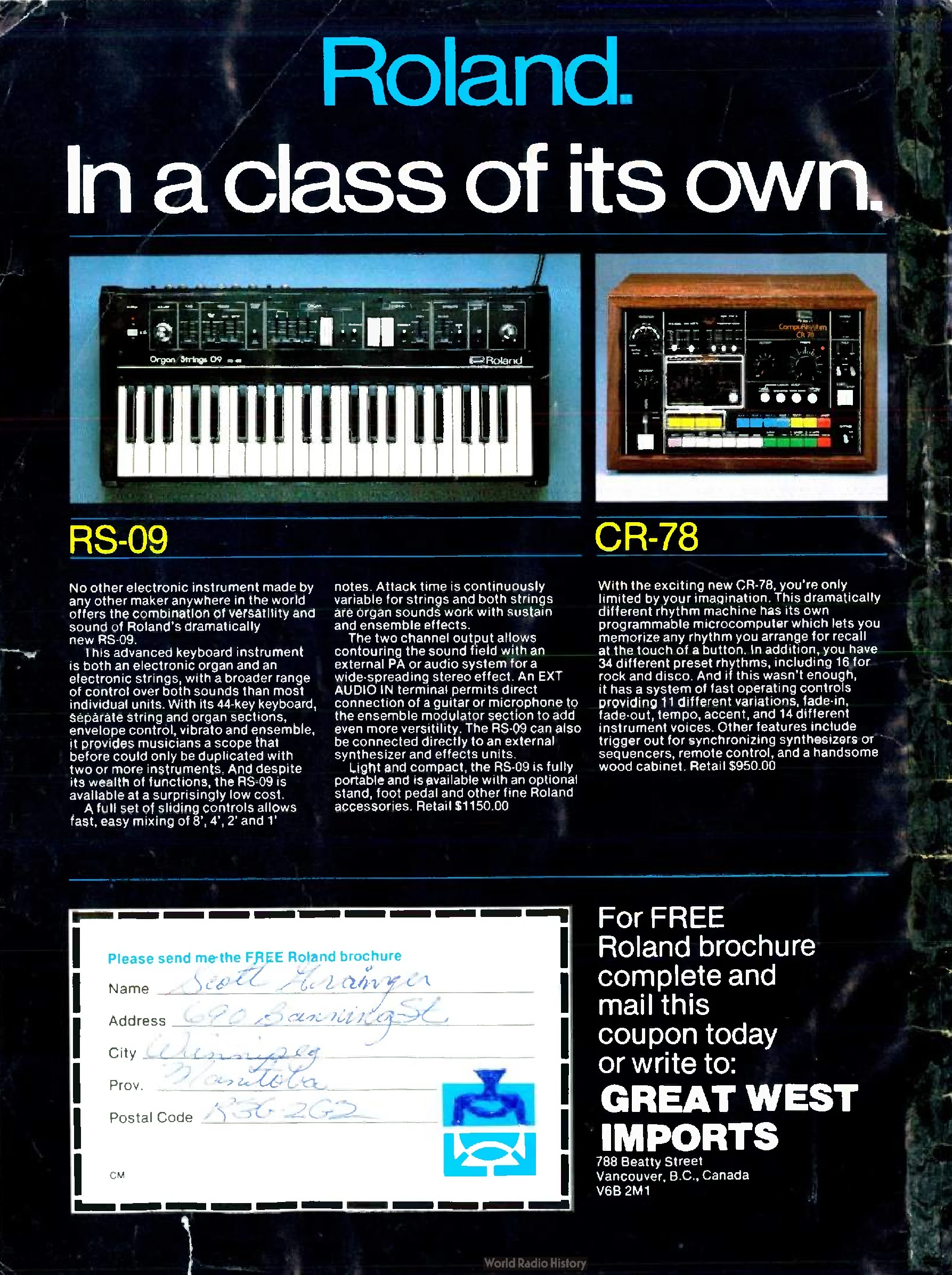
Roland's contemporary advertising called this programmability an escape from waiting for a drummer named Louie. The joke is dated, but the premise is precise: a musician could now decide the rhythm before a session, retain it and reproduce it without asking the factory—or another player—to supply the pattern.

Period Roland advertisement headed In a class of its own and devoted to the CR-78 CompuRhythm
ROLAND CR-78 // IN A CLASS OF ITS OWN // CANADIAN MUSICIAN // JUNE 1979DOCUMENTARY SOURCE

PAGE 02 // OBJECT // COLLECTION UNIT 841853

The front panel teaches. The rear panel connects.

The Big Beat Collection unit preserves the CR-78 as a complete working object: arranger, programmer, clocked studio device and self-contained analogue rhythm instrument.

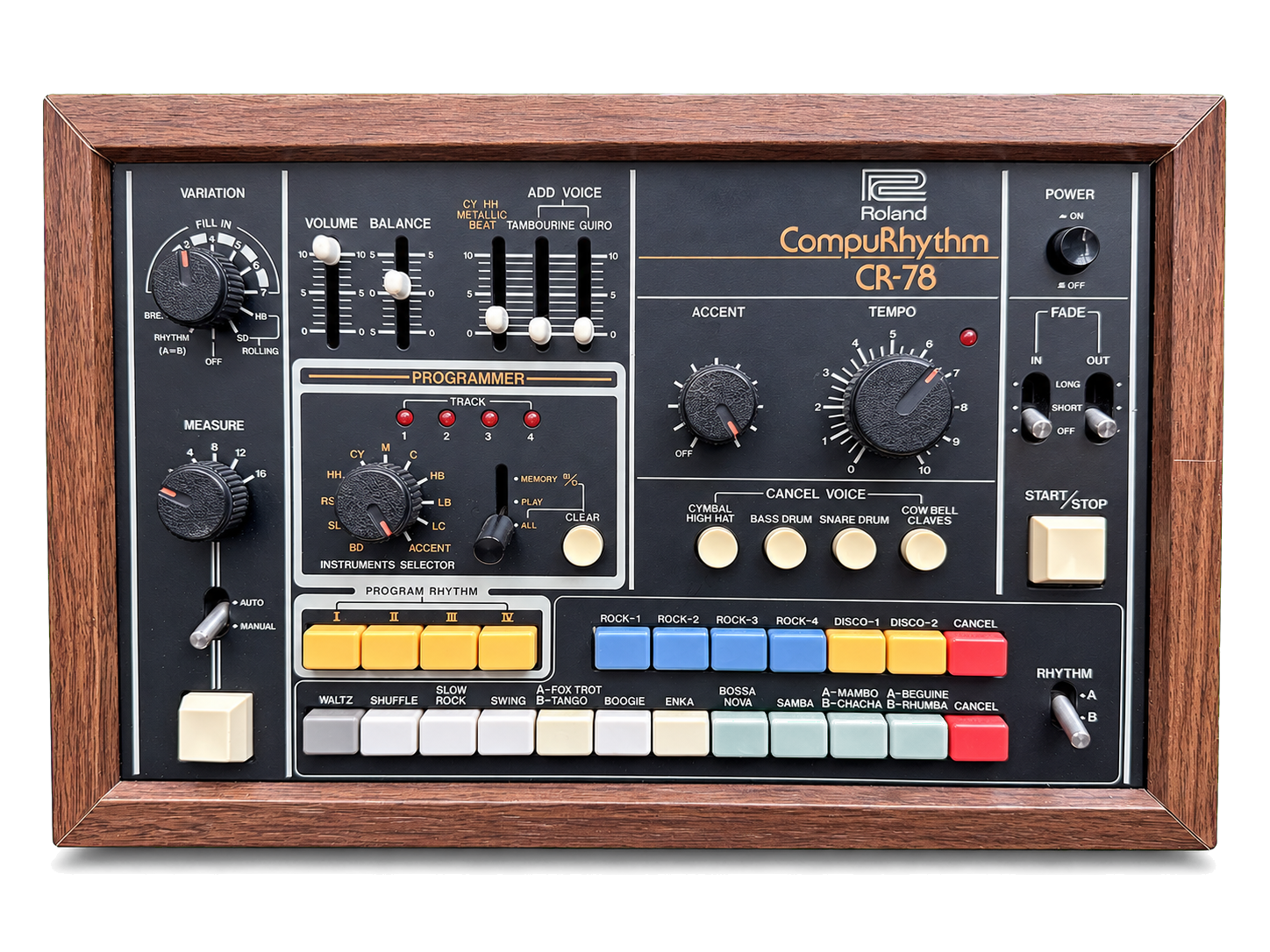
Across the front, the machine separates performance from authorship without hiding either one. Variation, measure length, preset rhythms and fills occupy the outer field; the four-track programmer sits at the centre; accent, tempo, voice cancellation and fade remain available while the rhythm runs. The layout makes the CR-78's central proposition visible before a note is heard: a prepared arrangement can be played, interrupted, rewritten and stored from the same surface.

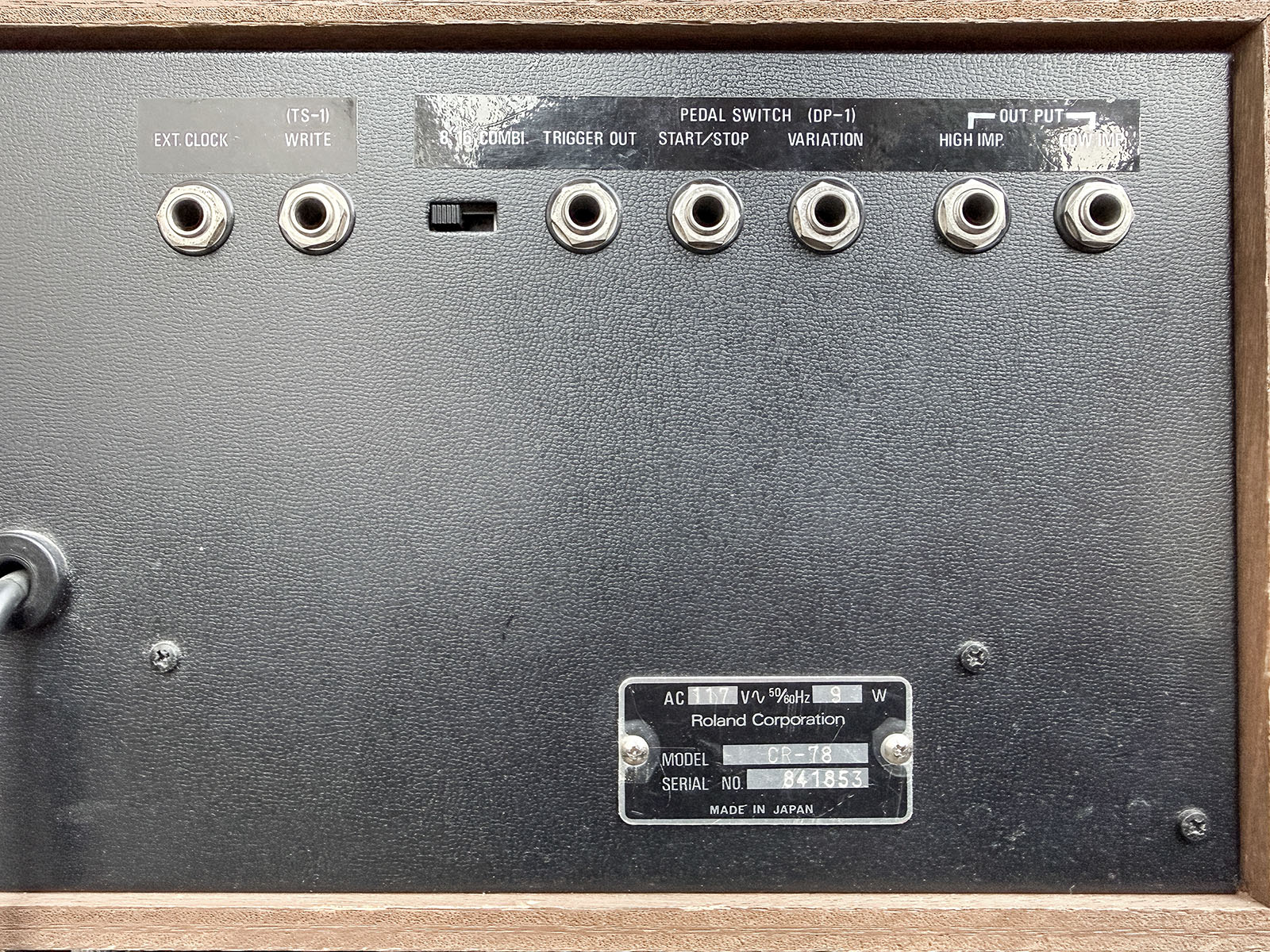
The rear panel reveals that the wooden cabinet was never a sealed domestic appliance. External clock and TS-1 write inputs sit beside an eighth-/sixteenth-note combination trigger output, pedal connections for start/stop and variation, and separate high- and low-impedance audio outputs. The machine could follow another clock, send a pulse onward and place its performance controls underfoot.

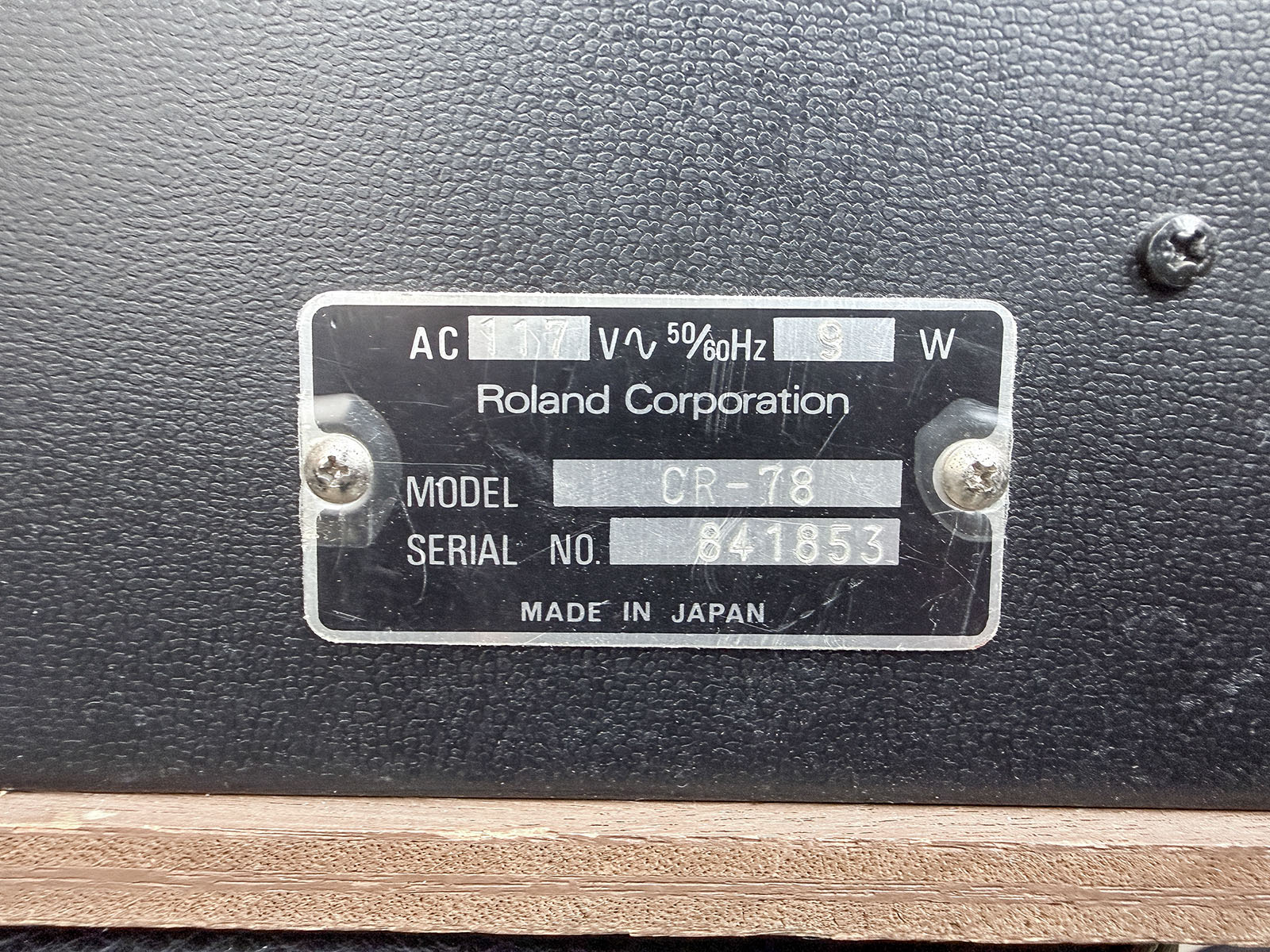
The identity plate records this survivor as a 117-volt, 9-watt Japanese-made CR-78, serial 841853. The plate identifies the collection object but does not date its internal board revision; that requires a documented service inspection.

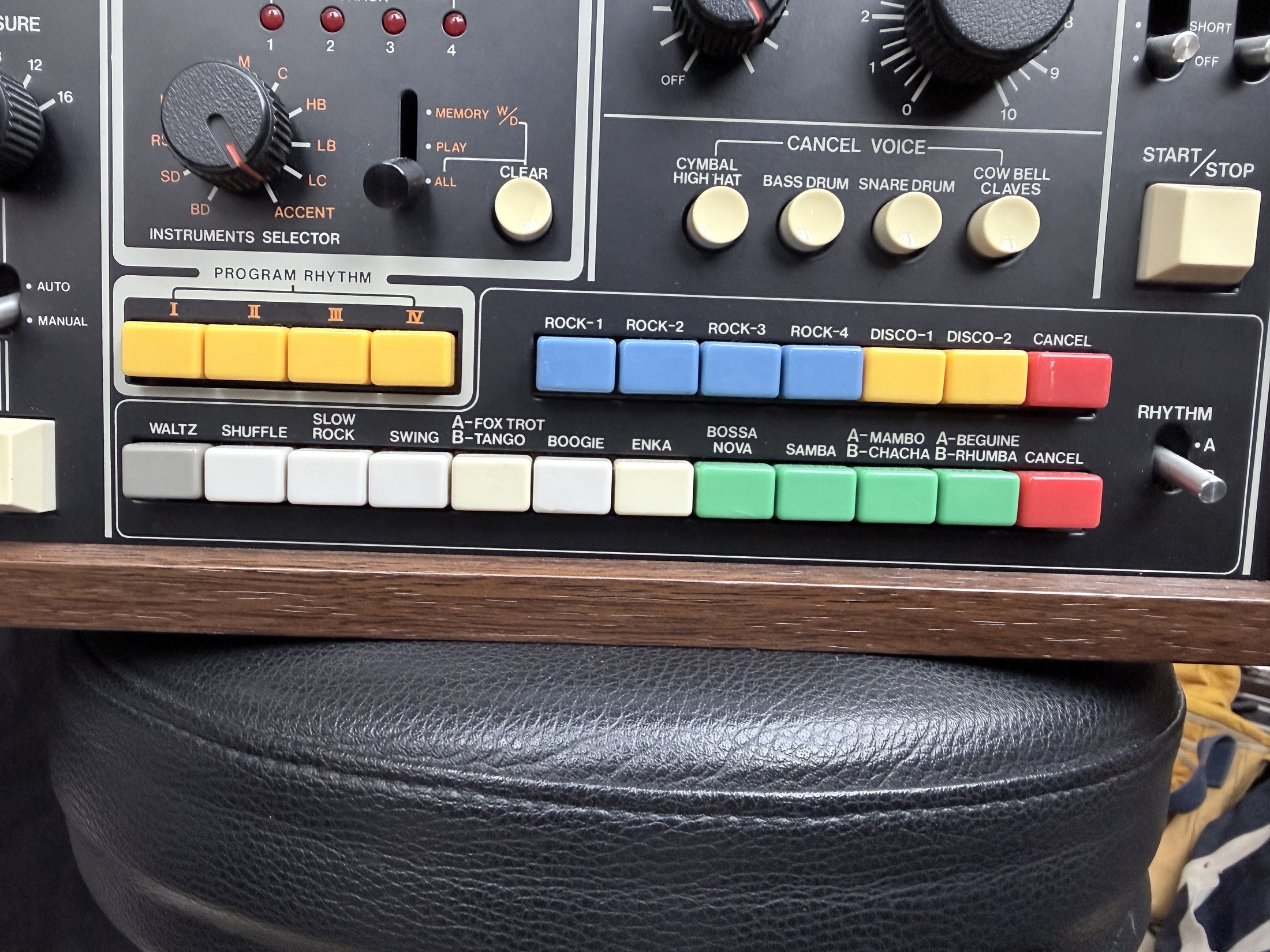
Complete frontal object view of the Big Beat Collection Roland CompuRhythm CR-78 with every cabinet edge visible
COMPLETE FRONT OBJECT // PANEL, PROGRAMMER AND CABINET
Rear panel of the Big Beat Collection CR-78 showing clock, write, trigger, pedal and audio connections
REAR PANEL // CLOCK, WRITE, TRIGGER, PEDAL AND AUDIO
Open the deeper story +

Read the physical machine from left to right

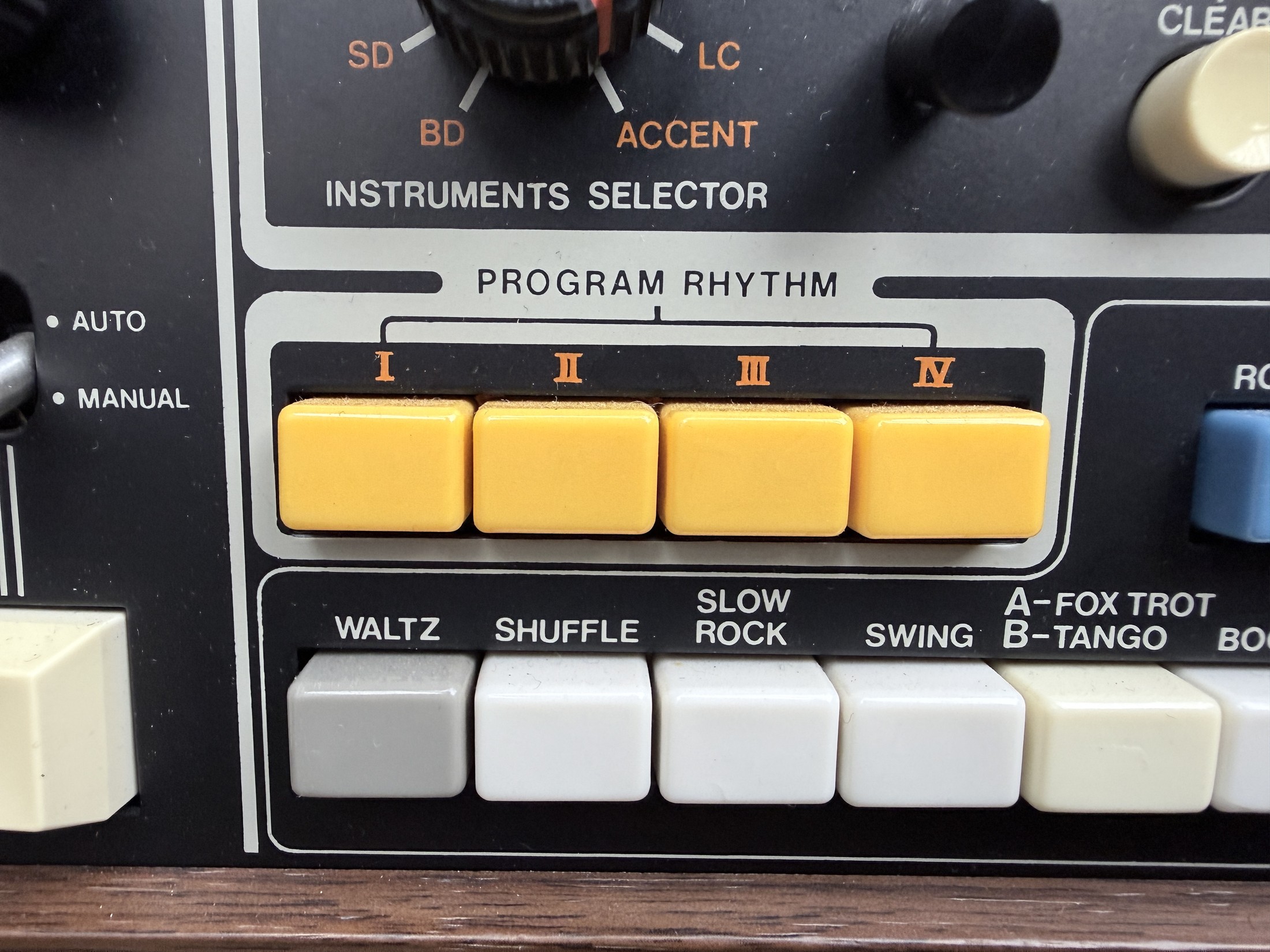
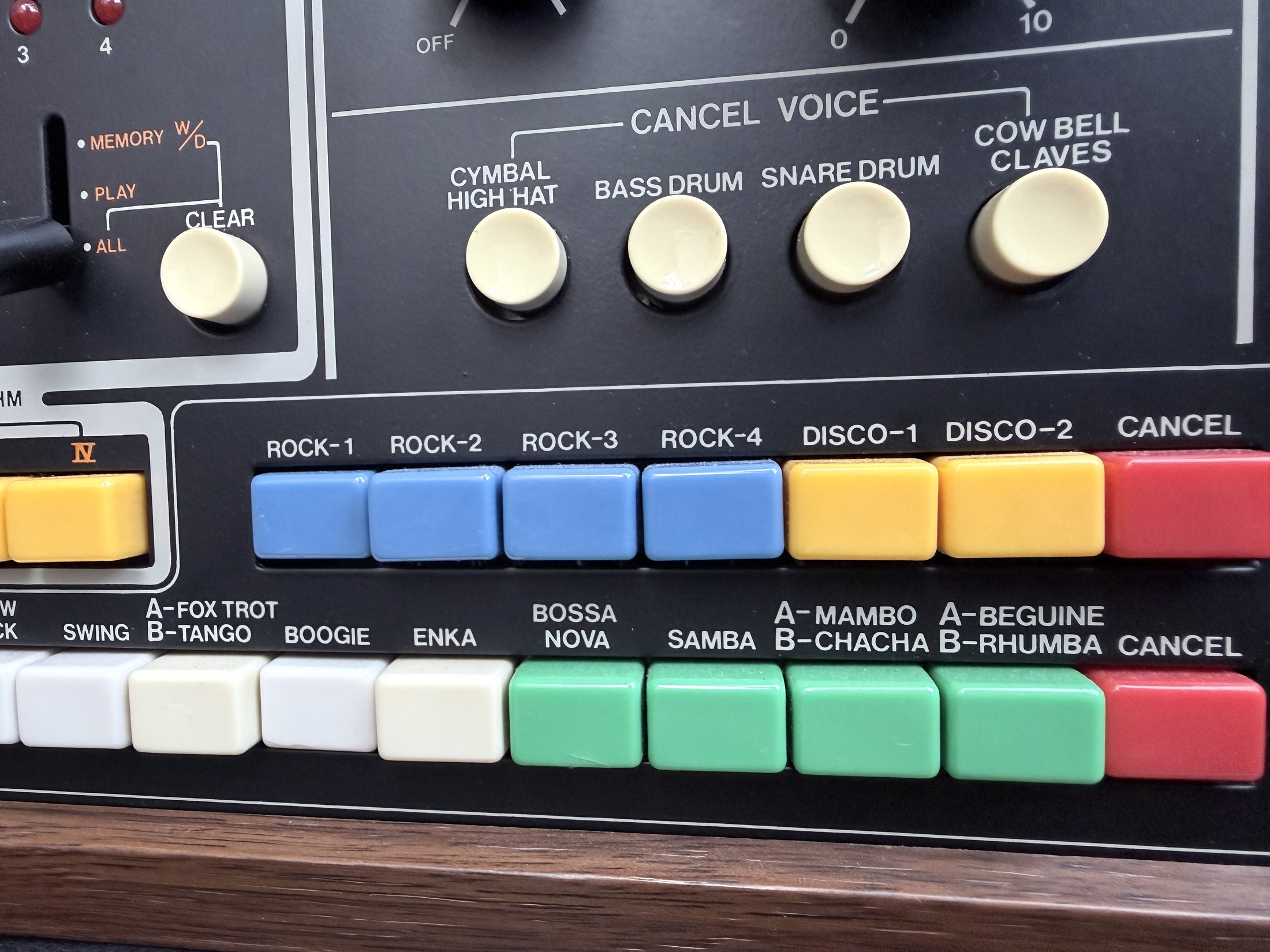
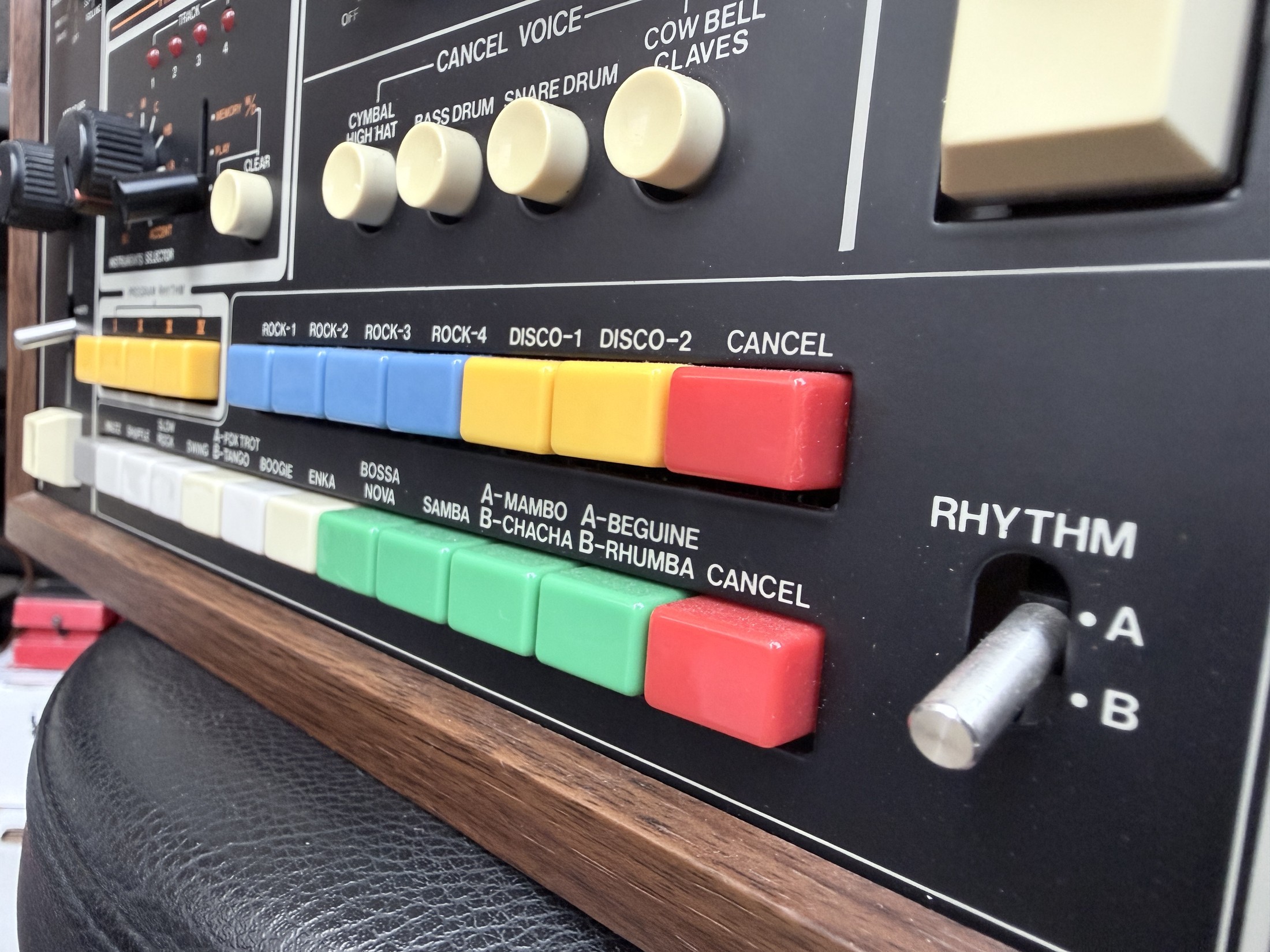
The preset bank occupies the lowest row because it is the quickest route into sound. White keys select older dance forms and basic pulses; green keys carry Latin-derived rhythms; blue and yellow keys bring rock and disco into the vocabulary; red keys cancel the active group. The A/B switch doubles selected labels without doubling the number of visible buttons.

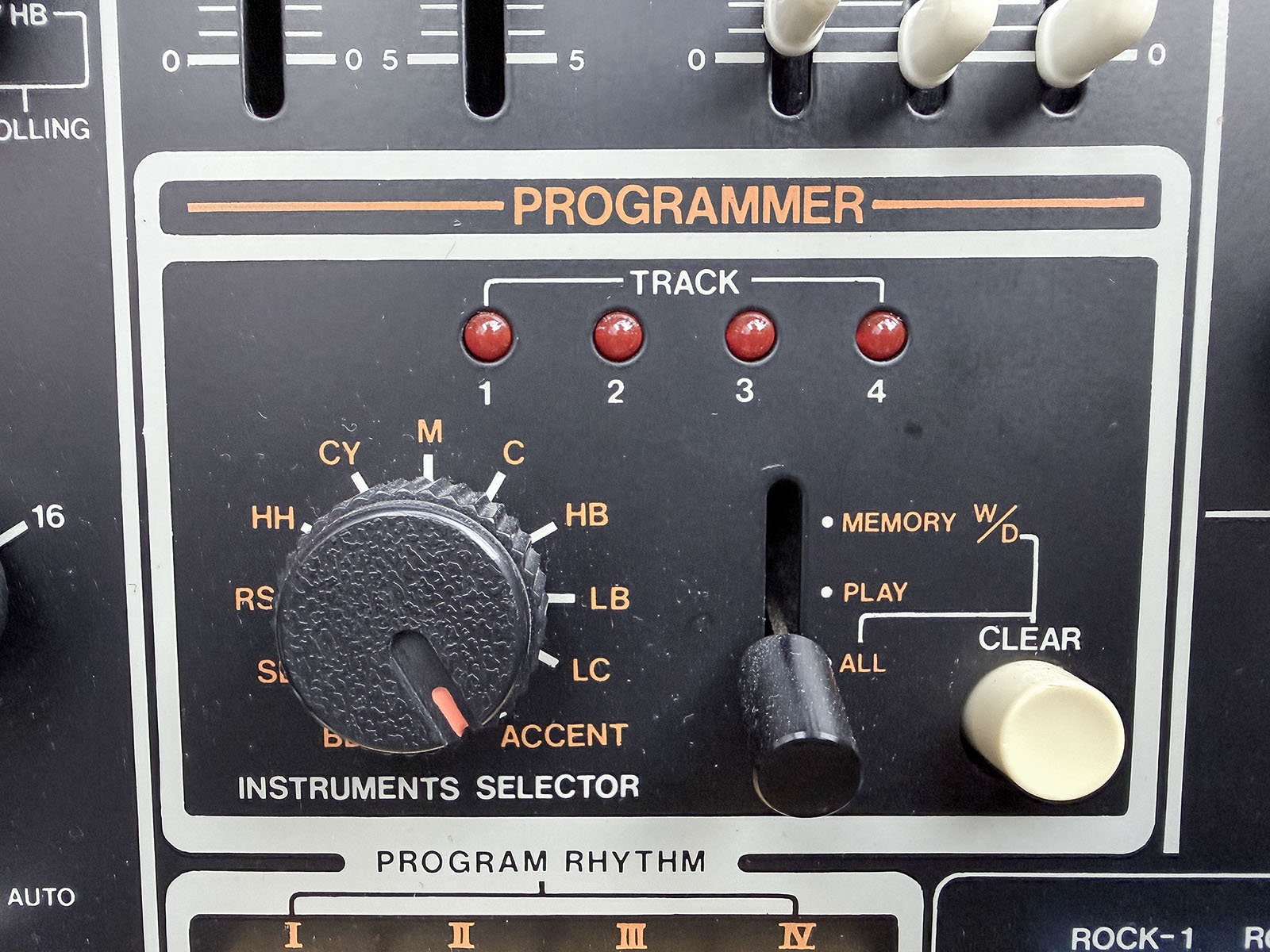
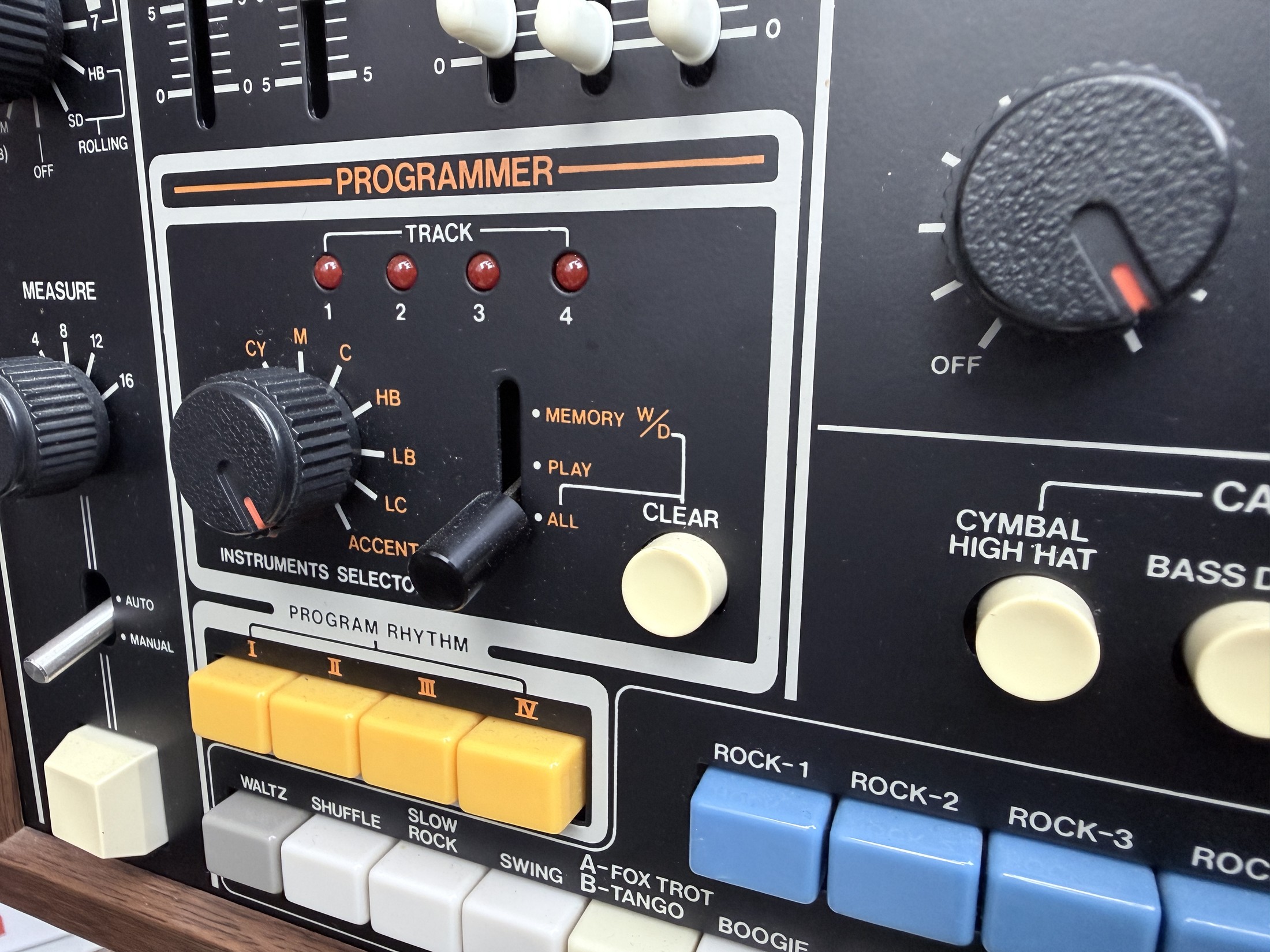
Above that bank, four yellow programme memories create a second route through the instrument. The selector chooses one voice at a time, the MEMORY/PLAY control changes the panel from playback to writing, and CLEAR removes either the selected part or the whole stored rhythm. Four indicator lamps show which memory is active; they do not display the notes inside it.

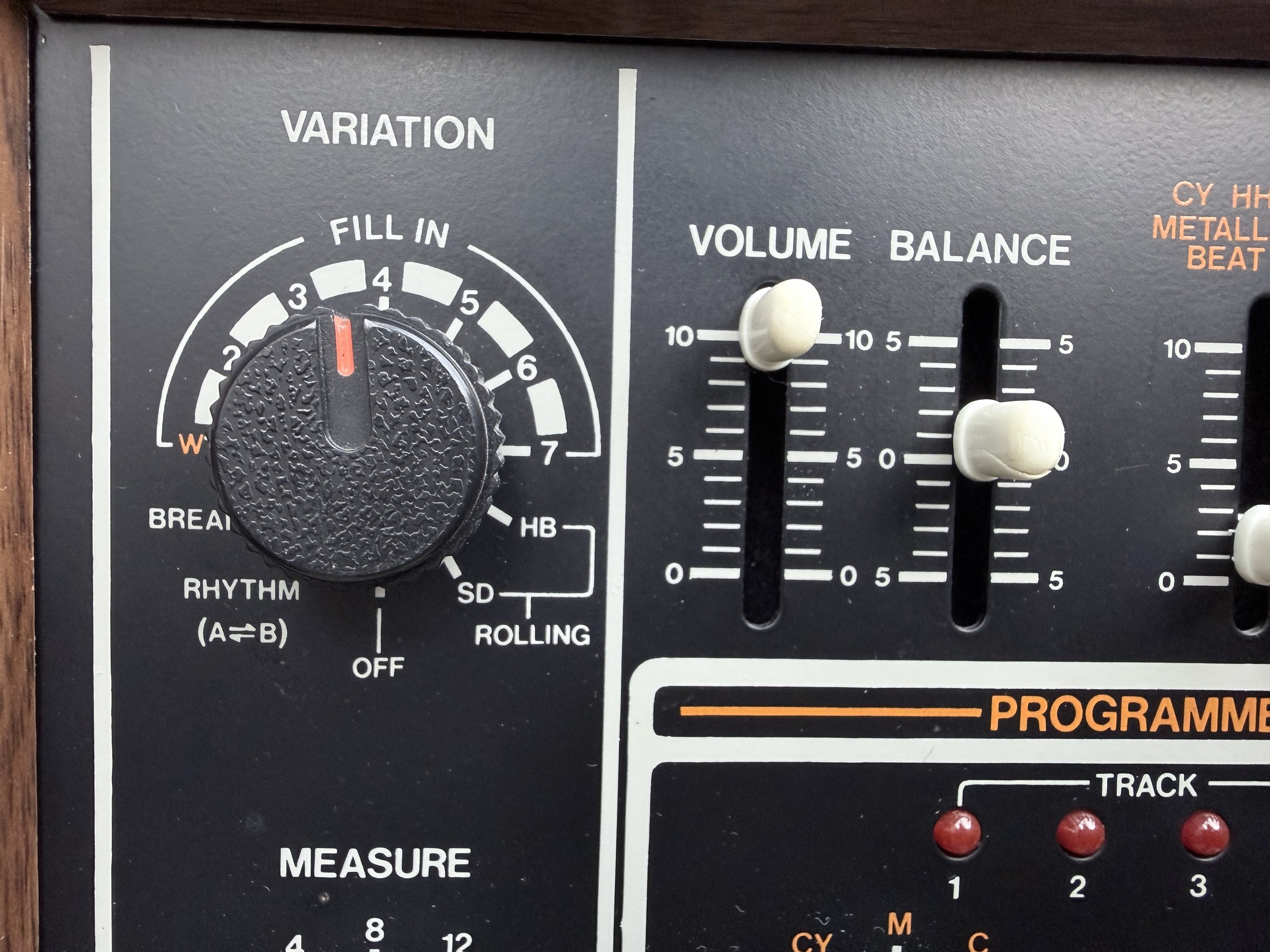
The left-hand controls shape time at the level of the arrangement. Measure chooses how often an automatic variation arrives, while the adjacent selector chooses a fill, a break, an A-to-B change or rolling snare and high-bongo figures. The manual switch lets the player call the event rather than wait for the counter.

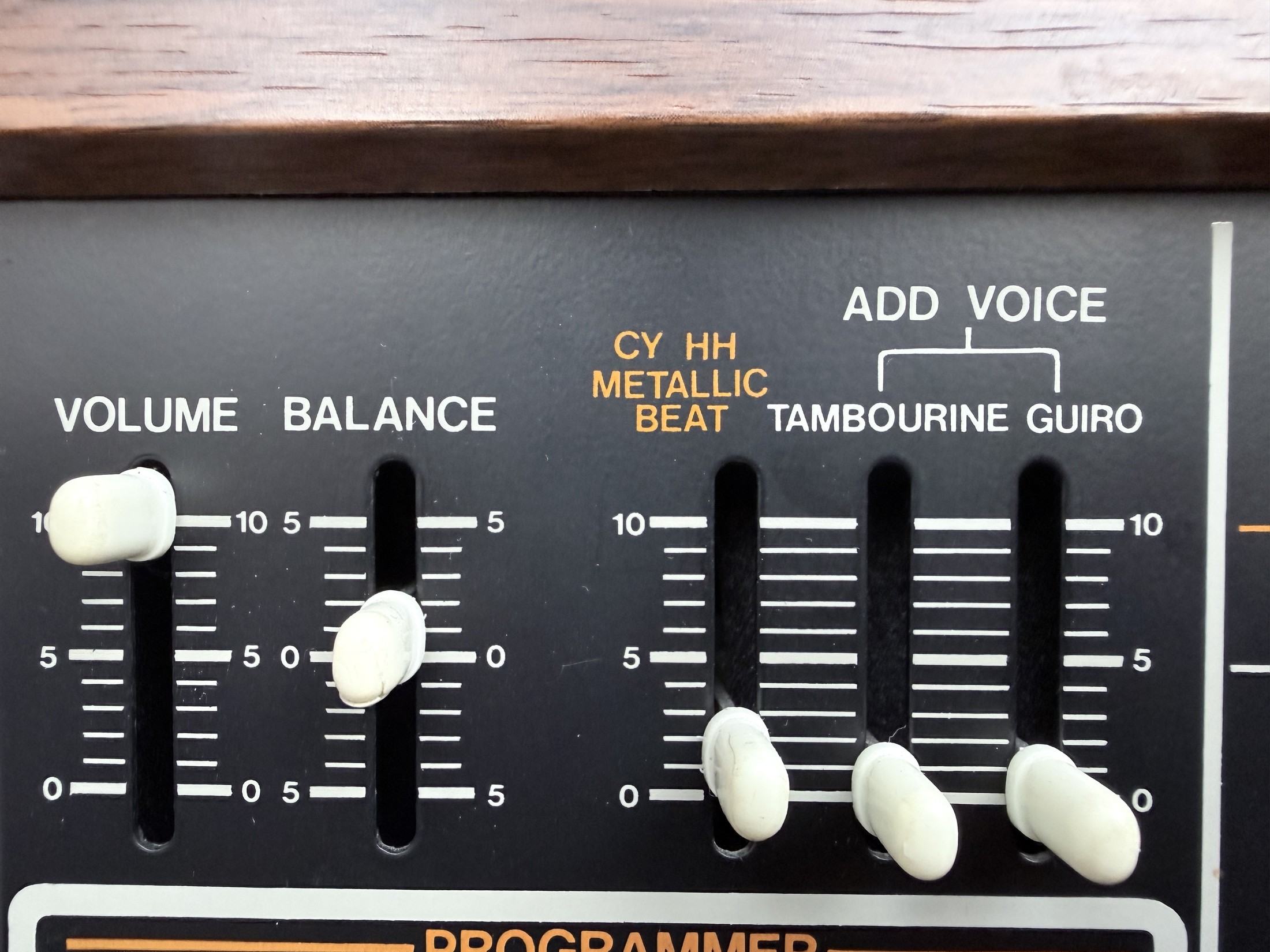
The right-hand controls shape what reaches the output. Cancel Voice removes broad instrument groups; Add Voice returns cymbal/high-hat, Metallic Beat, tambourine or guiro at independent levels; Balance tilts low percussion against high; the two fade switches make entrance and exit part of the performance rather than an edit made later.

The rear-panel pair marked HIGH IMP. and LOW IMP. provides alternative output matching rather than stereo. External clock accepts a compatible pulse train, and the combination trigger output can advance suitable connected equipment. The footswitch sockets move start, stop and variation away from the hands, which matters when the CR-78 is accompanying a keyboardist or another instrumentalist.

01020304050607080910111213141516

PAGE 03 // INSTRUMENT // HYBRID WORKFLOW

Preset and programme coexist

The radical part of the CR-78 is not that presets disappear, but that they can now sit beside user-authored patterns.

A player can combine A and B variations, set recurring or manual fills, accent a written pattern and cancel selected voices from the preset mix. These operations make arrangement granular without turning the machine into a workstation.

The interface preserves genre labels as useful shortcuts while opening a small blank space for invention. This duality—factory character plus user memory—will return throughout the Roland line.

Close view of the Big Beat Collection CR-78 programmer controls and four memory indicators
BIG BEAT COLLECTION // FOUR MEMORIES, ONE VOICE AT A TIME
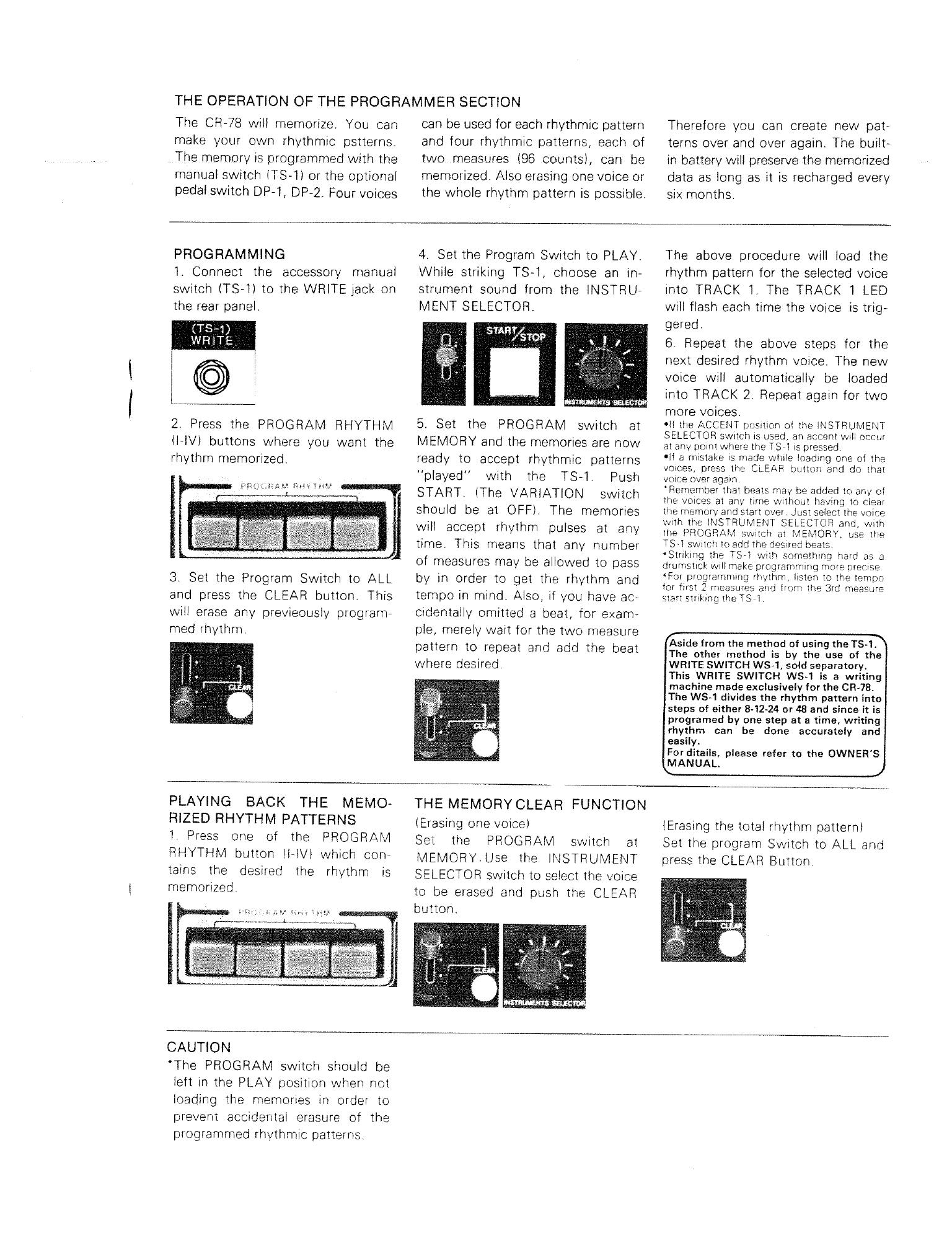
Original CR-78 owner's manual page explaining the programmer section
CR-78 OWNER'S MANUAL // PROGRAMMER OPERATION // PAGE 5

CR-78 FOUR-MEMORY LAB // PRIMARY-MANUAL MODEL

Write beside the presets.

The original machine stores four selected instrument parts plus accent across two measures. This browser model follows its 96-count memory and WS-1 beat/rest method; the generated sounds are teaching approximations, not samples or a circuit emulation.

48visible stepstwo measures / 24 divisions each

MEMORY I // PART 1 / Bass drum

WRITE POSITION 01 / 48

SWIPE OR USE ARROW KEYS TO READ EVERY STEP →

MEM I

AUDIO STARTS AFTER YOUR FIRST PRESS

WHAT THIS TEACHES: four memories are four small sections, not four recordings. Change division to see the same 96-count store through the WS-1’s coarser or finer step choices; switch memories to preserve another part of an arrangement.

Open the deeper story +

Programme, perform and verify a rhythm

Select one of the four PROGRAM RHYTHM buttons, clear its previous contents, choose an instrument, and move the programme switch from PLAY to MEMORY. The ordinary TS-1 write switch enters hits against the running rhythm. Missing a strike does not merely make a quiet performance: it writes an empty position into the stored part.

The WS-1 gives a slower, more exact method. Its BEAT and REST pedals move through 8, 12, 24 or 48 divisions of the measure one position at a time. This explains the unusual two-measure, 96-count architecture: the finest setting provides 48 decisions per measure, while coarser divisions let the same memory describe simpler patterns quickly.

Build from the lowest-information layer upward: establish bass drum, add the backbeat, and use hi-hat or Metallic Beat to reveal subdivisions. Repeat the process for each of the four available instrument parts. Accent is entered as its own pattern information, so phrasing is stored rather than added globally after the fact.

Four memories work best as sections rather than a large library: a stripped verse, a denser chorus, a bridge and an ending. Automatic variation can insert a fill after 2, 4, 8, 12 or 16 measures; manual variation lets the player decide the boundary. Cancel Voice and the add-voice sliders reshape a preset without consuming a user memory.

Verify the result. Recall another rhythm, return to the written location and test it at several tempos. If it survives while mains power is on but disappears after shutdown, the failure is in retention—the rechargeable battery, charging path or RAM supply—not in the act of programming.

The rear panel extends the arrangement. The +15 V trigger output can advance suitable equipment and the external-clock input can make the CR-78 follow another source at 48 pulses per measure. Check the receiving manual first: a shared quarter-note idea is not enough to guarantee electrical compatibility.

PAGE 04 // SOUND // VOICE ARCHITECTURE

The computer conducts; the circuits speak

Digital control gives the CR-78 memory, but every audible drum is still built from oscillation, noise, filtering and decay.

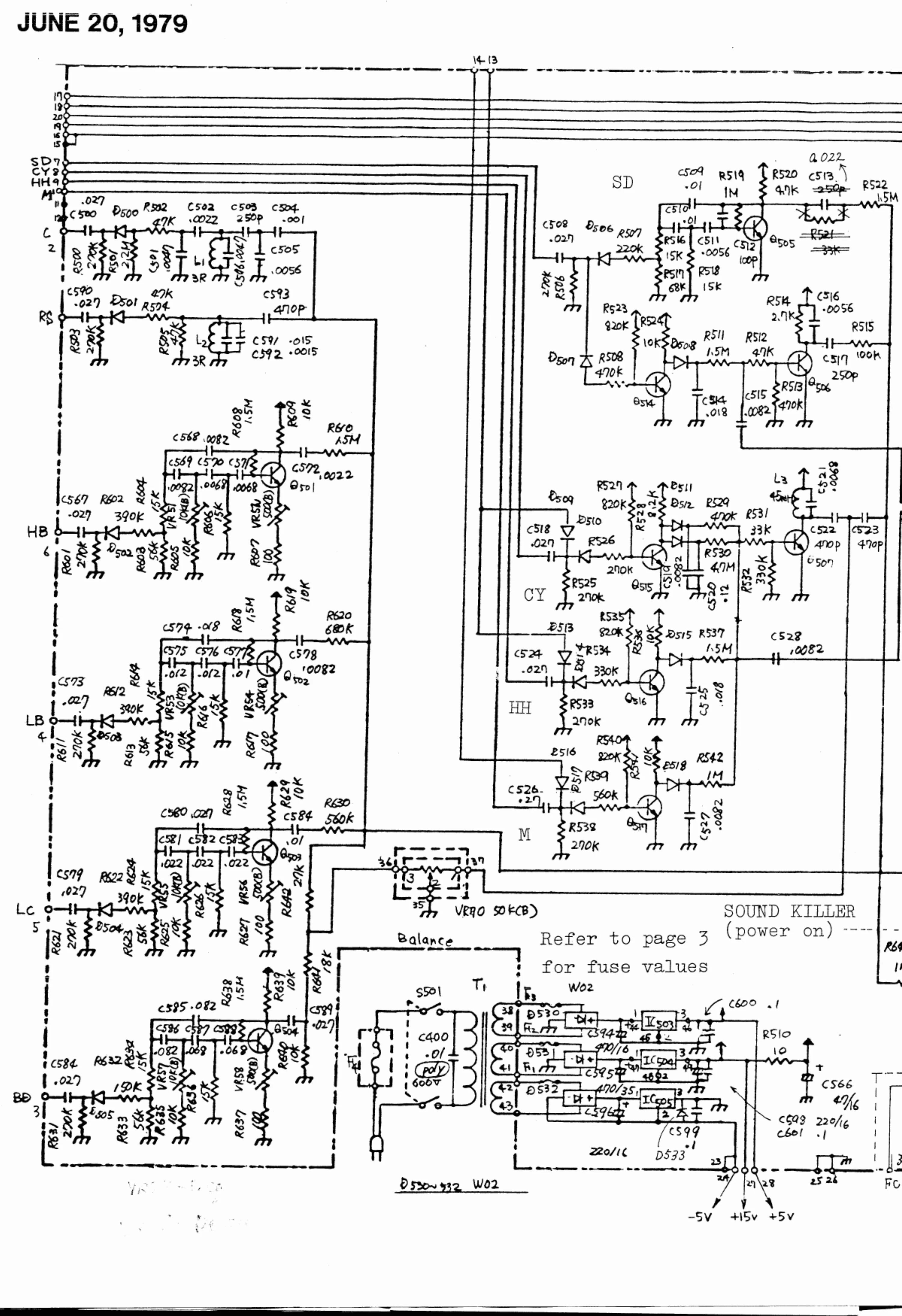
The processor sends short trigger instructions to the analogue voice board. Tuned resonators become bass drum, conga and bongos; a noise source is divided by filters and envelopes into snare, maracas, hi-hat and cymbal. Brighter fixed-frequency circuits supply rim shot, claves and cowbell.

Tambourine, guiro and Metallic Beat extend the palette beyond a basic kit and help explain why the CR-78 reads as an arranger rather than a drummer replacement. The manual specifies eleven core sound sources; panel combinations and add-voice functions create more labelled roles without turning them into separate samples.

The important engineering boundary is simple: pattern memory stores when a voice should fire, not a recording of the sound. A memory fault, a missing trigger and a silent analogue generator are therefore three different problems.

CR-78 service schematic showing hand-drum and metallic percussion voice circuits
CR-78 SERVICE NOTES // VOICE CIRCUITS AND MIXING // PAGE 25
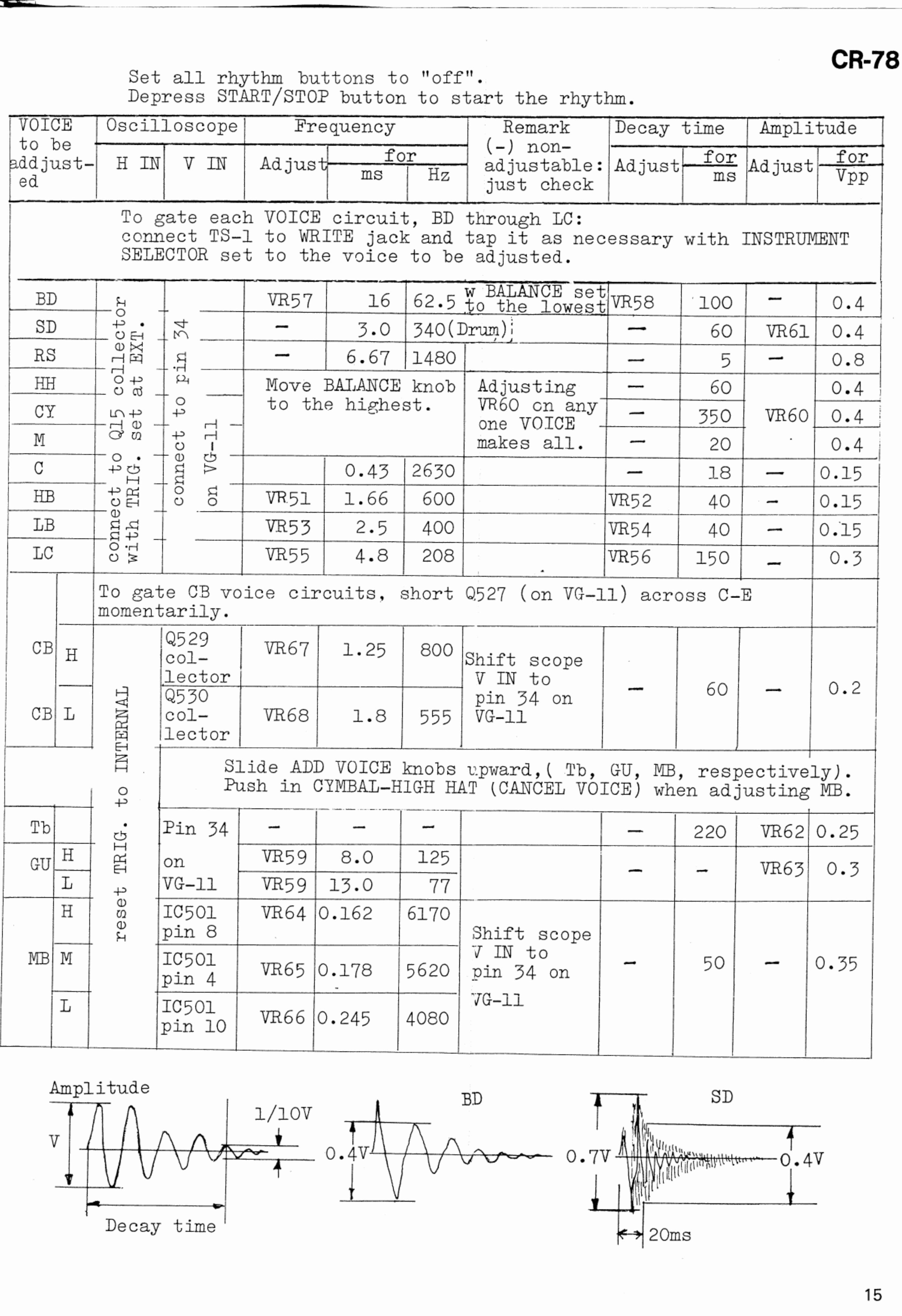
CR-78 service adjustment table listing voice frequencies, decays and output levels
CR-78 SERVICE NOTES // FACTORY VOICE TARGETS // PAGE 30
Open the deeper story +

Trace the sound from trigger to output

Start at the instrument trigger line leaving the control section. A narrow pulse charges or switches part of the relevant voice circuit. For a resonant drum, that disturbance starts a damped oscillation; for a noise voice, it opens a short control envelope around an already running noise source.

The bass drum target is 62.5 Hz with a 100 ms decay. A trigger disturbs a tuned network, which rings and then loses energy; pitch establishes the apparent drum size and damping establishes its length. High and low bongos are tuned near 600 and 400 Hz, while the low conga sits near 208 Hz and is allowed a longer 150 ms tail.

Snare combines a pitched body near 340 Hz with a brief noisy attack and a designed decay of about 60 ms. Rim shot and claves are much shorter, brighter events—approximately 1.48 kHz/5 ms and 2.63 kHz/18 ms. These targets show how the machine preserves clarity: every voice is assigned its own frequency region and duration.

The cowbell is the beat between two oscillators near 800 and 555 Hz. Metallic Beat uses three far higher oscillators near 6.17, 5.62 and 4.08 kHz, deliberately avoiding a single stable pitch. Noise, filtering and envelopes create hi-hat, cymbal, maracas and tambourine textures; the result is electronic metal rather than a recording of metal.

Guiro uses two much lower pulse rates, around 125 and 77 Hz, to create alternating scrape-like movement. Its dedicated add-voice level means it can sit over a factory pattern independently. This is a useful reminder that the panel's named instruments are not all generated by one universal circuit copied at different pitches.

Accent changes the level of stored events through a shared control path before final mixing. Balance then tilts the combined output between low and high percussion groups. Cancel Voice suppresses selected bright parts during performance, while add-voice sliders introduce tambourine, guiro and Metallic Beat without rewriting the source rhythm.

On the bench, use the service table as a factory reference rather than a command to make every survivor identical. Prove the trigger before adjusting a voice; measure both frequency and decay; document the original trimmer positions; and change only what falls outside the documented operating target or causes a real fault.

MEMORY BECOMES BEHAVIOUR

The programmer is a decision tree.

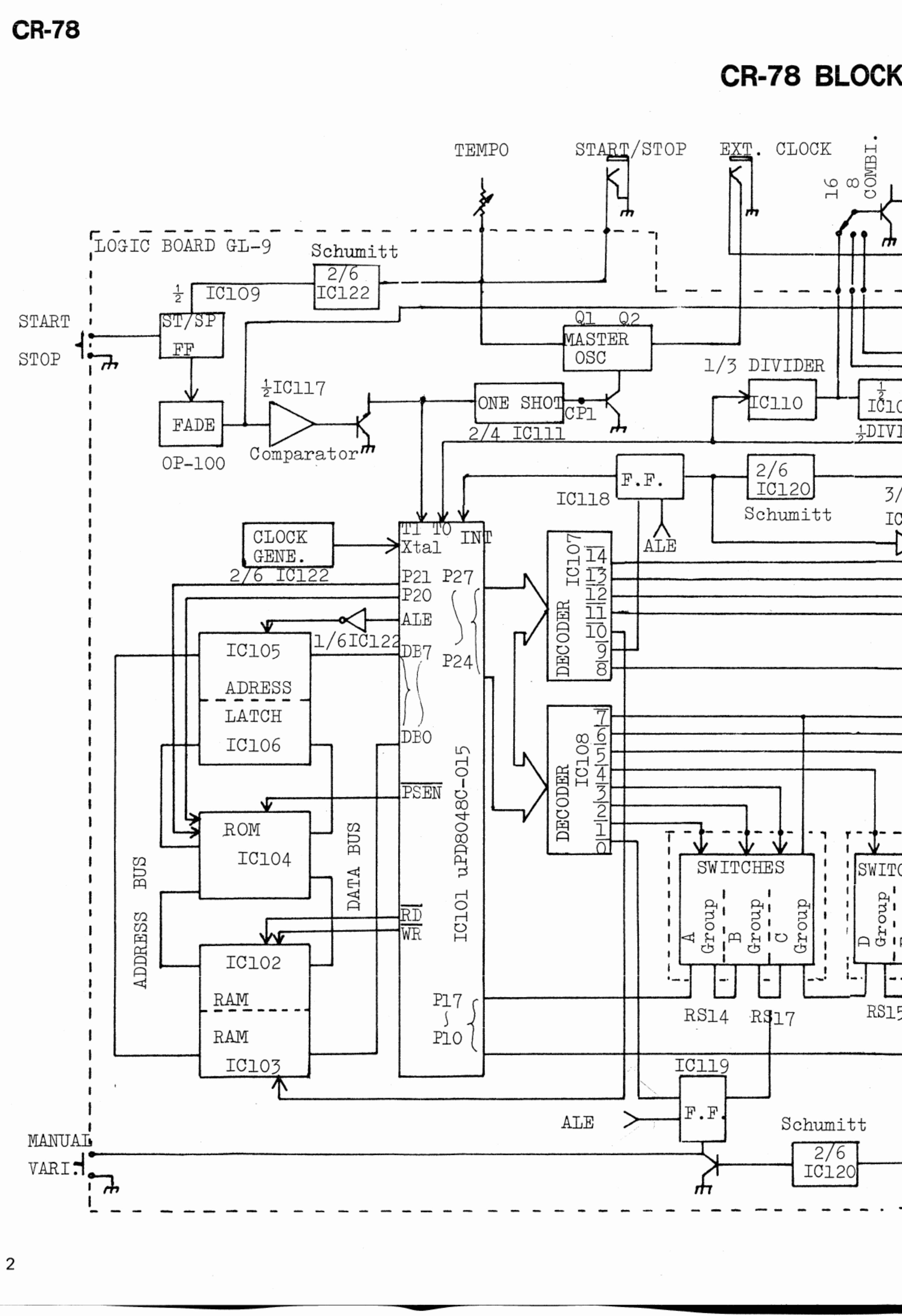
The block diagram separates the CR-78 into two machines that cooperate. A µPD8048 microprocessor scans the panel, addresses ROM and battery-backed RAM, and sends timed trigger decisions onward. The percussion voices themselves remain analogue circuits on the voice board.

CR-78 service-manual block diagram showing the µPD8048 processor, ROM, RAM, clock and panel scanning
CR-78 SERVICE NOTES // CONTROL, MEMORY AND CLOCK BLOCK DIAGRAM // PAGE 3PRIMARY TECHNICAL EVIDENCE
Read the circuit in depth +

From a tapped beat to stored control data

IC101 is a NEC µPD8048C-015 single-chip microcomputer. Its resident programme advances the rhythm, scans the rhythm keys and operating switches, and addresses three different stores: ROM for factory decisions and IC102/IC103 RAM for the player's material. The CPU decides when a voice should fire; it does not synthesize the audible drum.

The user memory is small enough to describe exactly. Four programme locations each hold four selected instrument parts plus accent across two measures of 96 timing counts. That is 4 × 4 × 96, or 1,536 stored bits, distributed across the two RAM devices. It is not four recordings and not a modern multitrack pattern: it is a compact grid of yes-or-no trigger decisions.

The ordinary TS-1 input records events against the running clock. The rarer WS-1 divides a measure into 8, 12, 24 or 48 positions and offers separate beat and rest steps, so a player can build a rhythm deliberately without performing the whole bar in real time. In both cases only the instrument selected on the panel is written; the process is repeated for the other parts.

During playback the processor and decoding logic scan the panel, fetch the appropriate factory or user data, and present instrument triggers to the analogue board. Cancel Voice switches are scanned as performance instructions, while cymbal/high-hat, tambourine and guiro level controls alter what joins the mix. The machine's arrangement controls therefore work both before and after the memory decision.

External clock expects a positive pulse between +5 and +15 volts, at least 5 ms long, with 48 counts to one measure. The published range is roughly 5–100 Hz. That interface can bind the CR-78 to a sequencer, but it is not MIDI: rate, voltage, pulse width and grounding must all be suitable before connecting equipment.

At the voice board a trigger becomes sound in one of two broad ways. Resonant networks are struck into damped oscillation for bass drum, congas and bongos. Noise or deliberately inharmonic oscillators are gated and filtered for snare, hi-hat, cymbal, maracas, tambourine and Metallic Beat. The final balance control weights low and high percussion groups before the output amplifier.

The service adjustment table makes the designed targets audible: bass drum is centred at 62.5 Hz with a 100 ms decay; snare body is checked near 340 Hz with a 60 ms decay; rim shot at 1.48 kHz lasts about 5 ms; claves sit near 2.63 kHz; cowbell uses two oscillators near 800 and 555 Hz. Metallic Beat combines three much higher oscillators around 6.17, 5.62 and 4.08 kHz.

Troubleshooting should follow the same order as the signal. Confirm the regulated rails and master clock; prove that IC101 scans and runs; confirm preset selection; test user-memory write and retention; observe the appropriate trigger at the voice input; then follow the waveform through its resonator or noise gate, accent path, balance network and output amplifier. That order prevents a memory fault from being misdiagnosed as a bad drum voice.

Board revisions matter. Roland's notes distinguish GL-9, GL-9A and GL-9B assemblies and document component changes across production. A repair should begin by recording the board marking and serial number, because a value copied from another survivor may belong to a different revision.

Battery service is safety-critical. Earlier machines used a 5.6 V 4N-100AA rechargeable pack; later documented units use a 3.6 V N-SB3 arrangement. Roland explicitly warns that an early machine must not be powered with its original battery merely disconnected, because the resulting voltage condition can damage IC102 and IC103. Leakage, charging components and board revision should be assessed by a qualified technician before power is applied.

Open the 34-page CR-78 service notes ↗Open Roland's CR-78 technical specifications ↗

PAGE 05 // RECORDS // FOUR METHODS

Four records make the machine audible

Blondie, OMD, Phil Collins and Hall & Oates each turned the CR-78 into a different kind of compositional partner.

On “Heart of Glass,” Blondie combined Mambo and Beguine, used the CR-78 as a stable electronic foundation and layered the band around it. The rhythm box supplies both audible texture and a repeatable framework for the arrangement.

OMD programmed the rhythm that became the bed of “Enola Gay.” Phil Collins told Mix that he adapted a supplied CR-78 rhythm and programmed his own bass-drum part while writing “In the Air Tonight.” Its small pulse remains before the acoustic entrance. Daryl Hall began “I Can’t Go for That” from Rock 1, building bass and chords against a factory rhythm that immediately suggested a song.

BLONDIE // HEART OF GLASS // OFFICIAL VIDEO

Blondie — Heart of Glass

Listen beneath the live kit for the CR-78’s fine, unwavering subdivision. The machine establishes the floor; Clem Burke’s drums add weight and human movement without erasing it.

Watch on YouTube ↗
OMD // ENOLA GAY // OFFICIAL VIDEO

Orchestral Manoeuvres in the Dark — Enola Gay

Andy McCluskey describes the CR-78 pattern as the bed of the track. Hear how its bright, compact pulse remains exposed enough to function as part of the hook rather than disappearing beneath the arrangement.

Watch on YouTube ↗
PHIL COLLINS // IN THE AIR TONIGHT // OFFICIAL VIDEO

Phil Collins — In the Air Tonight

Roland identifies the starting preset as Disco 2; Collins’s own account confirms that he added a programmed bass-drum part. The resulting pattern is intentionally slight. Its restraint creates the scale of the later drum entrance: the CR-78 does not imitate the acoustic kit, it prepares the space that the kit will transform.

Watch on YouTube ↗
DARYL HALL & JOHN OATES // I CAN’T GO FOR THAT // OFFICIAL VIDEO

Daryl Hall & John Oates — I Can’t Go for That

Rock 1 acts as a writing prompt rather than a finished production. Hall’s bass line and keyboard harmony answer its fixed accents, showing how a preset can provoke original material almost immediately.

Watch on YouTube ↗
Open the deeper story +

Four routes from the machine to a record

Chris Stein’s account of “Heart of Glass” emphasises combination: two named Latin patterns create the grid. Mike Chapman’s recollection emphasises studio function: the rhythm machine and its trigger help hold electronic and live elements together. These are compatible views of the same process, one heard from the band and one from the producer’s chair.

“Enola Gay” demonstrates the authoring feature directly. Andy McCluskey recalls OMD buying the programmable CR-78 and building the distinctive rhythm themselves. It became the bed of the finished track—not a temporary click to be replaced—and shows why four small user memories represented a genuine new capability.

For “In the Air Tonight,” the CR-78 belonged first to the act of writing. Collins adapted a supplied rhythm into the hushed opening pulse, then preserved the contrast between that miniature electronic space and the enormous acoustic fill. The machine’s apparent weakness becomes the arrangement’s dramatic premise.

Daryl Hall’s account is more immediate: Rock 1 was running when the bass part and chords arrived. The useful historical point is not that the CR-78 wrote the song, but that a particular preset supplied friction and momentum at the exact moment composition began.

Together the records demonstrate combination, original programming, adaptation and provocation. None required the CR-78 to sound realistic. Each depended on the stability and identity of a rhythm that left enough space for musicians to make the rest of the record.

Read Andy McCluskey on programming Enola Gay ↗Read Roland's Heart of Glass production study ↗

PAGE 06 // AFTERLIFE // AUTHORSHIP

The CR-78 leaves its wooden cabinet

Its sound now survives as restored hardware, component modelling, performance firmware and software—not merely as sampled nostalgia.

Roland added a component-modelled CR-78 voice set to the TR-8S and TR-6S in 2023. The TR-1000 carries CR-78 ACB instruments inside a newer hybrid system, placing the 1978 voice architecture beside analogue 808/909 generators, PCM and user sampling.

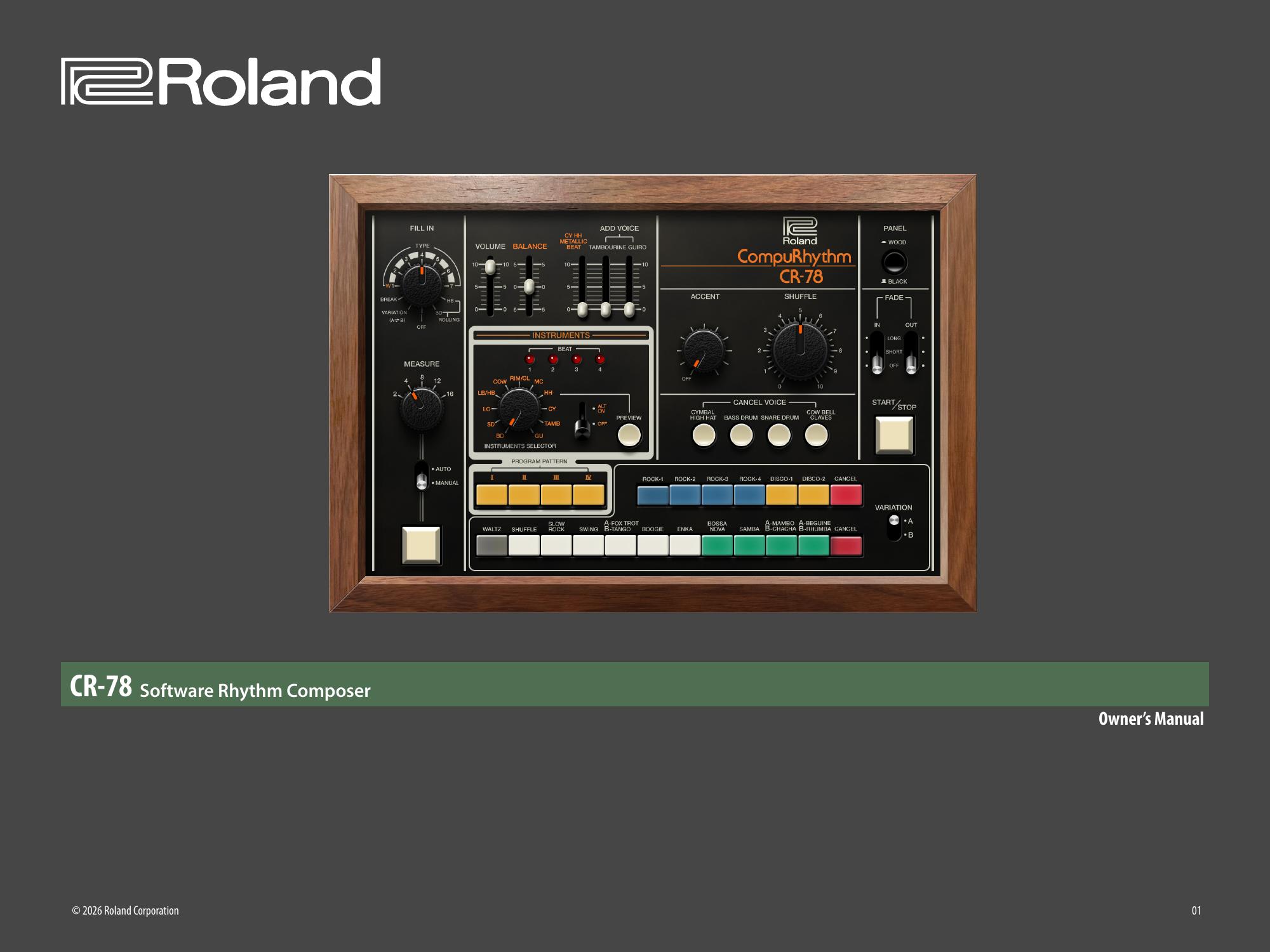
In 2026 Roland released a dedicated CR-78 Software Rhythm Composer. Its ACB model recreates the original circuit behaviour while adding per-instrument editing, modern synchronisation, expanded pattern memory and DAW workflow. The afterlife is therefore a continuing redesign of what should remain fixed and what later musicians should be allowed to change.

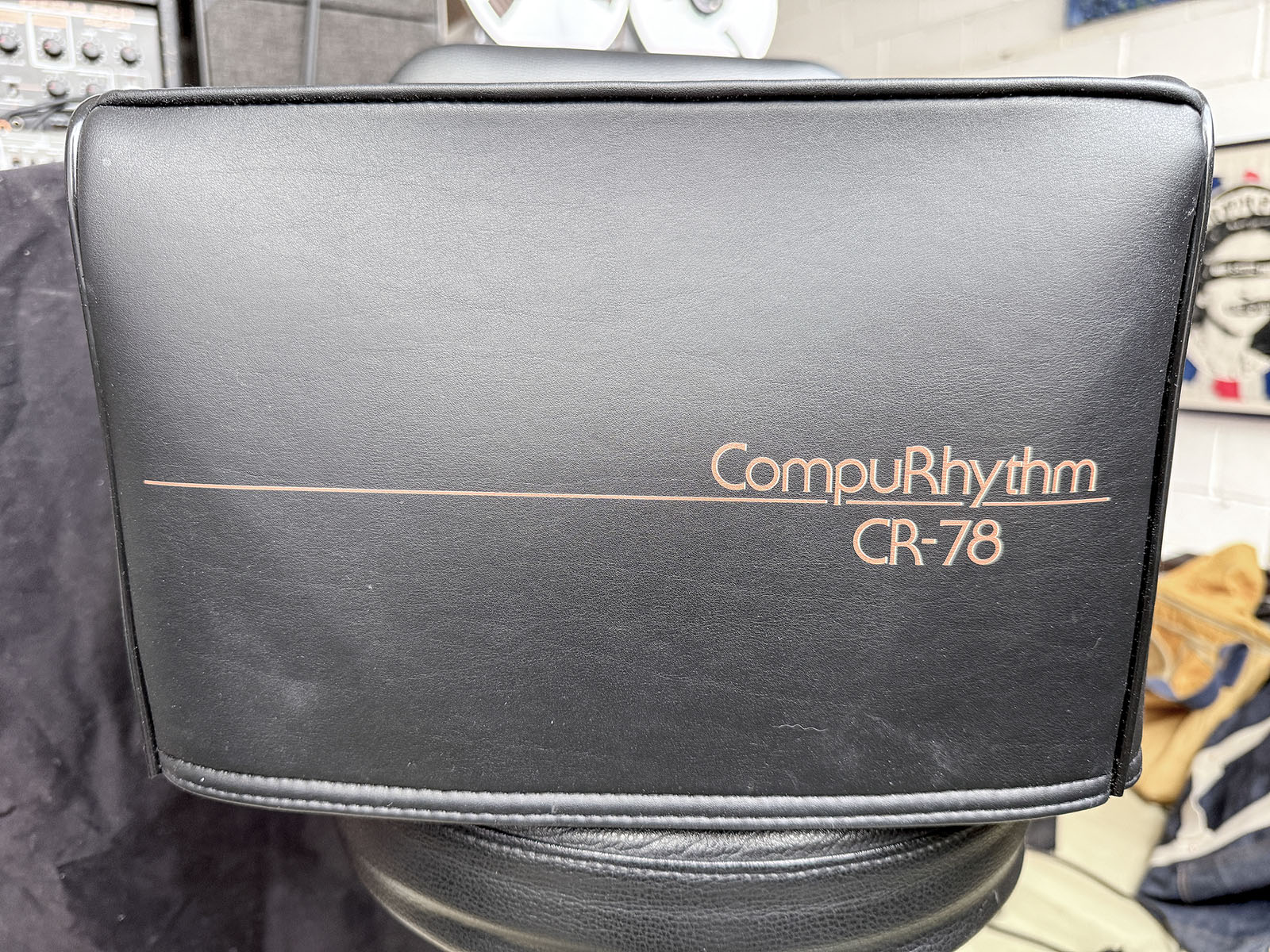
Black protective cover marked CompuRhythm CR-78 held with the Big Beat Collection unit
BIG BEAT COLLECTION // PROTECTIVE COVER HELD WITH UNIT 841853
Cover of Roland's 2026 CR-78 Software Rhythm Composer owner's manual
ROLAND CR-78 SOFTWARE RHYTHM COMPOSER // OWNER'S MANUAL // 2026
Open the deeper story +

Hardware survival and modelled continuity

An original CR-78 is not only a source of tones. Its panel timing, variation controls, battery-backed memory, ageing components and physical switching all shape the experience. Restoration preserves that coupled system, including behaviours that a sample library cannot carry.

The TR-8S and TR-6S update translated CR-78 voices into ACB instruments inside a performance-oriented modern sequencer. The TR-1000 extends that idea by letting CR-78 models coexist with multiple synthesis and sampling methods. In both cases the old sound becomes one selectable generator inside a much larger rhythmic grammar.

The dedicated Roland Cloud version returns to the identity of the complete machine. It models the original response but exposes tuning, decay, pan and mixing per instrument, provides 16-step A/B patterns and expands storage to modern proportions. It is simultaneously preservation and revision.

These versions should not be collapsed into a claim that every CR-78 is now interchangeable. Original hardware, ACB firmware and software share a designed lineage, but their converters, control resolution, clocking, gain structure and physical interface remain different. The archive records those differences as part of the instrument’s continuing history.

SOURCES AND FURTHER READING // CR-78

Continue through the original documents.

Owner’s manuals, service notes, period catalogues, contemporary press and first-hand accounts are identified by type so readers can follow the machine beyond this dossier.

B01

Big Beat Collection CR-78, unit 841853

Collection photography documenting the complete front panel, programmer, rear connections, identity plate and protective cover.

OPEN SOURCE ↗
R01

CR-78: The Whole Story

Official retrospective on memory, WS-1 and cultural use.

OPEN SOURCE ↗
R02

Sound Behind the Song: Heart of Glass

Trigger, pattern and recording context.

OPEN SOURCE ↗
M01

CR-78 owner's manual

Eight-page primary guide to controls, programming, connections, specifications and the WS-1.

OPEN SOURCE ↗
M02

CR-78 service notes

June 1979 service document: processor and memory logic, schematics, boards, calibration, revisions and battery warning.

OPEN SOURCE ↗
P01

Roland General Catalogue, October 1978

Primary Japanese catalogue presenting the CR-68 and CR-78 together and pricing the CR-78 at ¥105,000.

OPEN SOURCE ↗
P02

CR-68 / CR-78: No More Waiting for Louie

1979 US advertisement preserving contemporary product positioning.

OPEN SOURCE ↗
P03

Canadian Musician, June 1979

Period CR-78 advertisement, specifications and C$950 retail price.

OPEN SOURCE ↗
P04

Beat Instrumental CR-78 review, December 1980

Contemporary review of programming, interfacing and external-clock behaviour.

OPEN SOURCE ↗
A02

Phil Collins on In the Air Tonight

Participant account identifying the CR-78 preset foundation and added programmed bass drum.

OPEN SOURCE ↗
A01

Andy McCluskey: How I wrote Enola Gay

Songwriter testimony that OMD programmed the CR-78 rhythm used as the bed of the record.

OPEN SOURCE ↗
R03

Roland CR-78 technical specifications

Official control, sound-source, connection, voltage, dimension and weight reference.

OPEN SOURCE ↗
R04

Roland TR-8S system program 3.00

Official 2023 record of the CR-78 ACB instrument set.

OPEN SOURCE ↗
R05

Roland CR-78 Software Rhythm Composer

Official 2026 ACB software continuation, controls and specifications.

OPEN SOURCE ↗
R06

Roland announces CR-78 Software Rhythm Composer

Dated January 2026 release record for the dedicated software instrument.

OPEN SOURCE ↗

PASS THE FILE ON // CANONICAL TRANSMISSION

SHARE THE ROLAND COMPURHYTHM CR-78.

Send readers directly to this machine file on Drum Machines Have No Soul.

drummachineshavenosoul.com/machines/cr-78

THE MACHINE LINE // 04 OF 12

FOLLOW THE CHANGE.

Each machine inherits a working idea and moves one musical decision. Continue through the family by what the player can do—not by model number alone.