BIG BEAT MACHINE FILE // 005

808

The drum synthesizer changes gravity

Roland TR-808 Rhythm Composer1980Rhythm composer

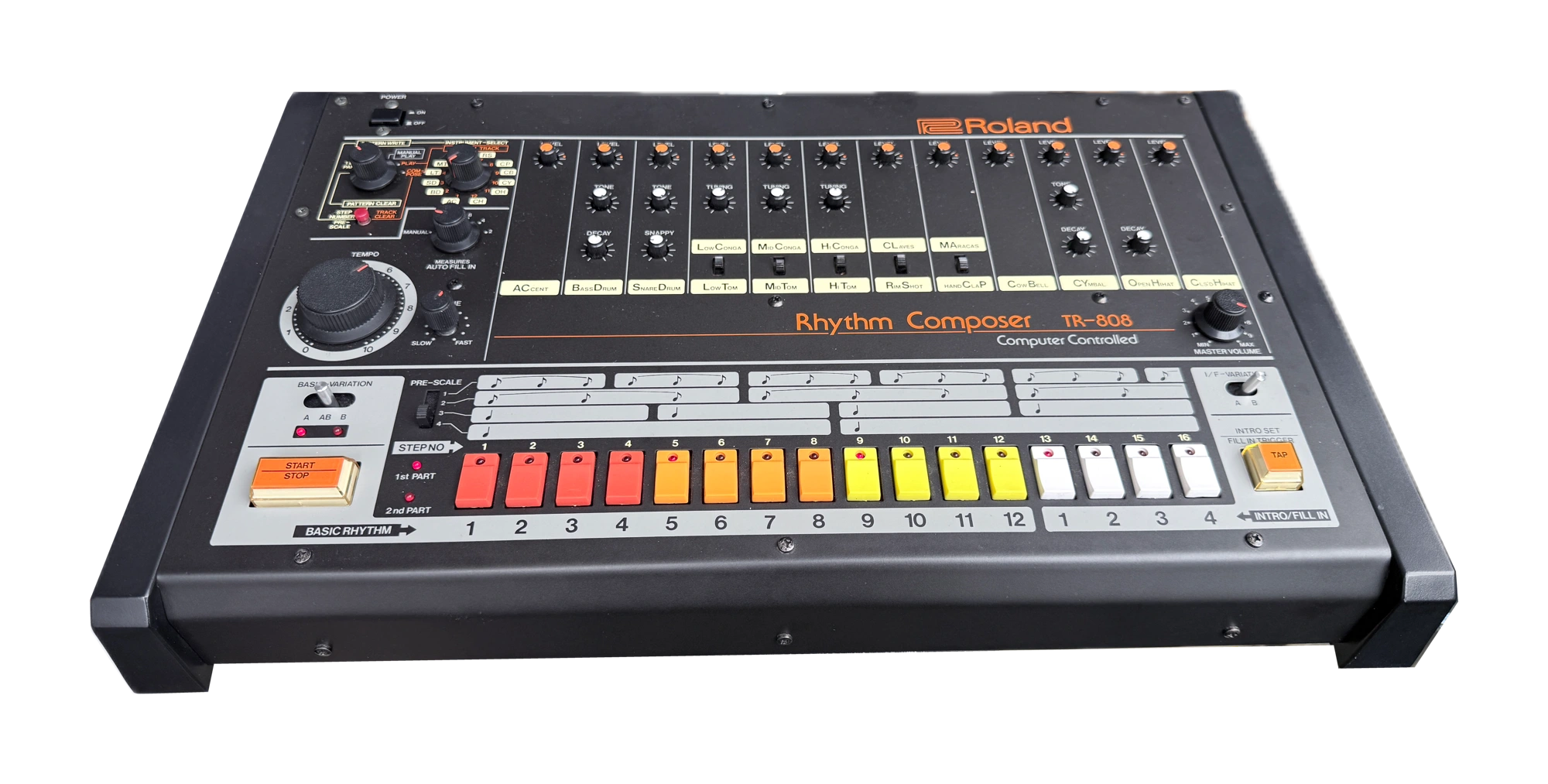
The Roland TR-808 Rhythm Composer joins eleven analogue instrument channels, a programmable sixteen-step language and a bass drum that stopped imitating acoustic reality and began reorganising popular music.

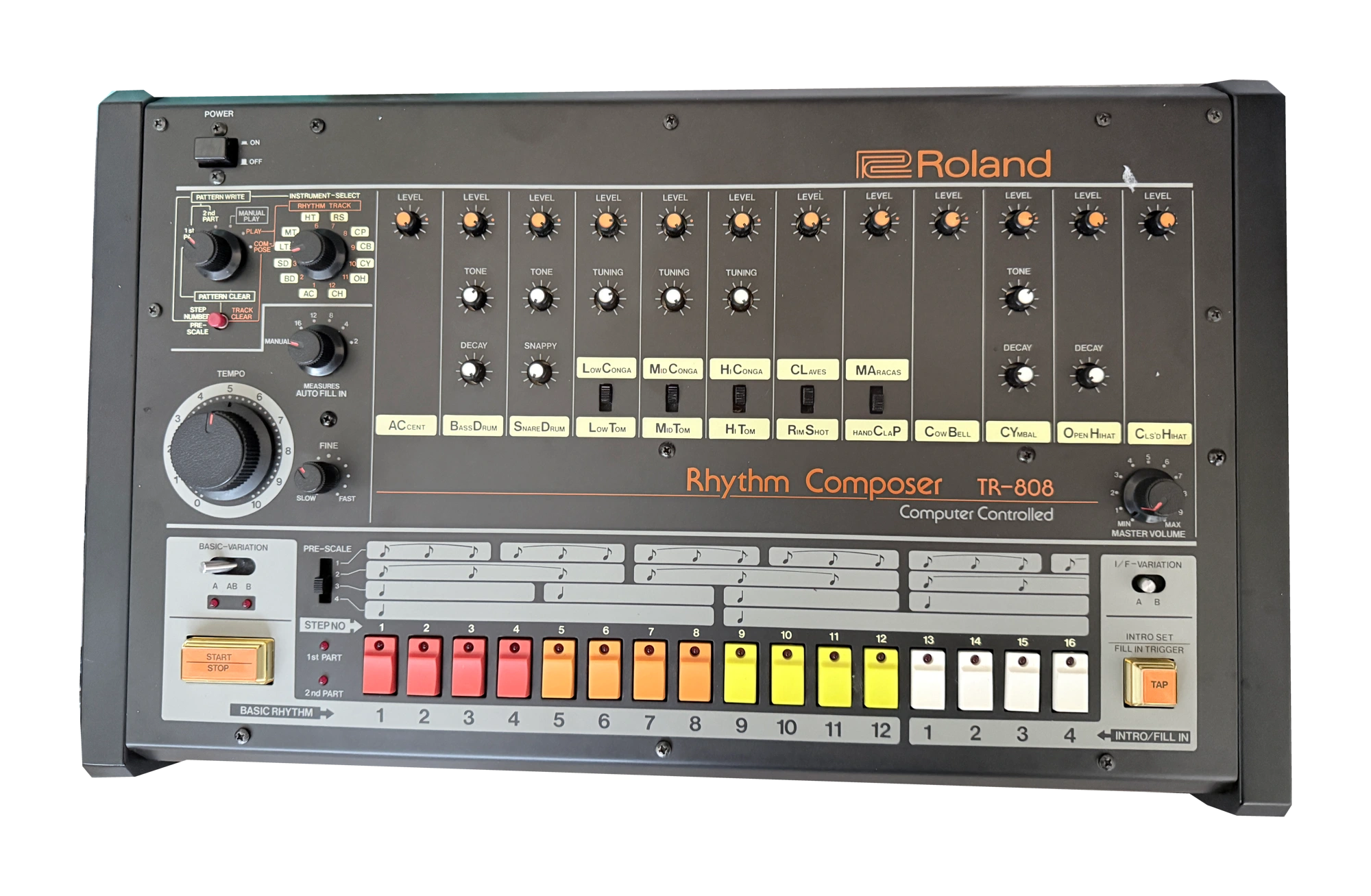
Big Beat Collection Roland TR-808, complete isolated view
PRODUCTIONRoland’s retrospective gives 1980–1982 and approximately 12,000 manufactured; its Japanese service register gives 1981–1983
SOUND ENGINE11 analogue instrument channels
RHYTHM MEMORY32 writable pattern memories; 12 × 64-measure rhythm tracks
More facts, listening references & sources
PERIOD PRICEUS$1,095 in period sources; ¥150,000 by October 1981
LINEAGE ADVANCERoland replaces accompaniment labels with a fully writable, per-instrument step grid and gives the analogue voices direct performance controls and individual outputs.
WHAT THE PLAYER GAINSEvery hit can be placed, accented, mixed and arranged into a track; the machine becomes the author of a rhythm rather than an arranger of factory styles.
NOTABLE USERSYellow Magic Orchestra · Marvin Gaye · Afrika Bambaataa · Egyptian Lover
START LISTENINGYellow Magic Orchestra — BGM (album project) · Marvin Gaye — Sexual Healing · Afrika Bambaataa & Soulsonic Force — Planet Rock
Sources for the artists and listening references

Artist accounts, historical attributions and performance films establish different things. These notes explain the basis for each reference.

THE BIG BEAT COLLECTION // ROLAND TR-808 RHYTHM COMPOSER

THE WHOLE INSTRUMENT IS THE INTERFACE.

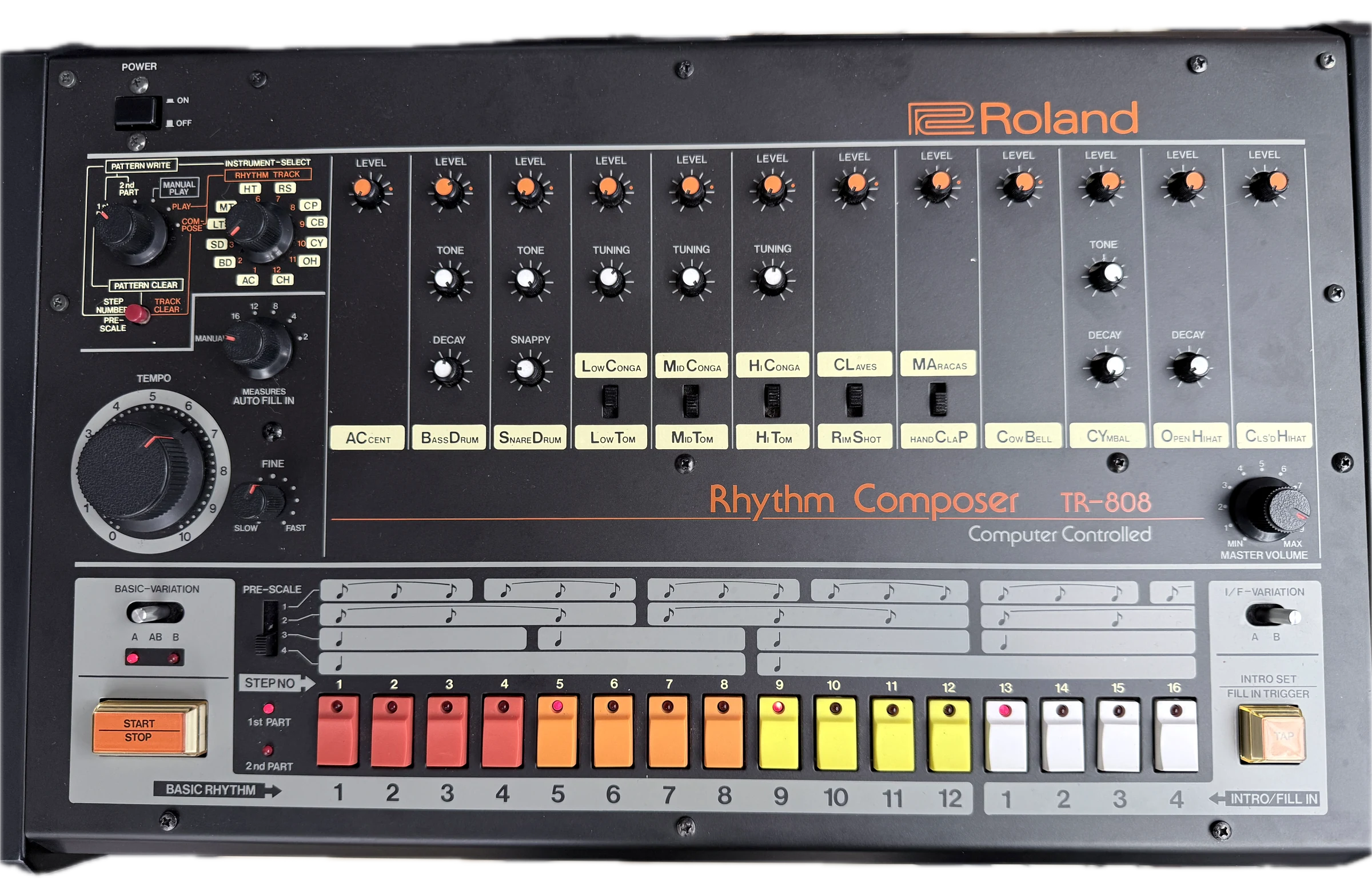
Seen directly from above, the TR-808 reads as one continuous working surface: pattern controls and tempo at the left, voice controls across the centre, and the sixteen-step row joining programming to performance.

PAGE 01 // ORIGIN // 1980

A drum synthesizer, not cheap PCM

Tadao Kikumoto proposed an electronic instrument whose voices could be shaped instead of an expensive machine based on short recordings.

The TR-808 was developed by the group later celebrated as Roland's 'Analog Mafia': Kikumoto with Jun-ichi Kadoya, Hisanori Matsuoka, Kiyokazu Fujiwara and Yoshiro Oue. The design brief joined individual analogue percussion circuits to computer-controlled sequencing and memory.

The familiar rejected-transistor story needs precision. Roland's account concerns selected out-of-specification transistors in the noise generator and the voices derived from that noise; it is not an explanation for every 808 sound. The bass drum's extended decay was an intentional musical choice.

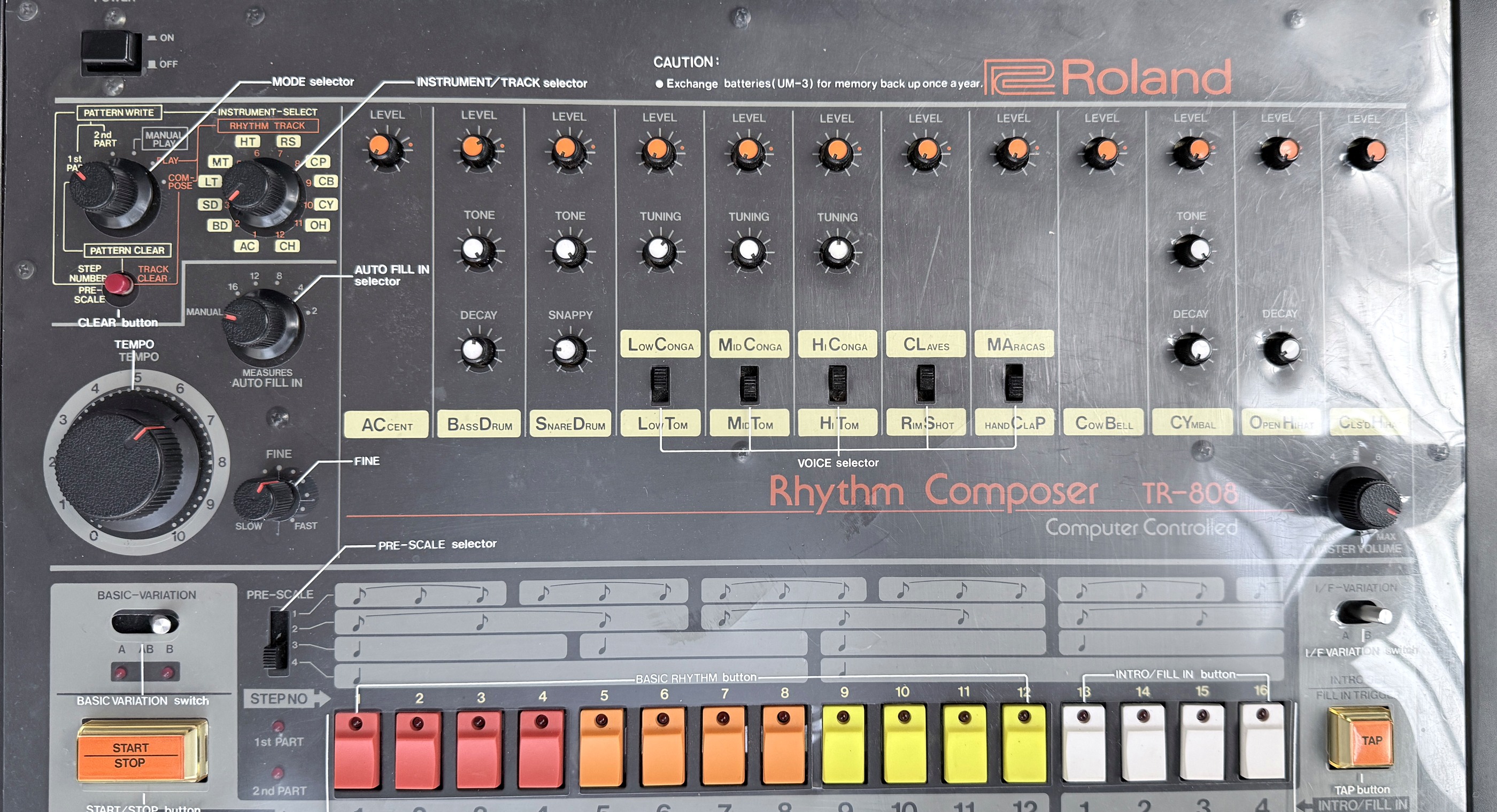
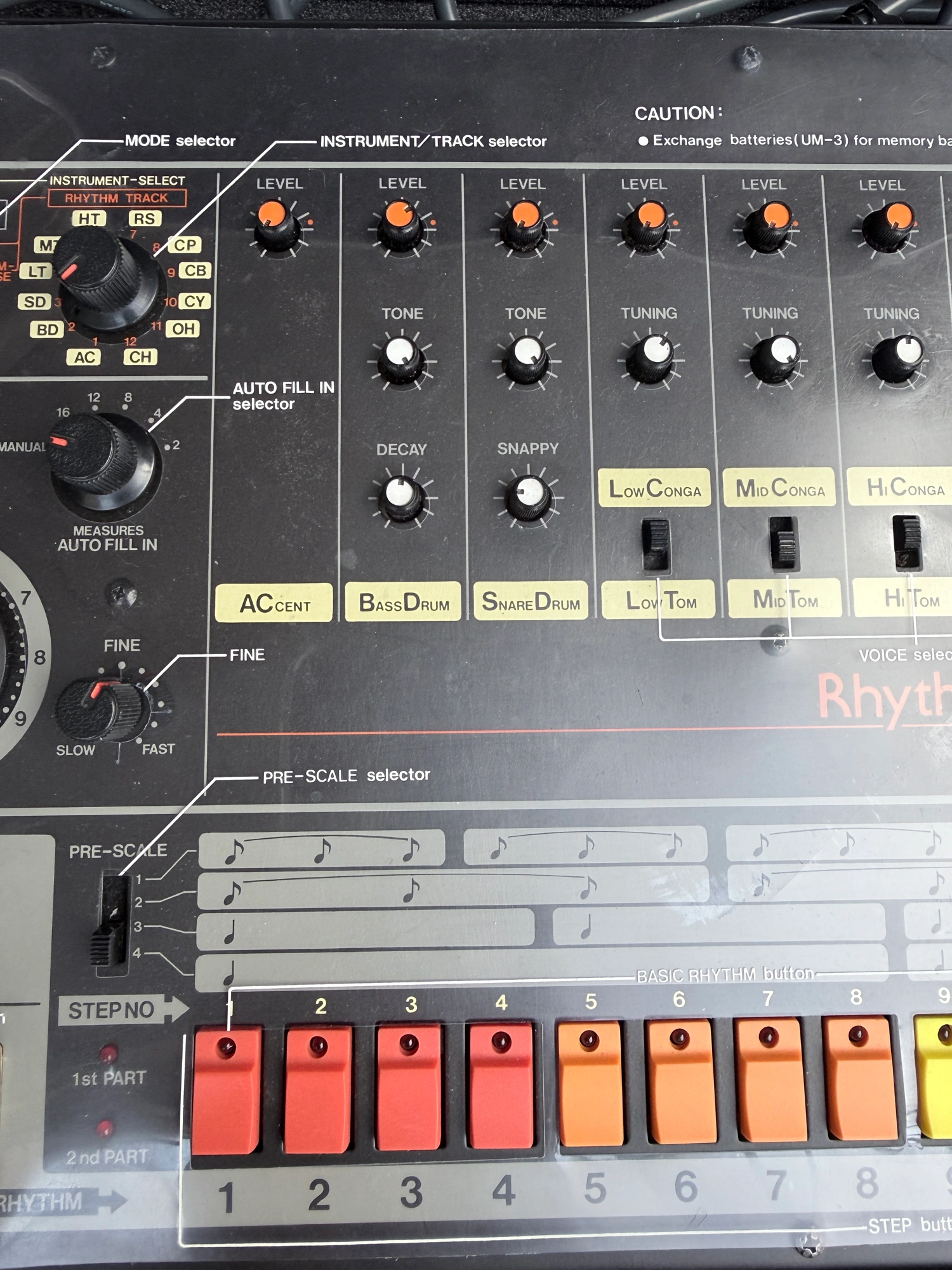
The collection machine also retains the transparent instructional overlay supplied with it for display in shops. Laid over the panel, it names selectors and buttons and traces their functions for a customer encountering the instrument for the first time. Few photographs of an 808 preserve this layer: it records how Roland introduced the machine at the point of sale, before the controls became a shared musical language.

Big Beat collection Roland TR-808 with its rare transparent instructional shop-display overlay laid across the control panel
THE SHOP-DISPLAY OVERLAY // THE 808 AS IT WAS EXPLAINED IN STORES
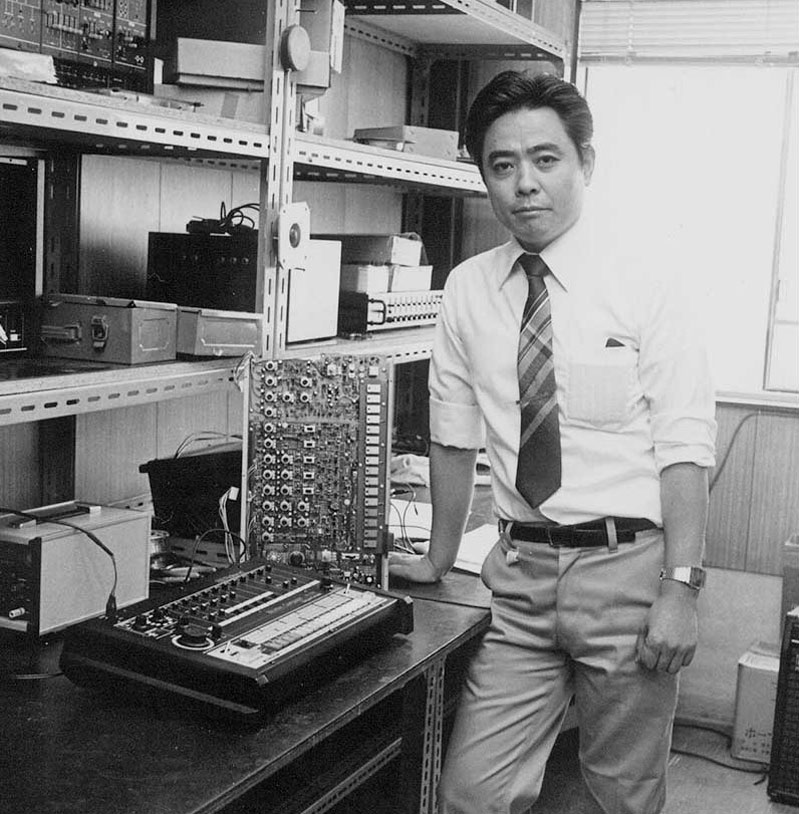
Roland engineer Tadao Kikumoto with an early TR-808 prototype
TADAO KIKUMOTO WITH AN EARLY TR-808 PROTOTYPE // ROLAND ARCHIVE
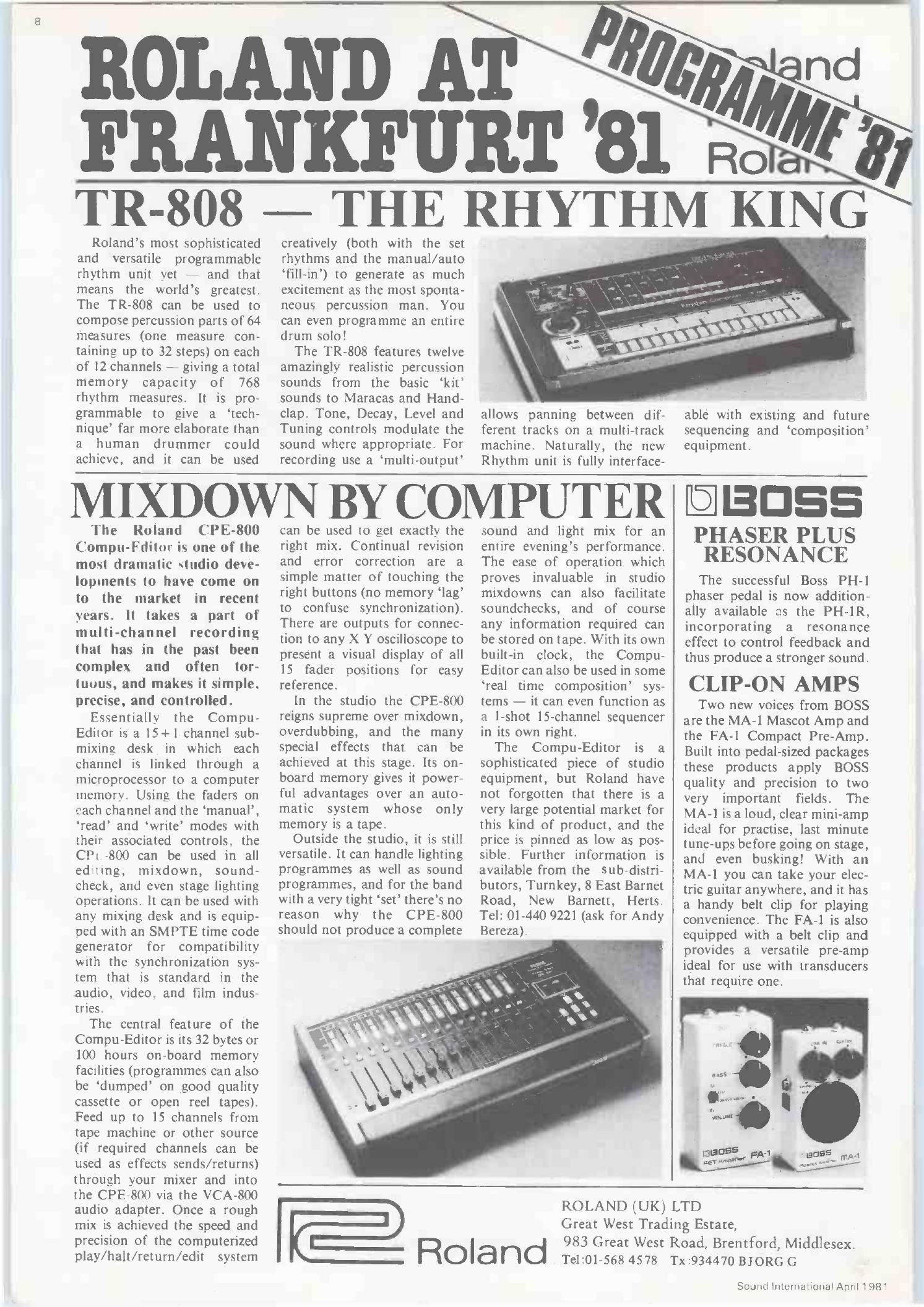
Roland at the 1981 Frankfurt trade fair presenting the TR-808 as The Rhythm King
ROLAND AT FRANKFURT 1981 // THE TR-808 PRESENTED AS THE RHYTHM KING
Open the deeper story +

From Don Lewis’s performance questions to Mid-O’s engineering team

Roland did not arrive at the 808 from nowhere. Earlier Ace Tone and Roland rhythm boxes established pattern combination, individual percussion voices and the idea that a rhythm machine could be performed rather than merely switched on. Don Lewis’s modified instruments and long exchange with Ikutaro Kakehashi belong to that prehistory, but they do not make one person the sole inventor of the 808.

Inside Roland’s Mid-O development group, Kikumoto worked with engineers responsible for circuit design, programming, sound and production. The project joined an emerging microprocessor-controlled rhythm composer to voices deliberately formed as electronic percussion. Authorship is therefore collective: a design organisation turned musical requirements into a reproducible instrument.

PCM was commercially available, but memory capable of holding a useful drum kit remained expensive. Analogue synthesis was not merely a cheaper imitation. It allowed controls such as bass-drum decay, snare tone and snappy, cymbal decay and conga tuning to remain alive on the panel.

The celebrated transistor story concerns a selected batch used in the noise source. It helps explain the noise-derived family—especially snare, clap and maracas—but not the bass drum, toms, cowbell or every other circuit. The 808’s identity comes from many deliberate topologies coordinated by one instrument.

Release was also a sequence rather than a single moment: prototype use, Japanese appearance, export demonstration, dealer stock and record release did not happen simultaneously. Yellow Magic Orchestra and the Plastics provide early documented routes into recording before the machine acquired its later global mythology.

That sequence can now be stated more precisely. Hideki Matsutake places a loaned prototype inside Yellow Magic Orchestra’s 29 December 1980 Budokan system; Kikumoto later recalled recognising its handclap in the broadcast. The prototype was returned. Matsutake then obtained an instrument from the first production lot and identifies BGM, released on 21 March 1981, as YMO’s first recording project with the TR-808. This is secure at project level, not a licence to assign an 808 voice to every track.

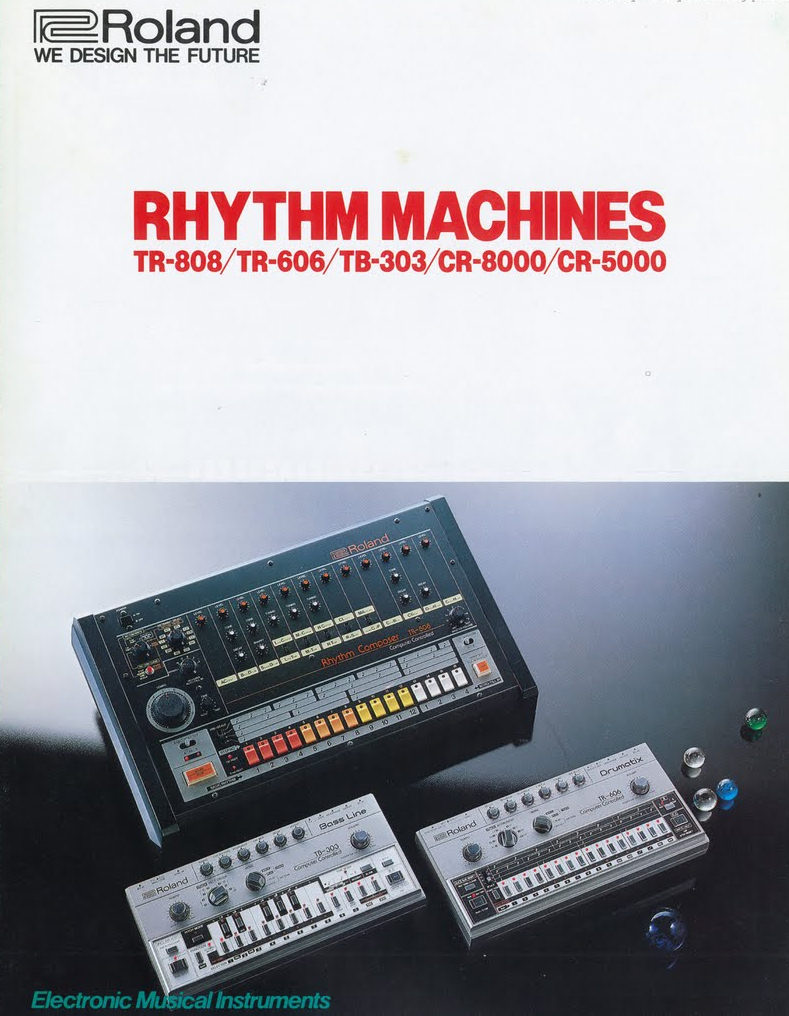
Period Roland Rhythm Machines catalogue showing the TR-808 with the TR-606, TB-303, CR-8000 and CR-5000
ROLAND RHYTHM MACHINES // PERIOD PRODUCT CATALOGUE // ARCHIVE COPYDOCUMENTARY SOURCE
01020304050607080910111213141516

PAGE 02 // SOUND // ELEVEN VOICES

A kit made from behaviours

The 808's instruments succeed because each occupies a clear envelope and spectrum, not because any one is acoustically exact.

The bass drum is a resonant circuit excited into a decaying oscillation; the snare combines tuned bodies with noise; toms, rimshot and cowbell use their own interacting resonances; clap, hats and cymbal turn noise and oscillator structures into metallic movement.

Front-panel tuning, tone, decay, level and snappy controls are distributed unevenly because each circuit has a different musical identity. The machine is not one synthesizer multiplied eleven times. It is a coordinated set of specialised percussion instruments.

Complete frontal collection photograph of the Roland TR-808 control surface
THE COMPLETE CONTROL SURFACE // ELEVEN VOICES AND ONE PROGRAMMING ROW
Collection photograph of the Roland TR-808 voice controls and step keys with its instructional overlay
VOICE CONTROLS AND STEP KEYS // SURVIVING INSTRUCTIONAL OVERLAY
Open the deeper story +

Eleven voices, circuit by circuit

BASS DRUM — A trigger pulse excites a bridged-T resonant network. The initial click establishes the strike while the oscillation supplies the low body. TONE changes the balance of the event; DECAY controls how long the resonance persists. At long settings the voice crosses from drum into bass note, which is why recording level and loudspeaker behaviour are part of its history.

SNARE DRUM — Two tuned oscillating bodies provide weight while filtered noise supplies the wire-like spray. TONE shifts the body relationship and SNAPPY controls the noise contribution. A thin snare may have lost a body component; a noisy snare is not necessarily producing the complete voice.

TOMS AND CONGAS — Three tunable resonant channels share panel lanes, with the selector changing excitation and envelope behaviour between tom and conga identities. Their stable pitch makes them harmonic material: tuned across a track they can form bass movement, melody or a non-descending answer to the usual fill.

COWBELL, CYMBAL AND HI-HATS — Six free-running square-wave oscillators create an intentionally inharmonic metallic source. Separate filtering and envelopes extract cowbell, cymbal and hat behaviours from related material. Open and closed hats also form a choke relationship, so programming one changes the duration of the other.

HANDCLAP AND MARACAS — Both begin with noise, but the clap’s multiple envelope bursts sketch the arrival of several hands before a diffused tail. Maracas turns a much shorter noise event into continuity. RIMSHOT and CLAVES share a lane and show the opposite lesson: a brief, bright event can imply motion without occupying the whole spectrum.

ACCENT is not an extra drum. It is a control lane whose voltage changes the response of voices on selected positions. Because the circuits do not all scale identically, the same accent pattern rearranges the kit rather than simply making every hit uniformly louder.

ELEVEN SMALL INSTRUMENTS

There is no single 808 circuit.

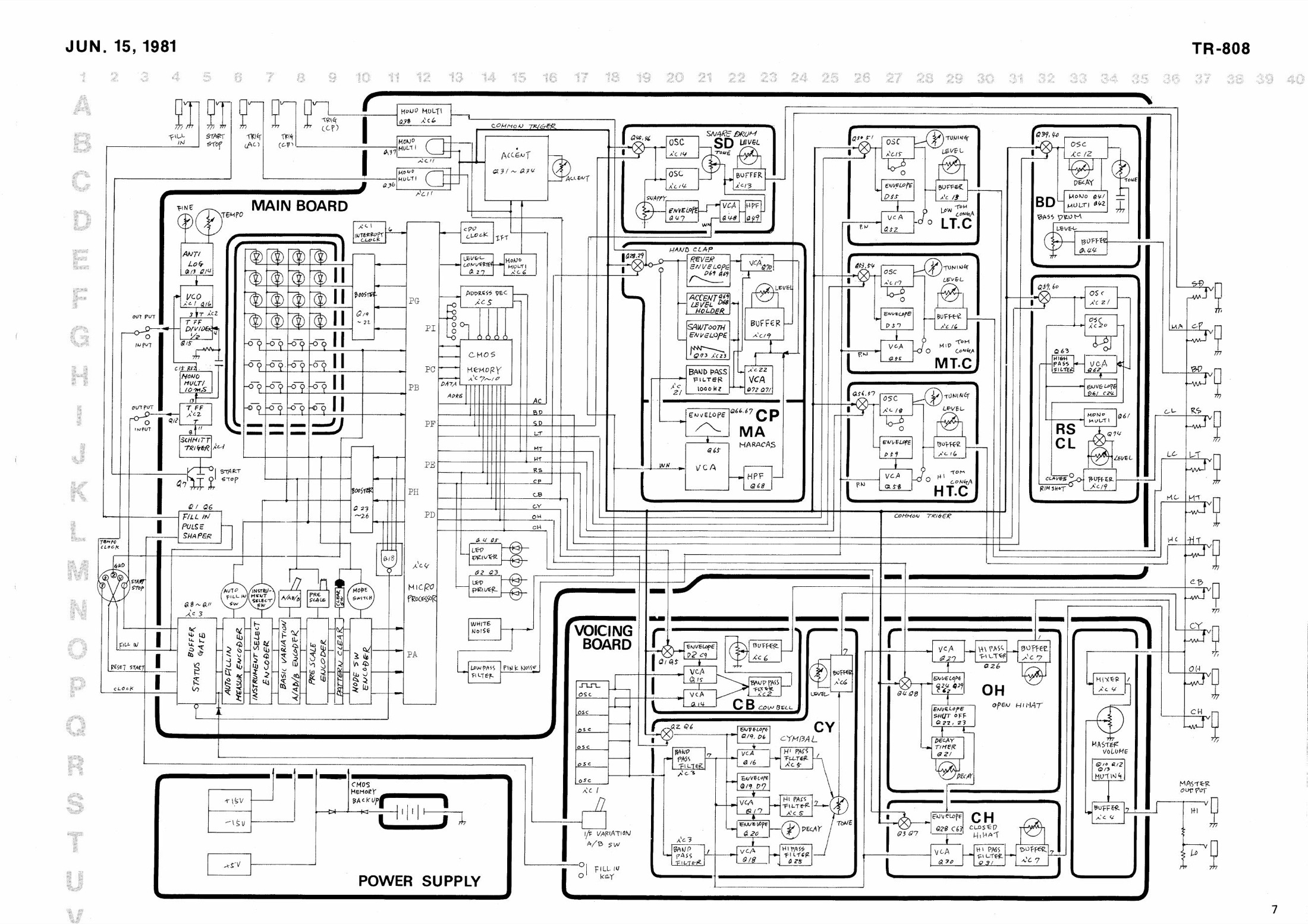
The functional diagram places the processor and trigger distribution beside separate blocks for bass drum, snare, toms, rimshot, clap, cowbell, cymbal and hats. The family sound comes from coordination; every voice reaches it by a different electrical route.

TR-808 functional block diagram showing its processor, trigger system and individual voice circuits
TR-808 SERVICE NOTES // FUNCTIONAL BLOCK DIAGRAM // PAGE 7PRIMARY TECHNICAL EVIDENCE
Read the circuit in depth +

Read the 808 as three machines and a studio

The first machine is the sequencer: processor, memory, mode logic, scale, A/B variation and track arrangement. It stores voice events rather than audio. The second is the trigger system, which converts those events and the Accent lane into timed control pulses. The third is the collection of independent analogue voice circuits that answer those pulses.

The studio becomes a fourth layer. Eleven individual outputs allow engineers to change gain, equalisation, dynamics, ambience and distortion voice by voice. A recorded 808 is therefore not simply the circuit on the service page; it is that circuit entering a desk, tape machine, sampler, sound system or overloaded input.

For diagnosis, separate those layers. Confirm that the sequencer advances, then test trigger and accent delivery, then measure the affected voice, and only then inspect the mix and individual-output paths. A silent bass drum and a bass drum missing from one pattern can have entirely different causes.

The schematic is a map of functions, not a recipe for indiscriminate adjustment. Document the instrument before service, use the specified test points and supply conditions, and preserve component and calibration history wherever the machine remains stable and musical.

PAGE 03 // SEQUENCE // SIXTEEN STEPS

The grid becomes shared musical grammar

Its programming method makes time visible, repeatable and editable one illuminated position at a time.

Basic Rhythm and Intro/Fill-In parts can be written at selectable scales, chained into longer tracks and performed from the panel. Individual outputs separate voices for the mixer; DIN Sync coordinates compatible devices; trigger outputs let programmed events drive external equipment.

The crucial innovation is ergonomic as much as electronic. A rhythm can be heard while it is being constructed, and each decision remains available for revision. The sixteen-step row becomes a notation system that musicians learn by touch.

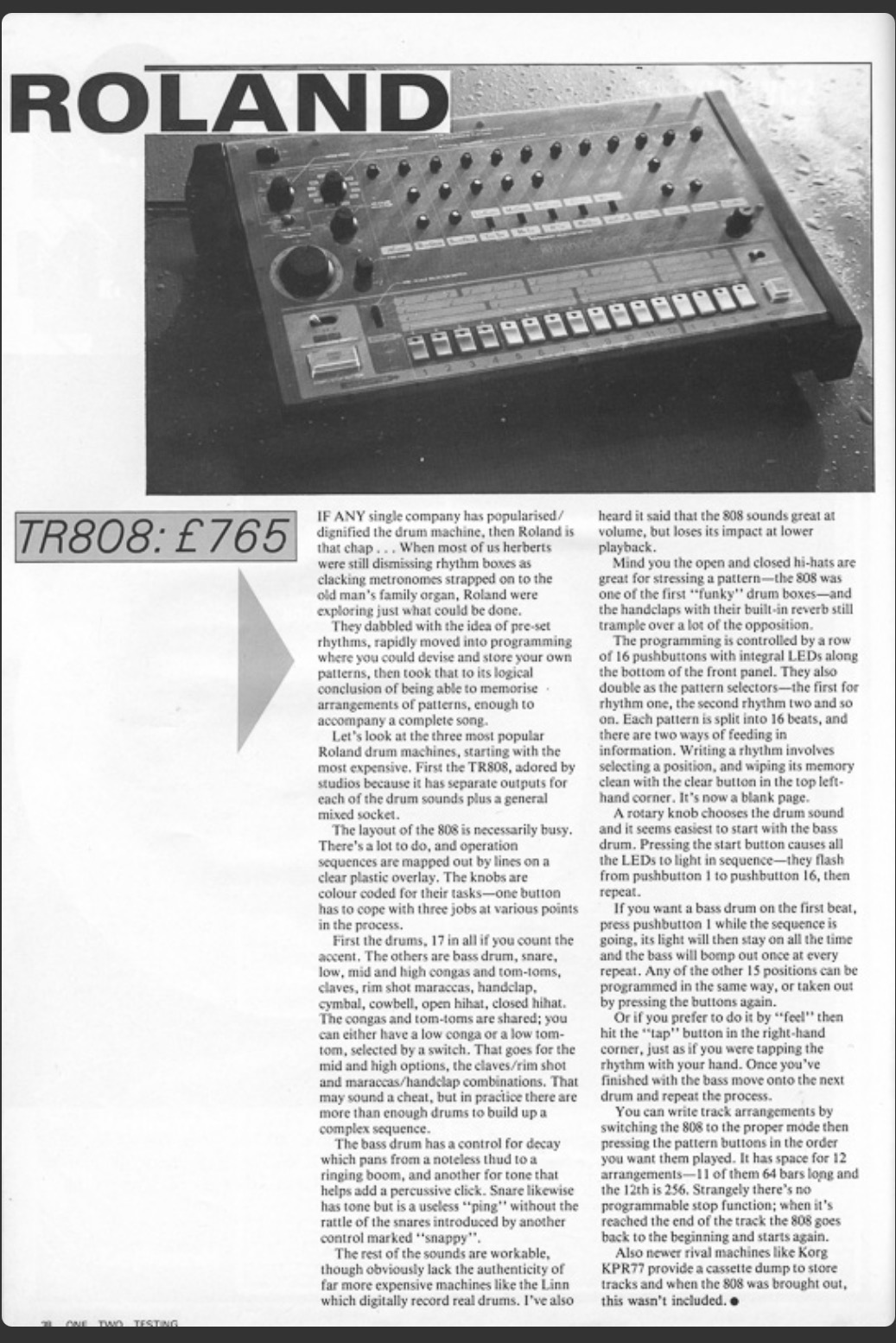
Contemporary British review of the Roland TR-808 Rhythm Composer
ONE TWO TESTING // CONTEMPORARY TR-808 REVIEW // £765
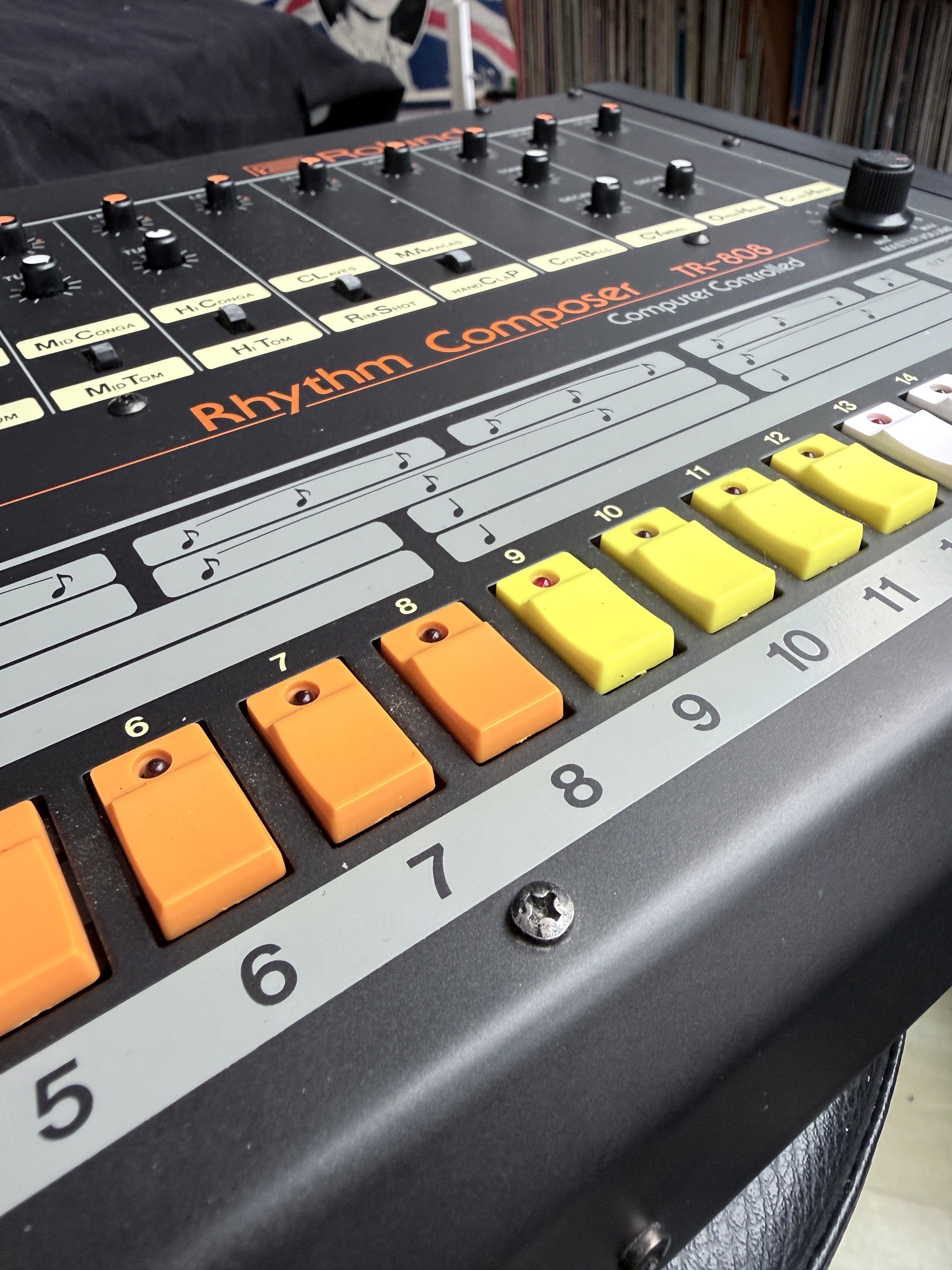
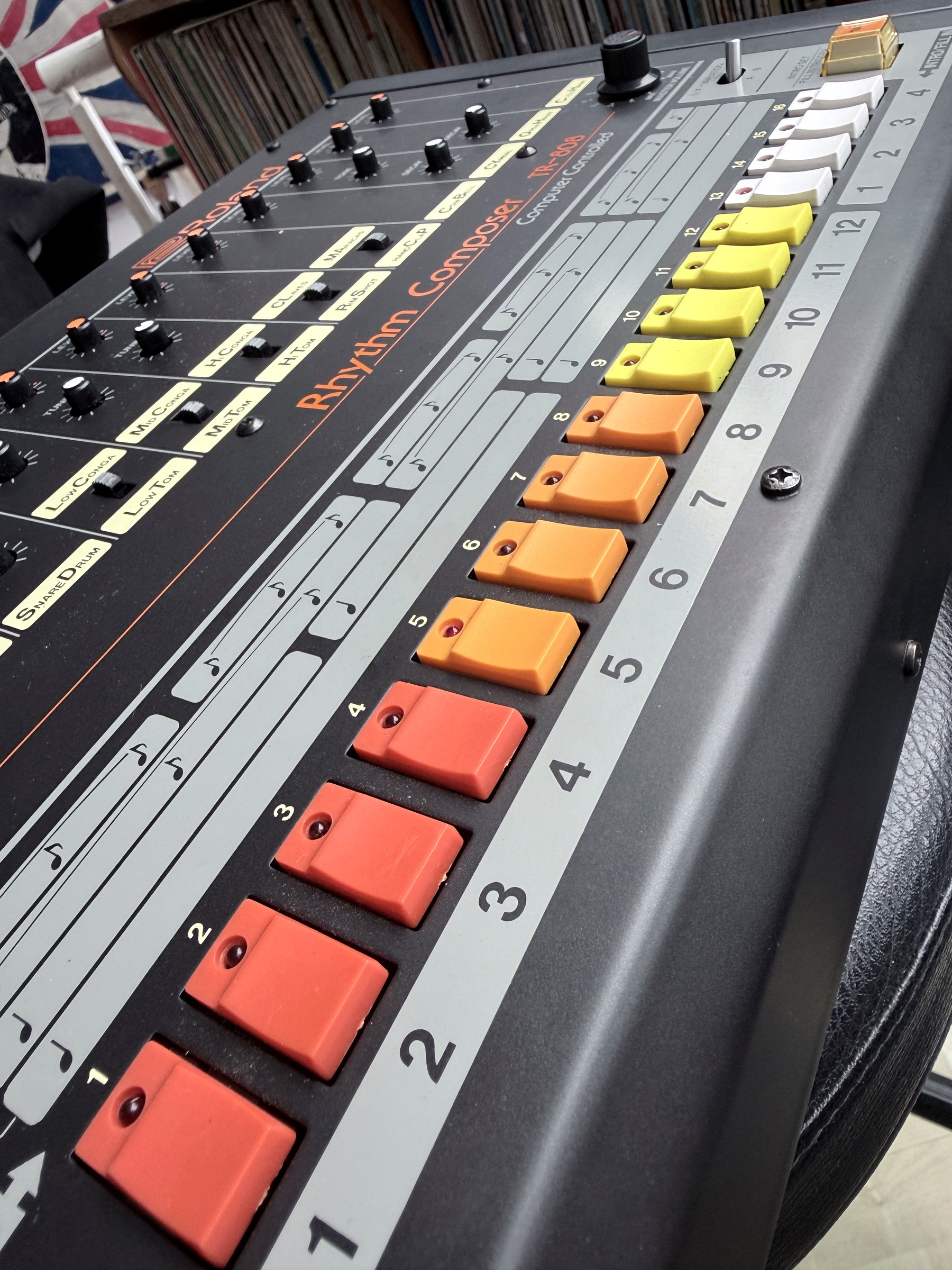
Oblique collection photograph following the Roland TR-808 sixteen-step keys from one to sixteen
THE PLAYABLE ROW // SIXTEEN POSITIONS READ ACROSS THE PANEL
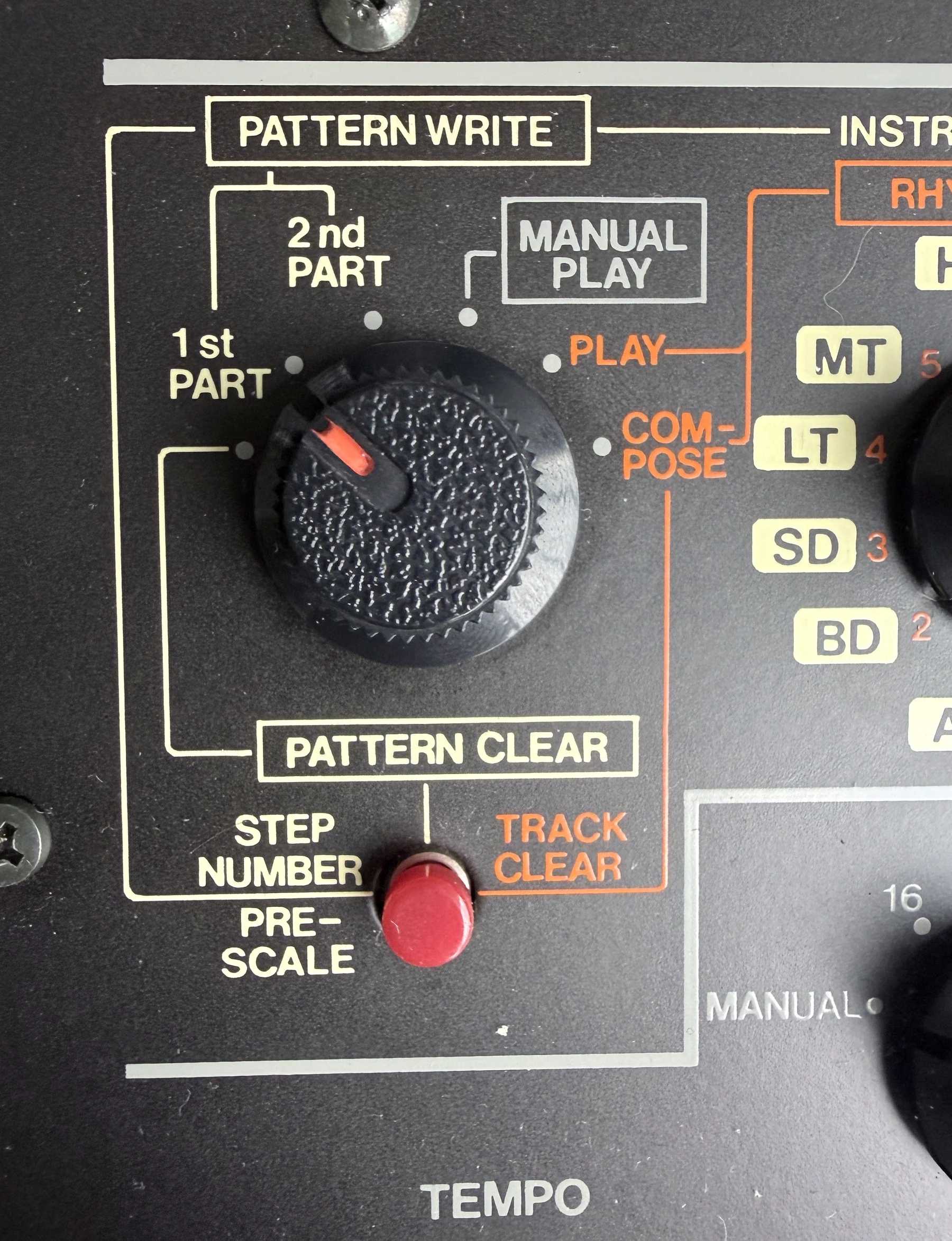
Collection detail of the Roland TR-808 Pattern Write selector and printed programming routes
PATTERN WRITE // PARTS, INSTRUMENTS AND CLEAR FUNCTIONS SHARE ONE SELECTOR

PROGRAM THE GRID // INTERACTIVE STUDY

PATTERN: ELECTRO SPINE / 4 VOICES / 16 STEPS / 116 BPM

Write the machine, then hear the method.

These four browser-generated voices demonstrate bass-drum placement, backbeat, subdivision and handclap layering on a sixteen-step 808-style working surface.

Practice patterns built to demonstrate the machine’s controls; they are not transcriptions of released recordings.

A syncopated low-end line answers the backbeat while short hats mark the spaces between quarter notes.

EDITING: Bass drum

AUDIO STARTS AFTER YOUR FIRST PRESS

Open the deeper story +

What the original 808 actually remembers

A pattern stores instrument events at positions defined by PRE-SCALE. The row may represent straight sixteenths, triplet subdivisions or longer values; sixteen lamps do not always equal one bar of 4/4. FIRST and SECOND PART extend a pattern, while A and B create a separate axis of variation.

The machine holds twelve Basic Rhythms and four Intro/Fill-In locations, with A/B relationships, then lets the player compose twelve Rhythm Tracks of up to 64 measures each. Track Compose records the performance of patterns and fills into an arrangement; it does not record audio or every movement of a knob.

Tap programming, manual fills, automatic fill intervals and foot control turn memory into live structure. A useful pattern bank is organised by role—foundation, sparse state, lift, breakdown, transition—so the performer can arrange rather than search for numbered fragments.

DIN Sync establishes shared tempo and transport with compatible Roland equipment. Three trigger outputs let programmed lanes become control information for external synth envelopes or sequencers. Individual audio outputs perform the complementary job: they send sounds outward so a mixer can complete the composition.

The 808 has no shuffle parameter. Groove comes from scale choice, rests, accent, alternating A/B material, hand-entered tap relationships and the timing behaviour of a larger synchronised system. Its grid is strict, but composition inside and around that grid need not be mechanical.

PAGE 04 // STUDIO // OUTPUTS, TRIGGERS AND SYNC

The back panel turns one box into a system

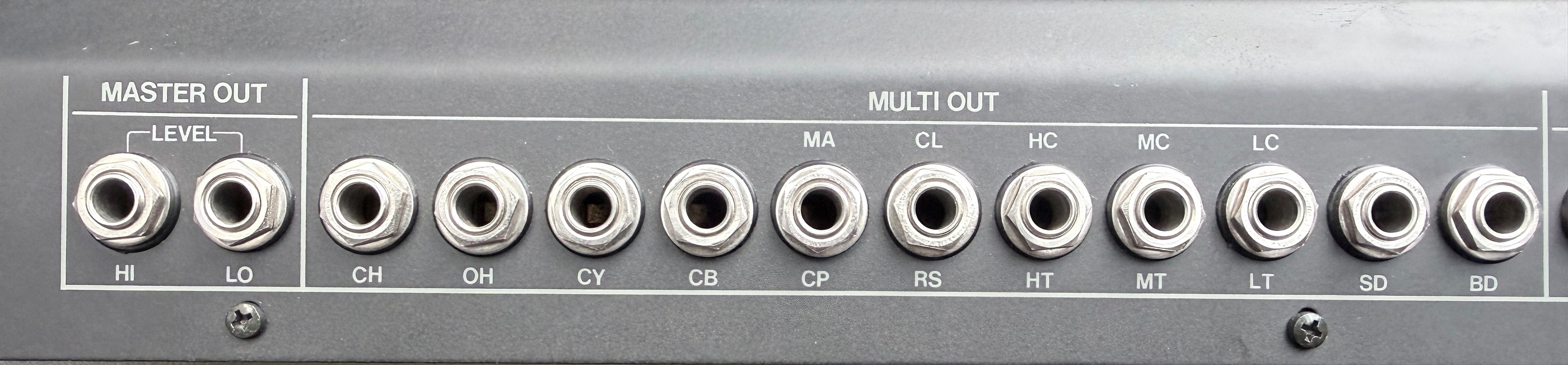
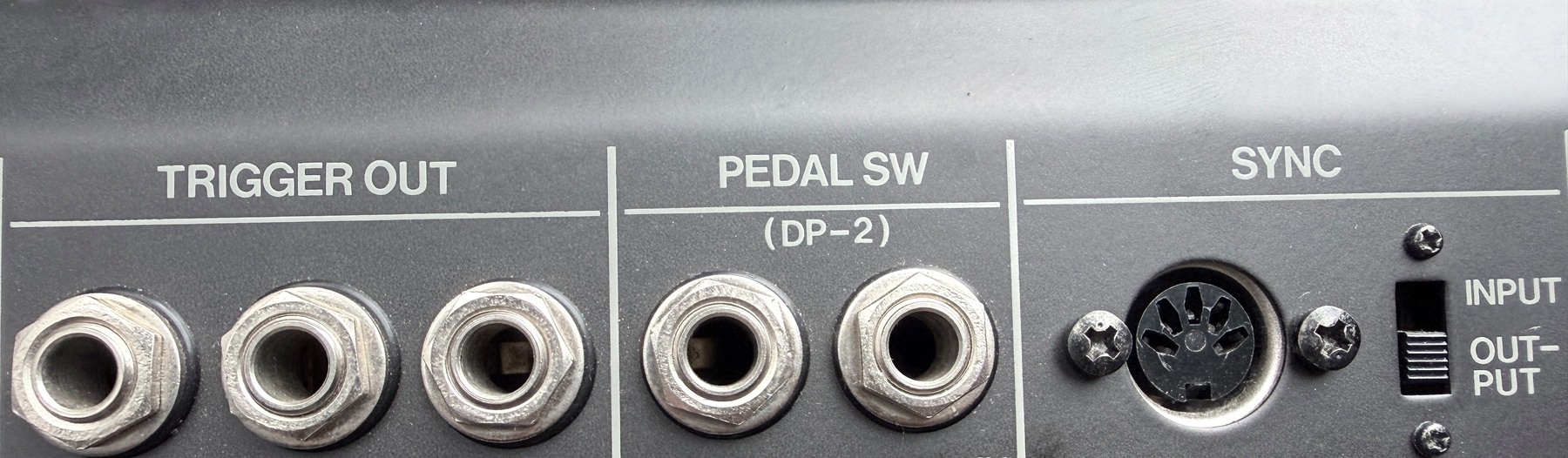
Eleven individual outputs, two master levels, three fixed trigger lanes and DIN Sync let the rhythm leave the cabinet as sound, voltage and shared time.

An individual-output cable does more than duplicate a voice. Its switching jack removes that instrument from the Master mix and gives the engineer a separate route for level, equalisation, compression, distortion or ambience. The familiar recorded 808 is often separately routed instrument channels meeting a mixing desk rather than one finished mono sound.

The three Trigger Outs convert selected programmed lanes into control pulses for compatible external equipment, while DIN Sync carries clock and transport to other Roland machines. Together they let an 808 rhythm organise synthesizers, sequencers and samplers while the connected instruments retain their own audible roles.

Isolated rear-panel strip of the Big Beat collection Roland TR-808 showing master and individual audio outputs
AUDIO // MASTER HIGH AND LOW, THEN ELEVEN SWITCHING INDIVIDUAL OUTPUTS
Isolated rear-panel strip of the Big Beat collection Roland TR-808 showing trigger outputs, pedal inputs and DIN Sync
CONTROL // TRIGGER OUT, PEDAL SWITCHES AND DIN SYNC
Open the deeper story +

Follow sound, voltage and time separately

INDIVIDUAL OUTPUTS — Each voice jack contains a normalled contact. With no plug inserted, that voice continues to the Master mixer. Inserting a cable breaks the normal connection and hands the voice to an external console. If a sound is present at its own jack but absent from Master, inspect the cable state and switching contact before entering the synthesis circuit.

MASTER HIGH AND LOW — Roland specifies approximately 6 V peak-to-peak into 1 kΩ at the High output and 0.6 V peak-to-peak into 3 kΩ at Low. The service circuit shows the Low path derived through a 27 kΩ / 3.3 kΩ divider. A level comparison means little unless the selected output, load and following gain stage are recorded.

TRIGGER OUTS — CB, CP/MA and AC provide the three fixed trigger lanes. These short positive pulses can fire a compatible envelope, sequencer or sampler, but they are not audio, note data or freely assignable outputs. Voltage, polarity, pulse width and receiving circuit must be confirmed before connection.

DIN SYNC — The five-pin socket carries 24 clock pulses per quarter note and separate run/stop state. It does not carry patterns or audio. A connected TB-303 or TR-606 keeps its own memory and sound engine while the machines agree on tempo and transport.

Jimmy Jam and Terry Lewis show why these provisions are musical controls. On the S.O.S. Band’s “Just Be Good to Me”, the kit could reach the desk voice by voice while bass-drum decay was moved during the pass. Programming, mixing and touching the instrument became parts of the same arrangement.

Marley Marl later used the distinction between sound and control even more radically. On MC Shan’s “The Bridge”, the 808’s pulses triggered sounds held in several samplers. The machine could organise the record while its stock voice circuits were no longer the whole audible kit.

PAGE 05 // SURVIVOR // SERVICE AND PRESERVATION

An original 808 is a circuit and an object biography

Forty-five years of batteries, switching contacts, transport, repairs and component drift now sit between a factory schematic and the instrument on the bench.

Begin with observation rather than adjustment. Record the serial number, regional voltage, modifications, battery condition, stored patterns, cold-start behaviour and every audio, trigger and sync function before anything is cleared or opened.

The most useful diagnosis follows the signal path. Establish power and clock, confirm the selected memory state, trace the trigger and Accent event, listen at the voice output, then compare the individual jack and master mix. That order prevents a switching-contact problem from being mistaken for a failed oscillator—or a pattern error for a dead voice.

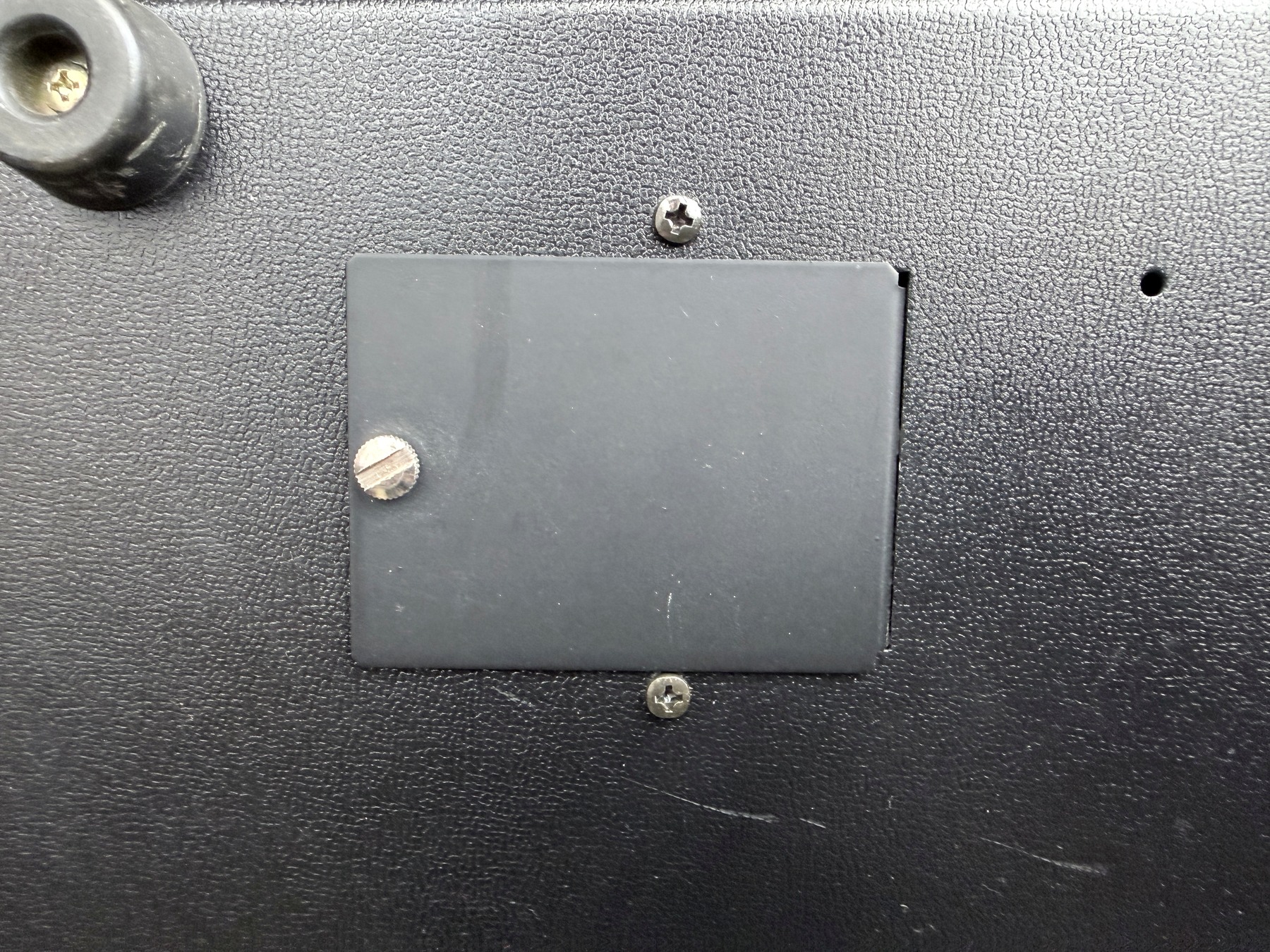
Close collection photograph of the Roland TR-808 battery door and retaining screw
MEMORY POWER // THE BATTERY COMPARTMENT IS PART OF THE PRESERVATION STORY
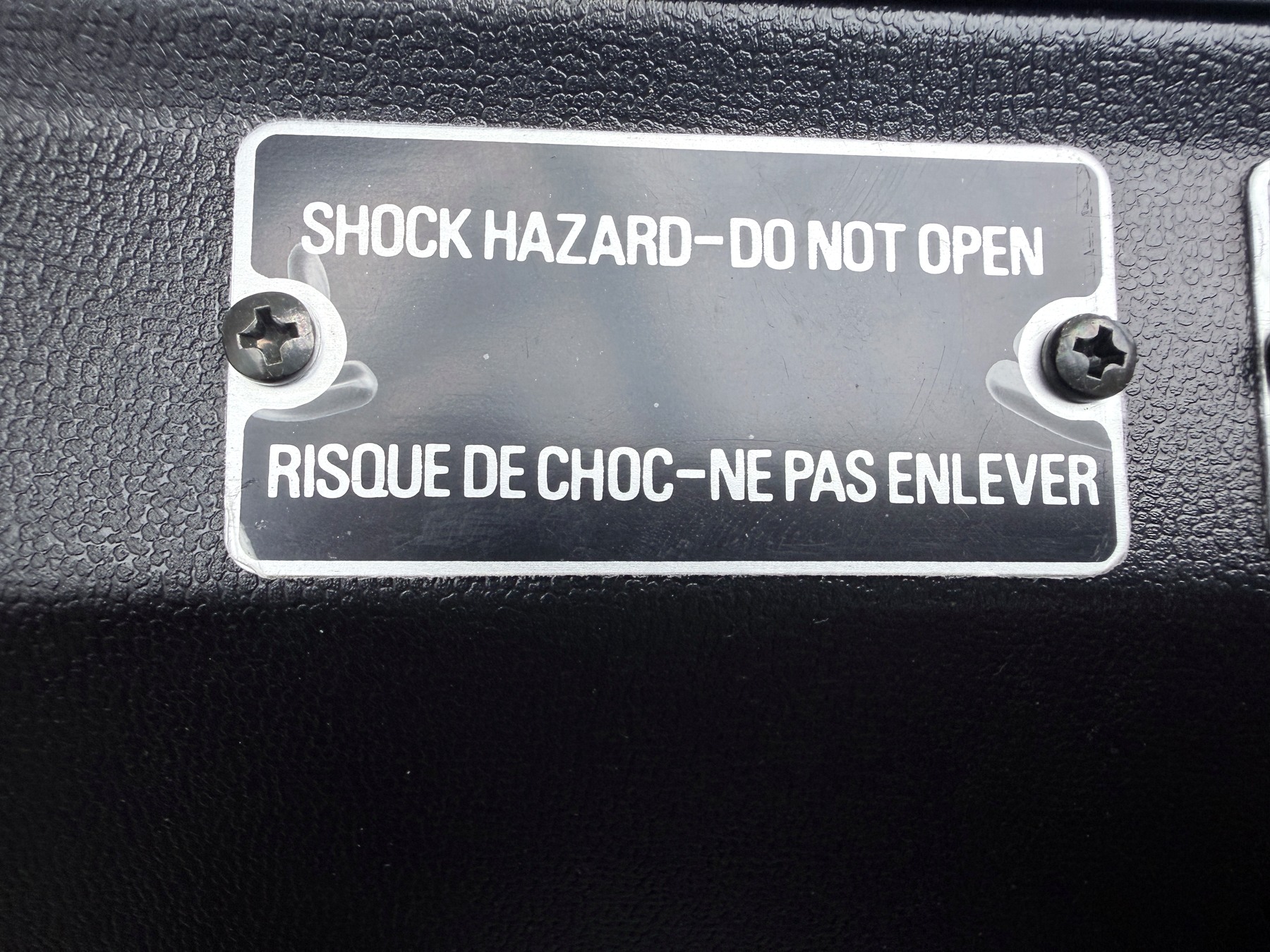
Close collection photograph of the bilingual shock-hazard plate on the Roland TR-808 underside
FACTORY SAFETY PLATE // A PHYSICAL LIMIT BEFORE INTERNAL SERVICE
Open the deeper story +

Bench triage without erasing the evidence

MEMORY — Loss after power-down does not prove failed RAM. Check the cells, holder and contacts, retention diode path, capacitor condition, abnormal drain and write-control behaviour before replacing memory. Photograph or transcribe valuable patterns first; Pattern Clear changes the historical object as well as the musical state.

ONE VOICE — If an instrument triggers but disappears only from the master output, inspect the normalled contact in its individual-output jack. Inserting a plug deliberately removes that voice from the master bus. If it is absent everywhere, confirm the trigger at the voice input before entering the synthesis circuit.

VOICE FAMILIES — Several altered noise voices point toward their shared noise source or distribution. Cowbell, cymbal and hats share a six-oscillator metallic source; closed hat terminates open hat. Diagnose the common source and shared control path before treating simultaneous symptoms as unrelated failures.

OUTPUT LEVEL — Roland specifies separate Master Hi and Lo paths: approximately 6 V peak-to-peak into 1 kΩ for Hi and 0.6 V peak-to-peak into 3 kΩ for Lo. The service circuit shows a 27 kΩ / 3.3 kΩ divider for the Lo path. Record which output, receiving load and gain structure were used before comparing two machines.

TRIGGER AND SYNC — The three Trigger Outs are fixed to CB, CP/MA and AC lanes and produce short positive control pulses; they are neither audio outputs nor freely assignable triggers. DIN Sync carries 24 clock pulses per quarter note plus separate transport state. Matching connector shape never proves voltage, pinout or safe compatibility.

CALIBRATION — Powered measurements, internal adjustment, mains inspection and component replacement belong with a qualified technician using the service notes and the installed board revision. A successful repair ends with cold and warm tests, memory retention, all modes, every voice, every output, fills, track transport, sync and trigger functions rechecked—and a record of parts and measurements returned with the machine.

PAGE 06 // RECORDS // PEOPLE AND ROOMS

The 808 does not make the same record twice

A hired programmer in New York, a prepared pattern in Belgium, a live breakdown in Los Angeles and a dorm-room lesson all reveal different instruments inside the same chassis.

These records matter because they expose working methods, not because famous names certify the hardware. “Planet Rock” joined collaborative programming, replayed electronic lines and studio effects. “Sexual Healing” used a prepared rhythm as the open foundation for voice, keyboards, guitar and tape construction.

Elsewhere the panel became a performance surface, the individual outputs became an arrangement, or the trigger sockets turned the machine into the clock for external samplers. The same 808 could supply sound, structure, low-frequency architecture—or only the pulse that made another machine speak.

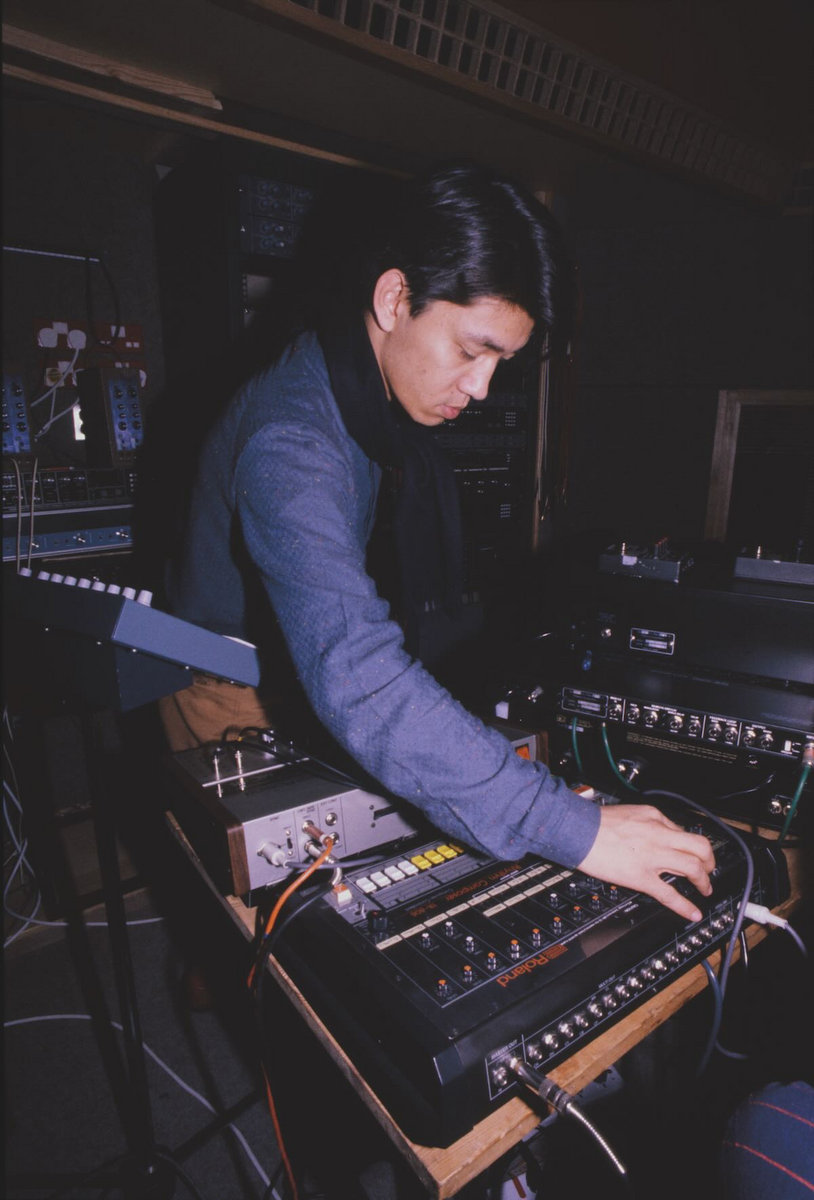
Ryuichi Sakamoto recording at AIR Studios in 1982 with a Roland TR-808 visible in the room
RYUICHI SAKAMOTO AT AIR STUDIOS // 1982 // TR-808 IN THE WORKING ROOM
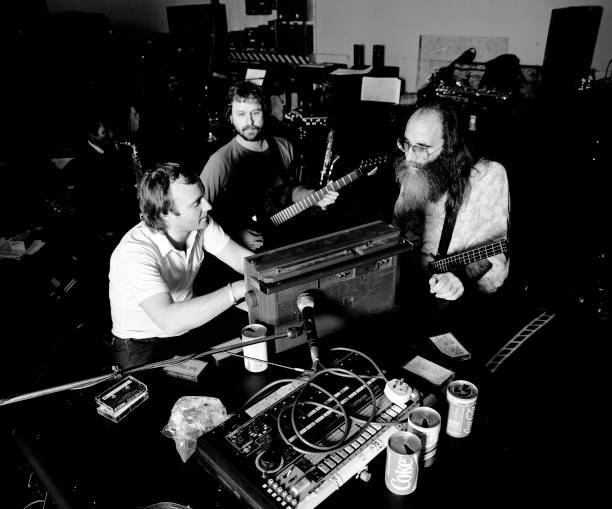
Phil Collins and Leland Sklar in the studio with a Roland TR-808 visible in the foreground
PHIL COLLINS AND LELAND SKLAR // STUDIO PHOTOGRAPH // TR-808 FOREGROUND
WATCH OFFICIAL VIDEO
AFRIKA BAMBAATAA & THE SOULSONIC FORCE // PLANET ROCK // OFFICIAL VIDEO

Planet Rock: a machine enters a production system

Arthur Baker did not discover a finished record inside an 808. He found a New York programmer remembered as Joe through the Village Voice, hired the machine with its operator, and built the rhythm collaboratively with Afrika Bambaataa and the studio team.

The Kraftwerk connection was performance and recomposition rather than a sample lifted from a master recording. At Intergalactic Studios, the programmed drums, replayed electronic lines, vocals and effects became one production. The 808 matters because its separate voices could be arranged, processed and made physically authoritative—not because the box authored the track by itself.

Watch Planet Rock on YouTube ↗
WATCH OFFICIAL VIDEO
MARVIN GAYE // SEXUAL HEALING // OFFICIAL HD VIDEO

Sexual Healing: the rhythm arrives before the session

Recording engineer Mike Butcher remembered the rhythm arriving at Studio Katy already programmed after preparatory work in Ostend. The work had already passed through several hands by the time the session began, with the original TR-808 providing the song's structural foundation.

Butcher built the recording in short sections with tape punches. Against the machine's exposed kick, clap, hats and rim-like side-stick placement, Odell Brown's Rhodes, Gordon Banks's guitar and Gaye's vocal could occupy their own space. The achievement is not realism. It is the confidence to let electronic percussion define intimacy.

Watch Sexual Healing on YouTube ↗
RHYTHM CREATORS // EGYPTIAN LOVER // ROLAND

Egyptian Lover: the 808 becomes the whole event

Gregory Broussard first heard the sound without knowing a drum machine was responsible. After “Planet Rock” revealed the instrument, he sought out a TR-808, learned to rebuild the rhythm and carried the machine onto the floor as an instrument rather than a backing track.

At the Los Angeles Sports Arena he stripped voices away, restored cowbell, hi-hat and rimshot, and changed the beat while the crowd was dancing. That performed breakdown is the key to his 808 history: the panel, pattern memory and individual voices became a live arrangement system.

Watch Egyptian Lover on Roland's YouTube channel ↗
AGAINST THE CLOCK // EGYPTIAN LOVER // FACT

Egyptian Lover demonstrates the method

A first-person studio demonstration makes the technique visible: pattern entry, voice balance, control movement and arrangement remain part of one performance. Listen for decisions made on the machine, not merely for a familiar collection of drum hits.

Watch the full demonstration on YouTube ↗
CYBOTRON // CLEAR // OFFICIAL CRAFT RECORDINGS AUDIO

Clear: the trigger output writes beyond the drum kit

Juan Atkins and Richard Davis bought a TR-808 together when the machine was new. Atkins took it home to a small system built around a Korg MS-10 and a Sequential Circuits Pro-One. The 808 supplied the rhythm, but one of its trigger outputs also advanced the Pro-One's internal sequencer. “Clear” was the first piece Atkins made once that connection worked.

The famous bass line was therefore neither stored inside the drum machine nor played as one uninterrupted keyboard performance. Atkins entered a short group of notes in the Pro-One, tried several possible orders, and let the 808 call the sequence forward in time. When the four-note relationship arrived in the order he wanted, he kept it. The record makes the rear-panel socket audible: a programmed percussion event becomes the timing instruction for another instrument.

Hear the official recording on YouTube ↗
THE S.O.S. BAND // JUST BE GOOD TO ME // OFFICIAL LABEL AUDIO

Just Be Good to Me: decay becomes a performance

Jimmy Jam and Terry Lewis chose the larger Roland machine because their smaller rhythm box could not give the studio the separately accessible voices they needed. The route into this record began with control: the bass drum had to reach the desk on its own.

Jam recorded the TR-808 directly to tape while moving the bass-drum controls. The boom changes inside the pass; Lewis heard it as the song's heartbeat. A single sample can preserve one setting, but this recording preserves a hand travelling through the decay path while the pattern repeats.

Hear the official recording on YouTube ↗
MC SHAN // THE BRIDGE // OFFICIAL ARTIST AUDIO

The Bridge: the 808 conducts three samplers

Marley Marl called this method “trigger music.” The TR-808 supplied programmed pulses while three short-memory samplers supplied captured kick, snare and hi-hat events. The machine's rhythmic authority survived even when its stock drum circuits were no longer the whole audible kit.

The four-track recorder tightened the architecture further: snare shared a track with hi-hat, kick shared another with bass, and the remaining tracks carried the “Bridge” phrase and vocal. The mix began before the faders because paired sounds could no longer be separated after recording.

Hear The Bridge on YouTube ↗
BEASTIE BOYS // PAUL REVERE // OFFICIAL ARTIST AUDIO

Paul Revere: tape invents the reverse button

The TR-808 itself has no reverse command. Mike D remembered Adam Yauch recording the beat, bouncing it to another tape, physically reversing that tape and returning the result to the multitrack.

That route makes the studio part of the instrument: the 808 contributes the patterned source, while tape reverses its attacks, decays and timing into a new rhythmic object. The record is evidence of a relationship between machines, not a secret function hidden on the Roland panel.

Hear the official recording on YouTube ↗
BIG BEAT LISTENING ROUTE // 32-TRACK NARRATIVE EDITION

TR-808: The Machine That Became a Language

Begin here. This compact route follows the machine from early electronic use through electro, pop, regional bass cultures, sampling and later reinterpretation. Each record demonstrates a different way of putting the 808 to work.

BIG BEAT LISTENING LIBRARY // COMPLETE RESEARCH EDITION

TR-808: Complete Research Edition

The larger research shelf extends beyond the familiar canon. Use it beside the dossier to compare how original hardware, mixed-machine systems, sampling, emulation and descendants change the machine's audible role.

BIG BEAT LISTENING ROUTE // GEOGRAPHIC EDITION

TR-808 Around the World

Follow the instrument through different rooms, cities and sound systems. The shared circuitry matters, but local recording practices, dance floors, loudspeakers and musical traditions determine what the machine becomes.

Open the deeper story +

Follow the records, rooms and regional techniques

In Japan, Yellow Magic Orchestra and associated musicians treated the machine as part of a wider electronic ensemble. In New York, “Planet Rock” joined a hired instrument and programmer to Arthur Baker and Afrika Bambaataa's arrangement, replayed Kraftwerk material, multitrack recording and studio effects. Its power comes from that complete production system, not from a solitary preset or a machine acting alone.

Marvin Gaye’s “Sexual Healing” shows a different scale of practice. Recording engineer Mike Butcher recalled that the pre-programmed rhythm reached Studio Katy after preparation in Ostend, then became the foundation of a recording assembled in short tape sections. The recognizable clap, hats, kick and rim-like placement remain exposed enough that the 808 feels like a participant rather than a hidden substitute drummer.

Egyptian Lover made the long bass drum, handclap and performed pattern central to a West Coast electro language. His account of the Los Angeles Sports Arena describes removing and returning voices while the audience danced: arrangement happening directly on the machine. Miami bass and Southern rap later extended the low-frequency role through different studios, cars, clubs and speaker systems. The circuit was shared; the mix priorities and social spaces were local.

In Detroit, Juan Atkins used the machine as both percussion instrument and control source. The TR-808's trigger output advanced the step sequencer inside a Sequential Circuits Pro-One, turning one programmed lane into the clock for the bass line on Cybotron's “Clear.” Atkins remembers testing several four-note orders and keeping the one that emerged with the right movement. The machine did not contain the bass sound; it made the synthesizer speak in time.

Jimmy Jam and Terry Lewis reveal another kind of performance on the S.O.S. Band's “Just Be Good to Me.” The individual outputs allowed the kit to enter the console voice by voice, while movement of the bass-drum decay control during the tape pass turned a front-panel setting into part of the arrangement. The 808 could therefore be programmed, mixed and physically played at the same time.

Rick Rubin’s route to T La Rock and Jazzy Jay’s “It’s Yours” was smaller and rougher. Rubin borrowed an 808 from Eric of the New York punk band the Speedies and worked with it in his NYU dorm room without a manual. T La Rock remembered rehearsing there before the record was completed at Power Play. The importance of the scene is practical: a professional rhythm composer had become a machine one person could borrow, teach himself and use to construct an independent record from the bottom up.

Marley Marl’s account of MC Shan’s “The Bridge” breaks the assumption that an 808 credit must mean an audible stock kick or handclap. He used the machine as a timing and trigger source for several samplers placed around the room. Its programmed pulses launched external sounds and made a distributed digital rhythm behave as one performance system. The 808’s historical role can therefore sit in the control path as decisively as it sits in the audio path.

Producers also sampled individual hits, copied patterns, repaired machines and rebuilt the sound in software. Those are different historical objects. A one-shot preserves one event; an original 808 preserves an interacting sequencer, accent system, voice circuit and panel performance. The archive records the distinction without declaring one practice legitimate and the other false.

Essential listening should therefore be read as evidence of several methods: early ensemble electronics, programmed electro, intimate pop composition, regional bass architecture and later sampling. No single canonical track can stand in for the instrument’s whole history.

DESIGNER / RECORD / WRITING ROOM

Kikumoto built an electronic instrument. Musicians decided what it meant.

Tadao Kikumoto and Roland's engineering team designed voices with their own electronic identities. Arthur Baker chose precisely that artificiality for Afrika Bambaataa & the Soulsonic Force's “Planet Rock”, after finding a programmer—remembered as Joe—who advertised drum-machine sessions in New York's Village Voice.

Marvin Gaye and recording engineer Mike Butcher used the machine differently on “Sexual Healing”: as the sparse, controllable rhythmic foundation around which vocals, keyboards, guitar and tape edits could be arranged. The 808's history is not one origin myth but many local decisions made with the same box.

The same instrument could therefore be scarce professional equipment, a private composition partner or the foundation of a regional bass architecture. Its circuitry stayed fixed; its social function changed each time the machine entered a different room.

01TADAO KIKUMOTO02AFRIKA BAMBAATAA / ARTHUR BAKER03MARVIN GAYE
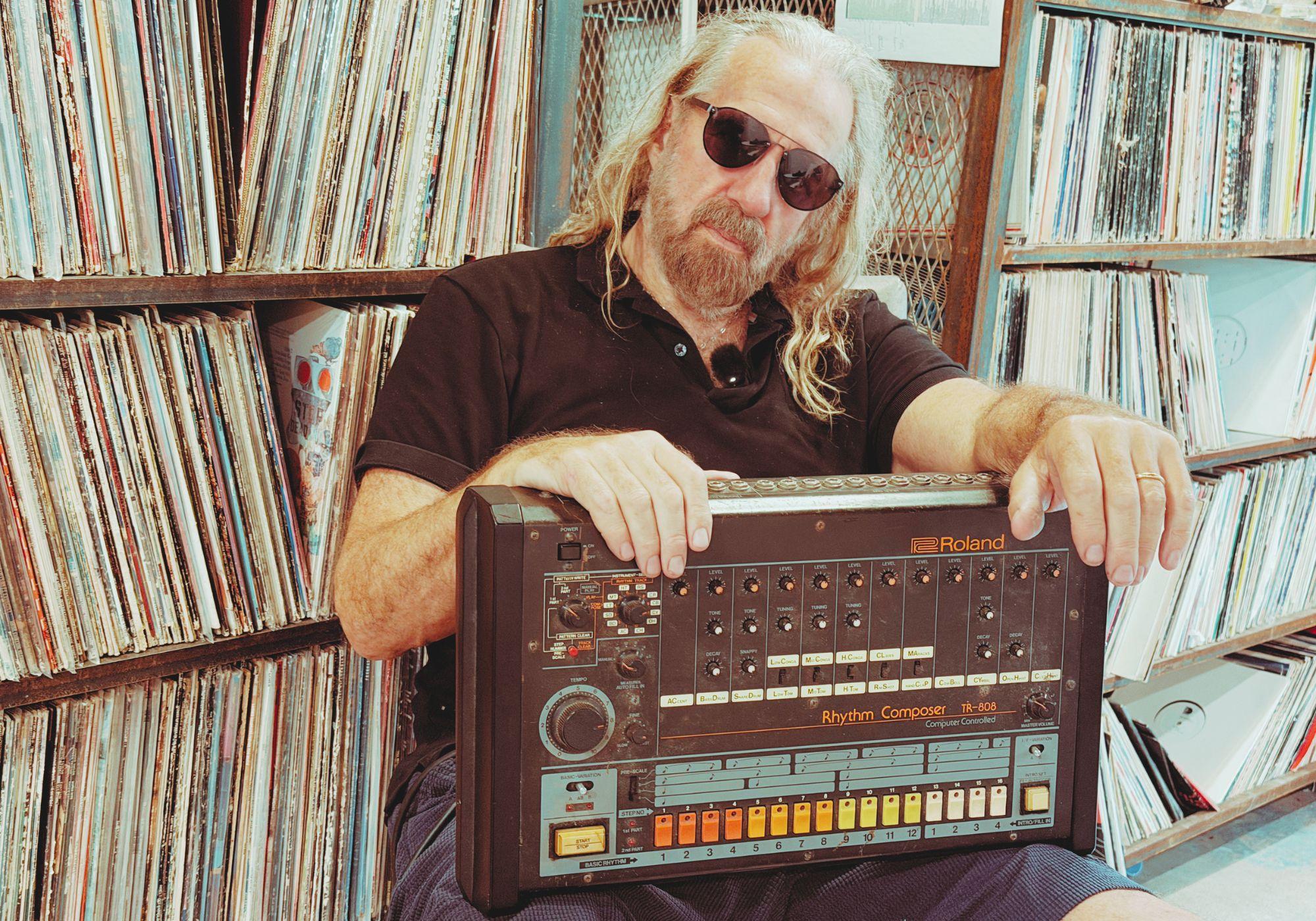
Producer Arthur Baker holding a Roland TR-808
ARTHUR BAKER WITH THE TR-808 // PHOTOGRAPH: EDYSMAR DIAZ CRUZ

PAGE 07 // AFTERLIFE // HARDWARE, SAMPLE, LANGUAGE

The chassis ended. The system kept multiplying.

Original machines, sampled hits, software models and later Roland instruments preserve different parts of the 808 rather than one identical object.

A sample can carry one strike into a new production, but it leaves the original trigger, Accent interaction, free-running metallic oscillators and panel performance behind. Software and later hardware can restore more of those relationships, while an ageing original adds its own calibration, repair and ownership history.

The name also escaped the machine. In current production, “808” may mean an original bass-drum circuit, a sample descended from one, or a completely synthesised sub-bass voice. The archive keeps those meanings connected without treating them as interchangeable.

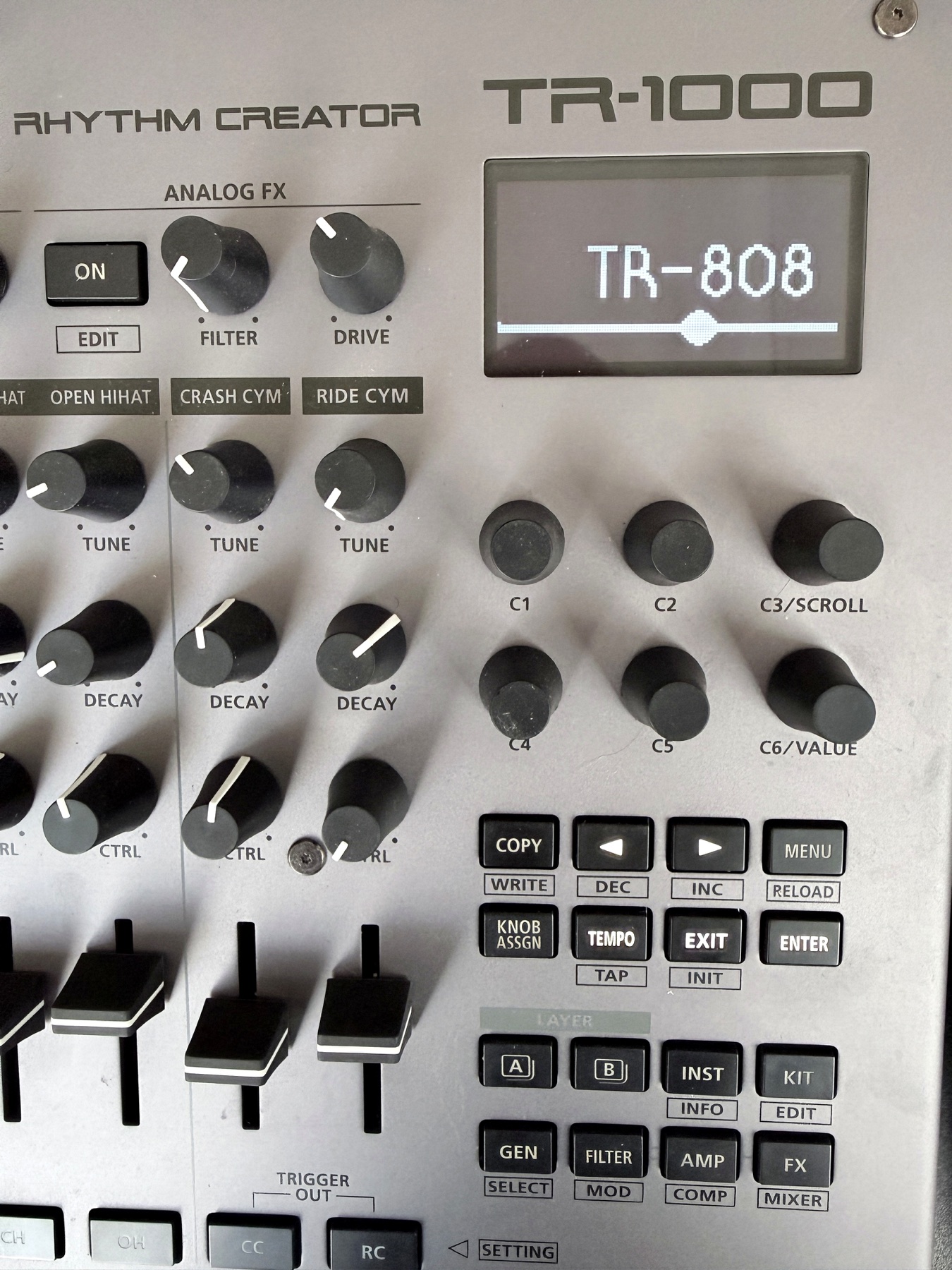
Big Beat collection Roland TR-1000 with its TR-808 engine selected on the display
ROLAND TR-1000 // A CURRENT HARDWARE ROUTE INTO THE TR-808
Open the deeper story +

What later instruments preserve—and what they change

Roland’s own descendants have taken several approaches: sampled libraries, circuit-modelled software, compact hardware and modern TR instruments that place 808 behaviour beside sequencing, effects and contemporary performance tools. Each route preserves a different combination of sound, control and workflow.

The collection's TR-1000 makes that distinction visible. Its display can call up a TR-808 engine, but the surrounding instrument adds contemporary sequencing, digital modelling, sampling, layering and effects. Roland describes both newly developed analogue 808/909-derived sounds and expanded ACB models: continuation through several technologies, not a disguised original chassis.

An original survivor preserves the relationship between its processor, trigger pulses, analogue voices, Accent lane, switching outputs and physical controls. It also carries component tolerances and decades of intervention. That biography is evidence, but it is not a reason to romanticise faults or unsafe power conditions.

A one-shot is intentionally narrower. It may preserve a superb bass-drum strike or clap, already coloured by a console, tape machine or sampler. Once repitched, enveloped and layered, it can become a new instrument. The correct historical question is not whether it is ‘really’ an 808, but which part of the chain survives and which part was newly authored.

That distinction explains the instrument’s unusual afterlife. The TR-808 remains a collectible physical machine, a reproducible circuit family, a performance interface, a library of recordings and a word for low-frequency design. Those identities overlap, but none replaces the others.

SOURCES AND FURTHER READING // TR-808

Continue through the original documents.

Owner’s manuals, service notes, period catalogues, contemporary press and first-hand accounts are identified by type so readers can follow the machine beyond this dossier.

R08

Roland Japan service register

Lists TR-808 release in 1981 and production completion in 1983, conflicting with the 1980–1982 retrospective; the two sources are not silently reconciled.

OPEN SOURCE ↗
R01

The TR-808 Story

Official development and production history.

OPEN SOURCE ↗
R02

Tadao Kikumoto: An Exclusive Conversation

First-person design brief, team and decay intent.

OPEN SOURCE ↗
R03

TR-808 service notes

Primary circuit architecture.

OPEN SOURCE ↗
R04

TR-808 operation manual

Primary operating, memory, connection and pattern documentation.

OPEN SOURCE ↗
P01

International Musician, November 1981

Launch-period review and reception.

OPEN SOURCE ↗
A01

Arthur Baker: The Man Who Rocked the Planet

First-person Planet Rock session account.

OPEN SOURCE ↗
A03

Marvin Gaye: ‘Sexual Healing’

Recording engineer Mike Butcher's first-person account of the pre-programmed TR-808 foundation, Studio Katy sessions and tape construction.

OPEN SOURCE ↗
A04

Egyptian Lover and the Art of Staying Gold

Egyptian Lover's first-person account of discovering, buying and performing the TR-808.

OPEN SOURCE ↗
A05

Jam & Lewis lecture

Jimmy Jam and Terry Lewis on the 808, Just Be Good to Me and performing bass-drum decay.

OPEN SOURCE ↗
A06

The Rick Rubin Interview

Rick Rubin's first-person account of borrowing the Speedies' TR-808 and learning it in his NYU dorm room.

OPEN SOURCE ↗
A07

Marley Marl on The Bridge Wars

Marley Marl's first-person account of using the TR-808 to trigger multiple samplers on The Bridge.

OPEN SOURCE ↗
A08

Mike Diamond on the Beastie Boys' last recordings with Adam Yauch

Mike D's account of Adam Yauch recording an 808 beat, reversing the tape and returning it to the multitrack.

OPEN SOURCE ↗
A09

Techno's Godfather Speaks: An Interview With Juan Atkins

Atkins's first-person account of the jointly purchased TR-808, his Pro-One and MS-10 setup, and using the 808 trigger output to create Clear.

OPEN SOURCE ↗
A10

Classic Tracks: Model 500 — No UFO's

Atkins describes testing short Pro-One note sequences advanced from a drum-machine trigger and retaining the four-note Clear bass-line order.

OPEN SOURCE ↗
V01

Egyptian Lover: Against the Clock

First-person studio demonstration of pattern programming and live control.

OPEN SOURCE ↗
B01

The Complete Roland TR-808 Guide

BIG BEAT’s book-length research supplies the page’s engineering, operational and cultural synthesis.

OPEN SOURCE ↗
A02

Roland 808 Day participant archive

Production history, artist testimony and the official interactive object model.

OPEN SOURCE ↗
T01

Real World Interfaces: TR-808 technical archive

Revision-controlled repair and modification research; use alongside the factory service notes.

OPEN SOURCE ↗
R05

Roland TR-1000 Rhythm Creator

Official documentation for the current instrument's analogue, ACB, sampling and sequencing routes into TR-808-derived sound.

OPEN SOURCE ↗
R06

A Taste of Music vol.46

Hideki Matsutake's participant account of the prototype loan, Budokan performance, return, first-production-lot replacement and BGM project.

OPEN SOURCE ↗
R07

YMO revealed the TR-808 prototype

Roland's retrospective Kikumoto account of recognising the prototype handclap in the 29 December 1980 broadcast.

OPEN SOURCE ↗

PASS THE FILE ON // CANONICAL TRANSMISSION

SHARE THE ROLAND TR-808 RHYTHM COMPOSER.

Send readers directly to this machine file on Drum Machines Have No Soul.

drummachineshavenosoul.com/machines/tr-808

THE MACHINE LINE // 05 OF 12

FOLLOW THE CHANGE.

Each machine inherits a working idea and moves one musical decision. Continue through the family by what the player can do—not by model number alone.