BIG BEAT MACHINE FILE // 006

8000

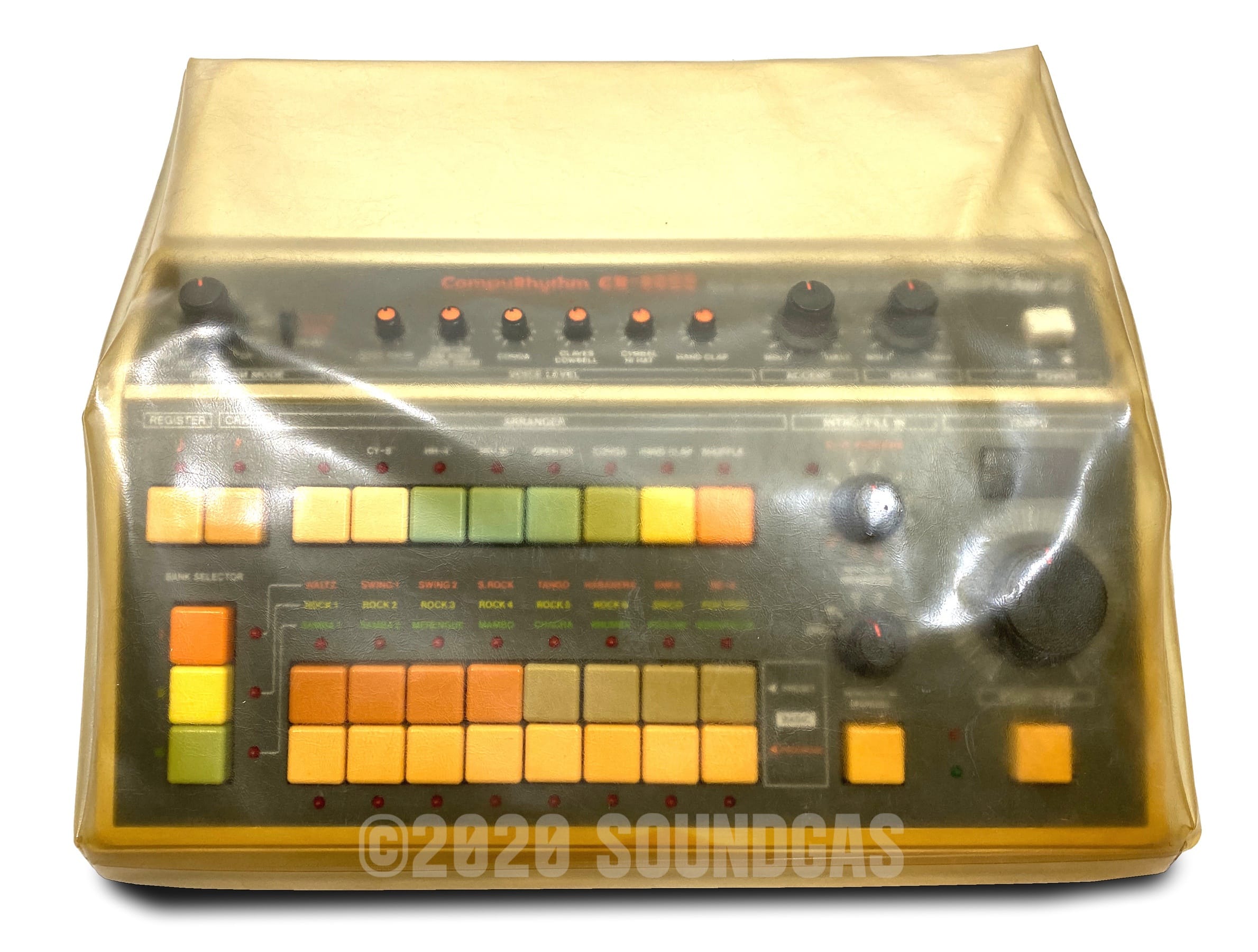
ROLAND COMPURHYTHM
CR-8000

198114 ANALOGUE VOICES24 PRESETS8 USER RHYTHMS

Roland's last great cabinet rhythm machine could play the room, write two-measure patterns, throw fills on command and speak to the next generation through DIN Sync.

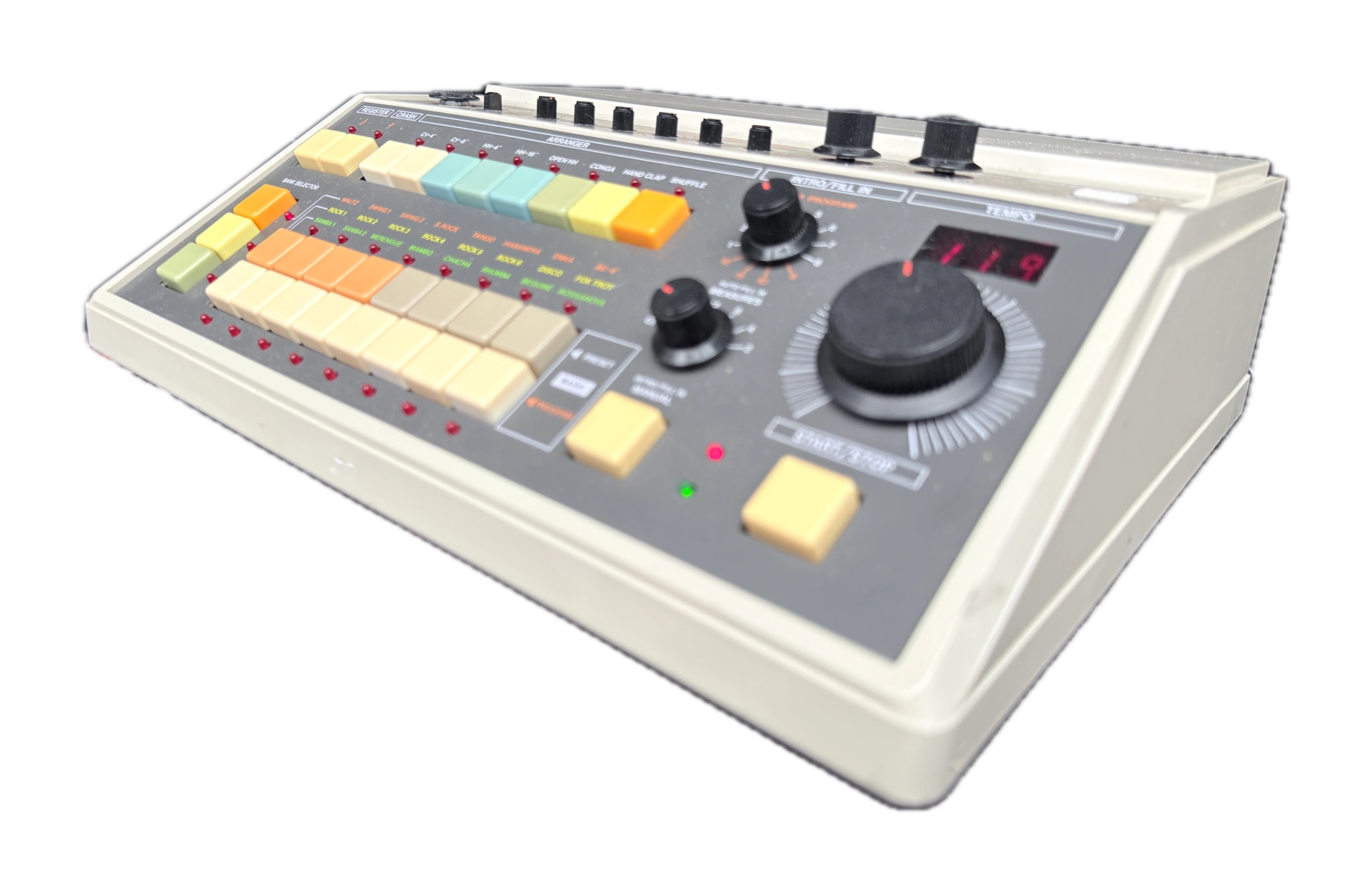
Big Beat Collection Roland CR-8000, complete isolated view
BIG BEAT COLLECTION // CR-8000 // UNIT 122331
PRODUCTIONIntroduced 1981
SOUND ENGINE14 analogue voices; common accent
RHYTHM MEMORY24 presets; 8 user rhythms; 4 user fills
More facts, listening references & sources
PERIOD PRICE£399 reviewed price, 1981
LINEAGE ADVANCEWritable rhythm and fill memory move onto the panel, with a tempo display and DIN Sync joining the last large CompuRhythm arranger.
WHAT THE PLAYER GAINSThe player can write two-measure patterns step by step, write dedicated fills, alter variation by hand and synchronise the arrangement with another Roland instrument.
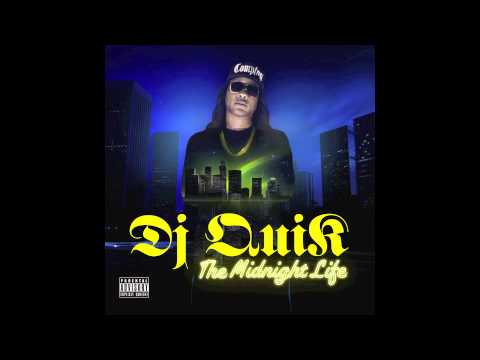
NOTABLE USERSChuck D / Spectrum City · Hank Shocklee · DJ Quik (tentative model identification) · Crypts
START LISTENINGPublic Enemy — Public Enemy No. 1 (1984 demo account) · DJ Quik feat. Robert Bacon — Bacon's Groove (tentative attribution)
Sources for the artists and listening references

Artist accounts, historical attributions and performance films establish different things. These notes explain the basis for each reference.

THE BIG BEAT COLLECTION // UNIT 122331

A MACHINE BUILT FOR THE HAND.

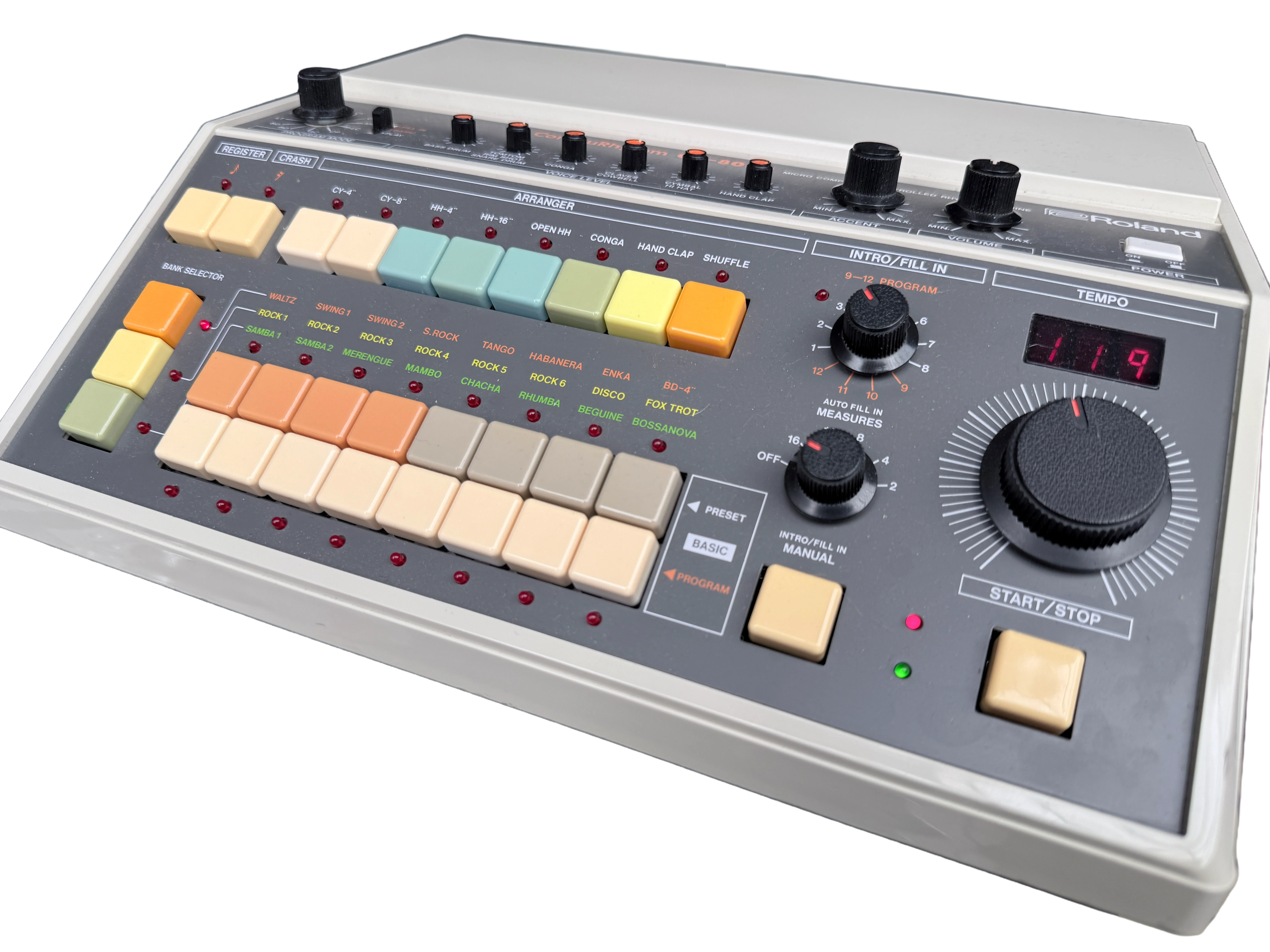
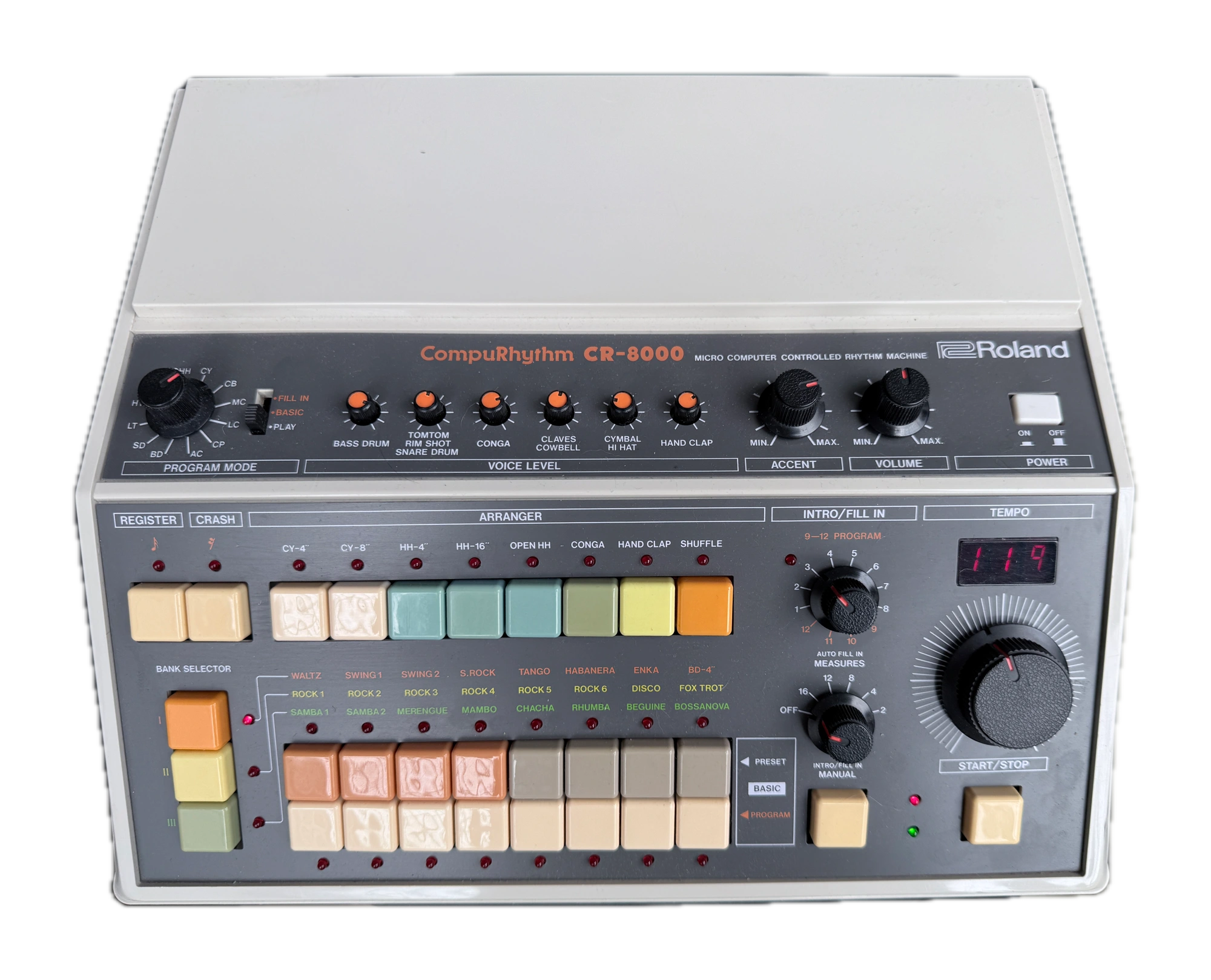
The sloping panel brings rhythm, arrangement, writing and tempo into one continuous playing surface. Seen from the right, the depth of the cabinet and the hierarchy of its controls become part of the instrument's design.

PAGE 01 // LAUNCH

THE ARRANGER
LEARNS TO WRITE.

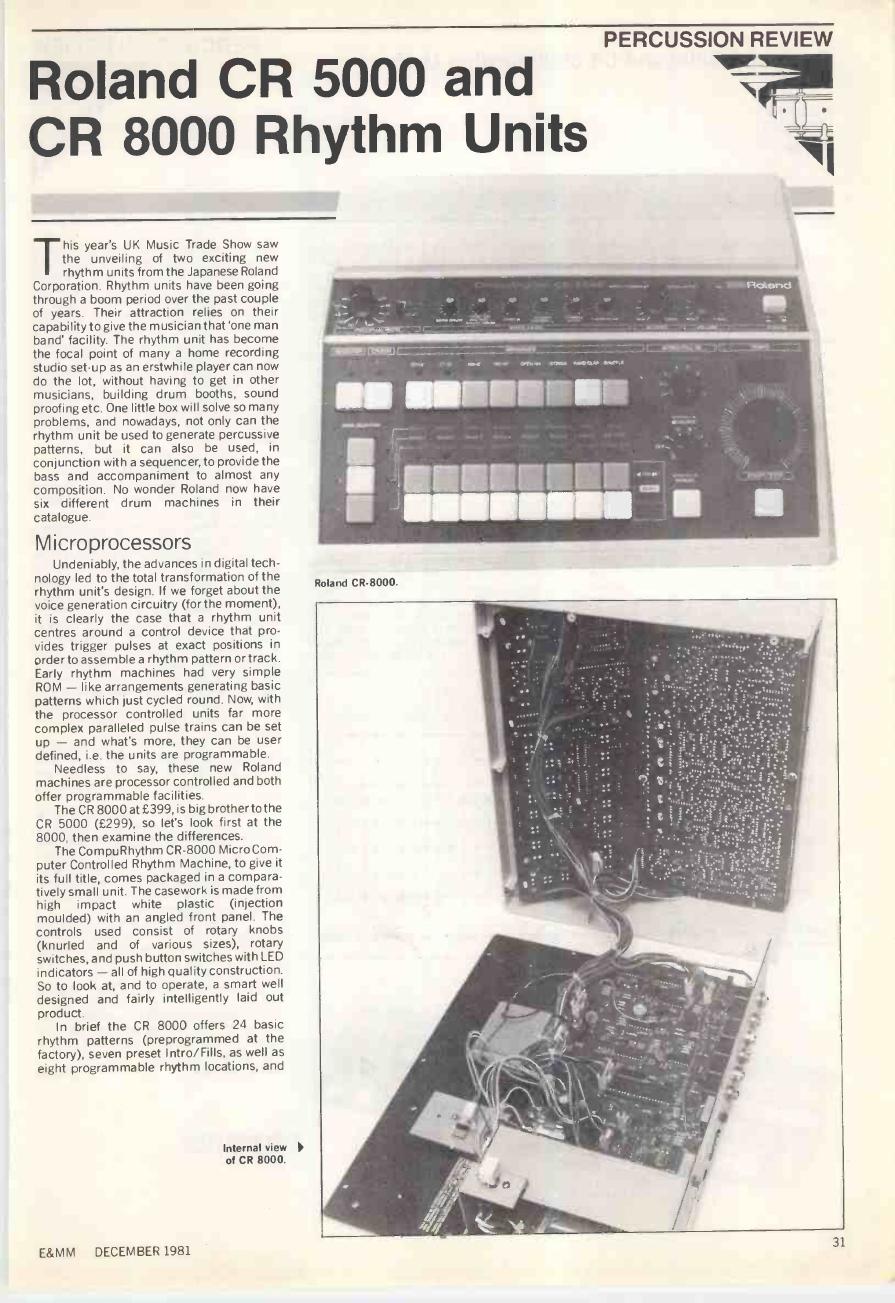
The Roland CompuRhythm CR-8000 arrived in 1981 as the larger member of a new pair. The £299 CR-5000 kept the preset approach; the £399 CR-8000 added eight writable basic rhythms, four writable intro/fills, handclap, register memory and a fuller control surface. Both used a microprocessor to organise analogue percussion, but only the 8000 let the player build a pattern from individual steps. [S03]

The distinction was not “home versus professional.” It was a difference in authorship. The CR-5000 arranged factory material; the CR-8000 kept that immediate vocabulary and opened a small, battery-backed space in which the owner could answer it.

First page of the December 1981 Electronics and Music Maker review showing the CR-8000 and its internal boards
E&MM // DECEMBER 1981 // MACHINE AND INTERNAL VIEW [S03]
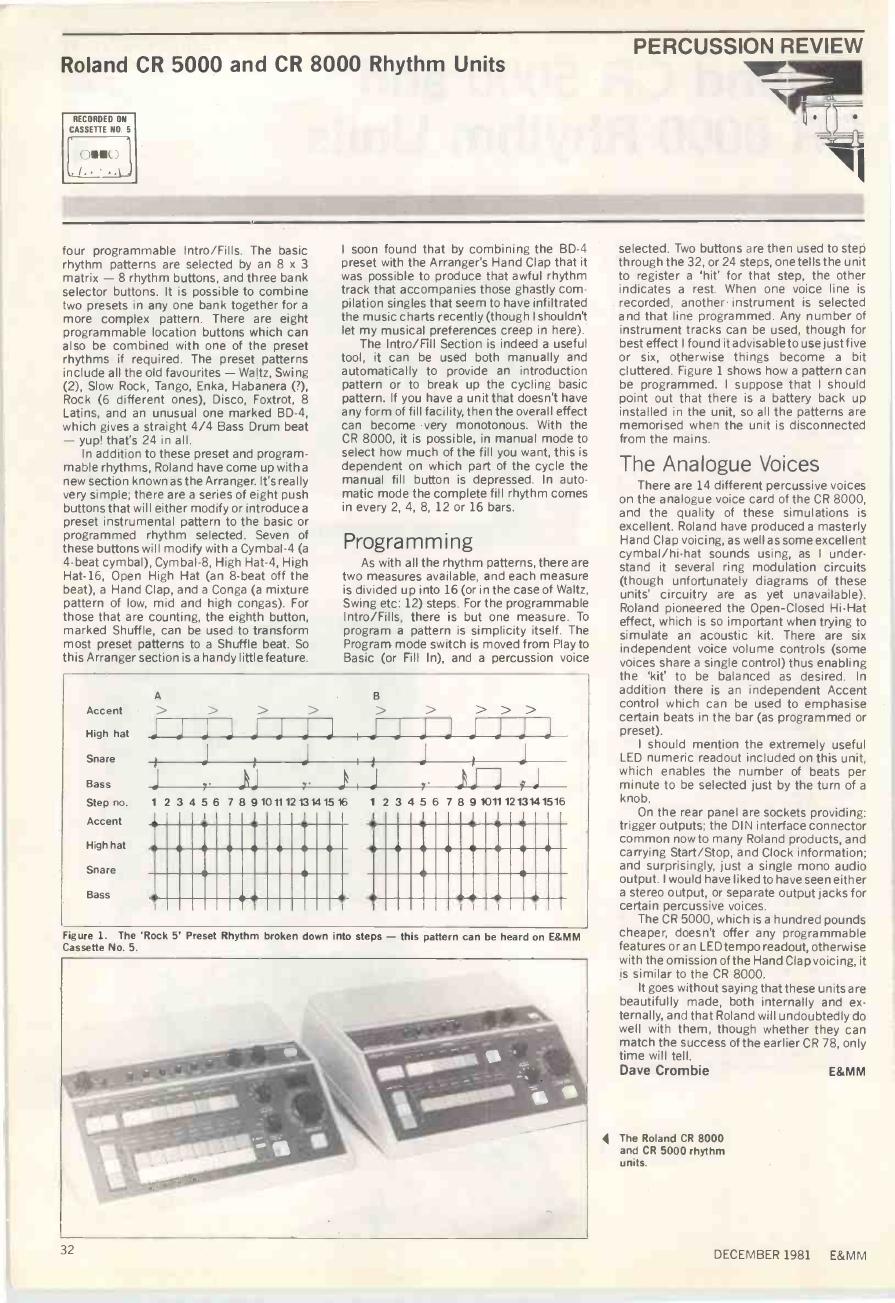
Second page of the 1981 CR-5000 and CR-8000 review with Rock 5 transcription and both machines
CONTROLS, ROCK 5 AND THE TWO-MACHINE COMPARISON [S03]
WHAT CHANGED?

THE PRESET BOX BECAME A COMPOSITION DESK.

The front still offers Waltz, Swing, Bossa Nova, Rock and Disco at one press. Above those buttons sits a second layer: arranger additions, fill timing, Crash, Register A/B and pattern writing. The CR-8000 is interesting because neither layer replaces the other.

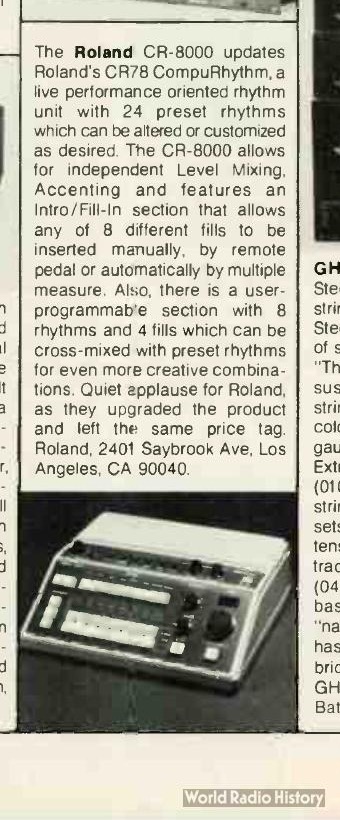
December 1981 Musician product-news notice introducing the Roland CR-8000 with a period product photograph
MUSICIAN // CR-8000 PRODUCT NEWS // DECEMBER 1981 ↗
THE AMERICAN INTRODUCTION

AN UPDATE TO THE CR-78—AT THE SAME PRICE.

Musician's December 1981 product-news page gives the CR-8000 a separate period photograph and describes Roland's own sales argument. The new box kept twenty-four ready-made rhythms but added independent level mixing, Accent, eight fills that could be called by hand, pedal or measure count, and eight user rhythms with four user fills. The short notice ends with a revealing detail: Roland had expanded what the player could write and conduct while leaving the CR-78's price unchanged. [S13]

THE FAMILY IN 1982

FIVE MACHINES. FIVE WAYS INTO RHYTHM.

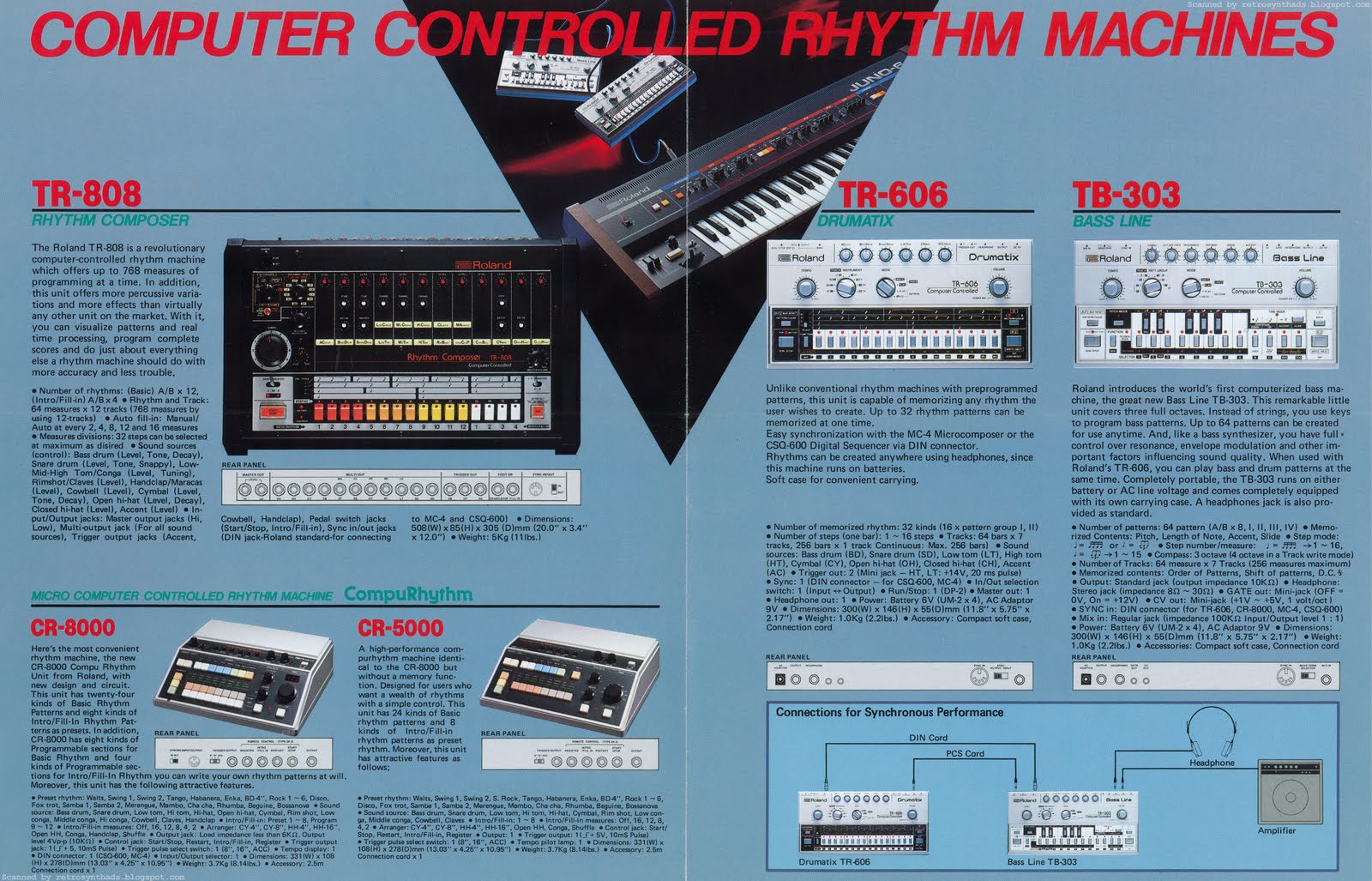
Roland placed the CR-8000 and CR-5000 on the same brochure spread as the TR-808, TR-606 and TB-303. The CR-8000 panel foregrounds twenty-four Basic rhythms, eight programmable Basics, four programmable Intro/Fills and the arrangement controls. This was not a simple replacement ladder. Roland was selling parallel instruments for different ways of working. [S12]

Roland's 1982 Computer Controlled Rhythm Machines brochure showing the CR-8000 with the TR-808, TR-606, TB-303 and CR-5000
ROLAND // COMPUTER CONTROLLED RHYTHM MACHINES // NOVEMBER 1982 ↗

PAGE 02 // PERFORMANCE CONTROL

THE MACHINE CAN
SHAPE THE PHRASE.

Right three-quarter view across Big Beat Collection CR-8000 unit 122331
BIG BEAT COLLECTION // THE SLOPING PLAYING SURFACE

THE ARRANGER IS A LIVE LAYER

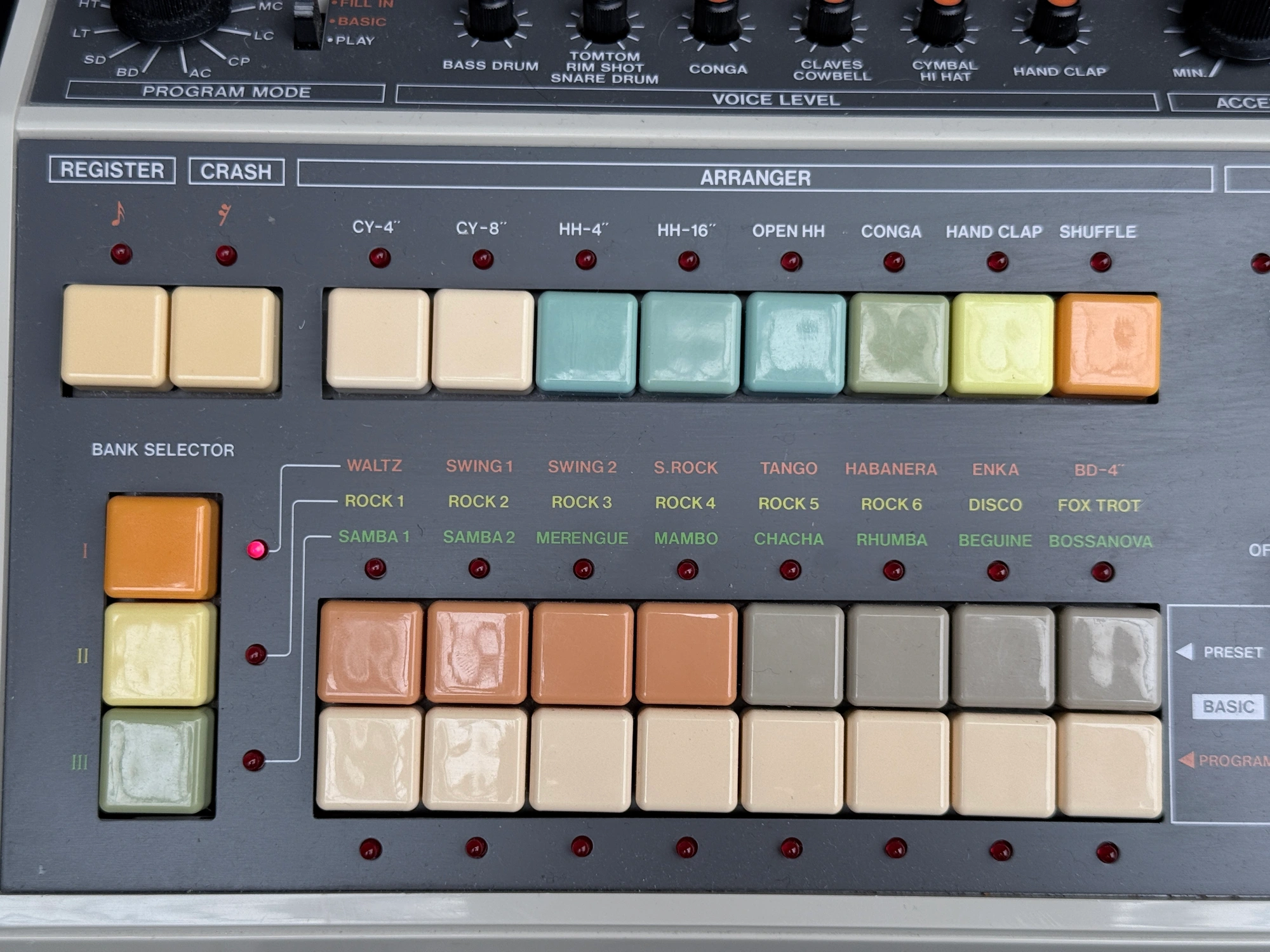
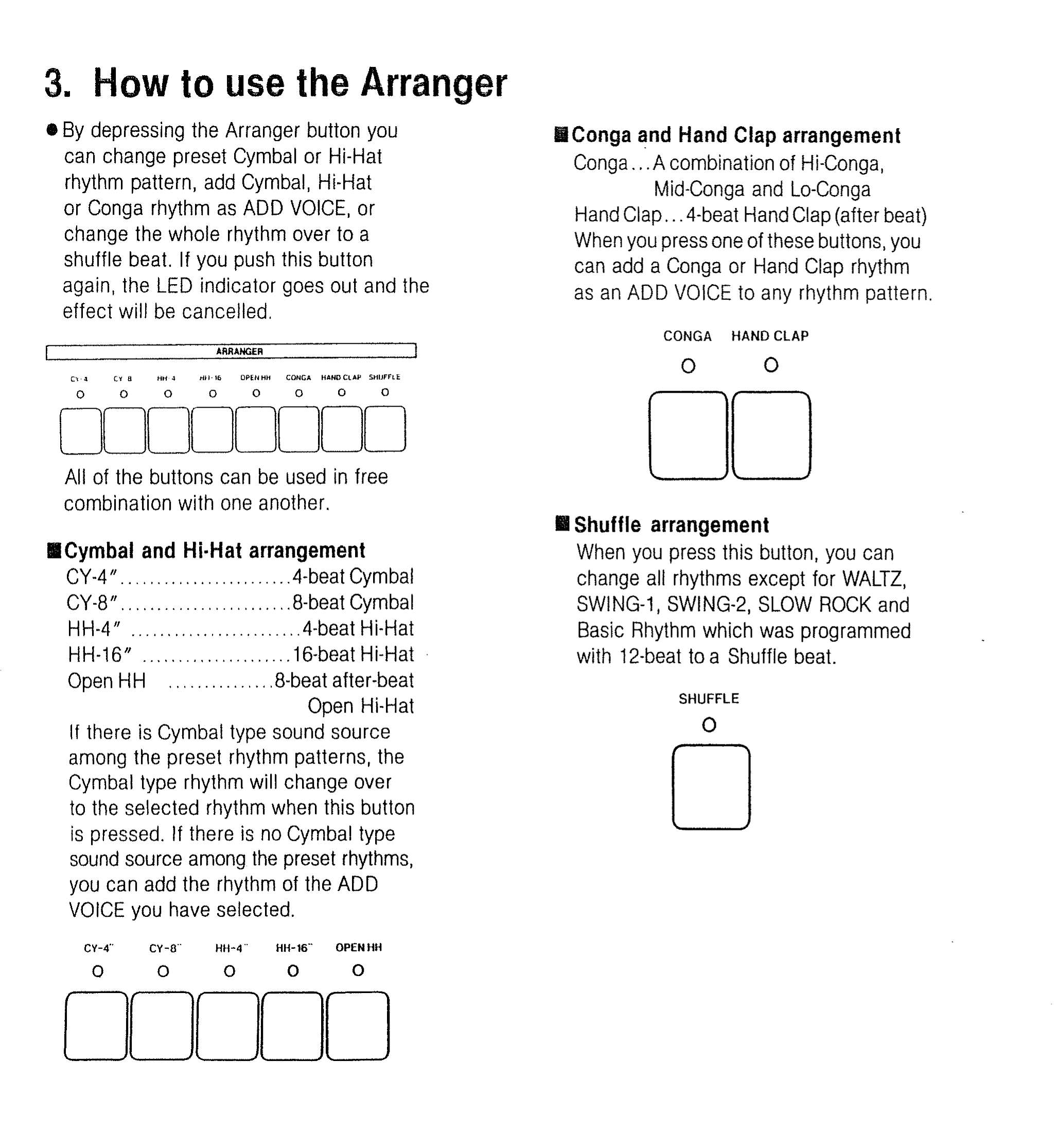
Eight Arranger buttons modify a rhythm while it runs: Cymbal on quarters or eighths, hi-hat on quarters or sixteenths, open hi-hat, conga, handclap and shuffle. The additions can be combined, so a plain preset can become a new performance without entering Write mode. [S01]

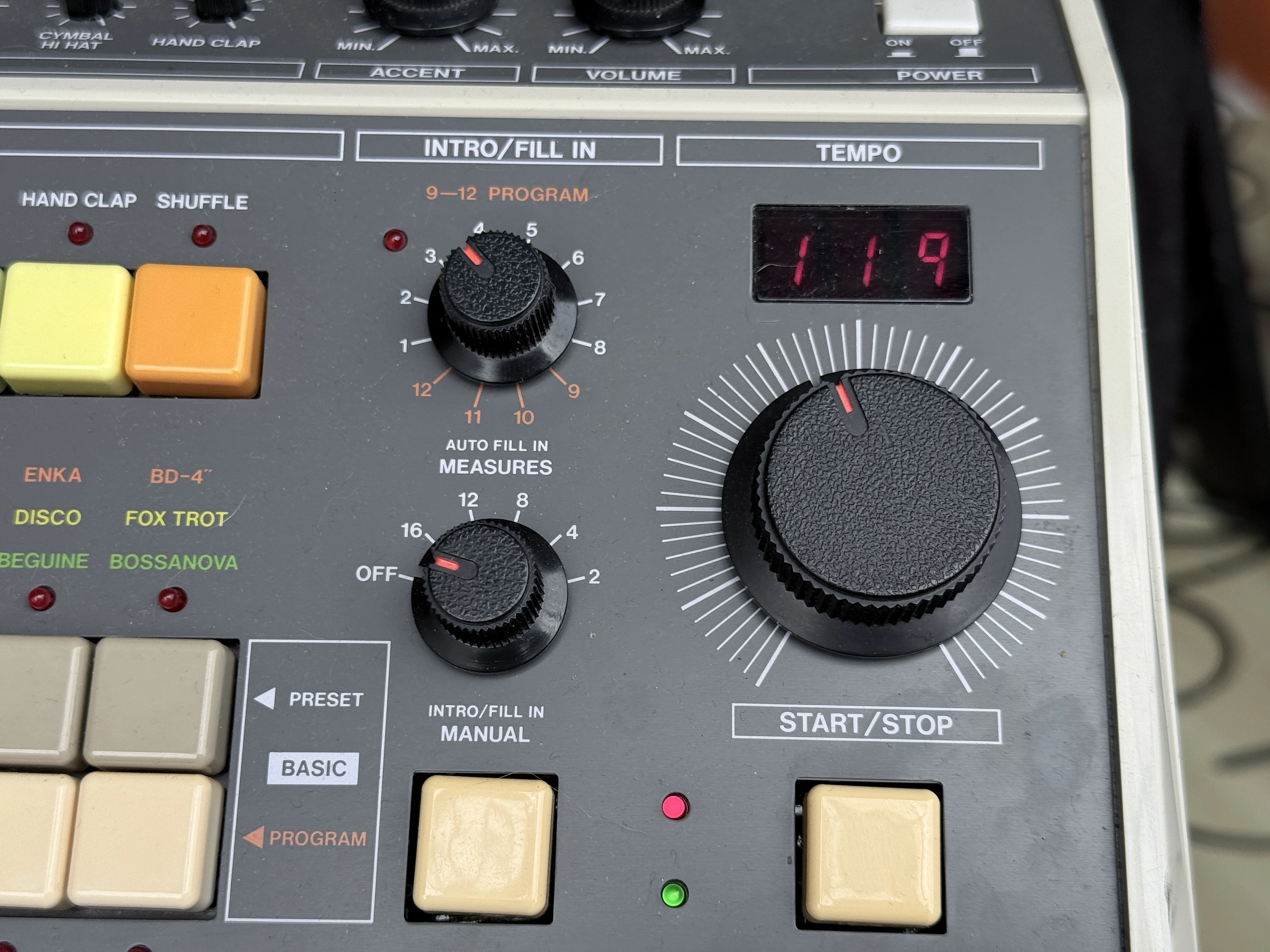
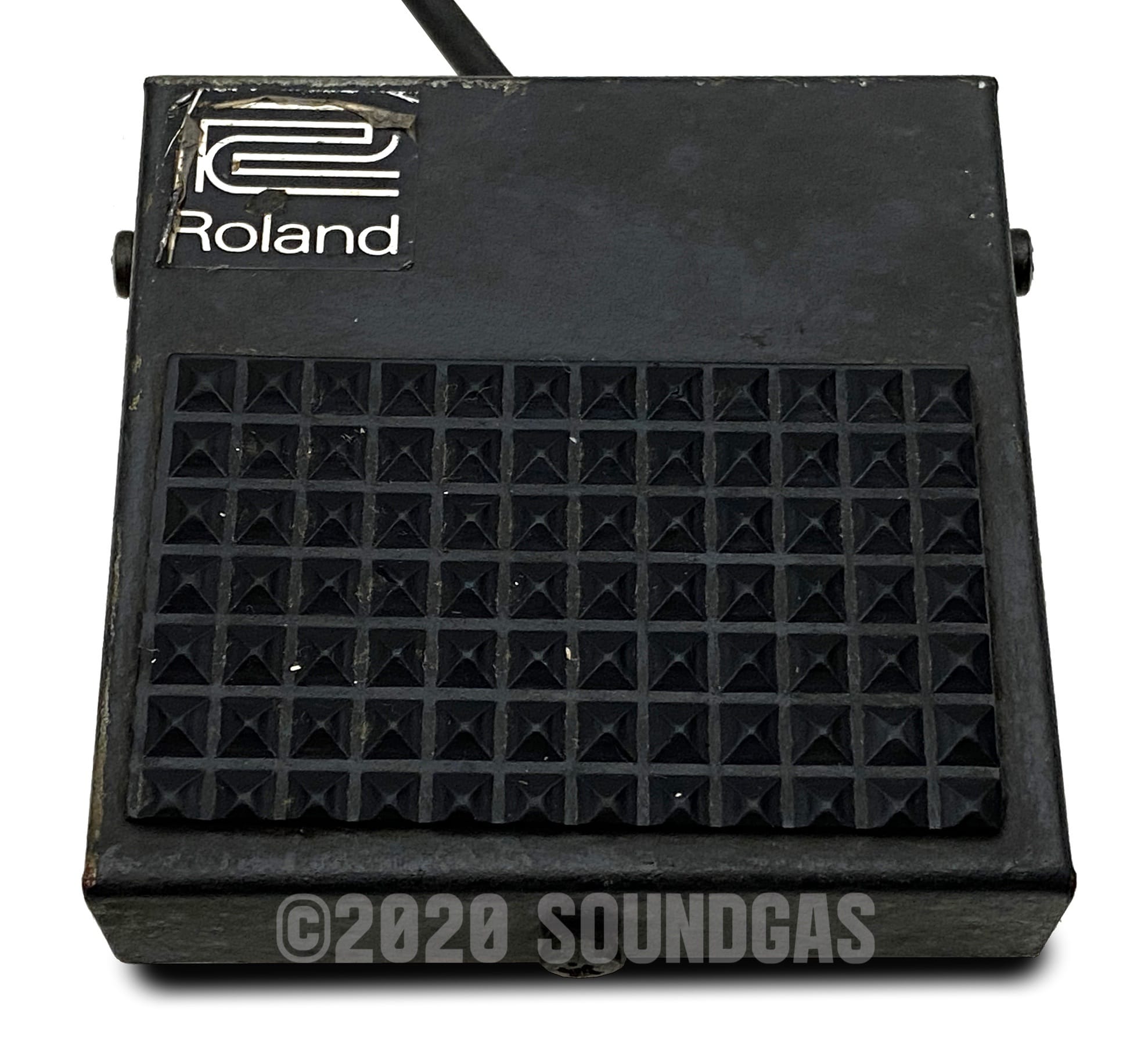
Manual fill interrupts when the player asks. Automatic fill can arrive every 2, 4, 8, 12 or 16 measures. Crash places a cymbal on the first beat as the fill returns to the basic rhythm. Register stores two complete rhythm-and-arranger states, A and B, ready to alternate.

Close view of the CR-8000 tempo display, Auto Fill In selector and variation controls
TEMPO, AUTOMATIC FILL AND THE RETURN TO THE BASIC RHYTHM
Close view of the CR-8000 Arranger buttons, preset rhythms and pattern controls
ARRANGER ABOVE, PRESET AND WRITABLE RHYTHMS BELOW
CR-8000 owner's manual diagram of the arranger, fill, crash and register controls
OWNER'S MANUAL // ARRANGER, FILL, CRASH AND REGISTER CONTROLS [S01]
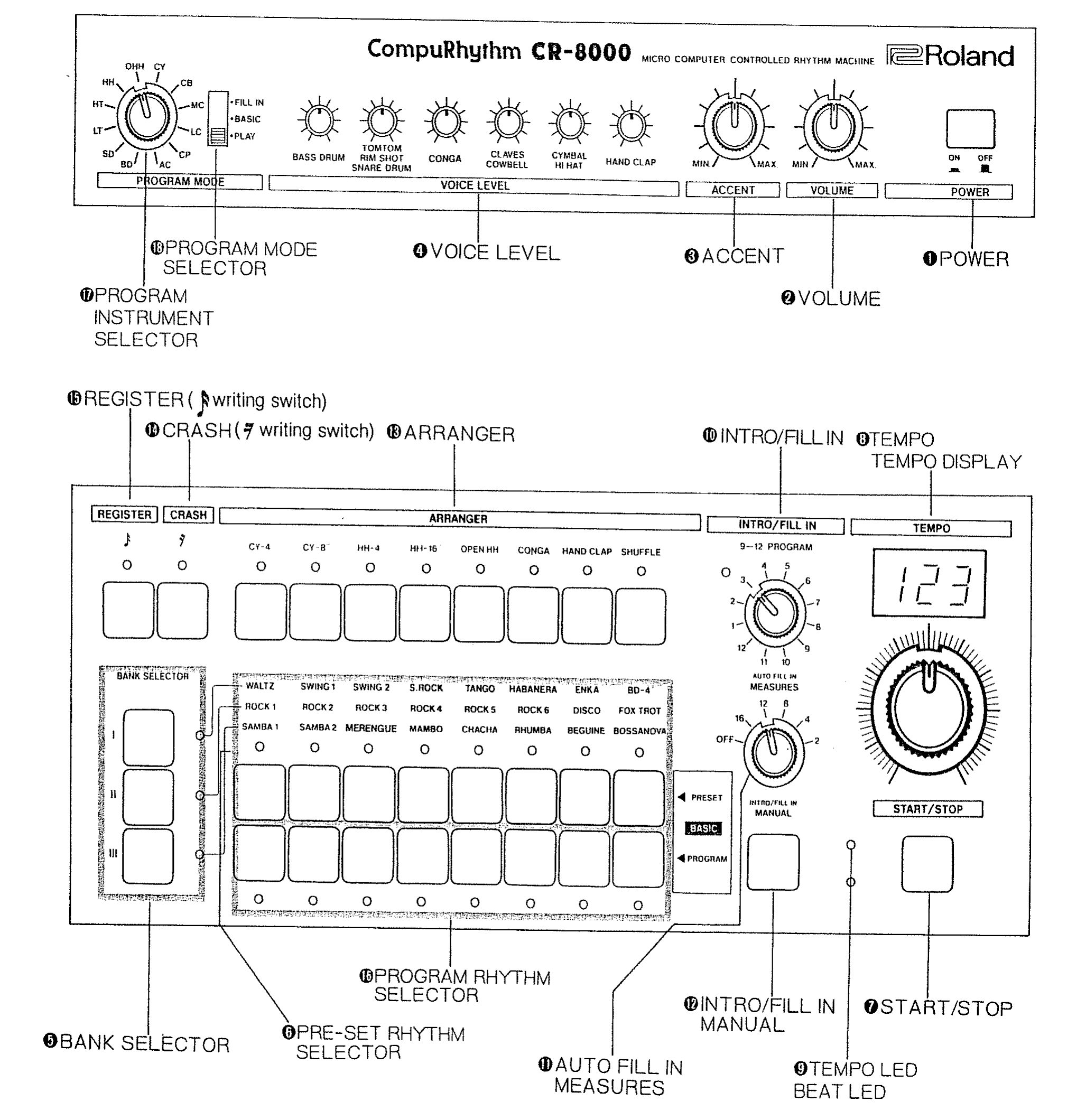
CR-8000 owner's manual map of every front-panel control
THE COMPLETE PLAYING SURFACE // PRESET, ARRANGER, FILL, REGISTER AND WRITE CONTROLS [S01]
01

CHOOSE

Press one or two basic rhythm buttons. The second selection combines with the first instead of simply replacing it.

02

ARRANGE

Add timekeeping, percussion or shuffle from the eight-button Arranger. Several additions can remain active together.

03

TURN

Choose a fill and decide whether it enters by hand or after a measured count. Crash gives the return a visible downbeat.

04

REGISTER

Store two complete panel states and move between them. It is a compact A/B arrangement memory, not a song sequencer.

OPEN THE OPERATOR'S PAPER // BUILD A PERFORMANCE FROM THE PANEL

Begin with the factory rhythm. Put the Arranger switches off, select one basic rhythm and set Balance near the centre. This lets you hear the original orchestration before adding anything.

Add one role at a time. CY-4 and CY-8 place cymbal events; HH-4 and HH-16 add hi-hat subdivision; Open HH changes the hat articulation; Conga and Hand Clap add new voices; Shuffle changes the spacing of eligible rhythms. Listen for what each control removes as well as what it adds.

Turn a loop into a phrase. Set an automatic fill interval, then use Crash to mark the return. The fill is not a separate song section—it is a timed interruption that makes a repeating rhythm breathe.

Use Register as two corners. Store a restrained A state and a denser B state. The two registers remember the rhythm selection and arranger condition, so one control can change several musical decisions together.

External alternation. The manual shows Trigger Out looped back to Register. With the correct trigger division, the machine can switch A/B from its own clock and make a longer self-changing cycle. [S01]

What the panel teaches. The CR-8000 treats rhythm as layers—basic pattern, arranger, fill, crash and register—not as a single frozen beat. That layered logic is its defining instrument design.

PAGE 03 // PROGRAMMING

TWO MEASURES.
ONE STEP AT A TIME.

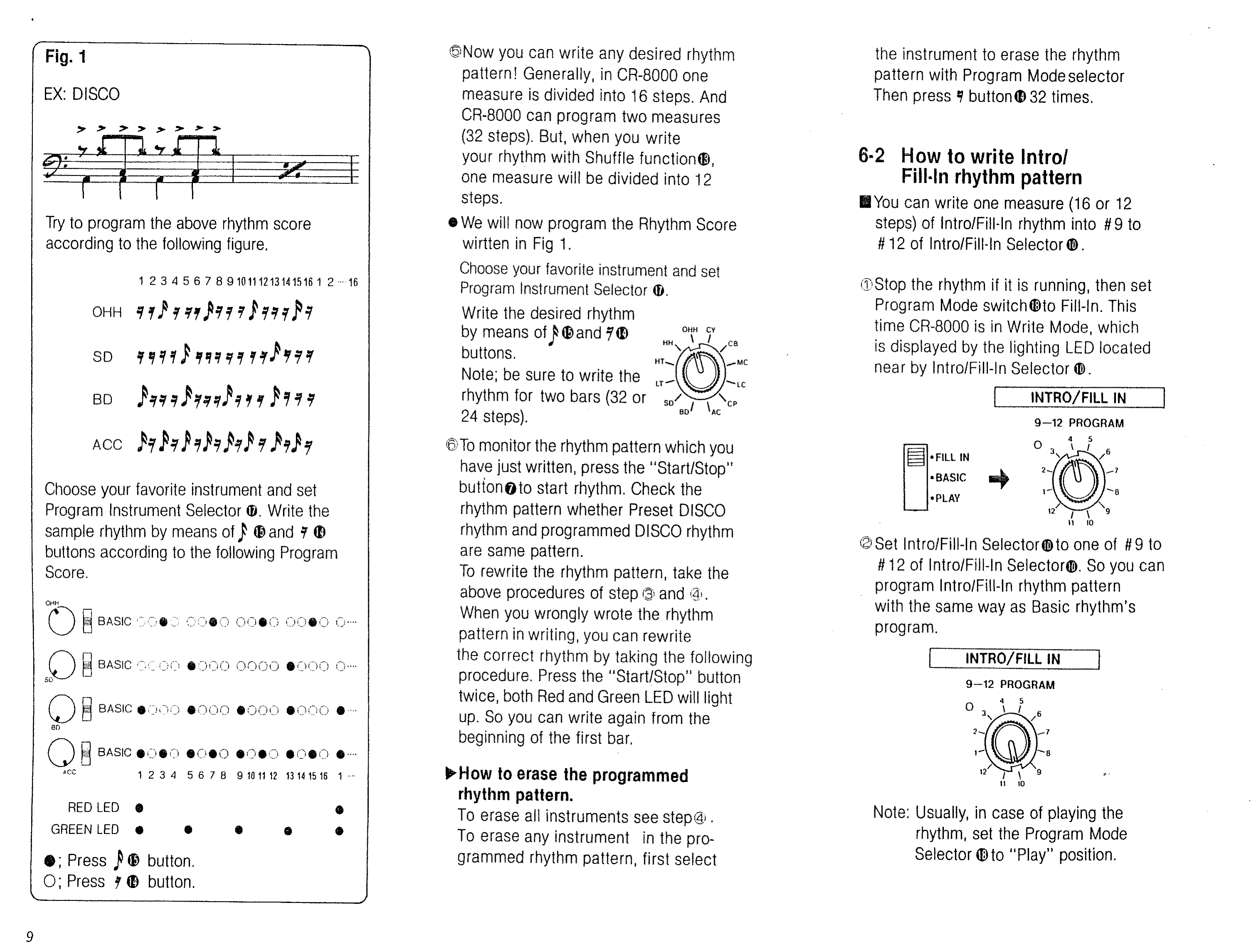
CR-8000 owner's manual instructions for writing a user rhythm

THE SOUND BUTTONS BECOME INPUT KEYS

Write mode separates time from performance. Choose a memory, select an instrument, and use two controls to move through the pattern: one enters a hit; the other records a rest. A normal measure contains sixteen positions. The machine stores two measures, so a basic rhythm can hold thirty-two decisions. [S01]

Shuffle and Waltz use twelve positions per measure, making a two-measure pattern twenty-four steps. User-programmed intro/fills are one measure long. The LED display counts the available positions while instrument selectors keep the voices separate.

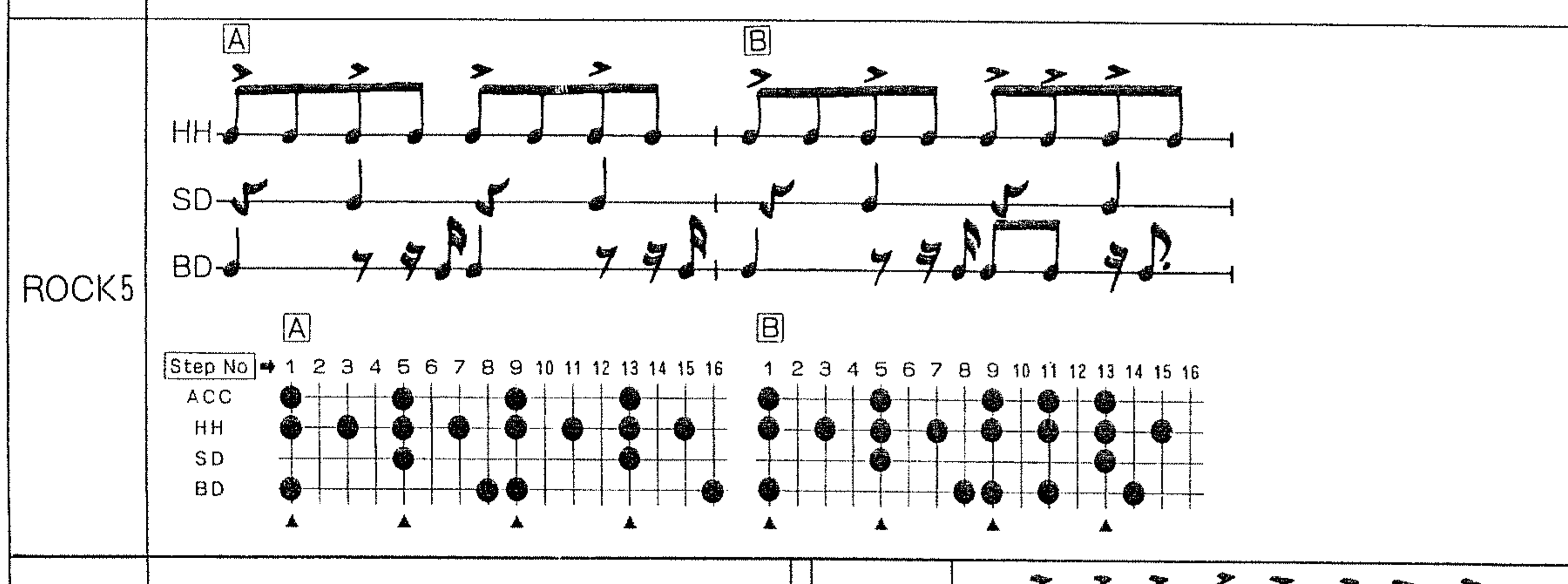
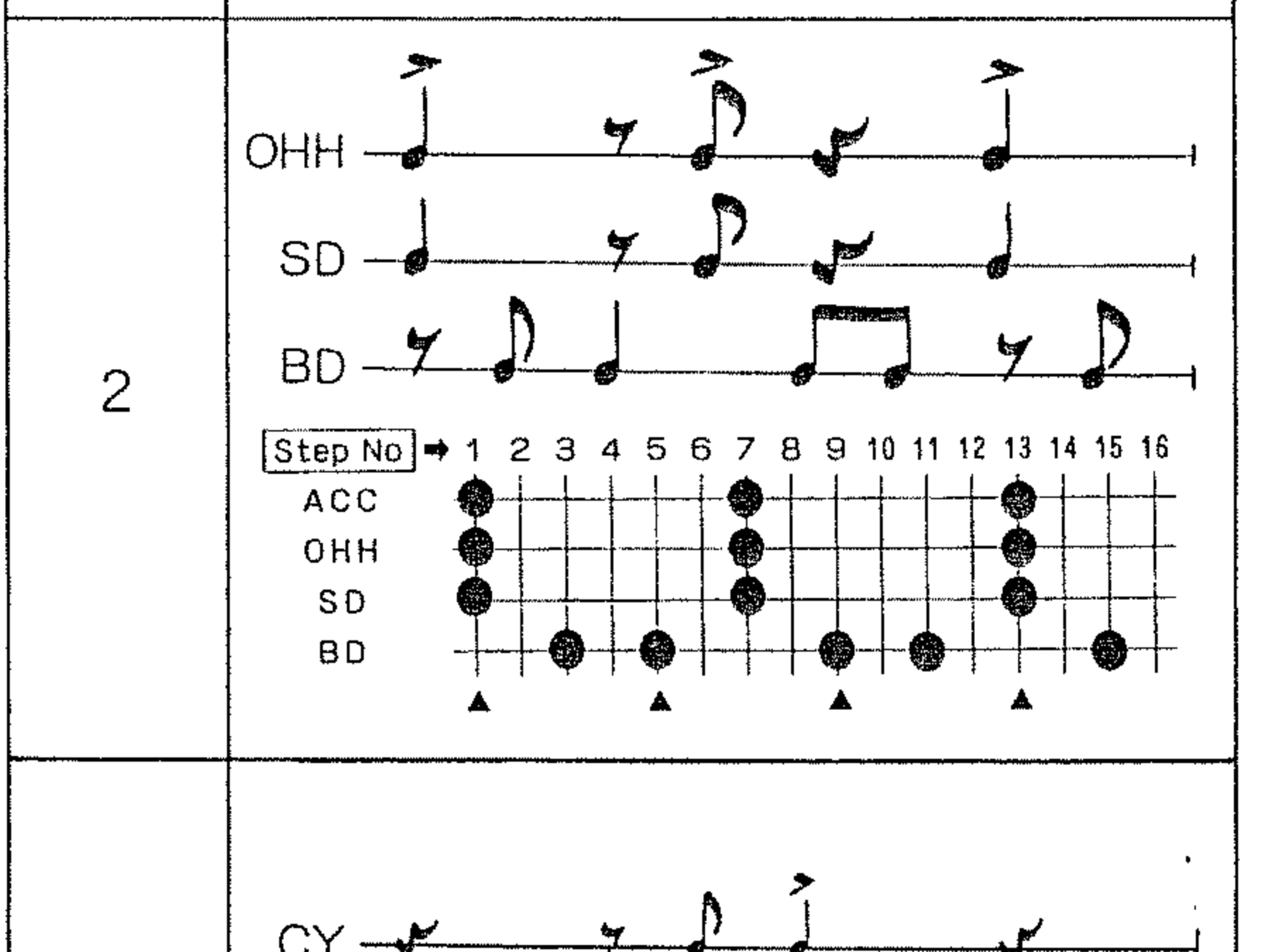
CR-8000 Rock 5 pattern shown as musical notation and a two-measure step grid
ROCK 5 // FACTORY PATTERN TRANSCRIBED INTO 32 STEPS
CR-8000 Fill 2 shown as source notation and step-grid evidence
FILL 2 // ONE-MEASURE INTERRUPTION

1981 SOURCE SCORE // ROCK 5 A + B // FILL 2

Write the basic. Conduct the fill.

The contemporary review printed these three sixteen-step plates. Run them as an A→B→Fill phrase, isolate any part, or edit a lane to feel the difference between stored basic material and a stored sectional event.

PLAY ROUTE // A → B → FILL 2

READY: THREE-BAR ARRANGEMENTSOURCE TRANSCRIPTION

SWIPE OR USE ARROW KEYS TO READ EVERY STEP →

ABD

STORED BASIC A

14 EVENTSThe stable opening bar.

STORED BASIC B

15 EVENTSA related bar with a changed bass-drum route.

STORED INTRO / FILL

11 EVENTSOpen hat and snare replace the regular hat line.

AUDIO STARTS AFTER YOUR FIRST PRESS

Score source: Electronics & Music Maker, December 1981. Browser audio is an explanatory approximation, not a sample recording or circuit-perfect emulation of the collection machine.

43 FACTORY RHYTHMS, FILLS & ARRANGER PARTS

Read the whole rhythm book.

Choose a rhythm, fill or Arranger part and press Run. The grid follows the printed score; browser synthesis lets you hear how the parts fit together.

How this reconstruction was made
4/416 POSITIONS14 SOUNDS4 ACCENTS

SWIPE OR USE ARROW KEYS TO READ EVERY STEP →

VOICE12345678910111213141516
ACCAccent control
BDBass drum
HHClosed hi-hat
SDSnare drum

Audio: starts after your first press.

Native timing retained. Five objects use twelve-position lattices; thirty-eight use sixteen. Slow Rock is heard as triplets, while Waltz keeps twelve sixteenth-note positions across 3/4.

Evidence boundary. Every mark above is source-written and independently reconciled. The browser makes the structure audible with approximate synthesis; it is not a recording or circuit model of the collection machine.

OPEN THE PROGRAMMING PAPER // FROM EMPTY MEMORY TO A WORKING RHYTHM

Choose the right scale. Sixteen steps per measure describe straight subdivisions; twelve steps accommodate Waltz and Shuffle structures. Decide the measure before entering notes, because the count defines where every event can exist.

Write by instrument. Program bass drum first, then snare, hats and colour voices. A voice-by-voice pass makes the architecture audible and reduces the chance of losing your position.

Use the second measure. A two-measure memory is more than twice the length: it permits an answer. Move one kick, open the hi-hat or withhold a clap in B so the cycle has direction.

Program the fill separately. The four user fill memories are one measure each. Treat them as punctuation: a pickup, a rolling snare, a conga answer or a gap that makes the return heavier.

Protect the work. The writable memory is retained by three 1.5 V cells. Record the pattern on paper or audio before service; a battery or power fault can remove the only copy.

Read Rock 5. The period review printed both conventional notation and the machine's grid. The kick syncopation changes between A and B while the hat holds the subdivision—an exact demonstration of why two-measure memory matters. [S03]

PAGE 04 // ANALOGUE ENGINEERING

FOURTEEN VOICES.
SEVERAL WAYS TO MAKE A DRUM.

The CR-8000 does not replay drum recordings. Its control system sends trigger pulses into fourteen analogue voice circuits. Bass drum, snare, toms and congas begin with tuned networks; hats and cymbal begin with a six-oscillator metallic source; handclap begins with noise; envelopes then decide how each event rises, bends and dies away. Roland's service notes describe the family as similar in approach to the TR-808, while documenting important differences. [S02]

That distinction is essential. The processor decides when a voice fires. The analogue circuit decides what the hit becomes.

01TRIGGER

The processor places an event at a rhythmic position.

02EXCITATION

A pulse or noise burst starts the voice circuit.

03RESONANCE

Tuned filters or oscillators establish pitch and colour.

04ENVELOPE

Control voltages shape decay, pitch movement and level.

05ACCENT + MIX

A common VCA lifts selected beats into the mono output.

OPEN THE ENGINEERING PAPER // FOLLOW EACH VOICE FAMILY

Bass drum. A short trigger excites a bridged-T resonant network. The network rings at a low frequency and loses energy over time, so one pulse becomes a rounded thump with a decaying tail rather than a click.

Snare drum. Two tuned bridged-T sections provide the pitched body while filtered noise provides the wire-like burst. Their envelopes overlap, joining a short tonal impact to a rougher broadband tail.

Toms and congas. A diode inside the resonant RC loop makes the pitch depend on signal amplitude. The hit begins at one pitch and settles as the envelope falls. The tom path also receives pink noise, used here as a compact suggestion of reverberant drum skin.

Rim shot and claves. Short resonant and clamping networks turn the trigger into a hard, narrow event. The rim-shot envelope is roughly 30 ms: enough tuned ring to give pitch, but short enough to retain its click.

Cowbell. Oscillators at approximately 800 Hz and 555 Hz are mixed and shaped together. Their interval produces a complex metallic spectrum from two simple square-wave sources.

Hi-hat and cymbal. Six square-wave oscillators—approximately 794, 649, 524, 444, 368 and 283 Hz—form a deliberately inharmonic metal source. Separate filter and envelope networks turn it into cymbal, closed hat or open hat. The closed hat falls away in roughly 74 ms; the open hat extends to about 300 ms. [S02]

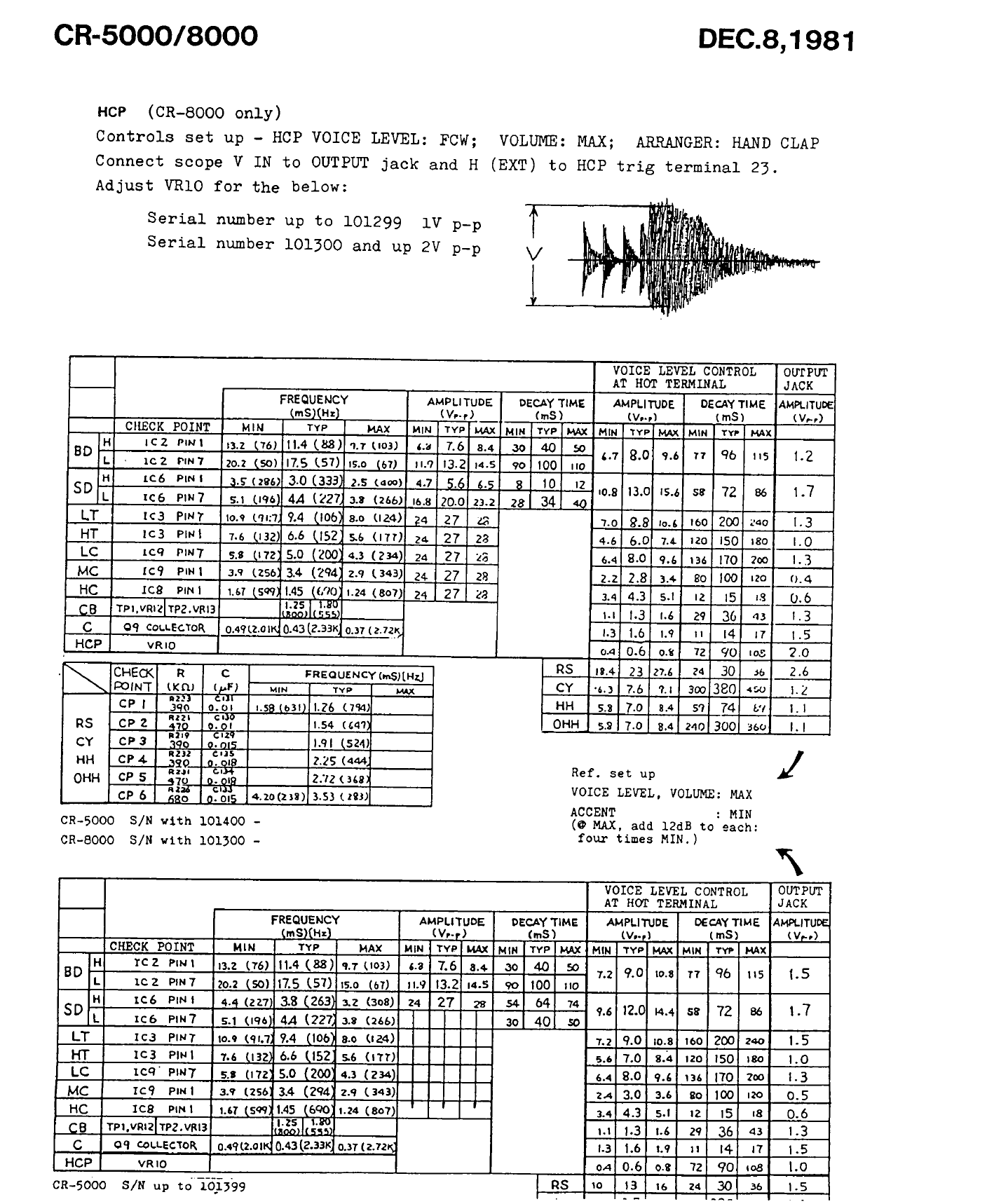
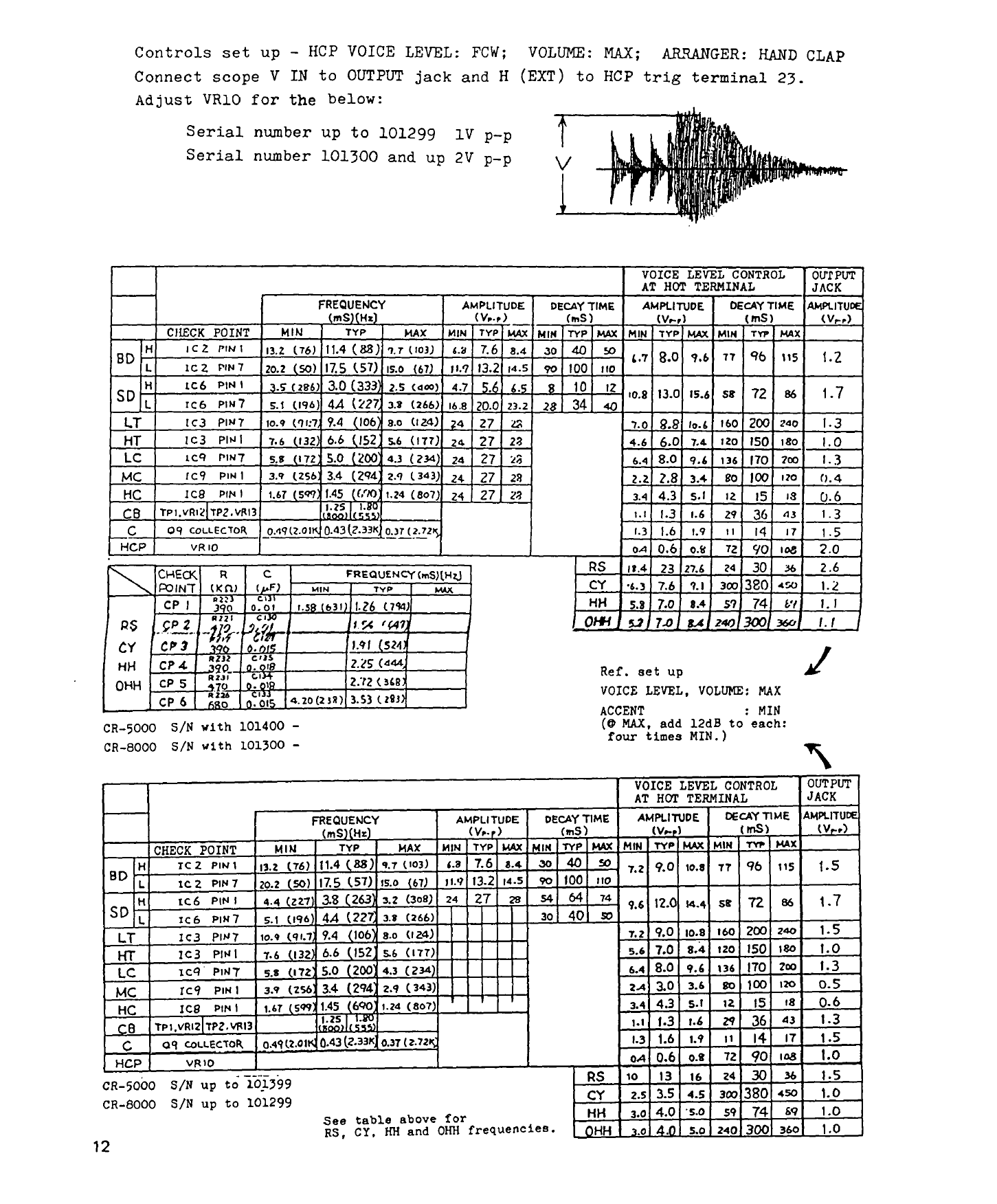
Handclap. White noise passes through repeated sawtooth-shaped amplitude envelopes. Several fast bursts create the group of impacts; a slower tail supplies the wash after them. The factory target changed at serial 101300 from 1 V peak-to-peak to 2 V peak-to-peak, so two correctly serviced machines may not match exactly.

Accent. The programmed accent controls a shared VCA downstream. It changes the force of the assembled kit together, which is why the accent row feels like a musical stress rather than fourteen independent velocity controls.

A crucial programming limit. Rim shot, claves and high conga are voices in the machine, but they are not offered as direct choices in the user-pattern instrument row. The writable kit and the full preset kit are not identical.

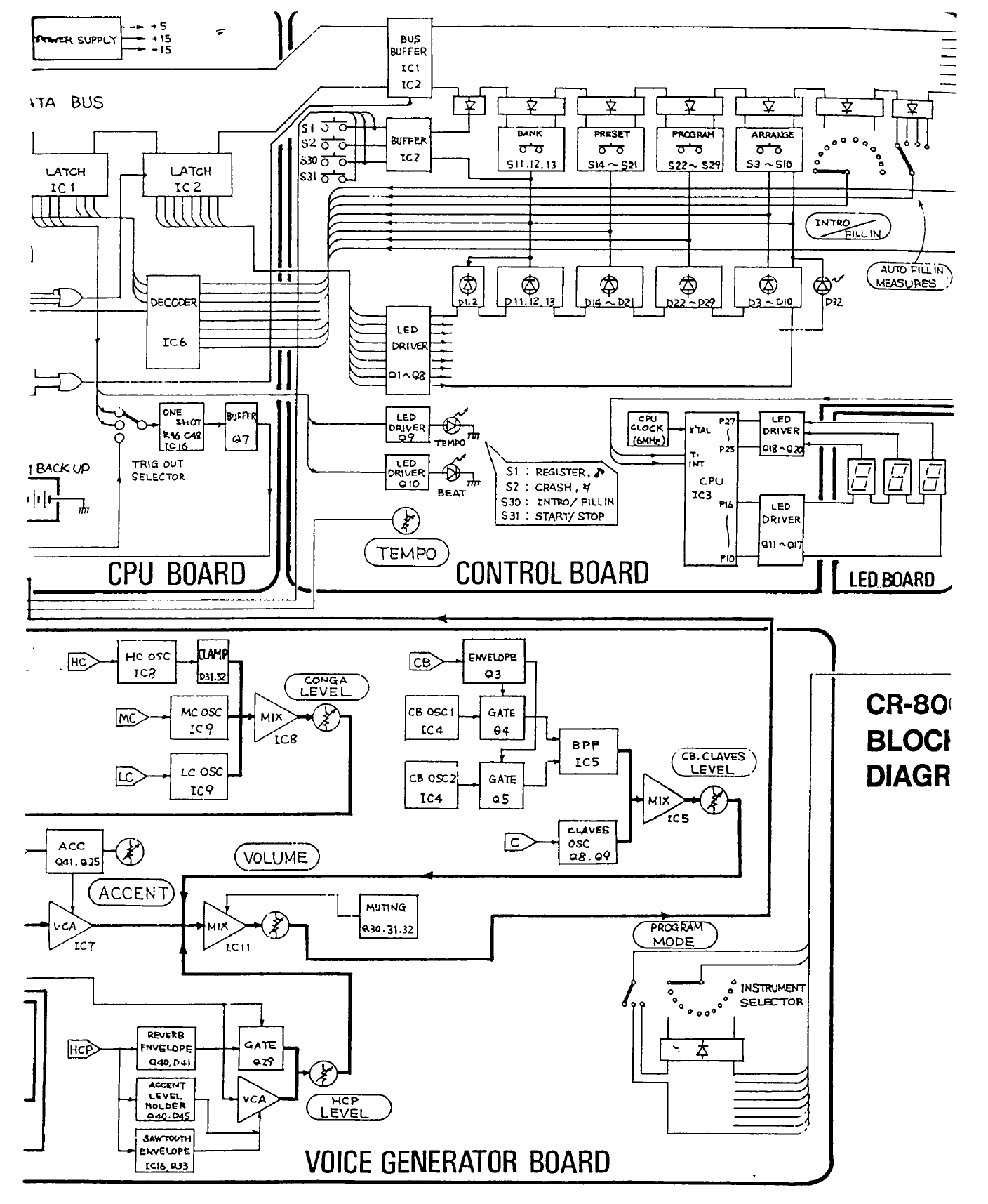
CR-8000 factory service block diagram showing CPU, control, voice and output relationships
FACTORY BLOCK DIAGRAM // CONTROL TO VOICE BOARD [S02]
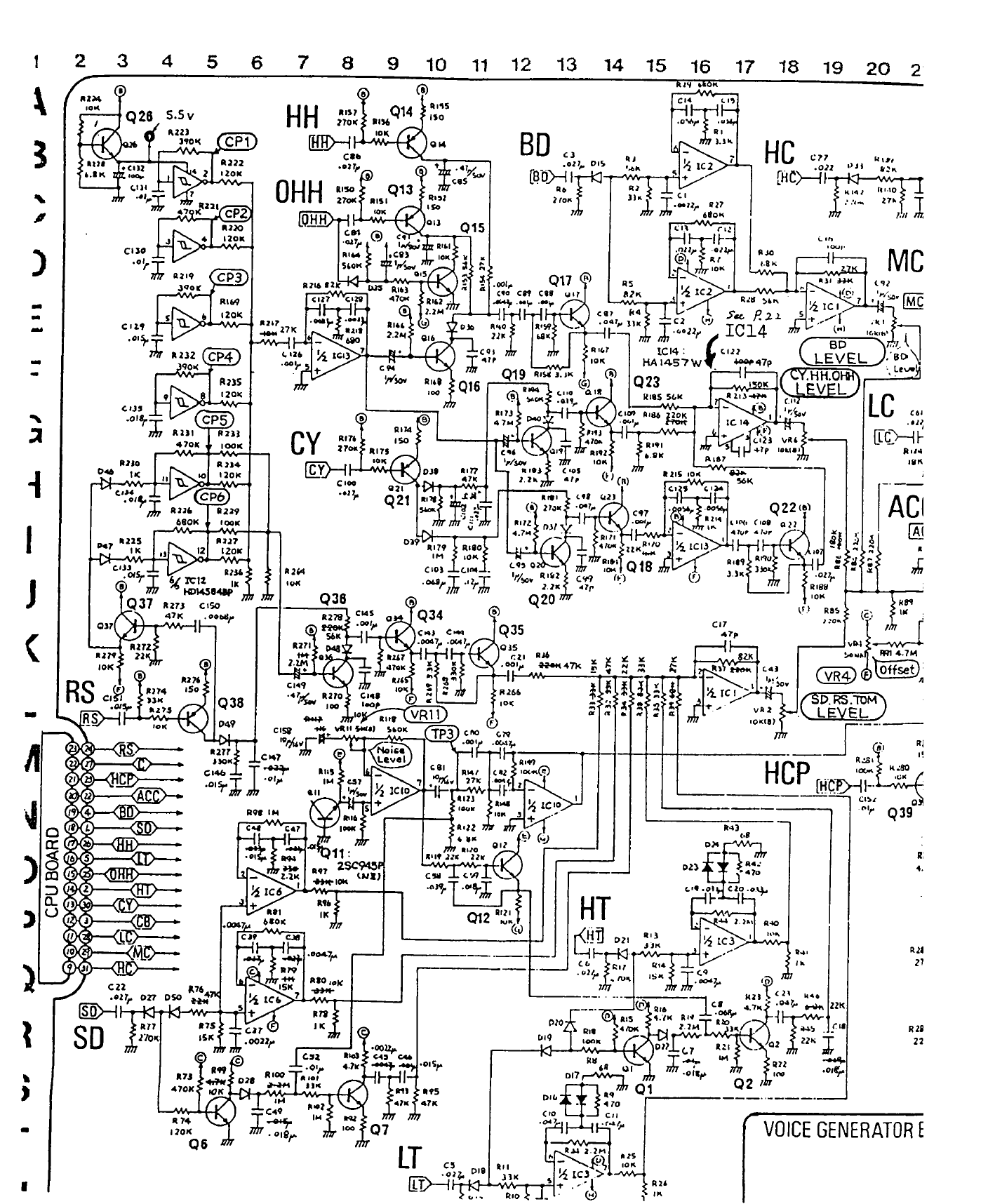
CR-8000 factory analogue voice circuit schematic
VOICE BOARD SCHEMATIC // RESONATORS, NOISE, METALLIC OSCILLATORS AND MIX [S02]
CR-8000 factory operation chart showing rhythm selection, arranger, register and fill logic
OPERATION CHART // HOW PANEL DECISIONS BECOME VOICE TRIGGERS [S02]

PAGE 05 // CONTROL AND CONNECTION

TWO PROCESSORS.
ONE RHYTHM SYSTEM.

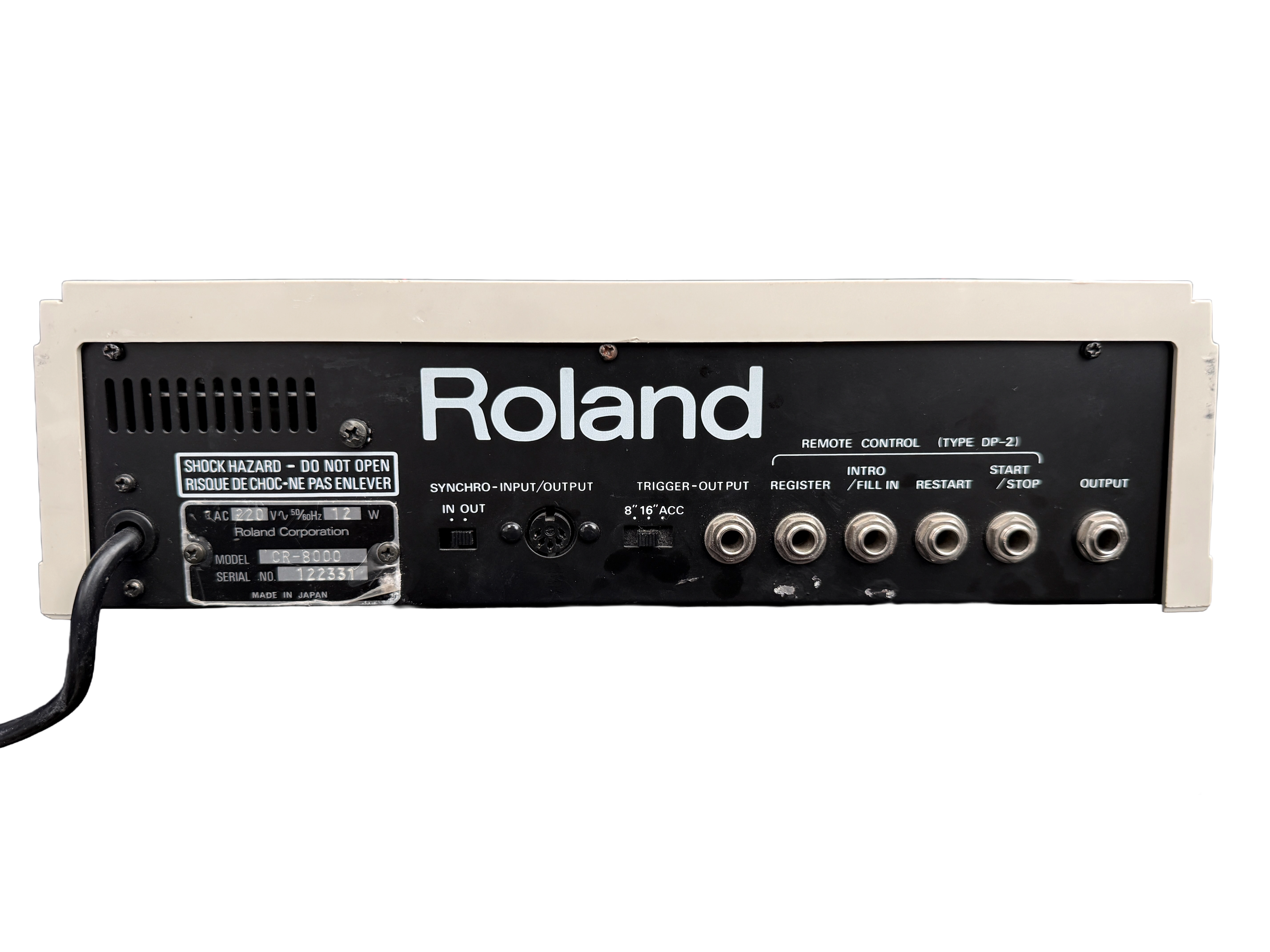
Complete rear view of Big Beat Collection CR-8000 unit 122331 showing its connection panel
BIG BEAT COLLECTION // COMPLETE REAR PANEL
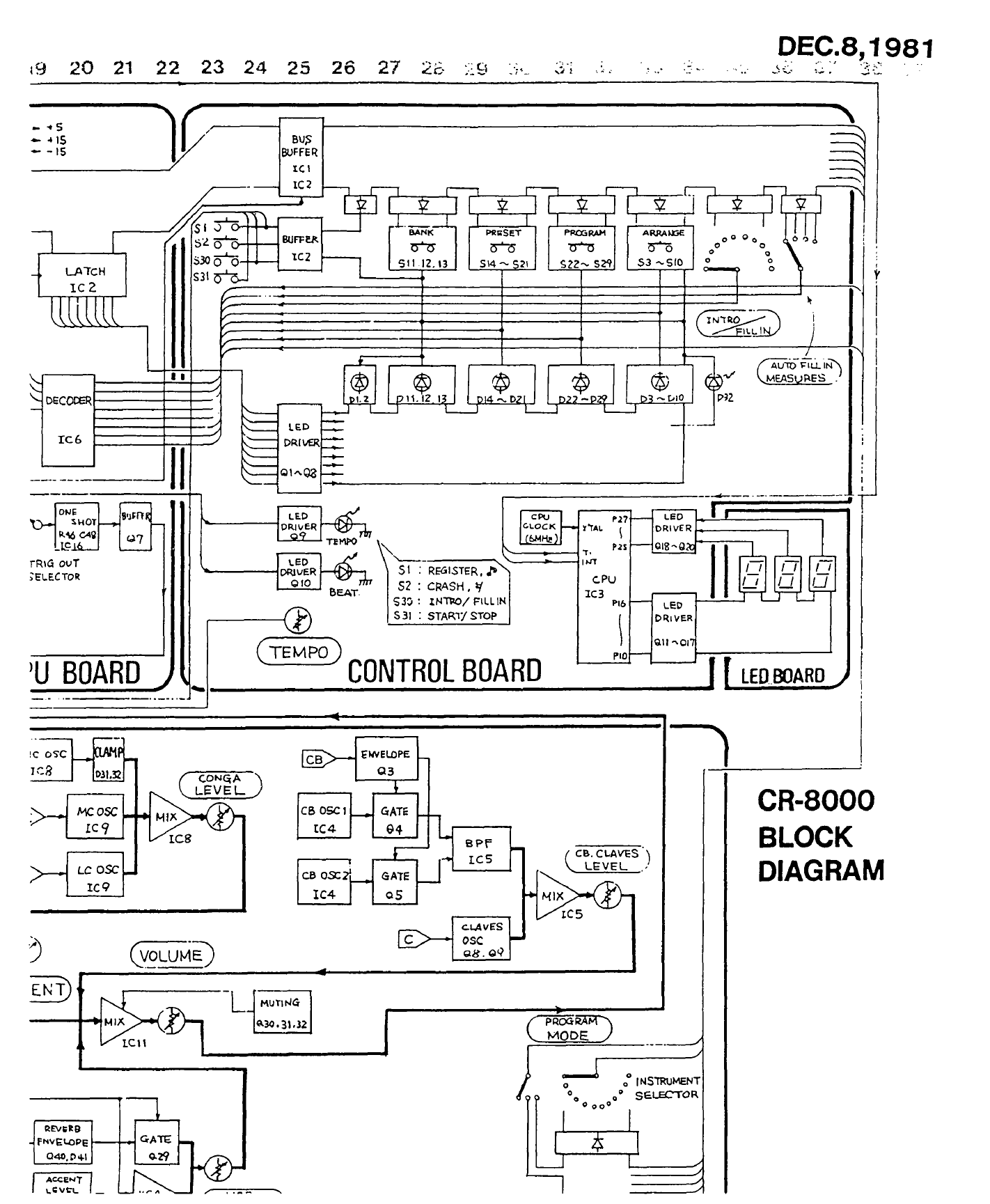
CR-8000 factory block diagram of the microcomputer control system
CR-8000 CONTROL BOARD // CPU, MEMORY, DISPLAY AND TRIGGER DISTRIBUTION [S02]
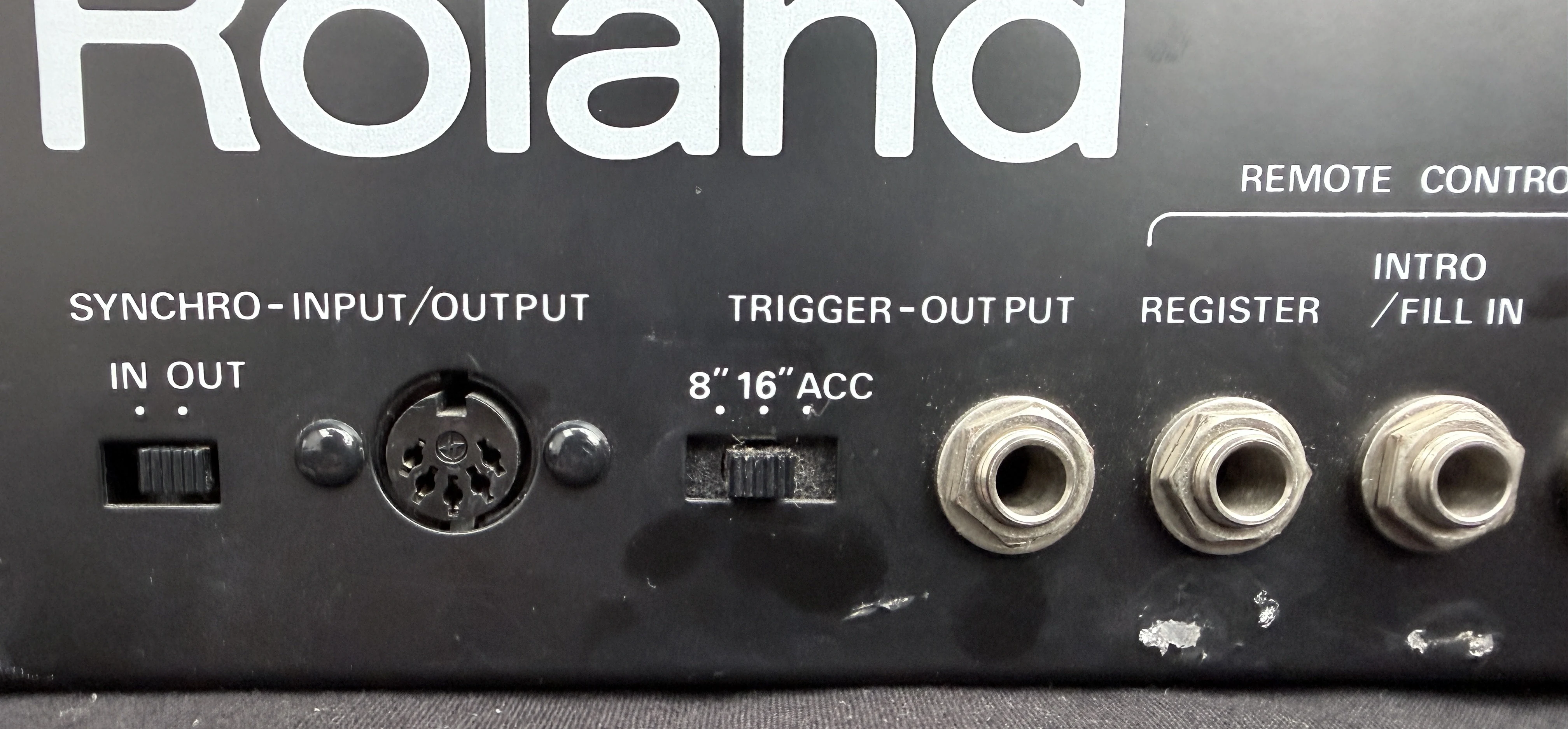
CR-8000 rear-panel detail showing Roland branding, DIN Sync input and output, Trigger Out, Register and Intro Fill In sockets
SYNC IN/OUT, TRIGGER OUT AND THE PERFORMANCE-CONTROL INPUTS
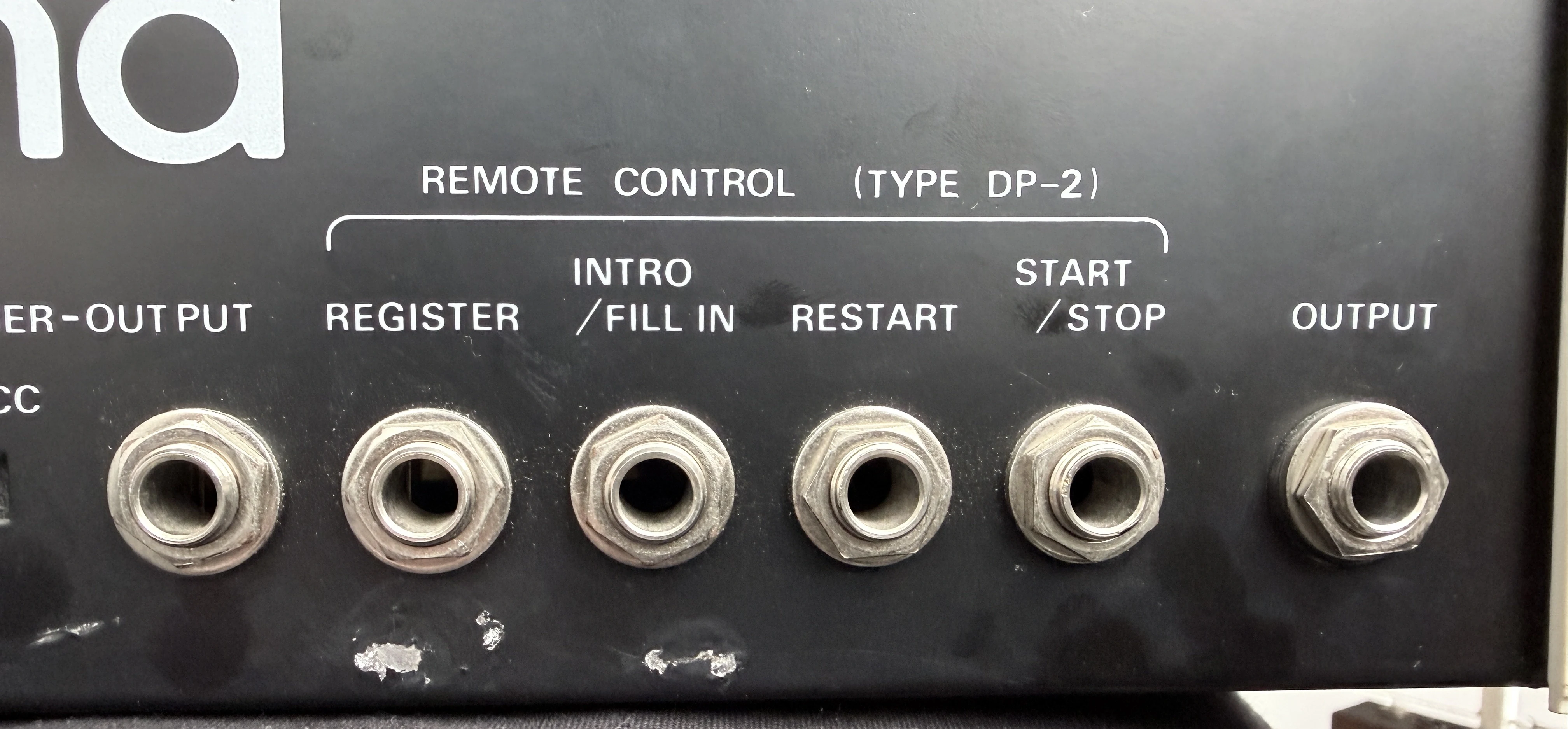
CR-8000 rear-panel detail showing remote-control inputs and audio outputs
REMOTE CONTROL, START/STOP, VARIATION AND HIGH/LOW IMPEDANCE AUDIO

MAIN CPU

A µPD8049C contains 2K × 8 program ROM and 128 × 8 internal RAM. It scans the panel, runs patterns, addresses memory and distributes voice triggers.

PATTERN RAM

A µPD444C supplies 1024 × 4 external CMOS memory for the user's rhythms and fills. Three 1.5 V cells keep that data alive when mains power is absent.

TEMPO CPU

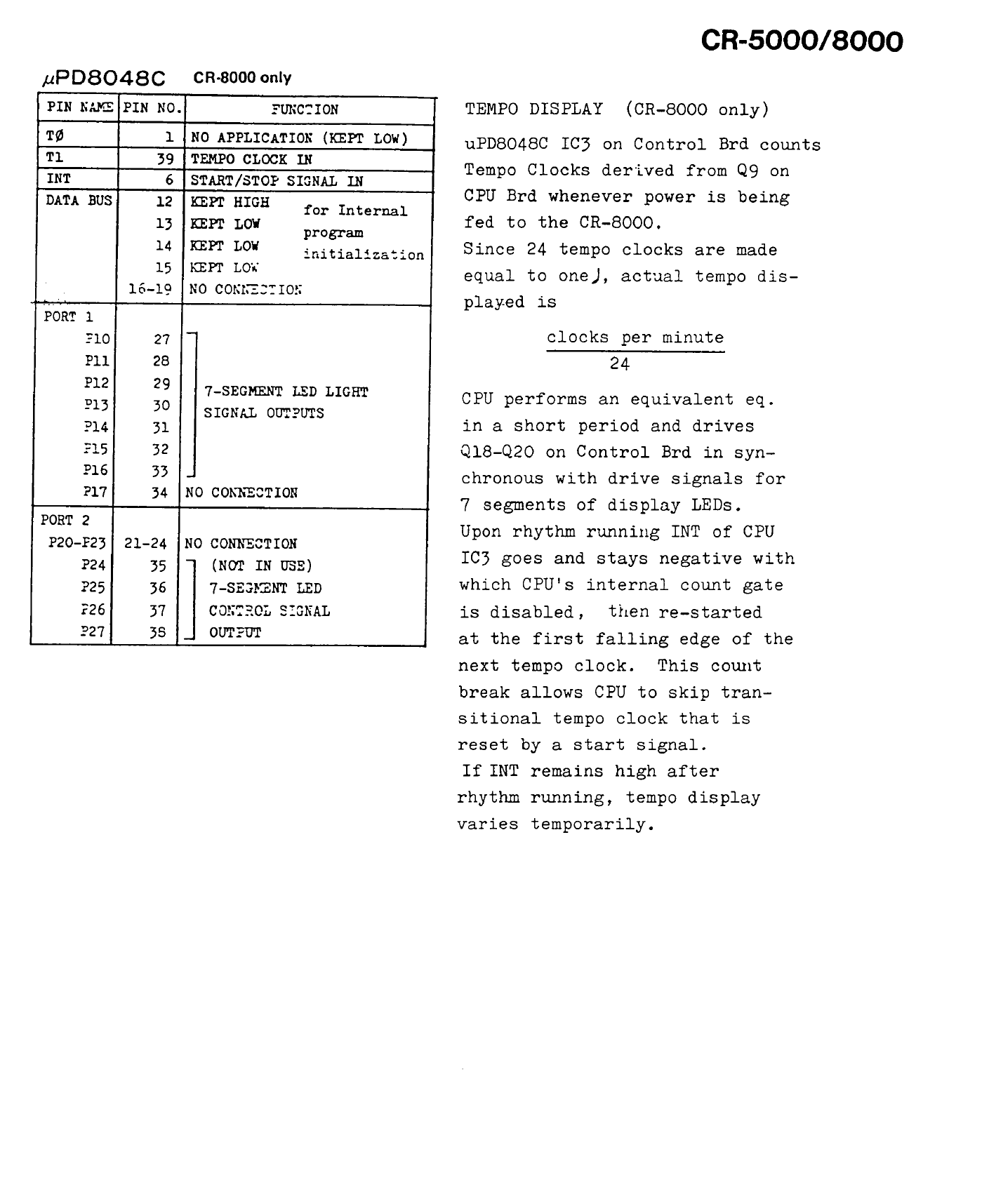
A second processor, the µPD8048C, drives the numeric tempo display. The number shown is the clock count per minute divided by 24, matching the machine's sync basis.

DIN + TRIGGER

DIN Sync In/Out carries clock and run/stop to compatible Roland equipment. Trigger Out can follow eighth notes, sixteenths or programmed accents. This is pre-MIDI timing, not MIDI data.

OPEN THE SYSTEM PAPER // CLOCK, RESTART, REGISTER AND OUTPUT

DIN Sync. The five-pin sockets carry a 24-pulse-per-quarter-note clock with run/stop information. Declare one master. Connecting two machines does not decide which one owns tempo.

Trigger Out. The rear selector chooses eighth-note, sixteenth-note or accent pulses. The owner's manual describes a nominal +5 V, 10 ms pulse; the service notes measure a tempo-dependent width of roughly 44 ms at minimum tempo and 12 ms at maximum. Those statements describe the same output at different levels of precision. Use it as a control pulse, never as audio. [S01] [S02]

Restart. Restart resets the rhythm to its beginning. A footswitch or external pulse can turn that into an odd-meter performance tool by forcing a new “one” before the stored bar completes.

Register loop. Feeding a divided Trigger Out back to Register can alternate the A and B memories automatically. The CR-8000 can therefore use its own timing signal to create a larger form.

Audio path. The machine provides a single mono output rather than individual voice outputs. Balance controls change groups inside that mix; recording separate sounds requires separate passes or modification.

Tempo display. The display is a measured clock indication, not a modern DAW guarantee. A temporary variation control can pull the rhythm around its set rate for live push and drag.

Battery memory. The original backup arrangement belongs to a mains-powered vintage instrument. Inspection, replacement and leakage repair should be handled by a qualified technician; this dossier documents the factory system, not a live-chassis DIY procedure.

PAGE 06 // RECORDS

THE BOX LEAVES
THE LOUNGE.

Three participant-led accounts place the CR-8000 in very different rooms: a Bronx bedroom where a freestyle landmark began, a 1984 Long Island demo assembled on two tape decks, and a later Los Angeles studio groove made while a guitarist played beside it.

TWO DECKS, ONE MACHINE

The Library of Congress interview introduces its technology question with an account of the 1984 “Public Enemy No. 1” demo using two tape decks and a Roland 8000. Hank Shocklee supplies the operating detail: they began with a basic rhythm, then changed the beat for the chorus. The machine's structure—preset rhythm, arranger and programmed variation—became a practical arrangement tool before the Bomb Squad existed under that name. [S08] [S09]

PROGRAMMED BESIDE THE GUITAR

DJ Quik remembers programming an old Roland while guitarist Robert “Fonksta” Bacon played. He tentatively identifies the model as a CR-8000; his recollection does not establish the model with certainty. The session became “Bacon's Groove” on The Midnight Life. An early programmable rhythm box became the live partner for a new studio performance decades after its release. [S07]

THE DEMO AND THE MASTER ARE TWO MACHINES

Producer Chris Barbosa says the original bedroom instrumental, “Fire and Ice,” grew from a CR-8000 working beside a JX-3P, TB-303 and MC-202. He connects its syncopated kick pattern to the Puerto Rican salsa rhythms and 1970s pop he had absorbed growing up in the Bronx. Mark Liggett heard that demo and developed it into the song Shannon recorded. The finished master followed a different drum route: Barbosa says Liggett and engineer Rod Hui used a TR-808 with plate reverb and gating. The CR-8000 therefore belongs to the composition's beginning—not to every drum sound heard on the release. [S14]

PAGE 07 // SERVICE AND AFTERLIFE

MEMORY FADES.
THE CIRCUIT REMAINS.

01

DATA

Write down or record user rhythms before opening the case. Battery-backed RAM means service can erase the owner's musical history even when the repair succeeds.

02

FIRMWARE

Main CPU suffixes -159 and -232 matter. The later program corrects a shuffle/alternate rhythm/fill fault that could substitute first-step data in measure two.

03

SERIAL

Factory notes document circuit changes around serials 090900, 101300 and 111700. Identify the board revision before treating one schematic as universal.

04

CALIBRATE

Handclap level changed from a 1 Vpp to 2 Vpp target at serial 101300. Cymbal oscillators are adjusted by relationship, not by forcing every oscillator to one frequency.

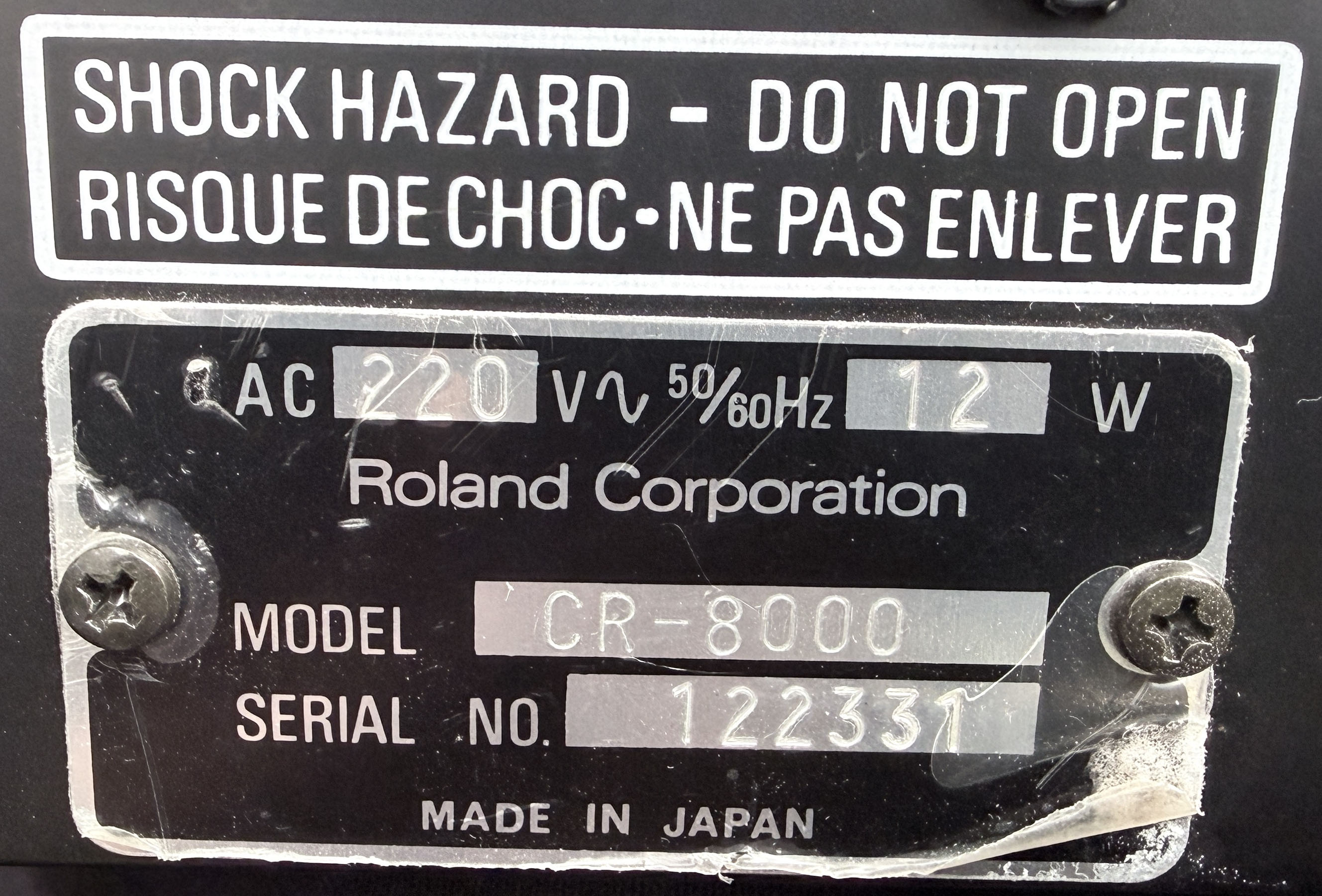
The Big Beat Collection machine is serial 122331, later than Roland's documented 101300 handclap-calibration change and the 111700 divider-board change. A serial number locates the instrument in the production sequence; it does not, by itself, identify every unseen board or later repair. [S02]

OPEN THE BENCH PAPER // PRESERVE THE MACHINE BEFORE CHANGING IT

Start with identity. Record serial number, CPU suffix, board markings, replaced components and battery condition. Roland changed both control and voicing assemblies during production.

Save the patterns. There is no cassette dump or cartridge slot. Document every user pattern and fill before power, memory or battery work. Photographs of button states are not enough; write the step positions voice by voice.

Confirm control first. Check power rails, reset, clock, panel scan and trigger delivery before adjusting the analogue voices. A silent voice can begin upstream in the processor or trigger path.

Measure the source. For bass, snare, tom and conga, inspect the excitation pulse and ringing network. For cymbal and hats, confirm all six oscillators before changing filters. For clap, confirm the noise source and burst envelope separately.

Respect serial changes. Roland's notes document an HA1457W-to-NJM4558S substitution with a matching board-layout change but no single serial-number boundary. A later op-amp or board revision is not automatically a repair. Compare the physical board with the correct note and corrected schematic before restoring an “original” value. [S02] [S06]

Safety boundary. The procedures below are historical factory references for a qualified technician. This mains-powered instrument should be disconnected, discharged and serviced with appropriate isolation and test equipment.

Afterlife. The CR-8000 did not become the software shorthand that the CR-78 became. It survives through hardware—sometimes heavily modified. Crypts described a modified CR-8000 as central to their live rig, evidence that the instrument's afterlife can be new circuitry and performance rather than nostalgia. [S11]

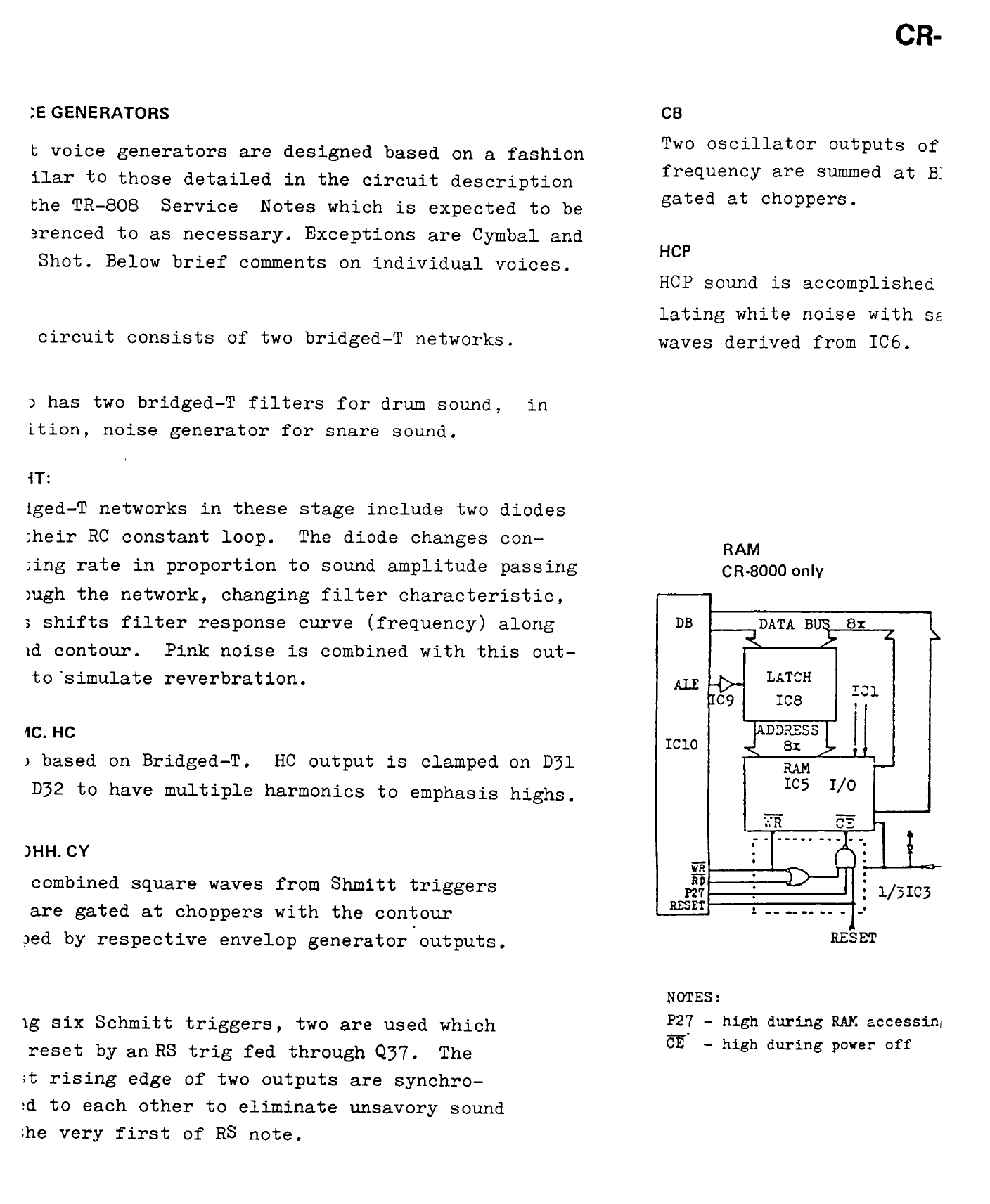
CR-8000 service notes describing CPU program versions and operation
CPU PROGRAM VERSIONS // THE SOFTWARE INSIDE THE ARRANGER [S02]
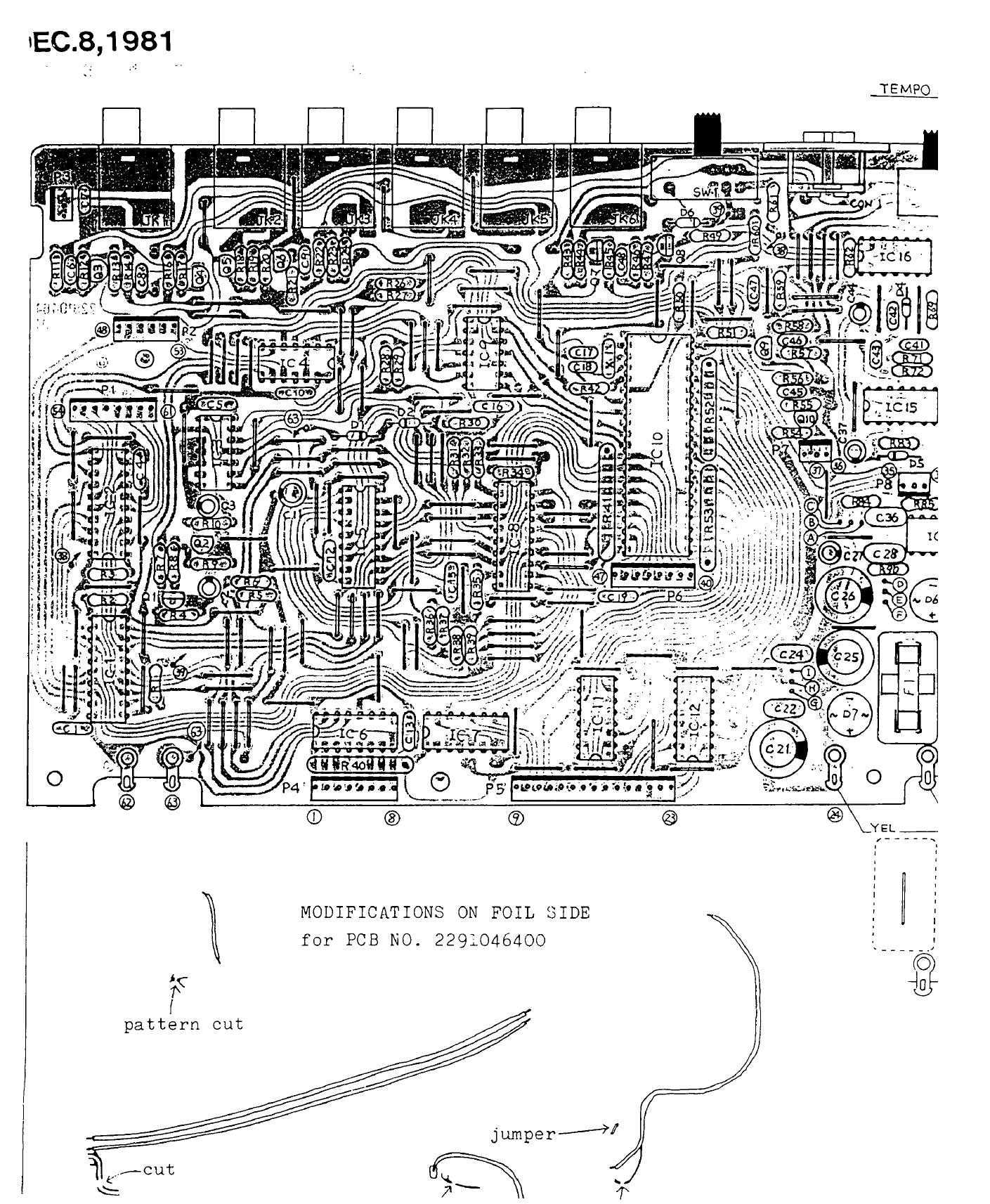
CR-8000 factory control-board layout
CONTROL BOARD // COMPONENT AND TEST-POINT MAP [S02]
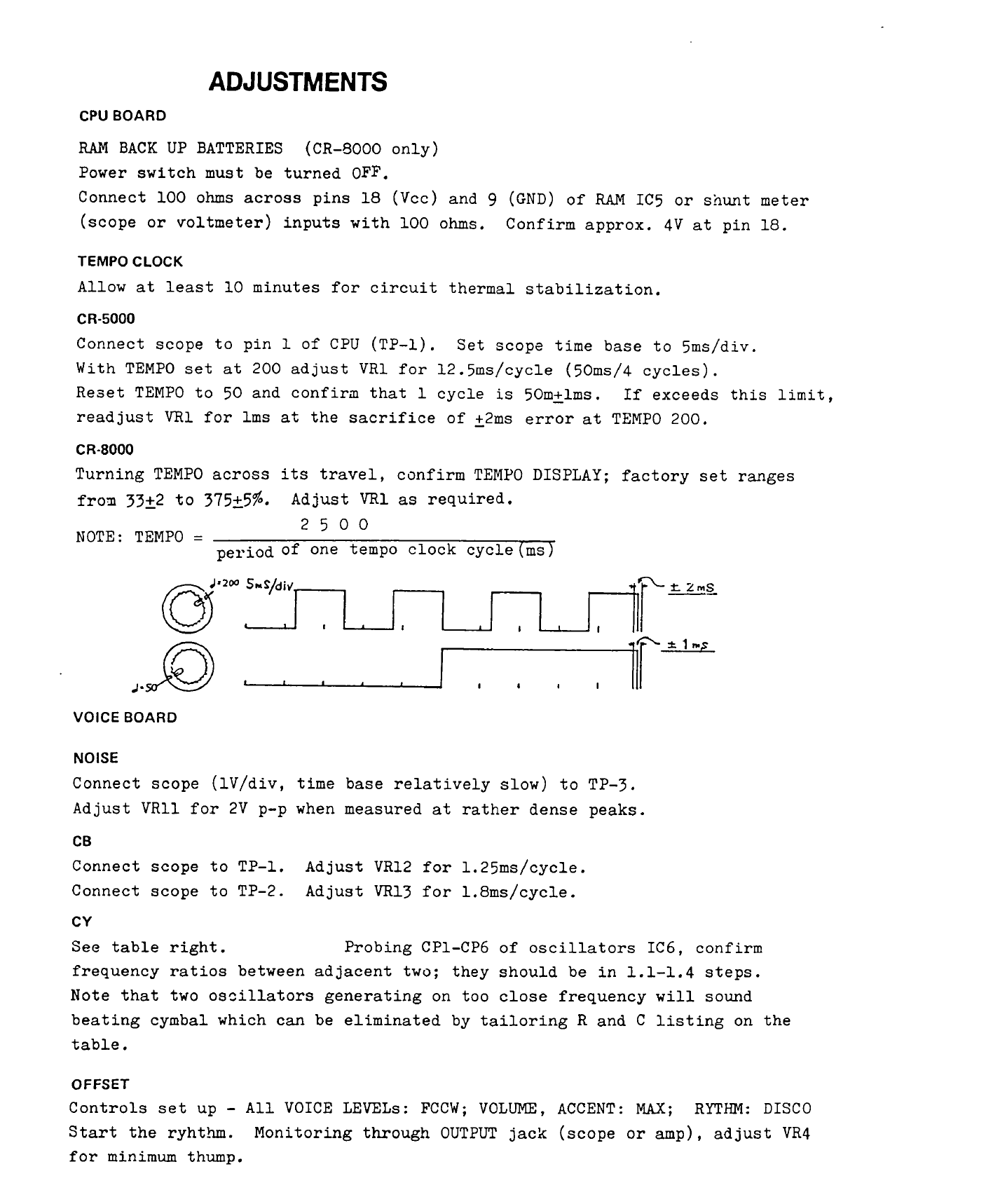
CR-8000 factory adjustment procedures
FACTORY ADJUSTMENTS // LEVEL, NOISE AND OSCILLATOR RELATIONSHIPS [S02]
CR-8000 service procedure for voice level and envelope calibration
VOICE CALIBRATION // FACTORY LEVEL AND ENVELOPE TARGETS [S02]
CR-8000 service procedure for metallic oscillator frequency adjustment
METALLIC SOURCE // SIX OSCILLATORS ADJUSTED AS A RELATIONSHIP [S02]

THE SOURCE DESK // FACTORY MANUALS, PERIOD PRESS, CIRCUIT STUDY, PARTICIPANT HISTORY

S01Roland CR-8000 Owner's ManualFactory operating manualS02Roland CR-5000 / CR-8000 Service NotesFactory service documentS03CR-5000 and CR-8000 Rhythm UnitsE&MM, December 1981S04Roland manual archiveManufacturer archiveS05CR-8000 circuit notesArchived independent circuit analysisS06CR-8000 corrected schematicIndependent service resourceS07DJ Quik: Bullseye interviewFirst-person interviewS08Chuck D: Library of Congress MagazineParticipant interviewS09Hank Shocklee: Tape Op interviewParticipant interviewS10Roland Drum Machine Chronicle: CR-8000Manufacturer historyS11Crypts: Sound CheckArtist interviewS12Roland Computer Controlled Rhythm MachinesRoland brochure, November 1982S13Roland CR-8000 product newsMusician, December 1981S14Shannon: Let the Music Play oral historyParticipant oral historyS15Roland CR-8000 survivor 101378Survivor photography: front, controls, rear, serial, cover and DP-2

PASS THE FILE ON // CANONICAL TRANSMISSION

SHARE THE ROLAND COMPURHYTHM CR-8000.

Send readers directly to this machine file on Drum Machines Have No Soul.

drummachineshavenosoul.com/machines/cr-8000

THE MACHINE LINE // 06 OF 12

FOLLOW THE CHANGE.

Each machine inherits a working idea and moves one musical decision. Continue through the family by what the player can do—not by model number alone.