LOW TOM → TRIGGER OUT
READYThe manual score’s LT lane is also a pattern of approximately +14 V, 20 ms control pulses. THE ELECTRONIC RHYTHM ARCHIVEDRUM MACHINES HAVE NO SOUL
ROLAND / JAPAN / 1981
DRUMATIX / SEVEN VOICES / TWO TRIGGER LANES
TR–606
A small box.
A complete drummer.
01 / ROLAND / THE SILVER INSTRUMENTS
Small enough to carry.
Serious enough to compose.
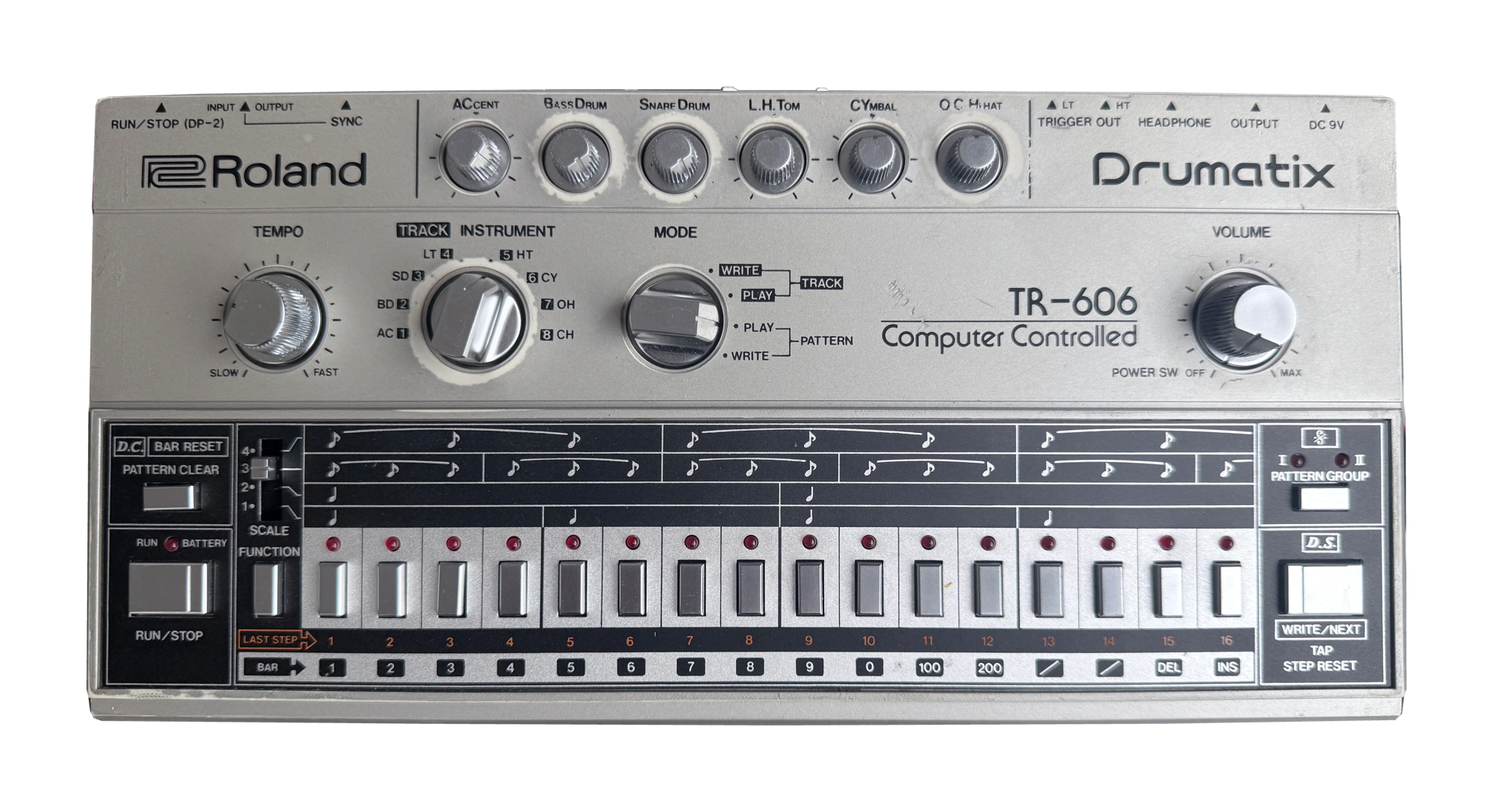
Put the Drumatix on a table and its scale can be deceptive. The silver case looks like a portable accompaniment box. Below the level knobs sits a row that can write a beat, choose its next bar and build an arrangement. The little machine is carrying the work of a drummer and a score.
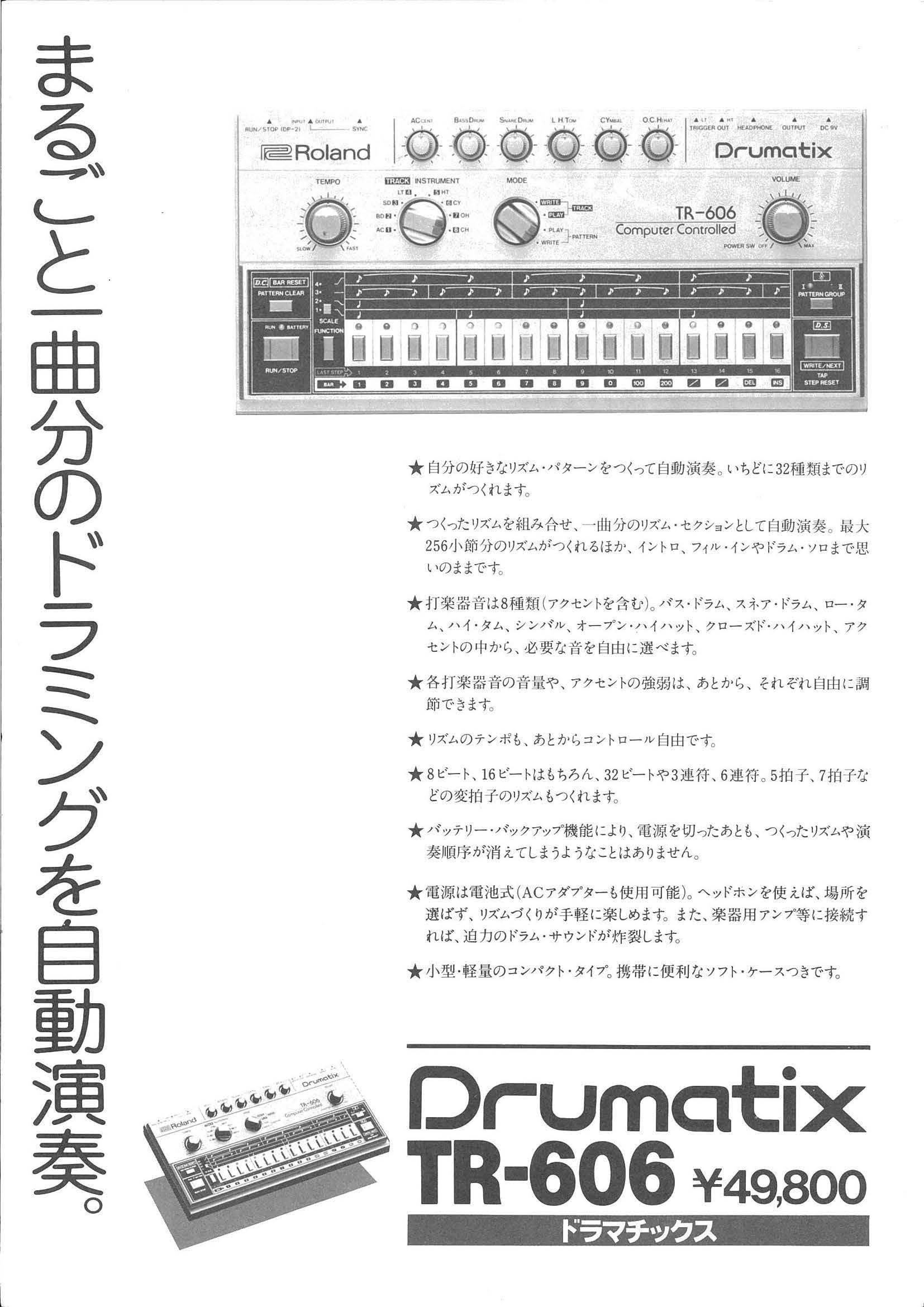
Roland introduced it alongside the TB-303 Bass Line. The two cases matched; each could run on batteries and remember its own part. Their DIN connection shared timing and transport while drums and bass remained separate performances. The 1982 Japanese catalogue offered the 606 for ¥49,800 and the 303 for ¥53,000.
That partnership is a useful place to begin, but it is only the beginning. The Drumatix could make a complete track without its sibling. Two of its percussion lanes could also send control pulses out of the case. The compact rhythm section contained the beginnings of a wider studio.
02 / THE MANUAL / PATTERN TO TRACK
Sixteen keys.
More than one bar.
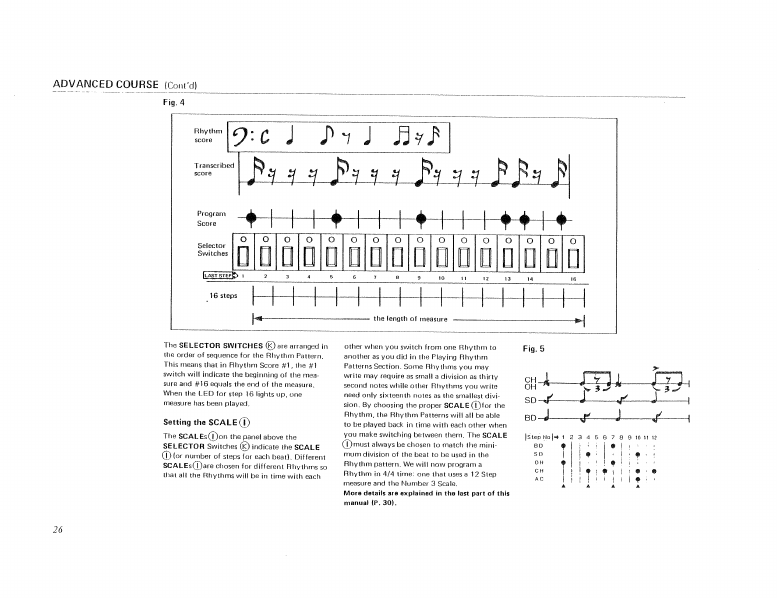
The row changes jobs with the mode selector. While writing, choose an instrument and place its strikes with the numbered keys. While playing, those keys recall patterns. In Track mode they help arrange the calls to memory. The panel stays small because the same surface carries several stages of composition.
There are 32 pattern locations in two groups. Adjacent patterns can be chained inside four-key blocks; eight tracks supply a longer arrangement. Seven can hold up to 64 measures and the eighth extends to 256. D.C. and D.S. borrow the economy of written music: repeated form can be remembered without storing every bar afresh.
Sixteen positions do not always mean sixteen semiquavers. Pre-Scale changes the relationship between a position and a beat, while Last Step determines when the cycle returns. Roland’s manual moves from its Basic Course into named rhythms, triplet divisions, unequal cycles and examples that change scale between bars.
03 / SEVEN VOICES / ONE SHARED ACCENT
Follow a rhythm.
One instrument at a time.
The sounds begin as electrical events. Bass drum rings down from its oscillator network. Snare joins a tonal body to noise. Two tom voices sit at different pitches. Cymbal and both hats draw on a common bank of six oscillators, then separate through their own filters, envelopes and amplifiers.
Open and closed hats share a level control. A closed-hat event cuts off the open hat, so the two lanes have a relationship beyond their positions in the score. Accent reaches the voices already sounding at that step; its placement can give a collision of instruments a common emphasis.
TR-606 MANUAL PATTERN LIBRARY // 31 CONTROLLED SCORES
Program the silver box.
Ten Basic Course assignments and twenty-one Sample Rhythms are transcribed from Roland’s owner’s manual. Select one, inspect its real step and accent lanes, then edit a working copy. Browser audio is explanatory—not a sample or circuit emulation.
I-1 Basic Course I-1
16 positions · Roland owner’s manual p. 9
SINGLE PATTERN · 16 STEPS
EDITING // BD // Bass drum
Damped low-frequency ring
SWIPE OR USE ARROW KEYS TO READ EVERY STEP →
BDVOICE
ACACCENT
HIGH TOM → TRIGGER OUT
READYTurn down the tom level and the same programmed steps can trigger external gear silently.04 / SYSTEM / SYNC AND TRIGGERS
A tom can be a drum.
It can also be an instruction.
High-tom and low-tom events have a second destination: their rear-panel trigger outputs. Turn the tom down inside the mix and the written lane can still command a compatible external instrument. Leave it up and one step can make a drum strike and an external event together.
DIN Sync does a different job. It coordinates the clock and run/stop state; it does not transmit a drum sound or a pattern. Each connected instrument still reads its own memory. Audio has to take its own route to an amplifier or mixer.
This is where the compact box opens out. A pattern can drive a sequencer or arpeggiator, bass can follow the shared clock, and each audio output can be processed separately. The arrangement lives in the wiring as well as in the bar.
05 / RECORDS / LEARNING / PERFORMANCE
The box travels.
The job changes.
The Sisters of Mercy gave its rhythm apparatus a name: Doktor Avalanche. Roland’s history identifies the 606 with “Alice”. The machine’s repeated pattern becomes part of a group’s identity, rather than an invisible substitute for a missing drummer.
Roland’s focused account attributes the rhythm of Drexciya’s “Rublick’s Cube” to the TR-606. The listening path moves from Leeds to Detroit: a compact drum vocabulary becomes part of an electro world. The attribution comes from the manufacturer’s later account.
Richie Hawtin describes a connected system of 303s, 606 and 808, shaped through live mixing and effects. Erika remembers the 606 as her first piece of equipment and the instrument on which she learned drum programming. These accounts describe different jobs for one small machine, not a single fixed sound.
06 / OBJECTS / PRINT / ENGINEERING
Keep looking.
Open the complete field guide, source desk and historical machine file +
BIG BEAT MACHINE FILE // 007
606
The silver rhythm composer that learned to travel alone
The Roland TR-606 Drumatix joins seven analogue percussion voices, a serious pattern-and-track sequencer and a small network of sync and trigger connections in one battery-powered machine.
PRODUCTION1981–1984
SOUND ENGINE7 analogue voices; global accent
RHYTHM MEMORY32 patterns; 8 tracks (7 × 64 measures, 1 × 256)
More facts, listening references & sources
PERIOD PRICE¥49,800 in Roland's catalogue; £199 contemporary UK price
LINEAGE ADVANCEThe 808's step-writing method is reduced to a battery-powered companion built to lock directly to the TB-303.
WHAT THE PLAYER GAINSA musician can carry a complete programmable rhythm section, write away from the studio and use DIN Sync to keep the 606 and 303 moving as one instrument.
NOTABLE USERSThe Sisters of Mercy · Drexciya · Richie Hawtin · Erika
START LISTENINGThe Sisters of Mercy — Alice · Drexciya — Rublick's Cube · Plastikman — Helikopter
Sources for the artists and listening references
Artist accounts, historical attributions and performance films establish different things. These notes explain the basis for each reference.
- The Sisters of Mercy — manufacturer editorial attribution. Roland attributes Alice to TR-606; this retrospective is not a participant session record. Read source for The Sisters of Mercy ↗
- Drexciya — manufacturer editorial attribution. Roland attributes Rublick’s Cube drums to TR-606. No participant session record is supplied by this article. Read source for Drexciya ↗
- Richie Hawtin — participant account. Hawtin discusses 606 sounds in the album’s production. This alone does not prove an isolated hardware track on every song. Read source for Richie Hawtin ↗
- Erika — official artist biography. Records BMG’s TR-606 gift and Erika joining Ectomorph in 1997; supports ownership and performance. Read source for Erika ↗
- The Sisters of Mercy — Alice — manufacturer editorial attribution. Roland attributes Alice to TR-606; this retrospective is not a participant session record. Read source for The Sisters of Mercy — Alice ↗
- Drexciya — Rublick's Cube — manufacturer editorial attribution. Roland attributes Rublick’s Cube drums to TR-606. No participant session record is supplied by this article. Read source for Drexciya — Rublick's Cube ↗
- Plastikman — Helikopter — manufacturer editorial attribution. Roland identifies Helikopter as a 606 example. Hawtin’s separate album interview supplies production context. Read source for Plastikman — Helikopter ↗
THE BIG BEAT COLLECTION // ROLAND TR-606
A SMALL PANEL WITH TWO WORKING LIVES.
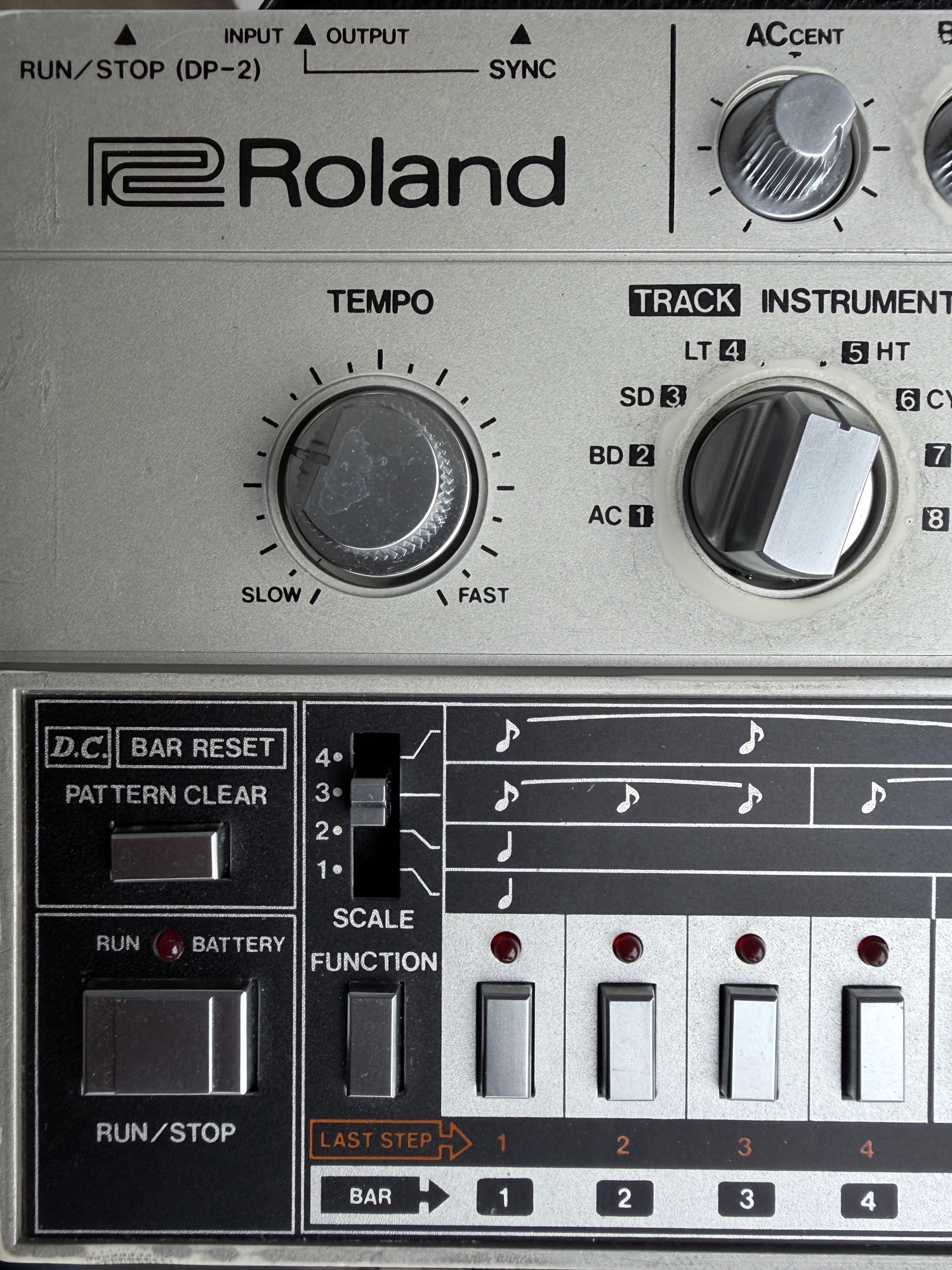
The mode and scale selectors sit beside the tempo knob. Pattern writing and track arrangement share the same compact surface, with the step keys immediately below.
PAGE 01 // ORIGIN // DRUM & BASS
Two silver partners, each with its own memory
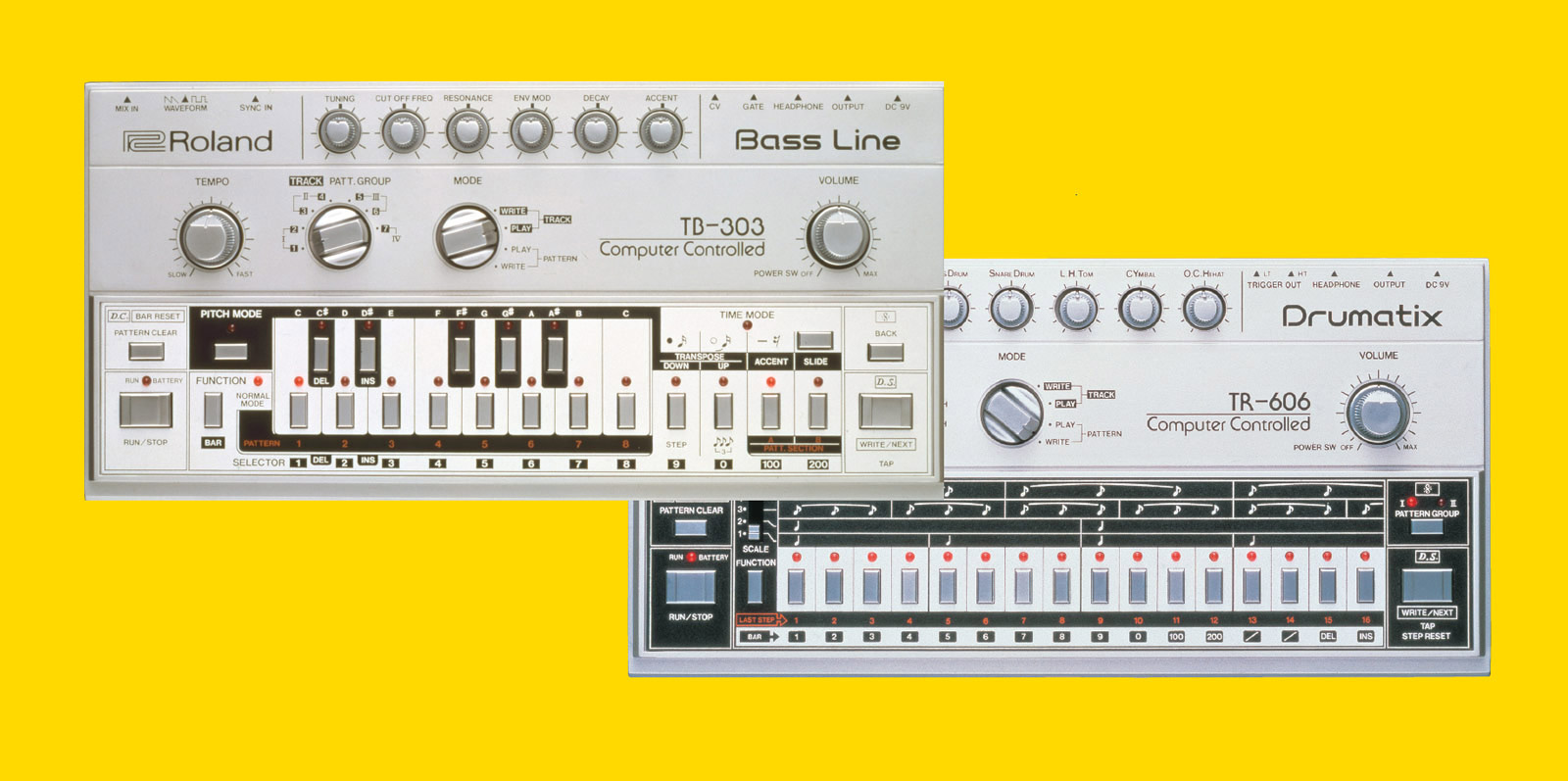
Roland launched the TR-606 Drumatix beside the TB-303 Bass Line as a portable electronic rhythm section: drums in one case, bass in the other, both able to start and advance together.
The family resemblance is precise. Both machines fit the same compact form, can run from batteries, store patterns and provide a DIN connection for shared timing. The catalogue shows them in a shoulder bag and routes them together through small amplifiers and contemporary Roland sequencers.
The 606 was not merely an accessory. It could write and play 32 rhythm patterns, chain them into eight tracks and run other equipment through two programmable trigger outputs. The 303 contributed a monophonic bass line whose pitch and articulation were stored separately. Together they behaved like two musicians following one clock.
Open the deeper story +
What the original Drum & Bass system actually shared
DIN Sync carries timing and run/stop state, not notes, patterns or audio. The TR-606 can be the output device and the TB-303 the follower, but both continue to read their own memories and create their own sound. Changing the 606 pattern does not select a bass pattern, and changing a bass note does not alter the drums.
This separation is why the pair remained useful after its practice-band marketing failed. A player could replace either half, route the trigger outputs elsewhere, process each audio stream separately and keep the whole rig locked. The system was small, but it was already modular in behaviour.
AN ABSENCE BECOMES CHARACTER
The first complaint was the missing handclap.
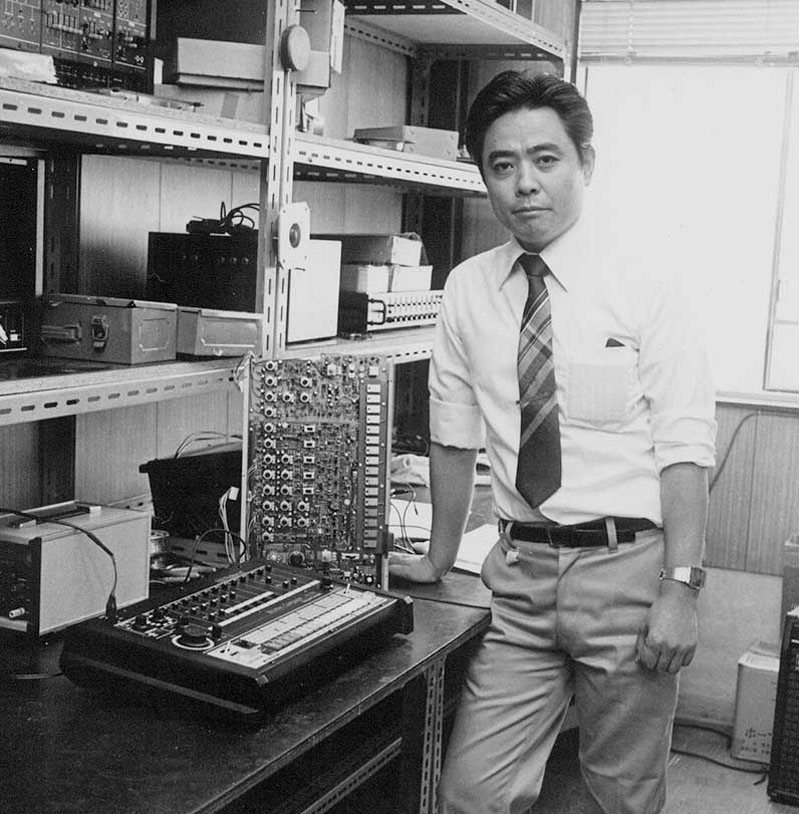
Tadao Kikumoto remembered that users immediately asked why the smaller machine lacked the TR-808's handclap. That omission pushed the 606 away from being a miniature 808: its kit is a sharper seven-voice system built around toms, hats and a distinctive metallic cymbal source.
Richie Hawtin later answered the missing voice by treating the studio as a network. On Plastikman's “Sheet One”, 606 and 808 sounds could coexist with 303 lines and small rimshots. The machines did not have to duplicate one another; their differences made room for a live mix to develop.
Continue the story +
Constraint becomes arrangement
The front panel gives each voice a level but no public tuning or decay controls. That leaves the player four main ways to shape a performance: where events occur, where the shared accent occurs, how adjacent patterns are chained, and how the mono output is treated outside the box.
The handclap complaint therefore points toward the 606's actual method. Add another device if a new timbre is essential, or let omission define the arrangement. The two programmable trigger outputs were designed for exactly this sort of extension: high-tom and low-tom steps can fire external percussion while the tom audio is turned down in the internal mix.
01TADAO KIKUMOTO02SEVEN VOICES03NO HANDCLAP
PAGE 02 // OPERATION // PATTERN TO TRACK
The row is a score, a keyboard and a memory map
Sixteen keys do several jobs. They place events while writing, select patterns while playing, and help assemble short rhythms into complete tracks.
Choose Pattern Write, select an instrument and press the numbered keys where that voice should sound. The LEDs make the bar visible as it repeats. Tap Write records performances against the running clock, while Step Write makes exact placements one instrument at a time.
Pattern Groups I and II provide 32 locations. Adjacent patterns can be chained within four-key blocks, so a fill or second bar can follow without entering Track mode. For longer form, eight rhythm tracks store pattern order and repetition: seven hold up to 64 measures, while Track 8 extends to 256.
Open the deeper story +
How to read the sequencer as an instrument
Pre-Scale changes what each numbered position means. The manual illustrates straight and triplet relationships rather than assuming every pattern is sixteen equal semiquavers. Last Step shortens the measure, so a pattern can cycle in two, four, eleven or any other available number of steps instead of waiting for key 16.
Accent is programmed like another instrument, but it is not another sound. When an accented step arrives, the shared accent circuit raises the voices occurring there. Because several instruments may occupy the same column, one accent can turn a kick-hat collision into the beginning of a phrase.
In Pattern Play, holding neighbouring pattern keys asks the machine to play them in sequence. This is the quickest route to an A/B phrase: write a stable bar, copy its logic into the next location, change only the final beats, then select both. Track Compose formalises the same idea by storing pattern numbers and repetition counts.
D.C. repeats the whole track. D.S. and its mark repeat a chosen section. These are not ornamental score references: they are memory-saving arrangement commands inherited from written music, allowing a small amount of CMOS RAM to describe a longer performance.
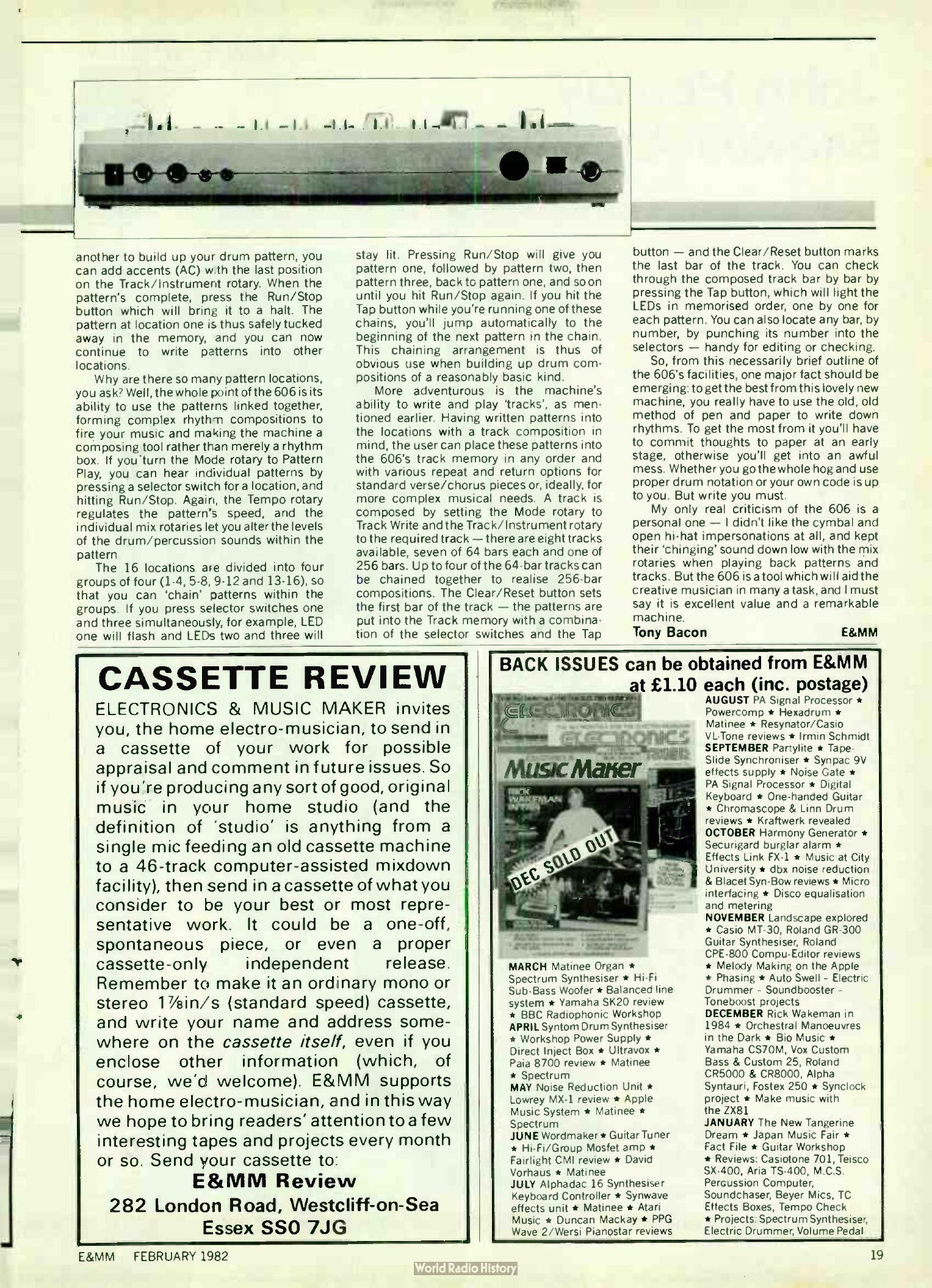
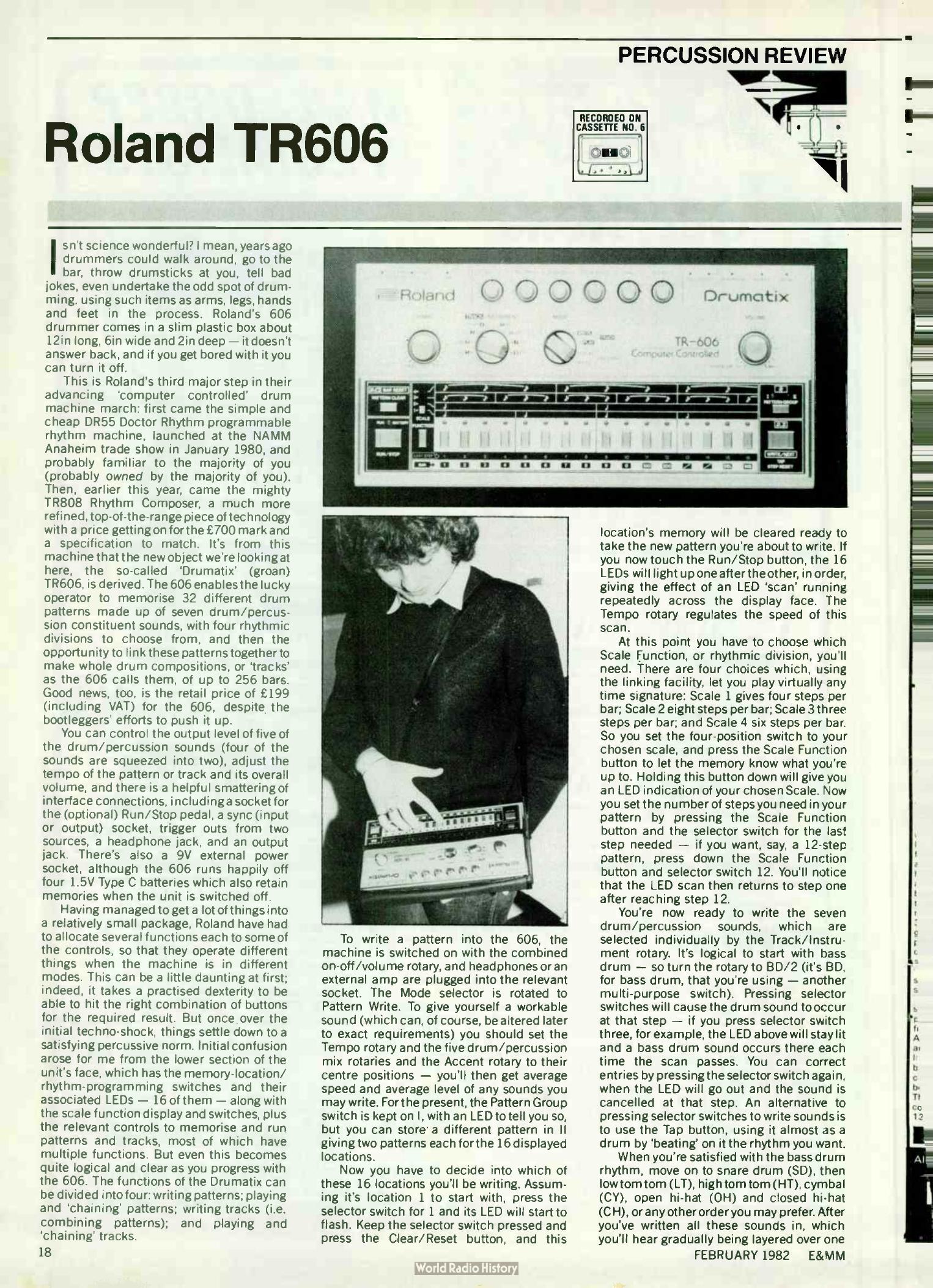
Tony Bacon's February 1982 review records how this felt before the machine acquired a mythology. At £199 including VAT, the 606 was presented as a composing tool: write the rhythm on paper, enter it carefully, chain related patterns and then order them into tracks. His criticism of the cymbal sits beside a much larger conclusion—that the little box rewarded preparation and musical thought rather than one-button accompaniment.
Read the complete owner's manual ↗Read the February 1982 review ↗PAGE 03 // SOUND // SEVEN ANALOGUE VOICES
Short circuits leave room around the beat
The Roland TR-606 does not contain miniature recordings. Each trigger starts a small electrical event whose pitch, brightness and duration emerge from oscillators, filters, noise, envelopes and amplifiers.
Bass drum is a damped low-frequency ring. Snare combines a pitched body with filtered white noise. Low and high toms are related resonant voices at different frequencies. The metallic family begins elsewhere: six free-running logic oscillators create a dense, non-harmonic source that filters and envelopes divide into cymbal, open hat and closed hat.
The front panel exposes only six instrument level controls because open and closed hats share one level. Accent is global. With no public tuning or decay knobs, the original player's sound design is mainly balance, density, shared emphasis and whatever happens after the mono output.
Open the deeper story +
Hear one circuit relationship at a time
Start with only bass drum and remove external effects. The circuit should produce a concise low body whose pitch falls into a short decay. If the trigger clicks but the body does not ring, trace the two IC15 oscillator sections and their surrounding capacitors and resistors before adjusting output level.
Next isolate snare. Its pitched component and noise component travel through different parts of the circuit before they meet. A snare with body but no spray points toward the white-noise or high-pass path; noise without body points toward the oscillator and attack section.
Finally compare closed hat, open hat and cymbal. If all three lose their metallic complexity, suspect the common IC16 oscillator bank or its supply. If closed hat works but open hat does not, the shared source is already proved and attention can move to the open-hat trigger, envelope, choke and VCA stages.
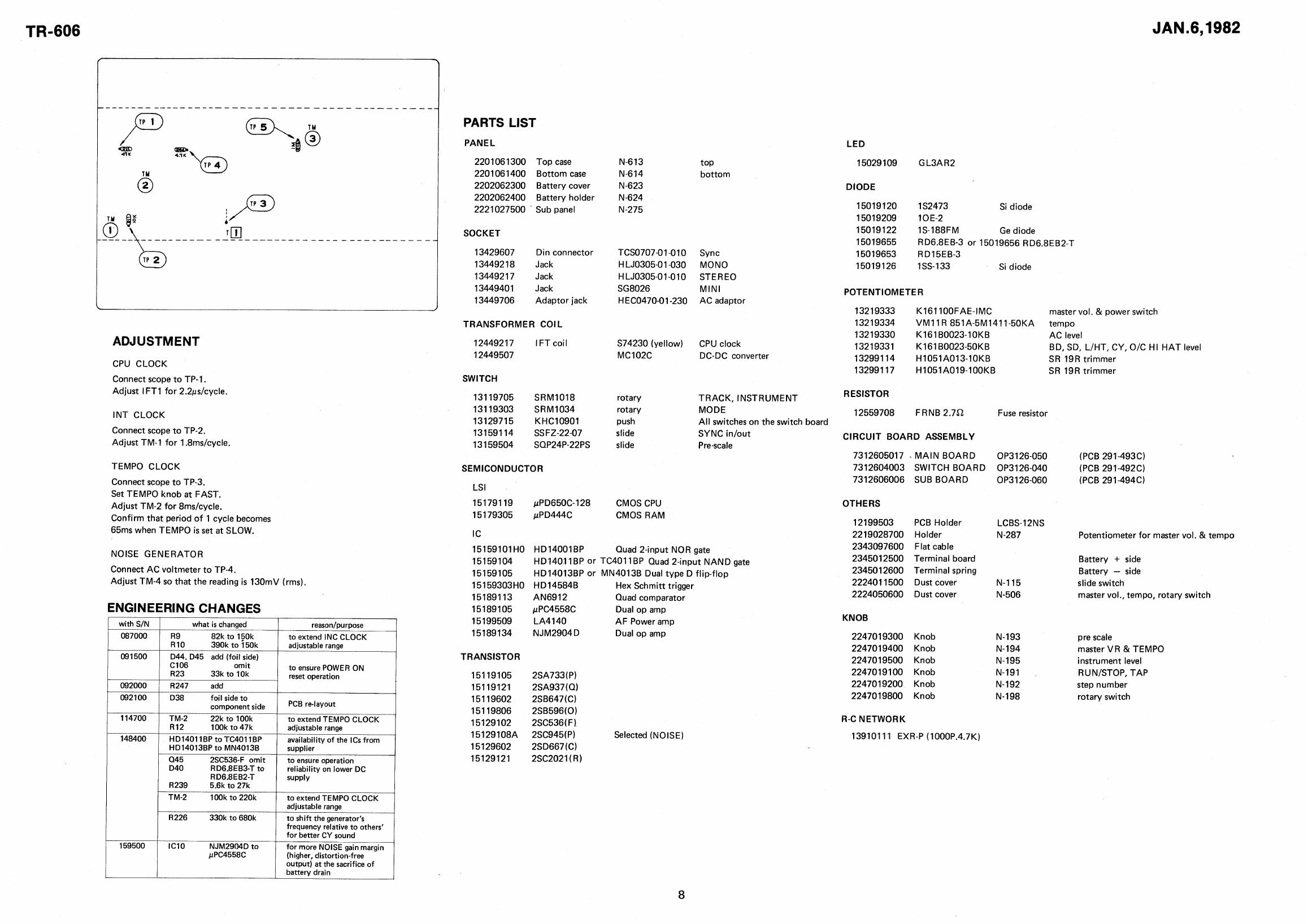
For calibration, the factory sequence is evidence, not an invitation to turn every trimmer. The service notes first establish CPU clock, interrupt clock, tempo range and noise level. Power rails and trigger integrity should be measured before changing any internal adjustment.
01020304050607080910111213141516
PRIMARY ENGINEERING PAPER
One processor schedules seven separate analogue instruments.
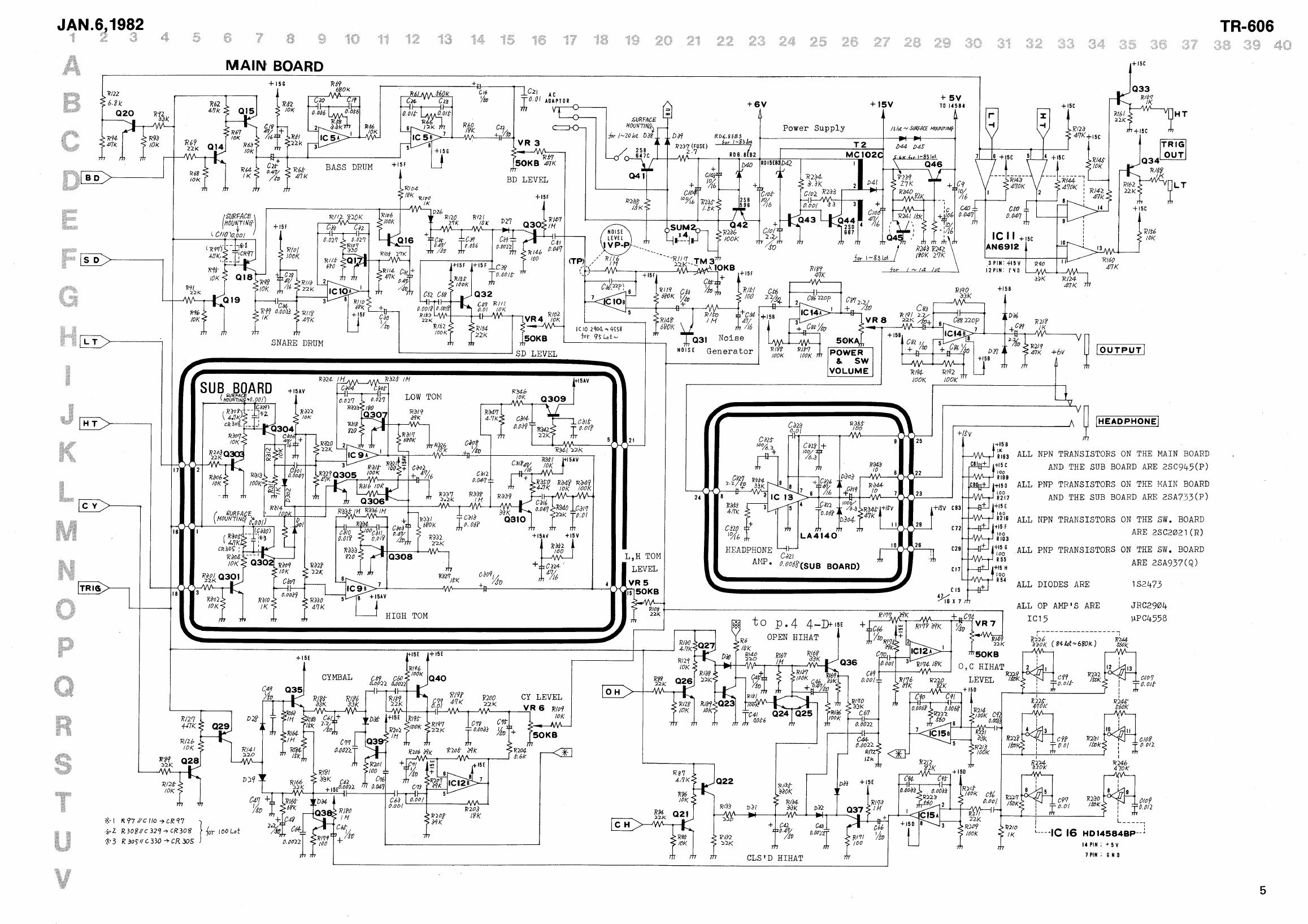
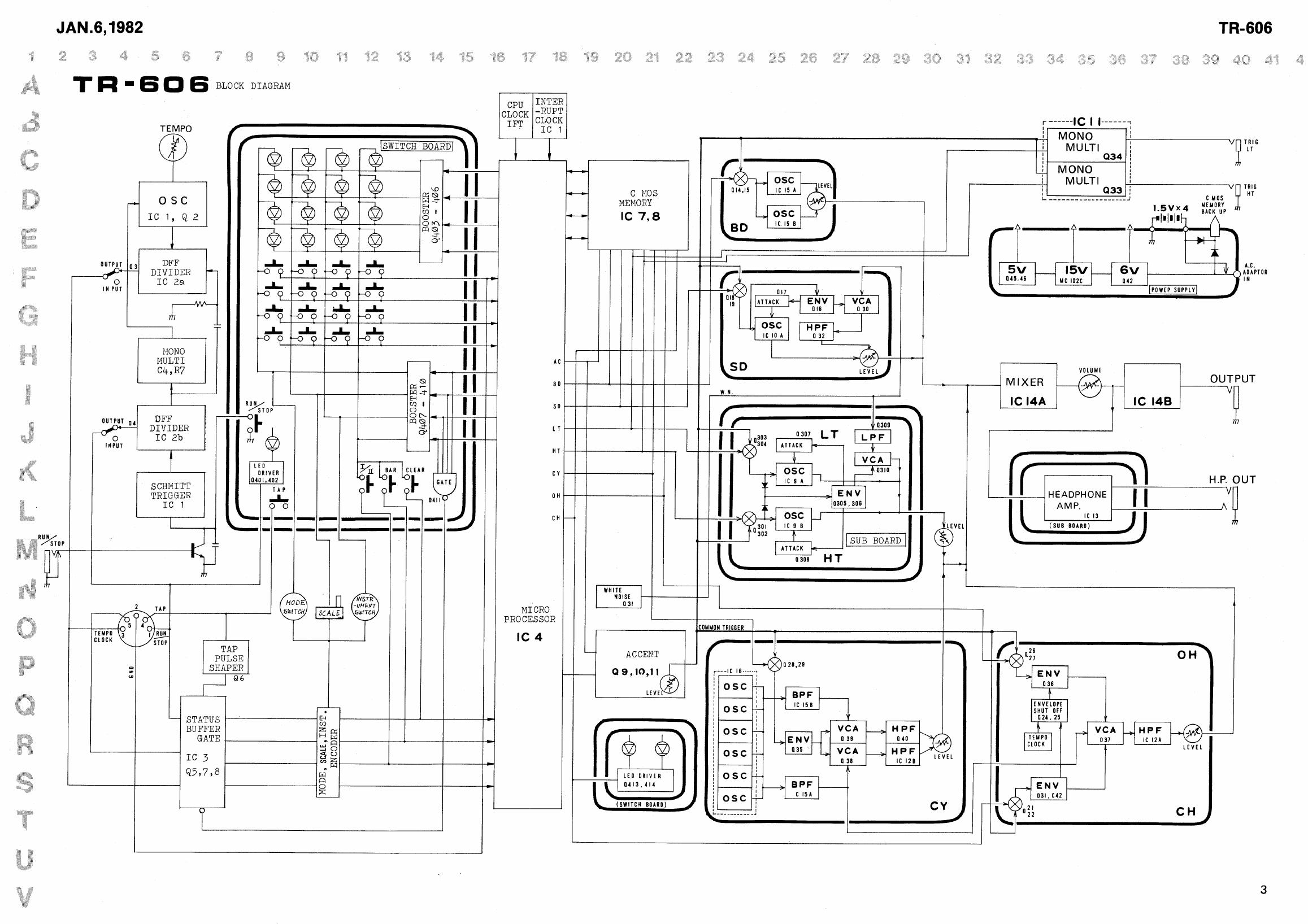
Roland's January 1982 service block diagram separates the TR-606 into three jobs: the µPD650C processor reads the panel and memory, timed trigger and accent signals leave the digital section, and dedicated analogue circuits turn those signals into percussion before one mixer combines them.
Read the circuit in depth +
Bench guide: clocks, triggers, voice circuits and the final mix
Timing begins with two clocks. The service notes identify a CPU clock adjusted at TP1 to 2.2 microseconds per cycle and an interrupt clock adjusted at TP2 to 1.8 milliseconds per cycle. A separate tempo oscillator and divider create the musical clock. The processor scans the switch board, drives the step LEDs, addresses two µPD444C CMOS RAMs and issues individual voice, accent and trigger commands.
The bass drum uses two oscillator sections around IC15. A short trigger perturbs the network and the circuit rings down: the pitch and damping are properties of the parts, not a stored sample. The snare combines an oscillator-derived body with white noise from Q31. Its attack, envelope, VCA and high-pass stages decide how much tone and hiss survive into the mixer.
Low and high tom are related resonant circuits on the sub-board. Their labelled steps also feed monostable trigger-output circuits, so an HT or LT lane can be both an audible tom and a +14-volt, 20-millisecond control pulse. Turning down the tom level hides the internal sound without removing the external rhythm.
Cymbal, open hat and closed hat share the six-oscillator bank in IC16. The oscillators form a deliberately inharmonic source; parallel band-pass and high-pass paths, separate envelopes and VCAs divide it into three instruments. The open-hat envelope is shut off when the closed hat is triggered, producing the choke heard as one cymbal is physically stopped by another.
All seven level controls meet at IC14A, then the master volume and IC14B feed the mono output. A separate amplifier on the sub-board drives the headphones. For diagnosis, establish the 5V, 6V and 15V rails first, then confirm clock, trigger arrival, raw oscillator or noise source, envelope, VCA and mixer in that order.
The final service page records factory changes by serial number. Roland widened clock-adjustment ranges, revised the power-on reset, improved low-supply reliability, shifted one metallic oscillator for a better cymbal, and changed the noise amplifier for greater clean-output margin. A surviving 606 therefore has a production history inside the circuit; revision and serial number matter before replacing parts or copying calibration values.
Open the Roland TR-606 service notes ↗Open the Roland TR-606 owner's manual ↗PAGE 04 // SYSTEM // SYNC AND TRIGGERS
The 606 keeps time, then lends out two of its limbs
DIN Sync coordinates a partner's clock and transport. Two trigger outputs turn programmed tom steps into control signals for sequencers, arpeggiators or extra percussion.
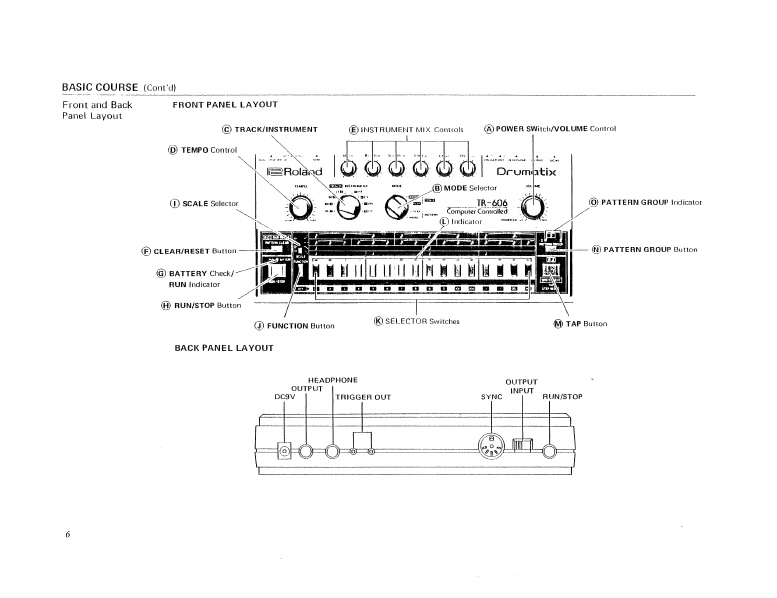
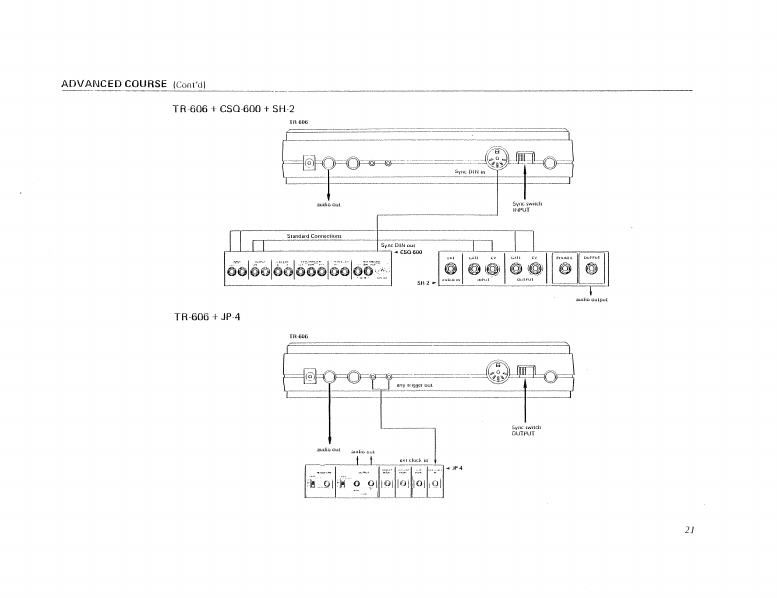
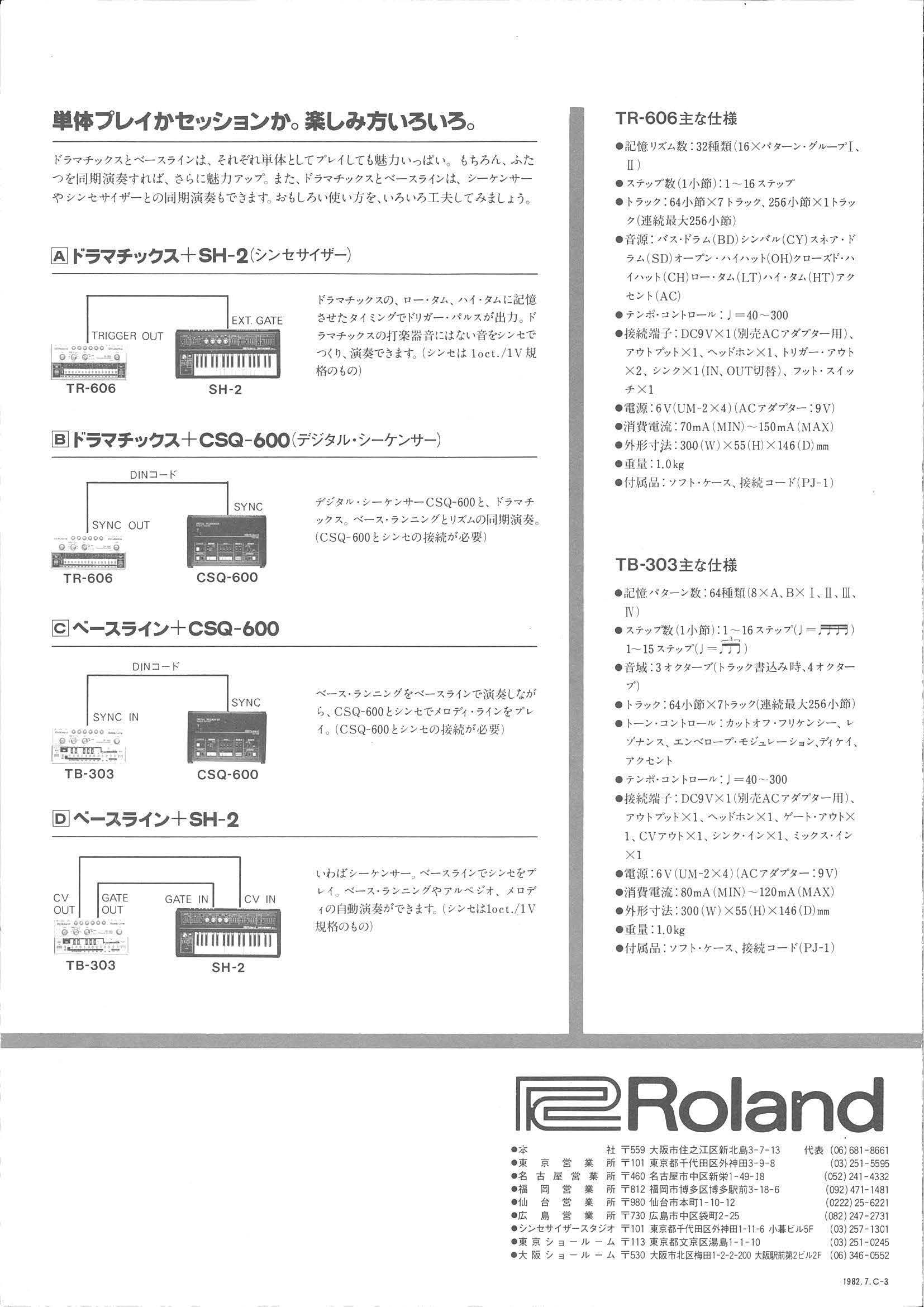
The rear-panel Sync socket can be switched to input or output. In output mode the TR-606 sends 24 clock pulses per quarter note plus run/stop state; in input mode an external master controls its tempo and transport. Audio remains separate and must still reach a mixer or amplifier.
High Tom and Low Tom each have a trigger output specified at approximately +14 volts for 20 milliseconds. The rhythm on those lanes becomes a voltage pattern. Turn the tom down and the same steps can silently fire another drum module, a sequencer or an arpeggiator.
Open the deeper story +
A practical connection and fault-finding guide
Choose one master clock. Set the TR-606 Sync switch to OUT when it should lead, or IN when it should follow. Confirm run/stop first, then listen for stable tempo over several minutes. A DIN cable can preserve one function while losing another because transport and clock occupy different pins.
Do not feed a trigger output into an audio input. The HT and LT sockets carry short control pulses, not sound. Use equipment designed to accept an external trigger, and verify its voltage tolerance before connection; the 606's pulse is substantially higher than a modern 5-volt logic signal.
The trigger lanes remain normal musical lanes inside the pattern. This is composition as routing: an audible high tom can double a synthesizer note, or the tom level can be reduced to zero so that only the external event remains. The sequencer is controlling two systems at once without MIDI.
PAGE 05 // RECORDS // AFTER THE BRIEF
A dry little drum machine becomes several different bands
Post-punk, electro, acid and hardware techno did not simply reuse the same silver box. Each scene made a different virtue of its short kick, sharp snare, metallic hats and unswung clock.
In Leeds, the Sisters of Mercy turned the drum machine into a named member: Doktor Avalanche. On 1982's “Alice”, the unswung pulse does not imitate a drummer. It gives the guitar, bass and Andrew Eldritch's vocal a hard rail to move against, making the machine's restraint part of the band's identity.
Roland’s retrospective attributes the drums on Drexciya’s “Rublick’s Cube” to the TR-606. This is a manufacturer editorial attribution, not a surviving session record. Listen to its narrow snare and metallic hats through an electro arrangement full of counter-motion, space and abrupt subtraction. The machine sounds futuristic because the parts around it keep changing while its dry attacks remain legible.
For Plastikman's “Sheet One”, Richie Hawtin ran 606 and 808 sounds beside multiple 303s and recorded through a live, feedback-rich effects network. “Plasticity” uses 303s, a 606 and an 808; “Helikopter” strips 808 and 606 drums into an escalating study of doubled kicks, toms and snare rolls.
The Sisters of Mercy — Alice
Listen to the rhythm as a structural member of the band. Its straight subdivisions and short sounds hold their position while the bass and guitars create movement around them; the machine is credited under the continuing name Doktor Avalanche.
Read Roland's account of the 606 in early Sisters of Mercy ↗Drexciya — Rublick's Cube
Roland identifies this Drexciya recording with the TR-606. Listen for the cutting snare and hats remaining exposed in the mix. Hear how those compact attacks remain clear when the bass figure, chords and electronic details begin to overlap.
Read the focused Drexciya listening story ↗Plastikman — Plasticity
Hawtin's own account identifies two 303s, a TR-606 and a TR-808 on the track. The useful lesson is the division of space: the 606 is heard as one member of a live electronic ensemble, not as the only drum source.
Read Hawtin's track-by-track account ↗Plastikman — Helikopter
808 and 606 kicks, toms and snares are pushed into a long live-form build. Listen for the 606's short events remaining intelligible while delays and feedback make the surrounding space increasingly dense.
Open the official Sheet One edition ↗Mr Oizo — Flat Beat
Roland includes Flat Beat in its TR-606 listening guide. Listen to how the compact drum part leaves room for the bass; this is a listening interpretation, rather than an isolated-stem identification.
Read Roland's TR-606 listening guide ↗Open the deeper story +
From first drum machine to a lifetime of hardware performance
Erika's relationship with the 606 begins at the level this archive cares about most: learning by living with the object. She identifies it as her first piece of gear and the machine on which she learned drum programming. Interdimensional Transmissions records the next step: BMG gave her a TR-606 in 1997 and invited her into Ectomorph, beginning a continuing hardware-performance practice.
That story explains why a fixed panel can remain useful for decades. The 606 does not ask the player to browse an expanding library. It asks for fluency in seven sounds, one accent lane, pattern memory, track form and the timing relationships created by external instruments. Repetition turns a limitation into a playable vocabulary.
The machine's afterlife divides into preservation, modification and recreation. Original units remain serviceable because their through-hole boards expose clear circuit stages, though battery memory, ageing electrolytics, switches and previous modifications must all be assessed before calibration.
Modification culture added the controls Roland left inside: individual outputs, tuning, decay and direct access to trigger points. These changes can make the machine more flexible, but they also change the relationship between the seven voices and the original mono mix.
Roland later returned the model as the TR-06 Boutique hardware and a software TR-606. Both add conveniences such as swing and expanded sound editing. They preserve the 606 as a named instrument while making clear how specific the 1981 design was: fixed voices, shared accent, straight timing and an output that required the whole kit to negotiate one channel.
Erika on joining Ectomorph ↗Roland TR-06 Drumatix ↗Roland TR-606 Software Rhythm Composer ↗SOURCES AND FURTHER READING // TR-606
Continue through the original documents.
Owner’s manuals, service notes, period catalogues, contemporary press and first-hand accounts are identified by type so readers can follow the machine beyond this dossier.
M01
Roland TR-606 Owner's Manual
Primary operating source for pattern writing, scale, track composition, D.S./D.C., synchronization, trigger routing and specifications.
OPEN SOURCE ↗S01Roland TR-606 Service Notes
Primary circuit source: block diagrams, schematics, board layouts, adjustment points, parts and serial-number engineering changes.
OPEN SOURCE ↗C01Roland Drum & Bass catalogue
Period catalogue for the TR-606 and TB-303 pairing, Japanese prices, product photography and system diagrams.
OPEN SOURCE ↗R01Drumatix: The Perpetual Appeal of the TR-606
Roland history and listening guide with artist testimony, circuit overview and accounts of the TR-606's later use.
OPEN SOURCE ↗R02Sound Behind the Song: Rublick's Cube
Focused account of Drexciya, the record and the TR-606's crisp snare and metallic hats.
OPEN SOURCE ↗P01Roland TR-606 — Electronics & Music Maker, February 1982
Complete two-page contemporary review of operation, £199 price, paper-first programming, pattern chaining, track composition and the reviewer's original verdict.
OPEN SOURCE ↗P02Beat On The Cheap — Electronic Soundmaker, February 1984
End-of-production comparison describing pattern chaining, tracks, mixing, triggers and the machine's position below £200.
OPEN SOURCE ↗P03Roland ProForm Series advertisement — Keyboard, 1982
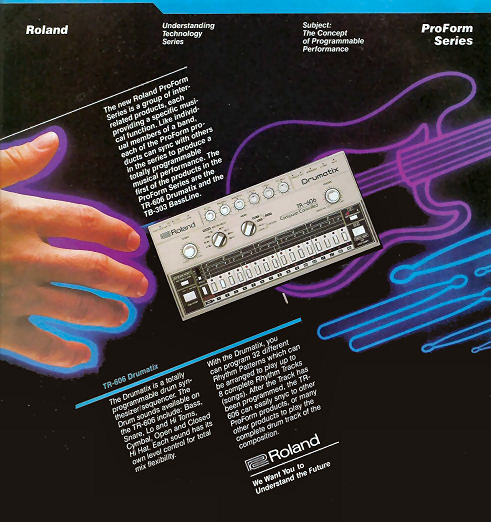
Period advertisement presenting the TR-606 and TB-303 as the first inter-related instruments in Roland's ProForm Series.
OPEN SOURCE ↗A01Richie Hawtin on Plastikman's Sheet One
First-person, track-by-track account identifying the 303, 606 and 808 network on Plasticity and Helikopter.
OPEN SOURCE ↗A02Erika Brings Detroit Techno Sound to Moogfest
Contemporary public-radio profile documenting the drum-machine gift that brought Erika into Ectomorph and her continuing hardware performance practice.
OPEN SOURCE ↗THE MACHINE LINE // 07 OF 12
FOLLOW THE CHANGE.
Each machine inherits a working idea and moves one musical decision. Continue through the family by what the player can do—not by model number alone.
BEFORE // 1981HERE // 1981 NEXT // 1981
Roland CompuRhythm CR-8000
The player can write two-measure patterns step by step, write dedicated fills, alter variation by hand and synchronise the arrangement with another Roland instrument.
← OPEN PREVIOUS MACHINERoland TR-606 Drumatix
The 808's step-writing method is reduced to a battery-powered companion built to lock directly to the TB-303.
WHAT CHANGES HERERoland TB-303 Bass Line
The owner can compose a bass part rather than only a beat, then perform its filter and envelope controls while the 303 remains locked to the drum machine.
OPEN NEXT MACHINE →