PITCH MODE
8 attacked pitches
1C02C03G-14C05C+06G07D#08G-1
Rests and ties do not enter this queue. Accent and Slide belong to pitch events on the original machine.
 THE ELECTRONIC RHYTHM ARCHIVEDRUM MACHINES HAVE NO SOUL
ROLAND / JAPAN / 1981
BASS LINE / PITCH / TIME / ACCENT / SLIDE
Write the phrase.
Then move it.
01 / ROLAND / THE SILVER INSTRUMENTS
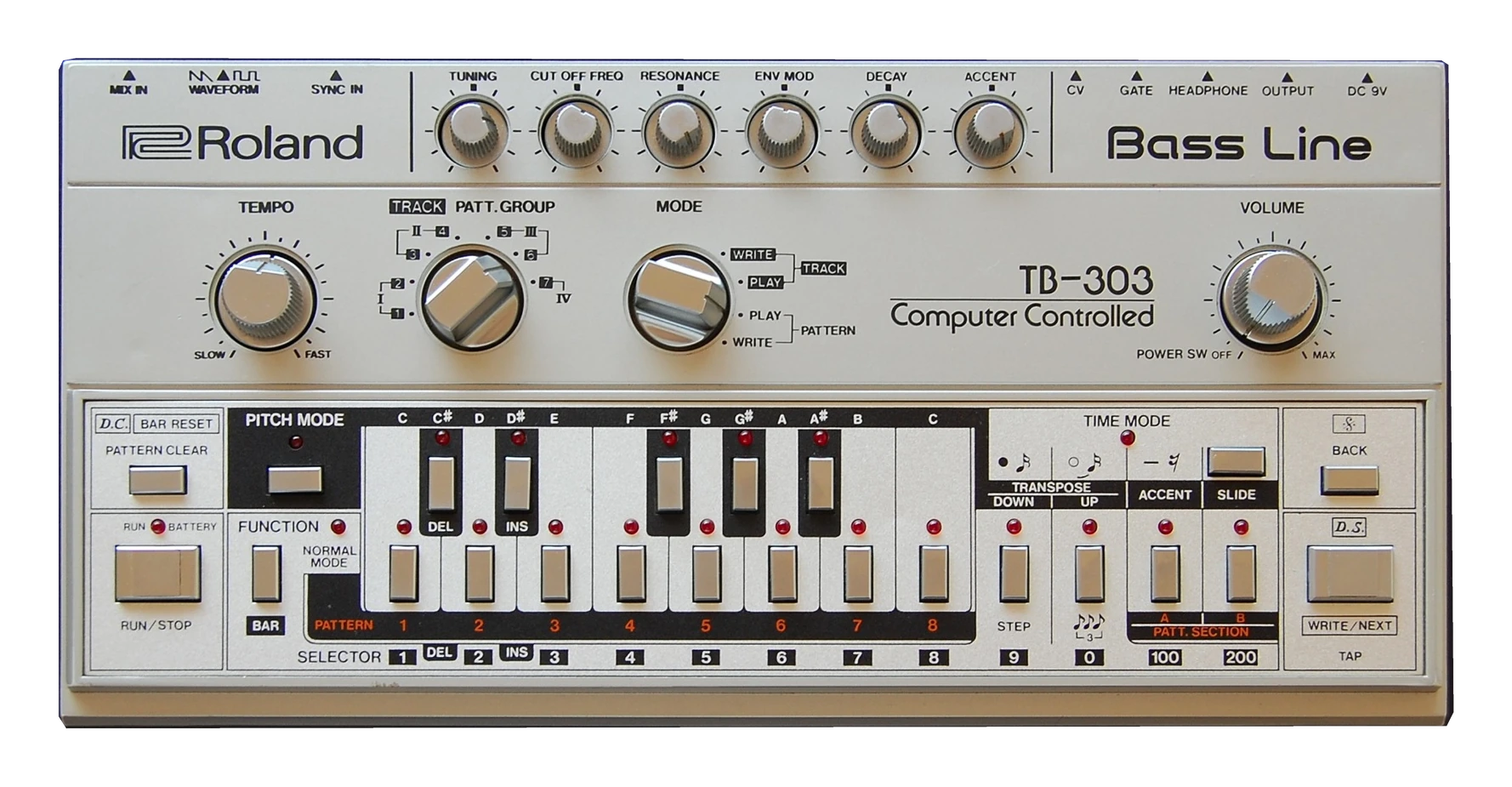
The name states its first job: Bass Line. Roland intended a portable instrument that could remember a bass part, organize its phrases and follow a partner’s clock. The case carried a sequencer and an analogue synthesizer together. Its history began with that complete proposition, before the later clubs and records gave it another meaning.
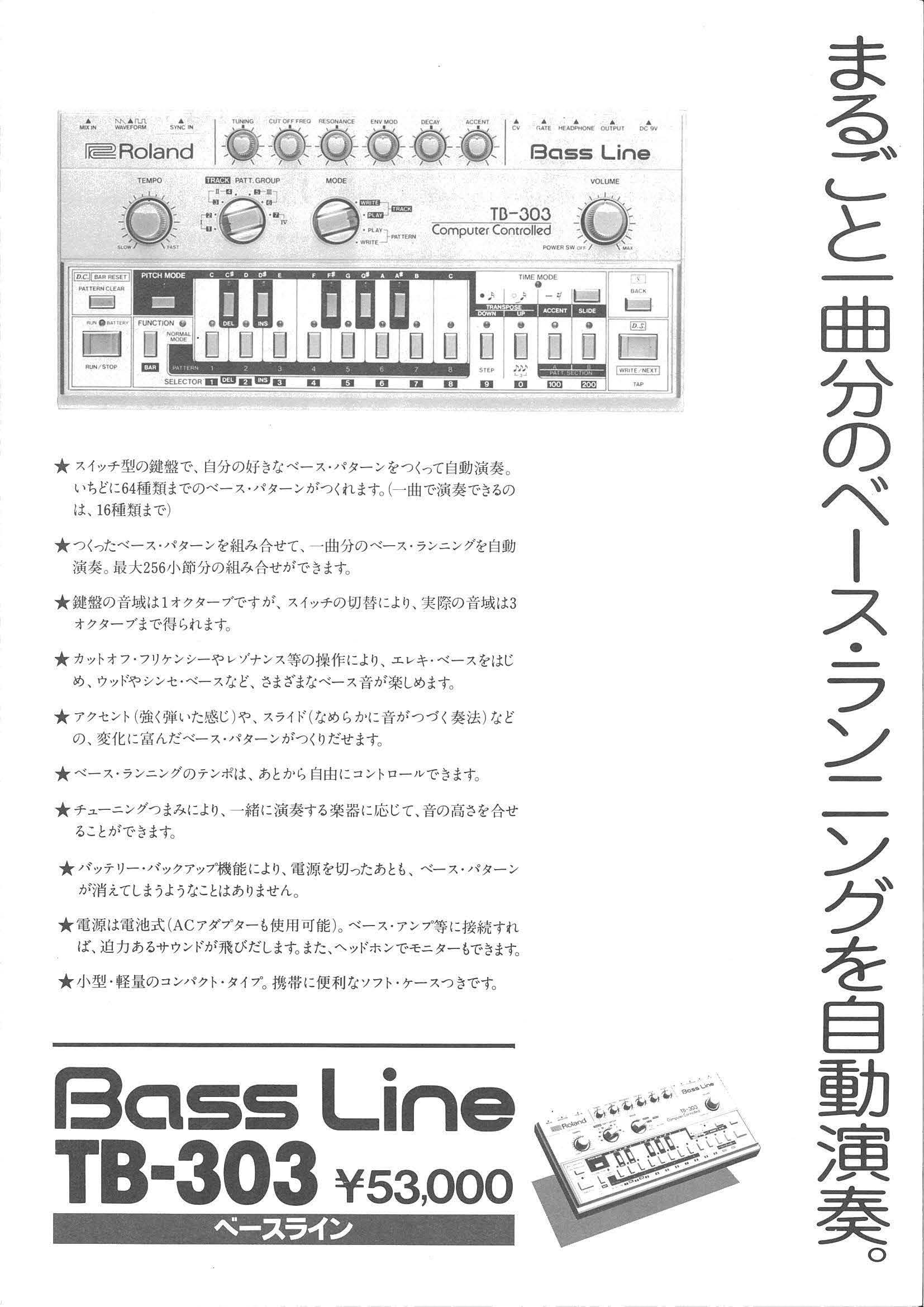
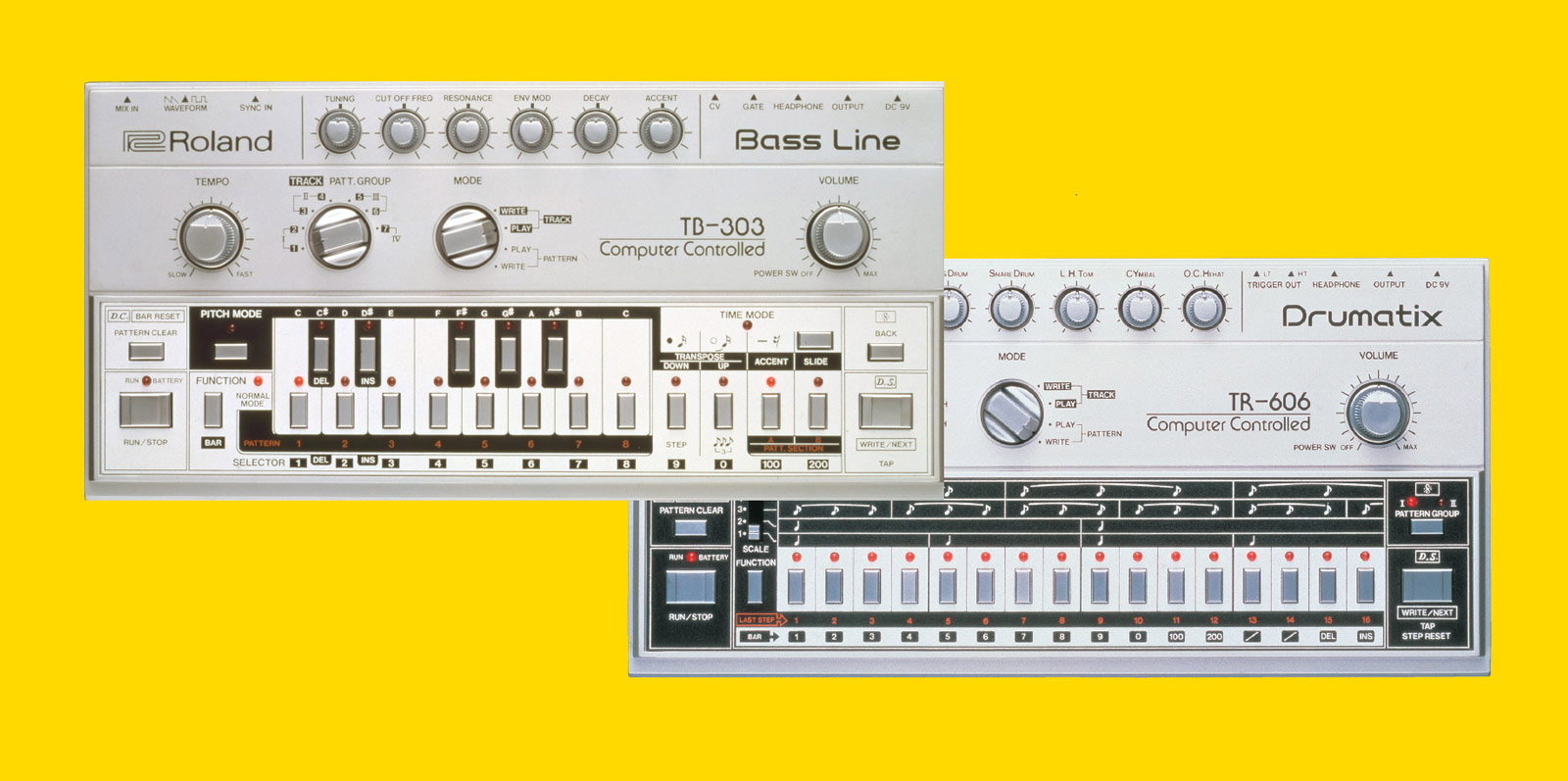
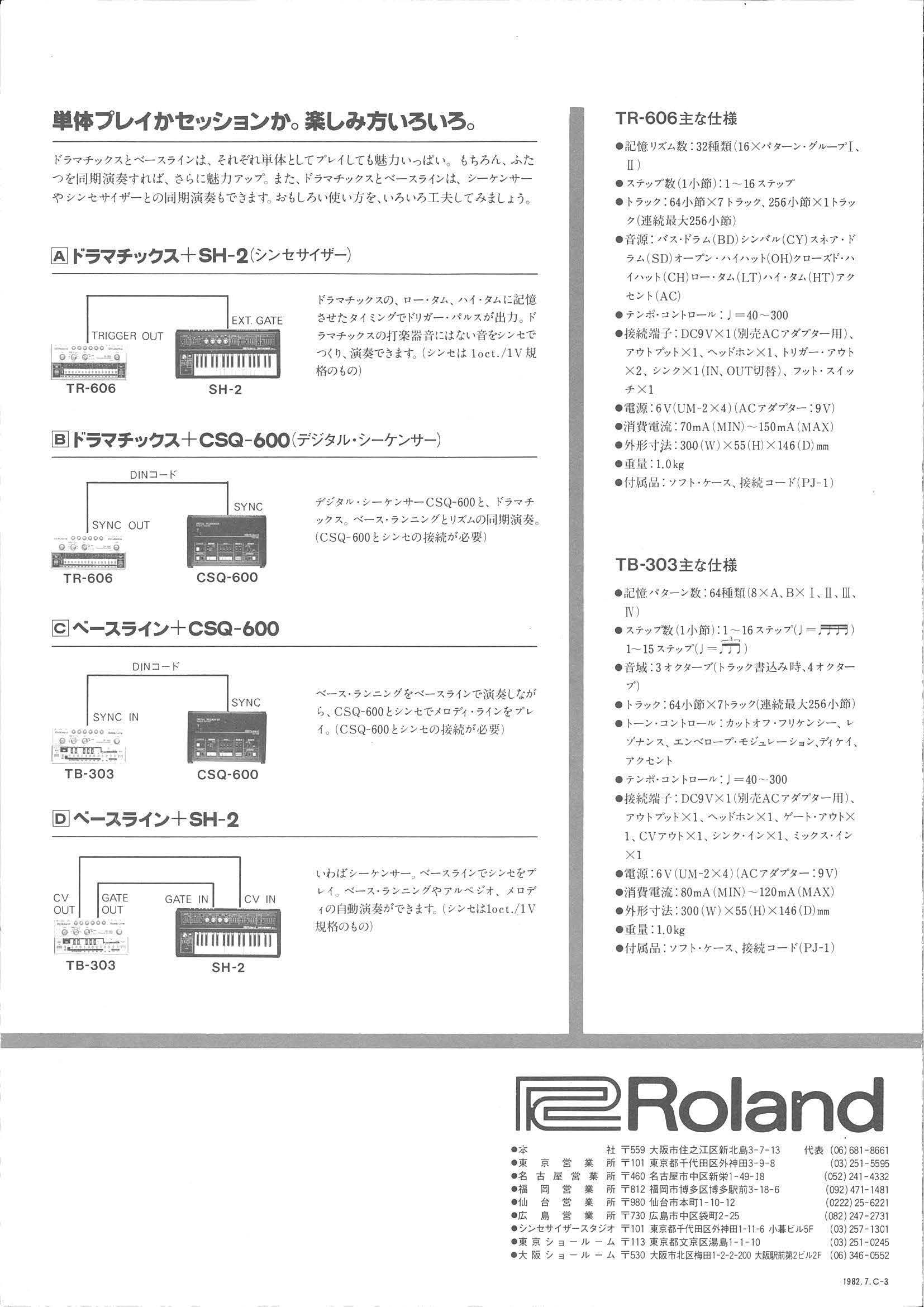
The 1982 catalogue presents it beside the TR-606. Their matching cases held separate musical memories and sound paths. The 303 could transpose a phrase and assemble patterns into tracks while the Drumatix supplied drums. The shared clock kept them together without making either one responsible for the other’s notes.
Tadao Kikumoto’s development account locates these machines in a cooperative engineering culture. The later reception was outside the original brief: he remembers the developers learning of the underground enthusiasm around 1992. The distance between a product’s design and its musical discovery belongs in the history.
Roland Drum & Bass catalogue, 1982 ↗TB-303 owner’s manual ↗Tadao Kikumoto in conversation ↗
02 / ROLAND / THE SILVER INSTRUMENTS
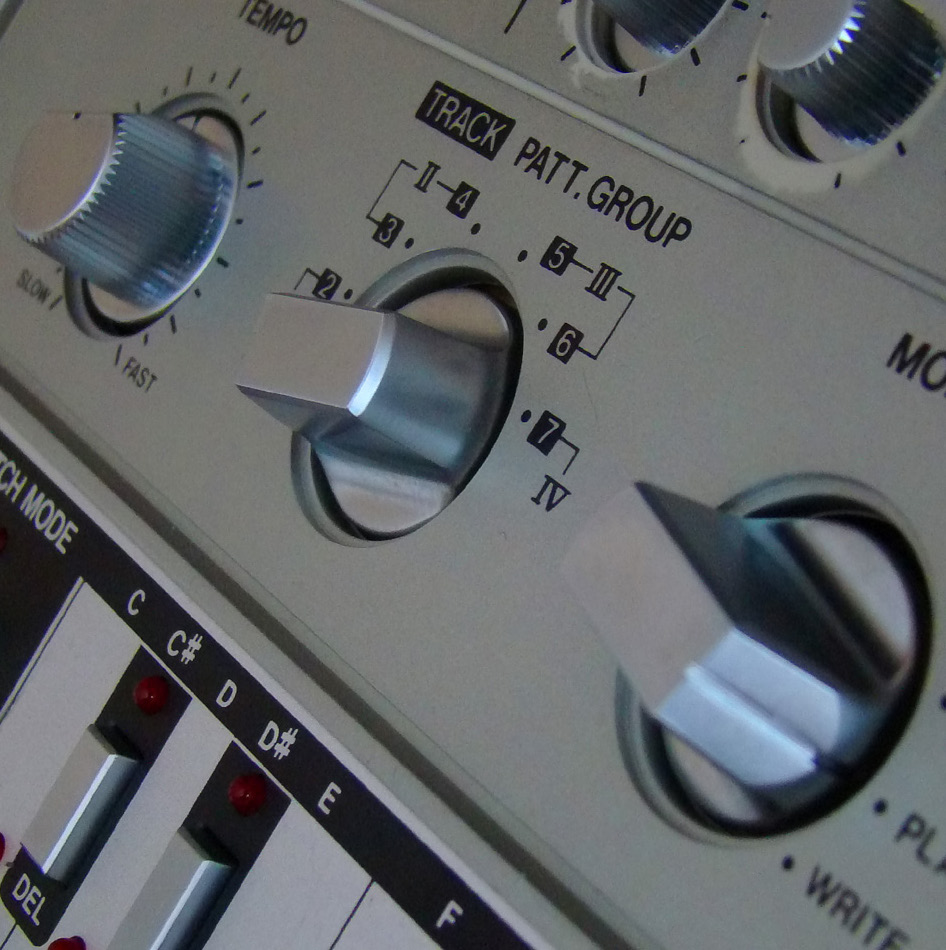
At the upper edge of the panel, a player can change the tone without entering a new sequence. Waveform chooses the oscillator’s sawtooth or derived square. Cutoff and resonance shape the filter; envelope modulation and decay shape its travel. Accent responds to the emphasis already written into the phrase.
Digital memory gives the analogue voice its instructions. Pitch becomes a control voltage, timing creates the gates, and articulation changes the relationships between events. The small instrument joins these systems tightly enough that a repeating line can still change under the hands.
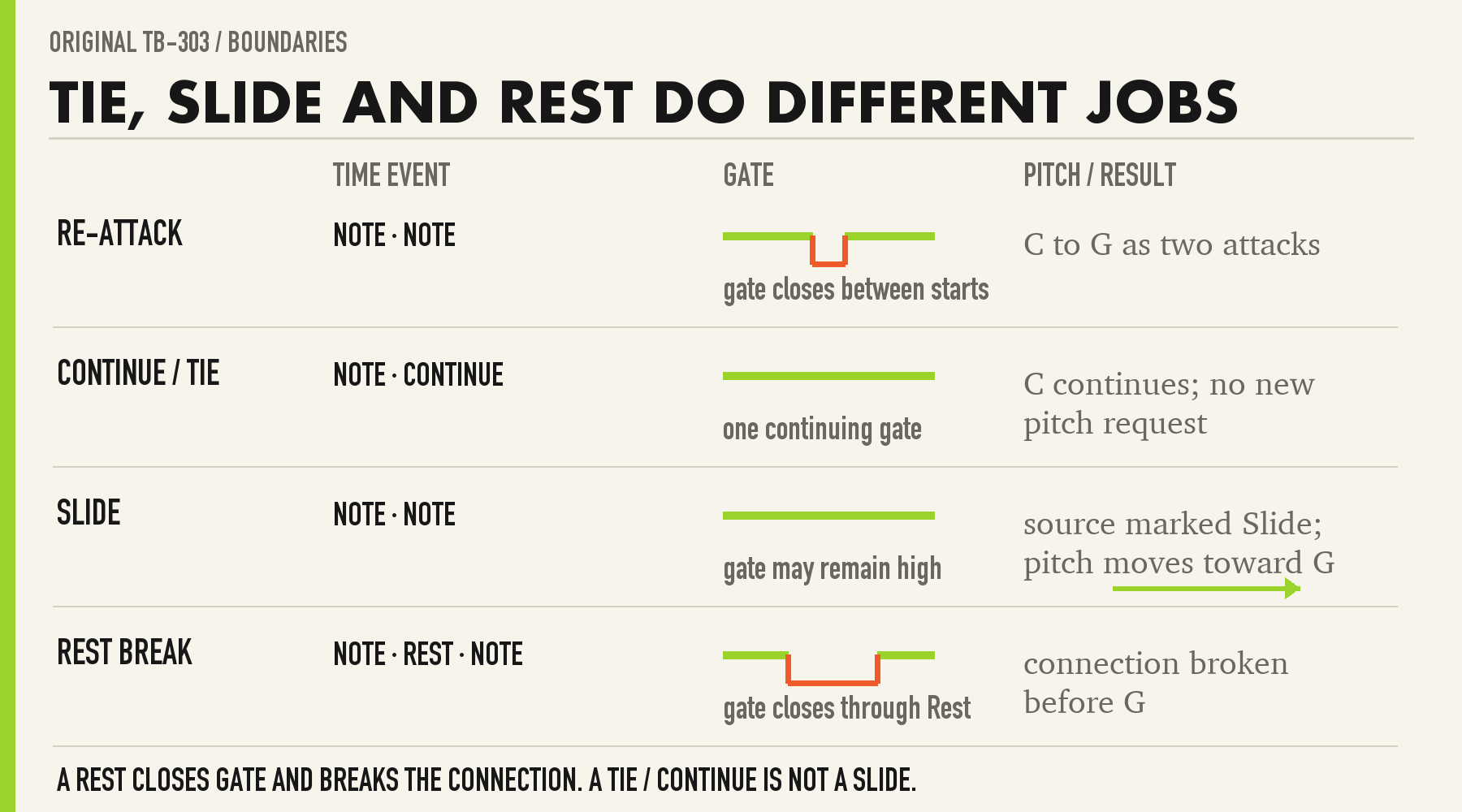
Slide connects a source event to its destination; a rest breaks that connection. Accent affects more than loudness. Robin Whittle’s investigations trace the slide and accent circuits, including the way closely spaced accents can interact through the circuit’s recent state. The sequence participates in the timbre.
03 / THREE PASSES THROUGH THE SAME PHRASE
The original writing method asks the player to enter pitches, then their Note, Tie and Rest events, with Accent and Slide as articulation. These layers meet during playback. A tie extends an event; a rest inserts silence. The next note-start calls the next pitch in the queue.
TCFM ORIGINAL PATTERN LIBRARY // 24 CONTROLLED STUDIES
Select a Big Beat teaching pattern and compare the heard step row with the pitch queue and Note/Tie/Rest stream an original TB-303 asks you to enter. The browser sound is an explanatory approximation—not a sample or circuit emulation.
SWIPE OR USE ARROW KEYS TO READ EVERY STEP →
PITCH MODE
Rests and ties do not enter this queue. Accent and Slide belong to pitch events on the original machine.
TIME MODE
N calls the next pitch. R advances time without consuming one. T holds the current event.
04 / THE MUSIC / SEVERAL ROUTES THROUGH ONE INSTRUMENT
Charanjit Singh’s 1982 raga-and-disco system placed a 303 beside an 808 and Jupiter-8. Edwyn Collins used it to write the bass on Orange Juice’s “Rip It Up”. Ben Cenac made it the arpeggiator on Newcleus’s “Jam On It”, while a Pro-One carried bass. These histories give the original instrument several musical jobs before acid became its best-known one.
Spanky brought a second-hand 303 into Phuture’s setup. DJ Pierre’s account follows the control experiment into a cassette, Ron Hardy’s Music Box and a later studio reconstruction with Marshall Jefferson. The Trax release came in 1987. The recording preserves a performed approach learned before the group entered that studio.
Gerald Simpson’s account places the machine inside an improvising Manchester system. Repetition gives the performance a centre; changing controls and the other instruments gives it form. The Bass Line becomes one member of the ensemble rather than the whole explanation of the record.
05 / ROLAND / THE SILVER INSTRUMENTS
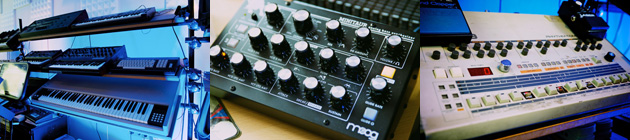
Richard Devine remembers buying his 303 from a friend in 1993 and having it Devil Fish-modified in 2005. His account follows a surviving object through ownership and a dated change. The performance-system photograph places that object back among working instruments.
Phuture’s founding machine has a different evidence trail. The retained research has no public serial or continuous custody record reconnecting it to a surviving chassis. Its role in the musical history can be well documented while the identity of a survivor remains unresolved.
Wear, a modification and a known owner are useful parts of an object’s biography. A recording credit needs its own support. The archive can follow both the instrument and the music without making one stand in for the other.
06 / PRINT / PANEL / PEOPLE / PHRASES
BIG BEAT MACHINE FILE // 008
The Roland TB-303 Bass Line is a programmable bass accompaniment system whose pitch, time, accent and slide became the grammar of several entirely unintended musics.
Artist accounts, historical attributions and performance films establish different things. These notes explain the basis for each reference.
PAGE 01 // ORIGIN // 1981
Roland intended a compact, programmable bass partner for practice, songwriting and the TR-606 Drumatix—not a prophecy of acid house.
The machine came from Roland's Mid-O development culture. Tadao Kikumoto was central, but his later account names a cooperative engineering group that included Jun-ichi Kadoya, Hisanori Matsuoka, Kiyokazu Fujiwara and Yoshiro O-e. The product combined their digital control work with a monophonic analogue synthesizer voice.
The original manual devotes ninety pages to bass lines, pattern locations, rhythm entry, tracks, transposition and synchronisation. That is the real product brief: a small arranger whose owner would learn a course. Its weak electric-bass imitation was only one part of the machine; its more durable invention was a way to store musical relationships and perform the tone controls over them.
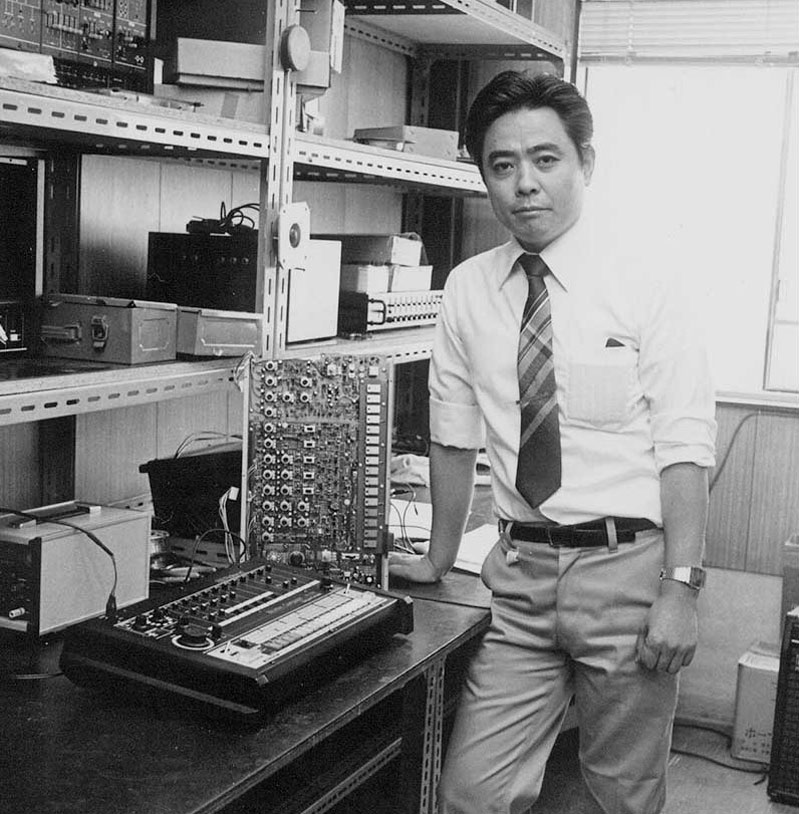
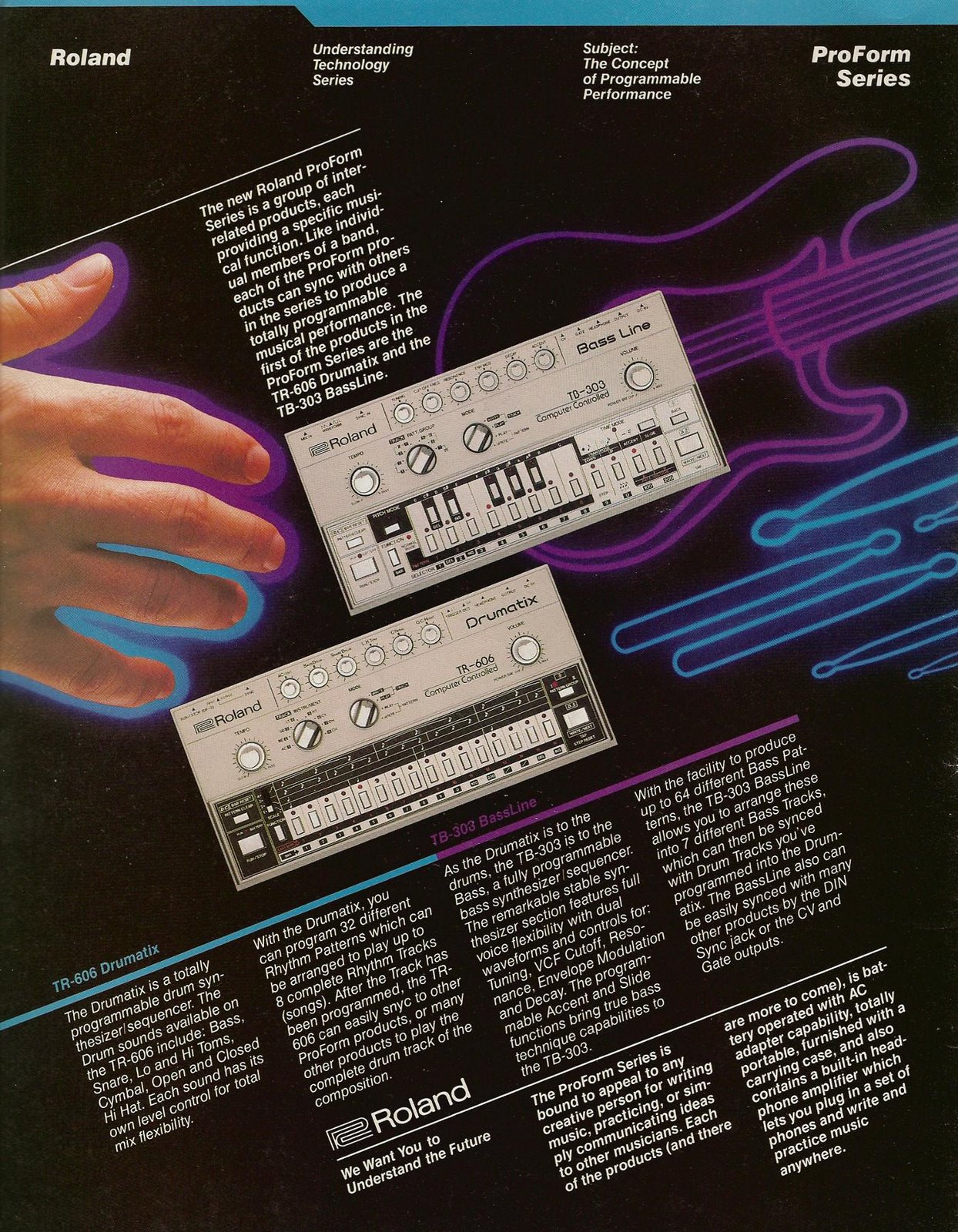
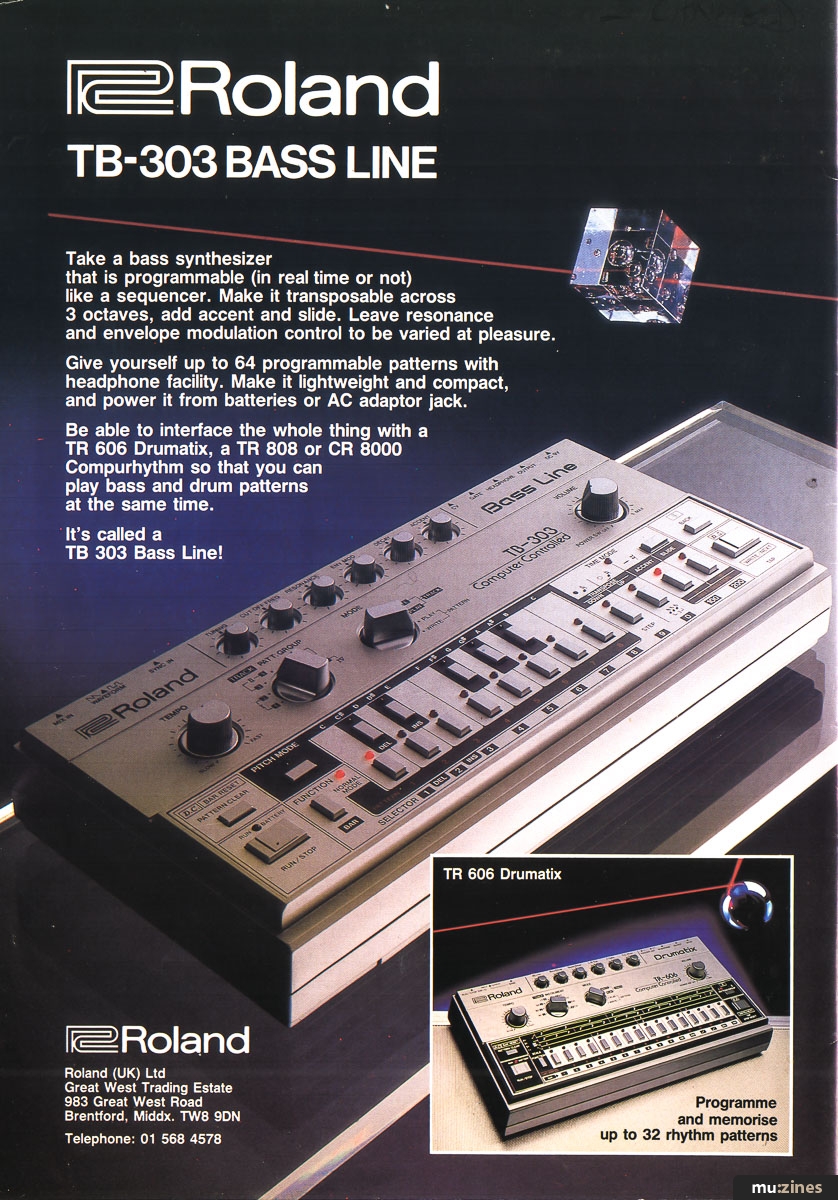
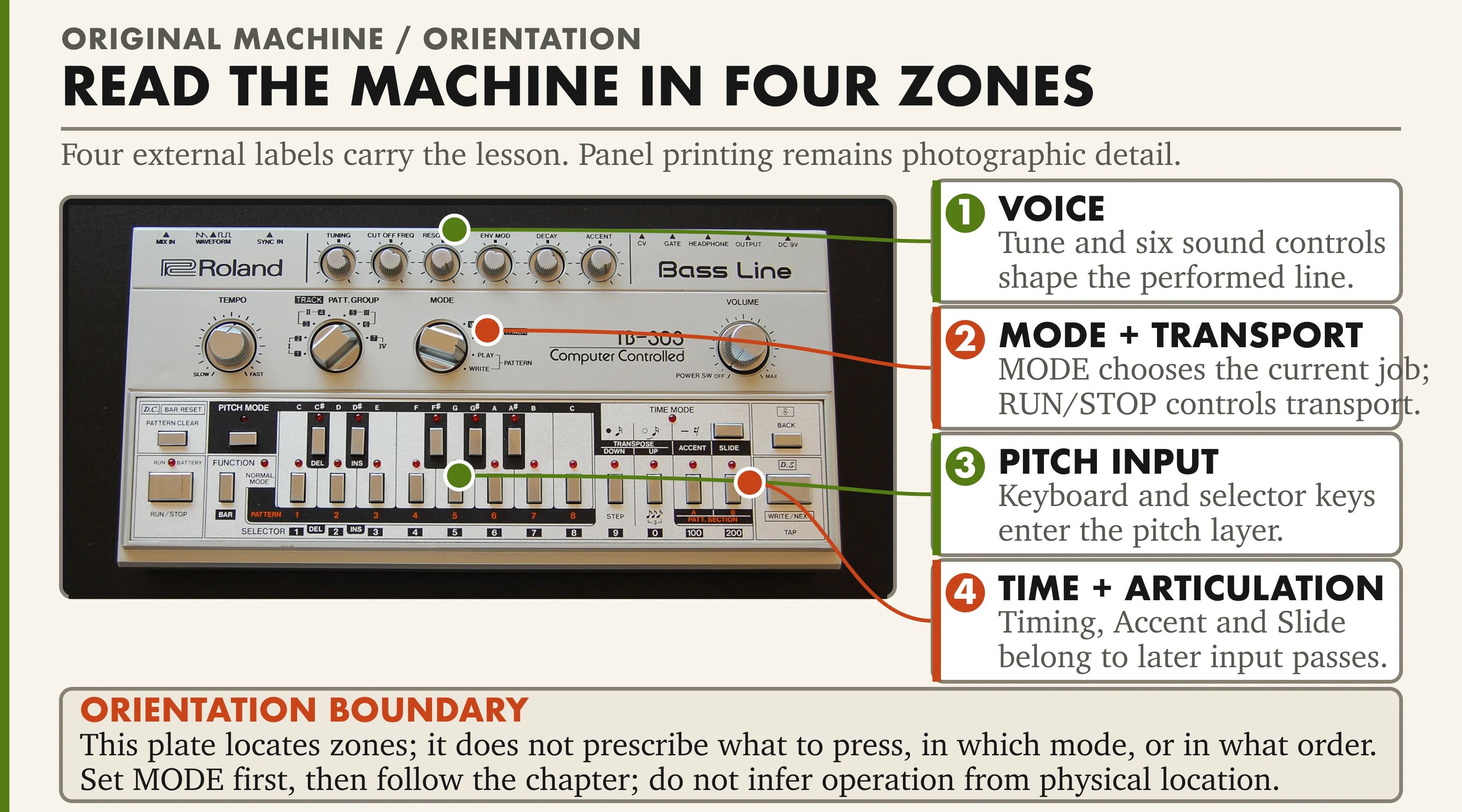
The TB-303 and TR-606 shared battery power, portable scale and DIN Sync. Together they could operate as a self-contained rhythm section: one stored bass phrases while the other supplied programmable drums. CV and Gate outputs also let the Bass Line control compatible synthesizers, while Mix In could carry another instrument through its final output path.
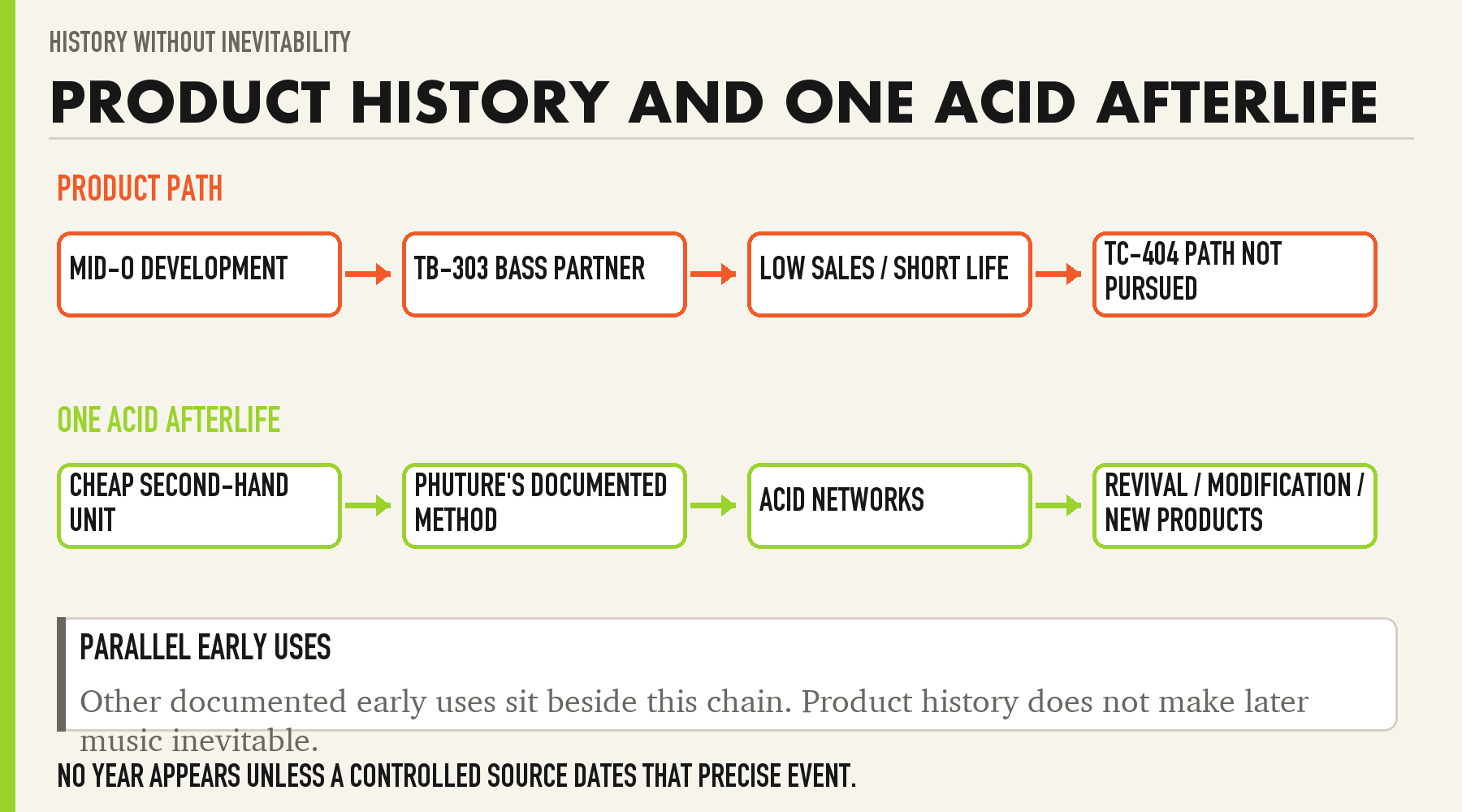
Kikumoto later recalled that the TB-303's commercial failure ended a proposed TC-404 chord-machine project. The intended family therefore closed before users had finished discovering the two products already released.
Roland's developers did not understand the underground ‘Mid-O fever’ until around 1992. That distance matters. The engineers made a constrained instrument; second-hand owners, clubs and record makers developed the techniques and meanings that followed.
Tadao Kikumoto in conversation ↗PAGE 02 // VOICE // VCO · VCF · VCA
Waveform, cutoff, resonance, envelope modulation, decay and accent act on a one-oscillator signal path; tuning and volume sit outside that six-control performance set.
Sawtooth supplies the richer spectrum; square sounds more hollow because the oscillator's ramp is reshaped before it reaches the filter. Cutoff chooses the starting region. Resonance emphasises the moving edge. Envelope Modulation determines how far the contour travels, while Decay determines how long that filter movement takes to fall.
Accent cannot create emphasis unless an accent is stored in the pattern. When one is present, the knob exposes a linked change in level and filter behaviour. Slide also belongs to the stored phrase: it changes the electrical boundary between a source note and the following destination. The recognisable voice is therefore circuit plus sequence plus hand movement.
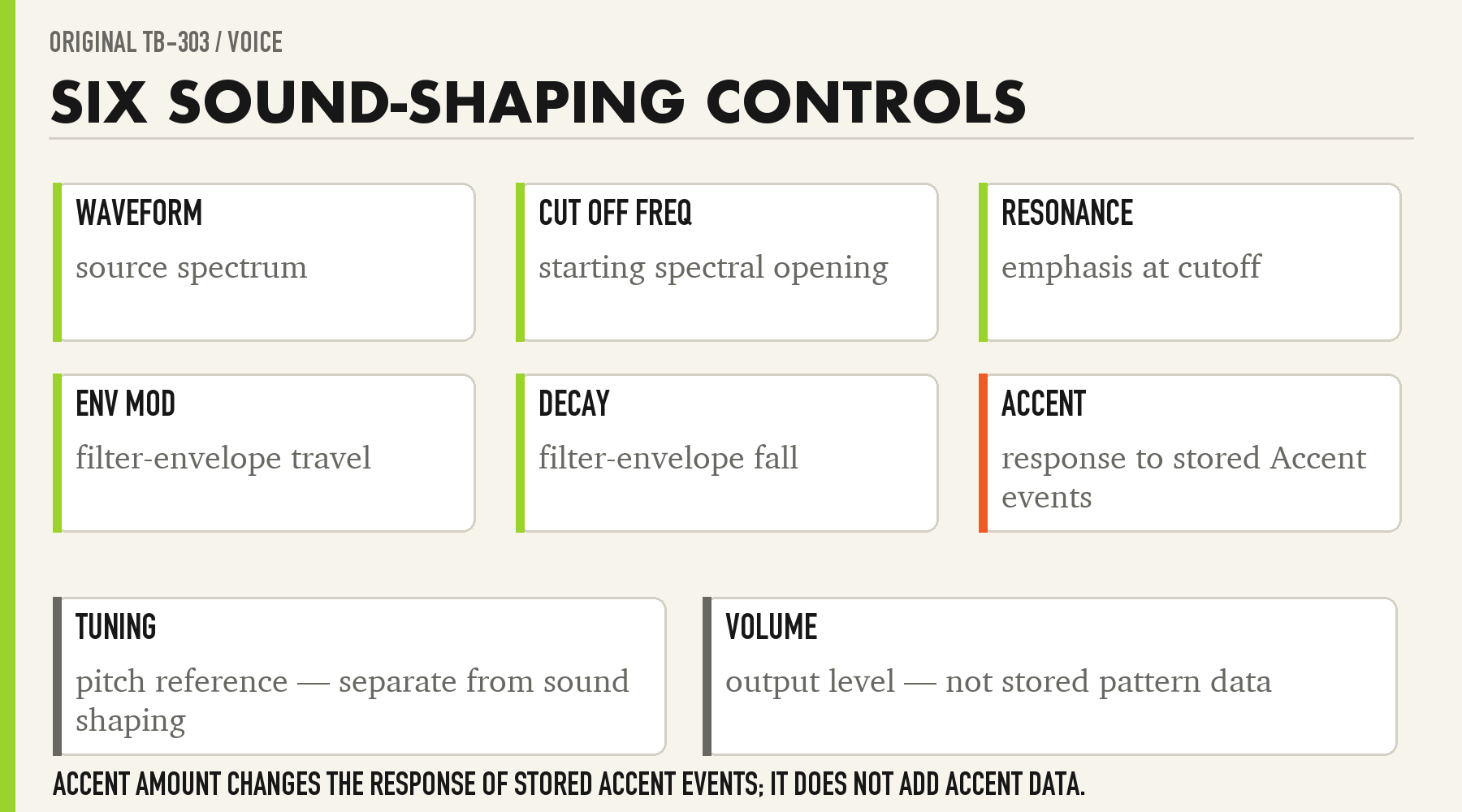
Begin with resonance low and compare sawtooth with square. Next hold the pattern constant while moving only Cutoff. Return Cutoff to the same area, raise Envelope Modulation, and compare short and long Decay. This separates the filter's starting point, distance and duration instead of treating every knob as ‘more acid.’
Program alternating accented and ordinary versions of the same pitch. Keep Resonance moderate, raise Accent gradually, then repeat the test with adjacent accents. You will hear the pattern-dependent accent-sweep response that a simple velocity boost cannot reproduce.
For slide, compare four two-note boundaries: ordinary notes, a slide across a small interval, a slide across a large interval, and a slide into an accented destination. Then place a rest between the same pitches. The rest breaks the connected gate relationship and proves that slide describes a boundary, not a note in isolation.
Knob positions are only the first page of a performance record. Photograph the starting position, then record several passes and note the direction and timing of each control move. On a TB-303, movement is part of the composition.
DIGITAL INSTRUCTIONS // ANALOGUE VOICE
Roland's block diagram separates the switch board, processor and CMOS memory from the D/A converter, oscillator, filter, envelope and amplifier. Pitch, gate, accent and slide become electrical control conditions before the single analogue voice can speak.
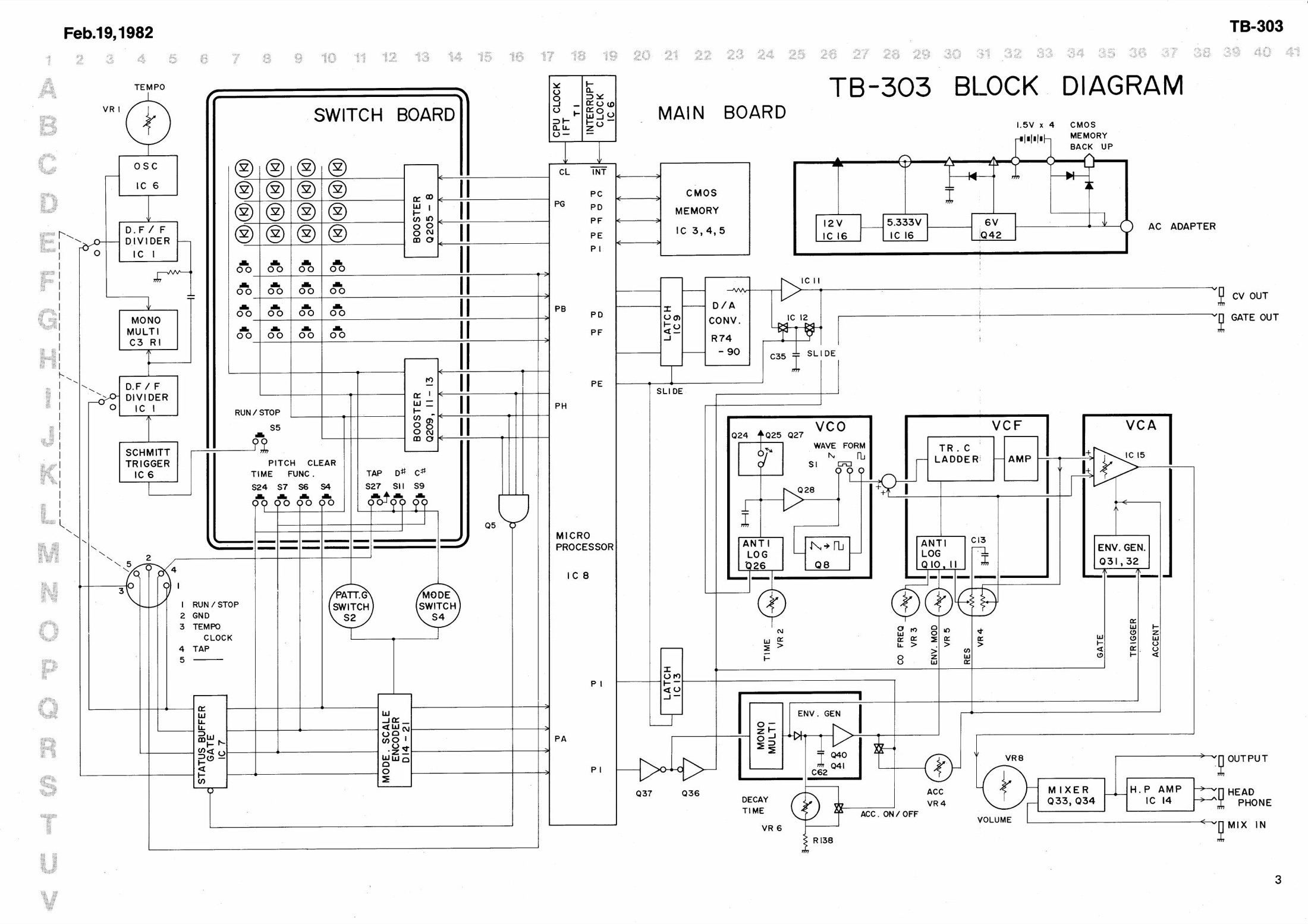
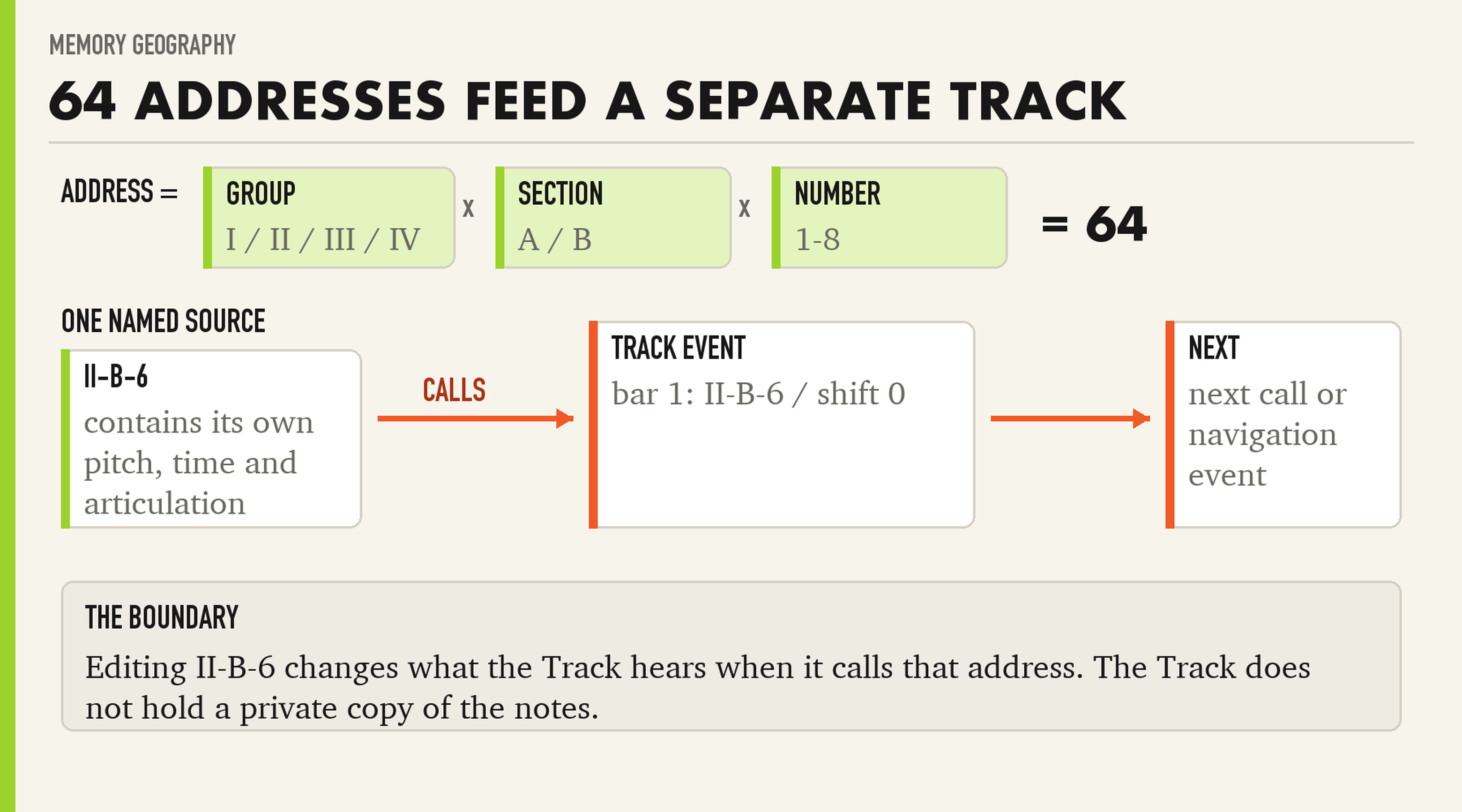
The µPD650C processor scans the keys and addresses three µPD444C CMOS RAM devices. The service notes specify 64 pattern locations—four groups, two sections and eight numbered positions—and seven tracks holding up to 256 measures in total. A latch and resistor network feed the pitch D/A converter; the result appears as the same nominal 1 volt-per-octave control used at CV OUT.
The VCO core around the matched transistor pair generates a sawtooth. The waveform switch either sends that ramp onward or selects the derived square wave. The factory procedure sets the oscillator at 110 Hz on A and then checks a four-octave rise at 1:4 frequency ratio; WIDTH adjusts the waveform conversion rather than a user-facing pulse-width control.
The filter is a four-section transistor-diode ladder. Calling it simply ‘18 dB’ or ‘24 dB’ misses the useful distinction: four reactive sections give a 24 dB-per-octave asymptote, while the non-ideal transition response helped produce the long-standing 18 dB shorthand. The service-note VCF explanation shows Q9–Q11 shifting the bias as envelope modulation increases so the sweep remains in an effective audible range instead of merely pushing the cutoff out of use.
The BA662A is used as the voltage-controlled amplifier. Gate opens the main envelope path; Accent also reaches the VCA and an additional filter-sweep route. Technician Robin Whittle's measured account explains why close accents can growl differently: part of that accent-sweep network may still be discharging when the next marked note arrives.
Slide is not generic portamento. The processor extends the source note's gate relationship and the C35 slide network delays the pitch-control transition toward the destination. Whittle measured a nominal stock slide near 60 ms. A rest breaks that boundary; two equal pitches with slide can behave as a tie.
For diagnosis, follow functions in order: memory and switch scan, pitch D/A and CV, gate/slide control, VCO, VCF, envelope/VCA, mixer and output. The service notes explicitly warn that apparent faults are often programming or mode errors. Internal calibration requires a meter or oscilloscope and belongs to a qualified technician; preserve patterns before any battery or service work.
Roland TB-303 Service Notes ↗Robin Whittle: slide investigation ↗Robin Whittle: accent and unique characteristics ↗PAGE 03 // SEQUENCER // THREE LAYERS
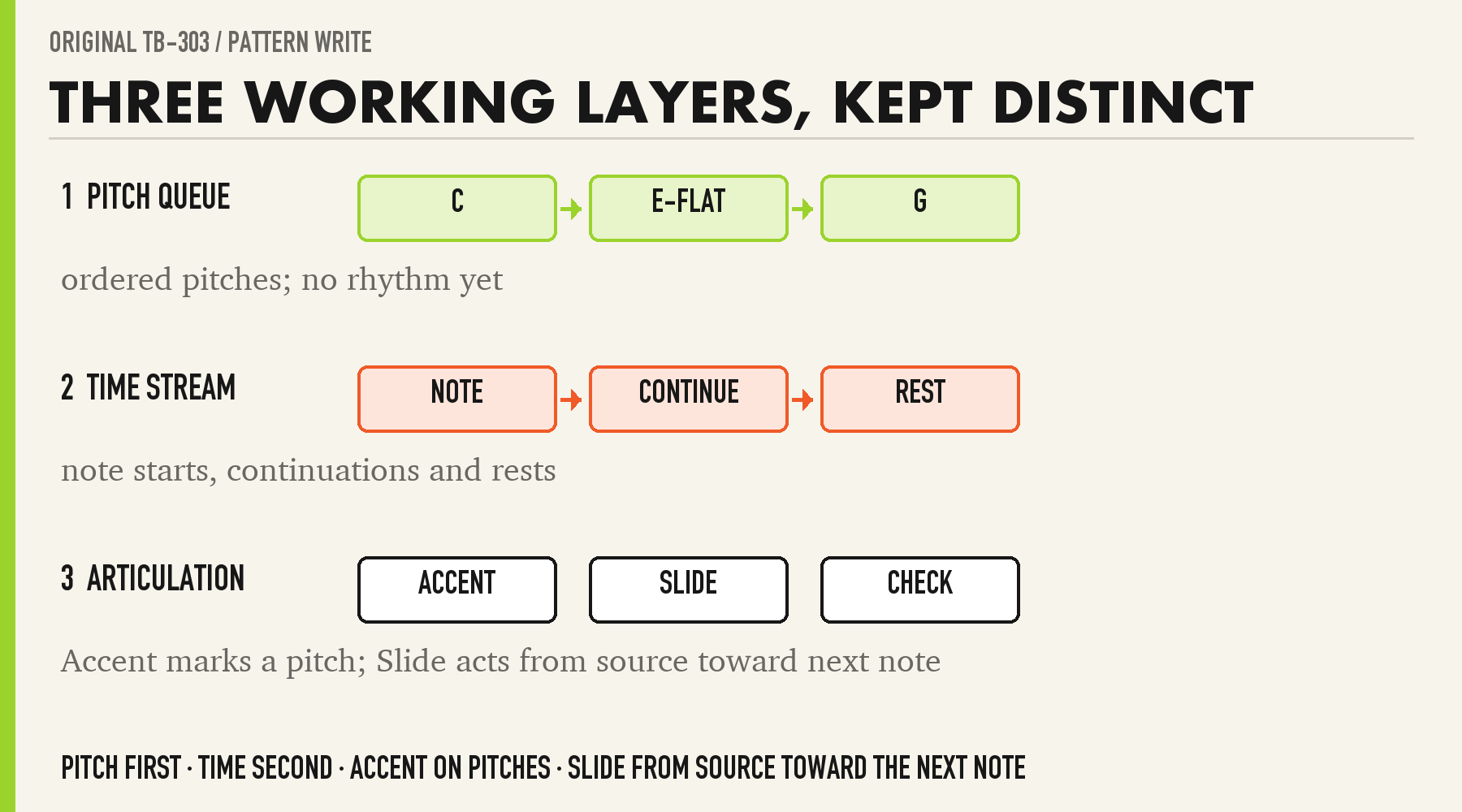
The original TB-303 does not record a keyboard performance. Its pitch queue, time stream and accent/slide data are separate jobs that meet only during playback.
First choose one of 64 addresses: four Pattern Groups, two sections and eight numbered locations. Clear only after confirming that the destination contains nothing worth keeping. Enter the pitch queue in Pitch Mode, including octave shifts. Then enter Note, Tie and Rest events in Time Mode; TAP can perform that time layer after the pitches already exist. Add Accent and Slide while checking the pitch events.
The number of pitches and the number of note-start events must agree. If they do not, the phrase rotates through the pitch queue and time stream at different rates. That apparent mistake is also a controlled compositional method once the user understands which layer is moving.
Before touching memory, write down the Pattern Group, section and number. Photograph or transcribe any valuable phrase. The original hardware has no documented stock export or copy command; paper notation and recorded audio are the dependable backup.
Set Pattern Write, select the address and clear it. Enter pitches in order. Use BACK to correct a pitch-entry error before leaving the layer. Enter the time stream only after the pitch queue is stable: Note begins the next stored pitch, Tie extends the current event and Rest creates silence. Finally step through the pitches with TAP to add Accent or Slide.
Regular Step Mode divides a beat into four positions; Triplet Step Mode divides it into three. A conventional 4/4 bar therefore uses sixteen regular steps or twelve triplet steps. Step Number sets phrase length, and mixed or unequal cycles can create patterns that do not resolve on the expected bar line.
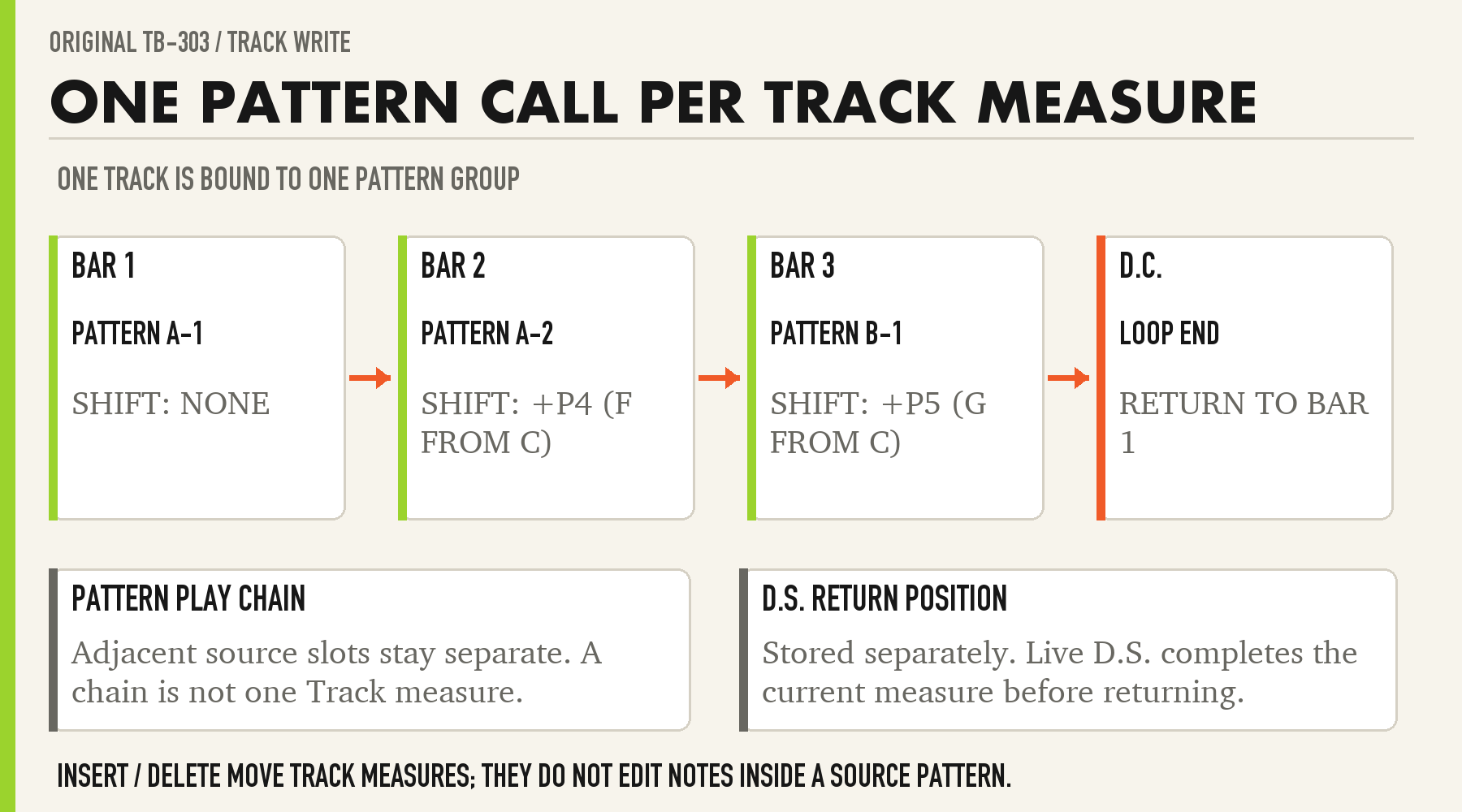
Track memory is a different scale of work. A track stores measure-by-measure pattern addresses plus shifts and navigation instructions such as D.C. and D.S.; it does not contain private copies of the note data. Editing a pattern can therefore change every track that calls that address.
When something sounds wrong, identify the layer before clearing. Correct pitches with a bad rhythm point to the time stream. Correct timing with wrong notes points to the pitch queue. A missing connection between two notes points to Slide, Gate or an inserted Rest. Layer diagnosis is faster and safer than starting again.
Roland TB-303 owner's manual ↗Alexander Robotnick's original-machine tips ↗PAGE 04 // SYSTEM // TRACKS · SYNC · SURVIVAL
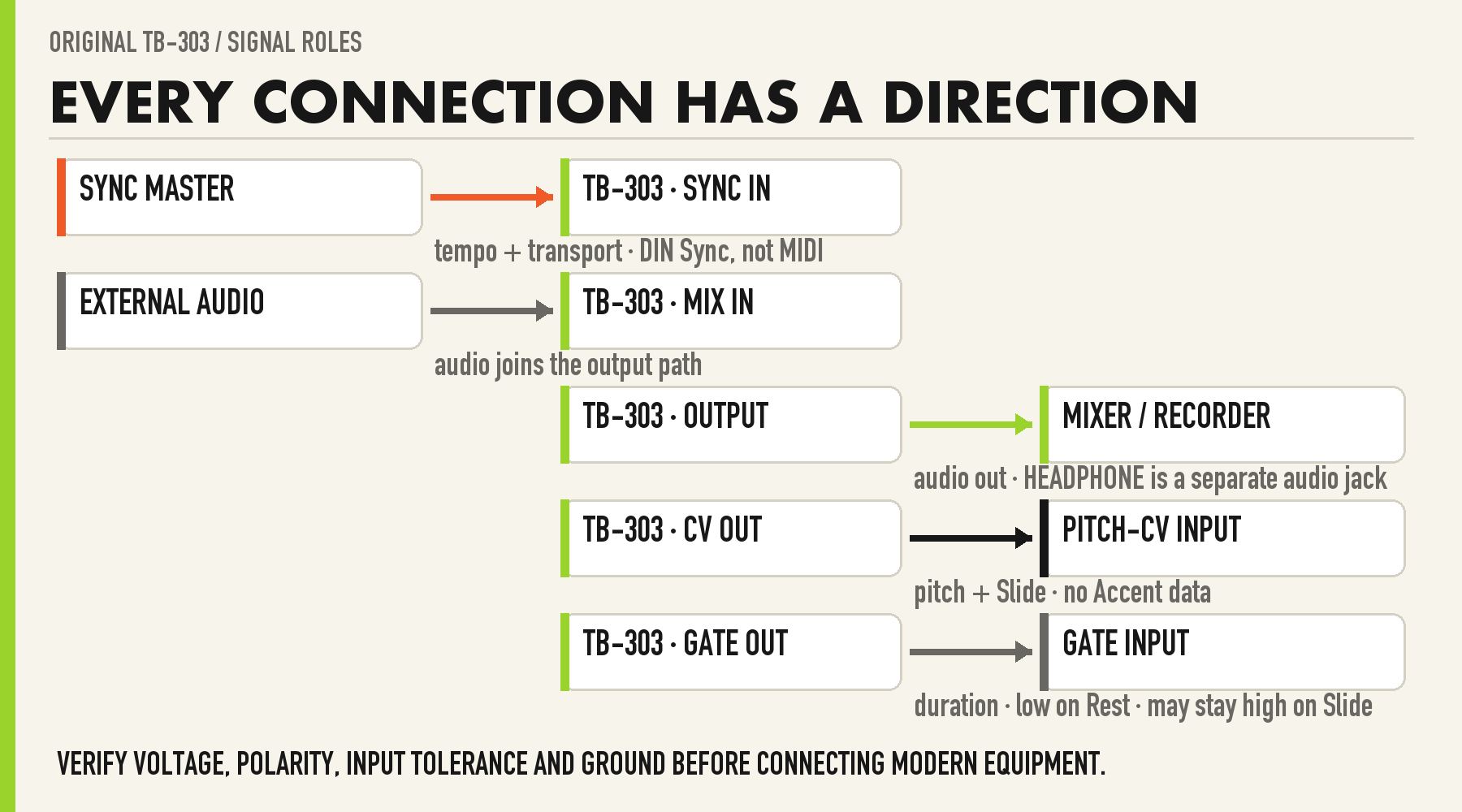
DIN Sync, CV, Gate, Mix In and Track memory give the TB-303 several jobs at once: follower, controller, arranger, mixer input and preserved performance object.
DIN Sync carries tempo and transport, not audio or MIDI notes. The original TB-303 is normally a Sync slave: choose one master clock and connect its Sync Out to the 303's Sync In. CV OUT carries nominal 1 volt-per-octave pitch over +1 to +5 V; GATE OUT is 0 V off and +12 V on. There is no separate accent CV output.
A surviving machine may still contain unique patterns and tracks in battery-backed CMOS memory. Before service, record audio, transcribe the data and document the address map. Do not use weak batteries or battery removal as a randomisation technique; unpredictable memory corruption is not a repeatable musical method.
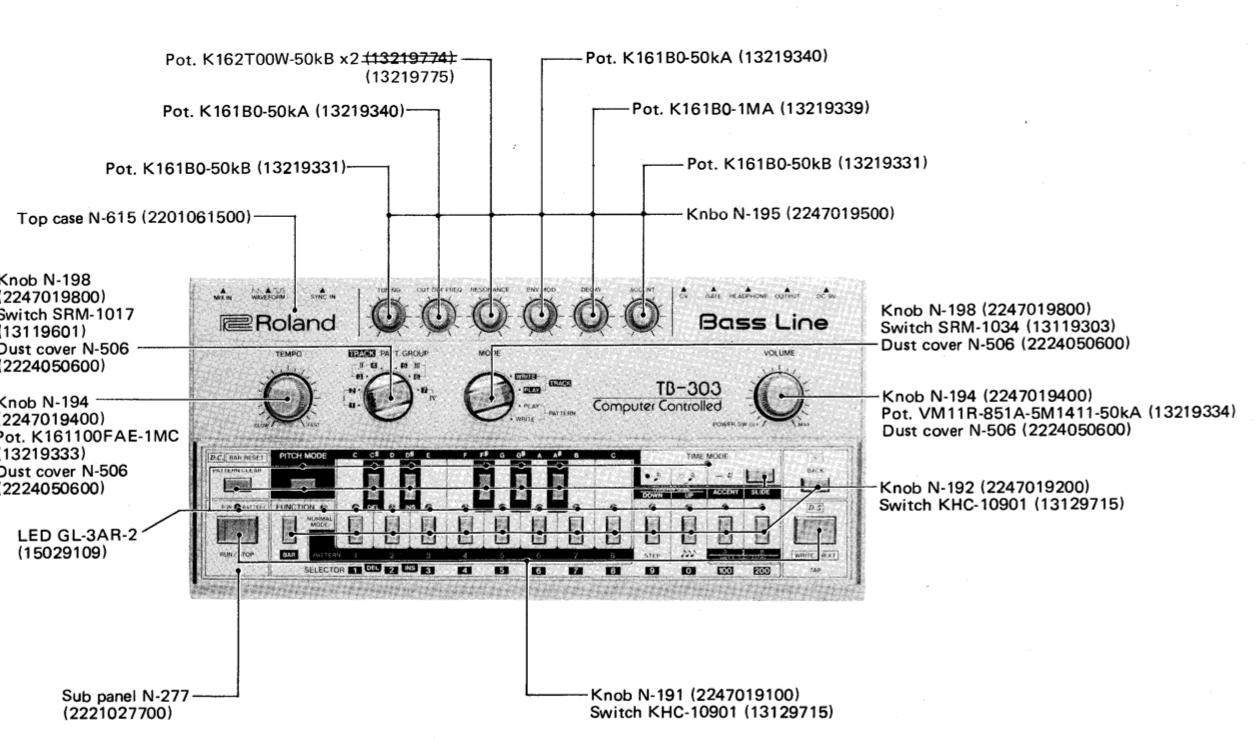
The service notes begin with preliminary diagnosis because illuminated LEDs do not prove healthy batteries and unfamiliar programming can resemble a defect. Confirm power, mode, memory address and operating procedure before turning a musical problem into an analogue adjustment.
The factory adjustment sequence checks tempo at TP1, the internal clock at TP2, pitch CV at the output, VCO width and four-octave scale, and VCF response at TP6. Those tests interact with stored Pattern Write data, so the notes tell the technician to locate an empty or easily copied address before calibration.
The published tuning-range specifications disagree: the owner's manual gives ±500 cents, while the service notes say approximately ±700 cents, or a perfect fifth. Preserve that difference rather than forcing the documents to agree; an individual survivor may also have drifted or been modified.
A silent or unstable original deserves conservative diagnosis. Document trimmer positions, change one variable at a time, and leave powered probing, waveform measurement and internal adjustment to a technician who has the correct service notes and equipment. Repair should preserve function and record every change, not erase the object's working history.
Open the original Service Notes ↗PAGE 05 // RECORDS // THE MACHINE CHANGES JOB
Mumbai, Glasgow, New York, Chicago, Manchester, Frankfurt and Detroit each reveal a different answer to the same small silver box.
In 1982 Charanjit Singh synchronized TB-303, TR-808 and Jupiter-8 while translating Indian ragas into a one-person electronic system. Edwyn Collins used the 303 as a bass-writing tool on Orange Juice's “Rip It Up”. Ben Cenac used it as an arpeggiator on Newcleus's “Jam On It” while a Pro-One carried the bass—a direct refusal of the product's assigned role.
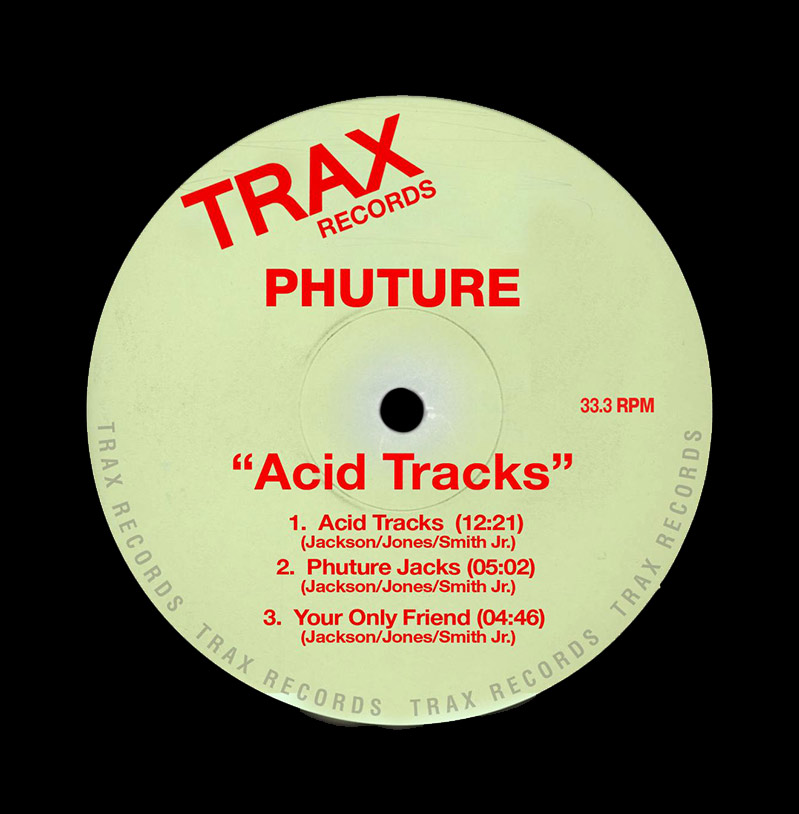
Phuture's Spanky, DJ Pierre and Herb J made the control performance itself the composition. Ron Hardy tested their cassette at the Music Box; dancers helped give the practice a name; Marshall Jefferson helped translate remembered movement into the studio recording of “Acid Tracks”. Gerald Simpson's “Voodoo Ray”, Hardfloor's three-machine “Acperience 1” and Richie Hawtin's stripped systems carried the method into new cities and structures.
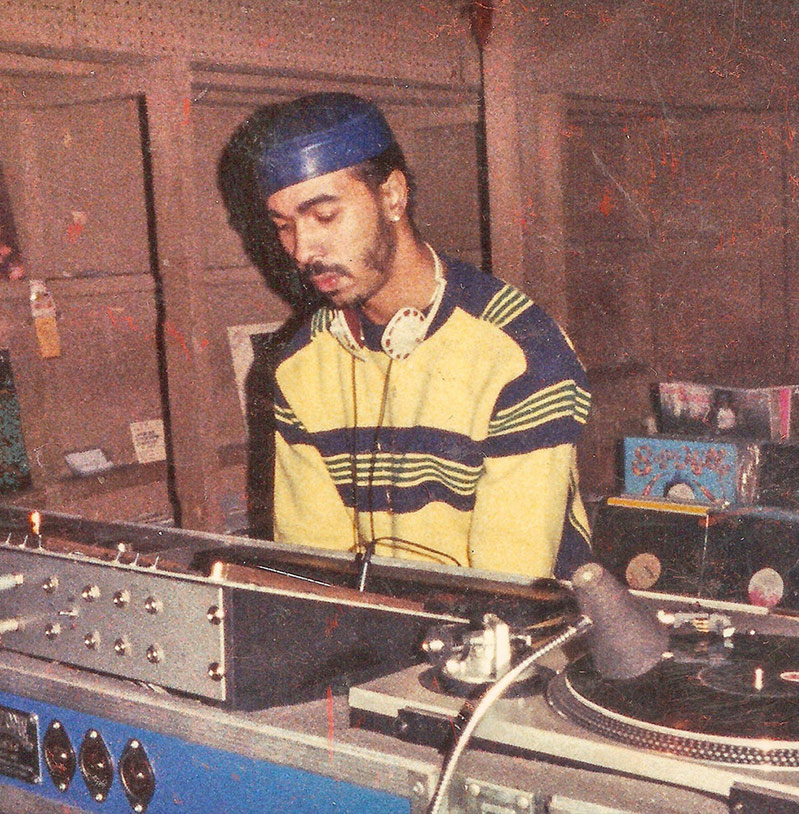


Spanky, DJ Pierre and Herb J began with a cheap second-hand machine and performed the controls while the pattern ran. Ron Hardy's Music Box tests turned that private experiment into a public event; the released recording preserved a learned performance, not merely a preset sound.
Listen on the Phuture catalogue channel ↗Edwyn Collins has identified the Roland 303 as the source of the song's bass line. Here the machine is doing the job Roland expected—writing bass—but the result is unmistakably personal pop rather than anonymous accompaniment.
Watch on the official Orange Juice channel ↗Ben ‘Cozmo D’ Cenac has explained that the TB-303 supplied the arpeggiated figure while a Sequential Circuits Pro-One handled bass. The machine's reassignment is the point: a Bass Line becomes an upper-register sequencer.
Listen on the official artist channel ↗Gerald Simpson treated the 303 as an improvising member of a connected machine ensemble. The repeated phrase becomes an arrangement because controls, mutes and surrounding rhythm keep changing its role.
Watch on the official Rham Records channel ↗Wink shaped the record as a long escalation. The TB-303 phrase keeps its identity while cutoff, resonance and intensity change around it, making control movement the track's central dramatic device.
Watch on the official Strictly Rhythm channel ↗The early record is not merely a prelude to Chicago. Singh used the machine inside raga and disco; Ryo Kawasaki placed it in a one-person electronic ensemble; Collins made a pop hook; Martyn Ware used it in Heaven 17; Cenac deliberately moved it above the bass register. The machine had several histories before one of them acquired the name acid.
The two Chicago ‘firsts’ answer different questions. Sleezy D and Marshall Jefferson's “I've Lost Control” is the earlier documented commercial release of the pair. Phuture supplies the stronger participant account of the home experiment, Music Box cassette, audience naming and rehearsed control performance that became “Acid Tracks”. Both facts can stand without turning chronology into a single winner.
Hardfloor later used three TB-303s as counterpoint rather than simply making one line more extreme. Josh Wink planned “Higher State of Consciousness” as a controlled crescendo. Norman Cook's method was to record the hands. These are different compositional answers to the same fact: the panel movement is not decoration added after the pattern; it is part of the work.
DJ Pierre and Phuture ↗A Guy Called Gerald ↗Hardfloor on Acperience 1 ↗ONE MODEL // MANY OBJECT LIVES
Earl ‘Spanky’ Smith Jr. bought the second-hand TB-303 used in Phuture's founding experiments for roughly forty dollars. DJ Pierre remembers the group later leaving it at a repair shop. No public serial number or repair record reconnects that historically central instrument to a surviving chassis.
Other machines have clearer biographies. Richard Devine has kept the unit he bought from a friend in 1993 and had it converted to Devil Fish specification in Australia in 2005. Hardfloor's “Acperience 1” was not one magic box but three TB-303s performing interlocking lines. Melbourne Electronic Sound Studio keeps another as a working collection object that musicians can still book and learn.
This is why the archive records custody, modification and service as well as records. A worn knob can show use, but it cannot prove a song. A modification is not damage to be hidden; it is a dated event in the life of the object.
Start with the object itself: photograph the front, rear, underside, labels and non-factory openings; record the Roland serial privately; and keep any modifier's job number separate. Add purchase history, invoices, service work, replaced parts and the earliest dated photograph.
Then separate documented use from memory and association. A participant, session document or period photograph may support a named recording. An owner can accurately remember acquisition without proving every title made during ownership. An auction listing can establish a sale while leaving the studio history unresolved.
The founding Phuture machine remains an active research question rather than a decorative mystery. The missing repair shop, approximate date, technician and paperwork are the evidence that could reconnect it. Until that chain exists, no similar-looking TB-303 should be advertised as the “Acid Tracks machine.”
Richard Devine on his long-owned TB-303 ↗MESS working-collection TB-303 ↗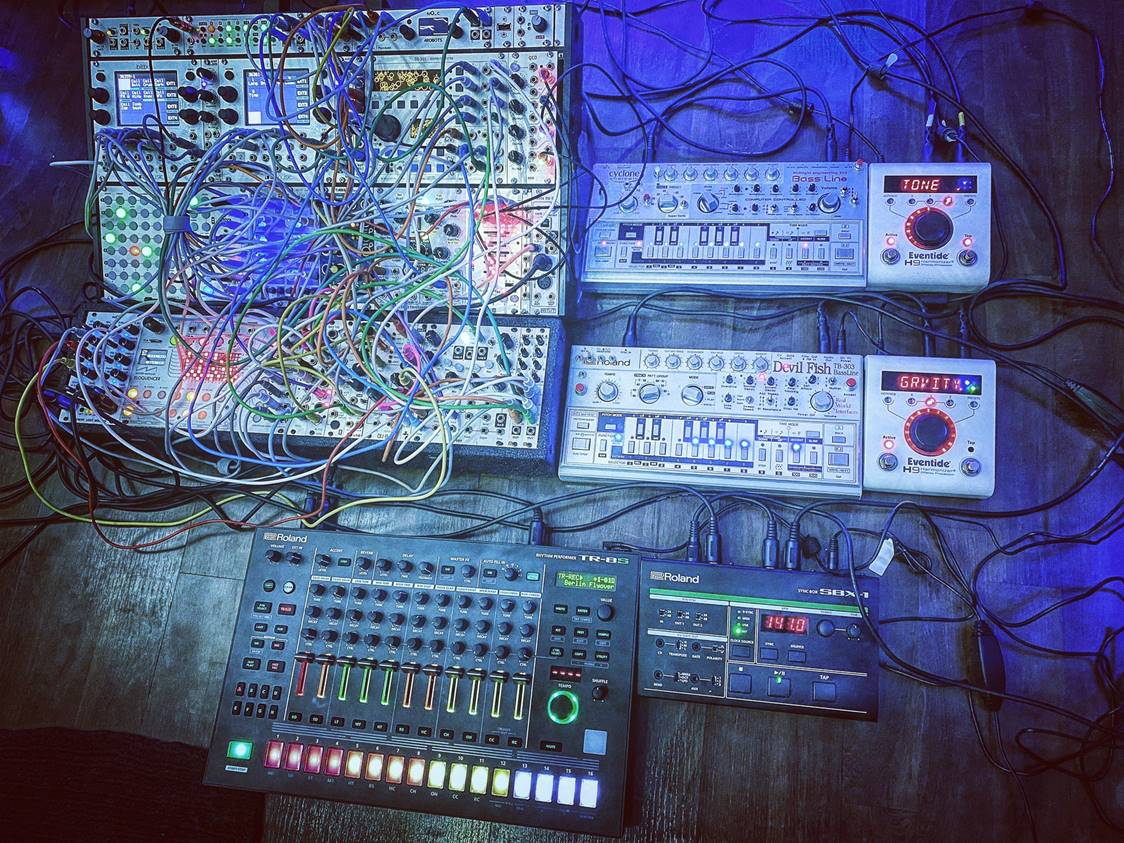
SOURCES AND FURTHER READING // TB-303
Owner’s manuals, service notes, period catalogues, contemporary press and first-hand accounts are identified by type so readers can follow the machine beyond this dossier.
Primary operation, memory, Track, connection and specification document.
OPEN SOURCE ↗S01Primary circuit, parts, calibration and preliminary-diagnosis document; first edition dated 19 February 1982.
OPEN SOURCE ↗E01Technician Robin Whittle measures the original slide circuit, gate extension and roughly 60 ms delayed pitch transition.
OPEN SOURCE ↗E02Whittle traces the main envelope and accent-sweep discharge that can make adjacent accented notes respond differently.
OPEN SOURCE ↗H01Developer testimony on the Mid-O team, design limits, commercial outcome and later recognition.
OPEN SOURCE ↗A01Participant testimony on the home experiment, Ron Hardy and the development of Acid Tracks.
OPEN SOURCE ↗A02Participant testimony on acquiring, programming and performing the TB-303 in Manchester.
OPEN SOURCE ↗A03Participant testimony identifying the TB-303 as the arpeggiator on Jam On It.
OPEN SOURCE ↗A04Participant testimony and performance-system photography documenting Devine's long-owned modified TB-303.
OPEN SOURCE ↗A05Oliver Bondzio's account of three TB-303s performing interlocking lines, with studio photography.
OPEN SOURCE ↗P01April 1982 period review documenting the operating burden and TR-606 partnership.
OPEN SOURCE ↗P02Period advertising reference for Roland's paired Drum & Bass proposition.
OPEN SOURCE ↗R01Peer-reviewed study of the visual notation systems musicians developed to preserve and exchange TB-303 patterns.
OPEN SOURCE ↗R02Named long-term practitioner's guide to writing, transposition, paper backup and performance.
OPEN SOURCE ↗THE MACHINE LINE // 08 OF 12
Each machine inherits a working idea and moves one musical decision. Continue through the family by what the player can do—not by model number alone.
A musician can carry a complete programmable rhythm section, write away from the studio and use DIN Sync to keep the 606 and 303 moving as one instrument.
← OPEN PREVIOUS MACHINEThe same compact, synchronised system gains a pitched sequence: note, octave, timing, accent and slide become stored musical events.
WHAT CHANGES HEREThe player can tune and decay the drums, push selected steps with accent, swing the grid, program flams and drive or follow a larger MIDI system.
OPEN NEXT MACHINE →