Analogue drums, recorded metal, a playable sixteen-step grid and an unusually open rear panel made the Roland TR-909 less a closed rhythm box than the centre of a changing studio.
RHYTHM MEMORY96 patterns; 896 measures per bank across four tracks
More facts, listening references & sources
PERIOD PRICE¥189,000 Japan; US$1,195 list
LINEAGE ADVANCEAnalogue drums and recorded cymbals share one kit while MIDI, shuffle, flam and extensive outputs place the Rhythm Composer at the centre of a connected studio.
WHAT THE PLAYER GAINSThe player can tune and decay the drums, push selected steps with accent, swing the grid, program flams and drive or follow a larger MIDI system.
START LISTENINGModel 500 — No UFOs · Inner City — Good Life · Underworld — Born Slippy .NUXX
Sources for the artists and listening references
Artist accounts, historical attributions and performance films establish different things. These notes explain the basis for each reference.
Juan Atkins — participant account. Atkins describes MIDI linking DrumTraks and TR-909 for No UFOs, with manual start alignment. Retrieved through indexed source text. Read source for Juan Atkins ↗
Frankie Knuckles — participant account. Knuckles identifies his first drum machine as a 909 from Derrick May and confirms continued live use. Read source for Frankie Knuckles ↗
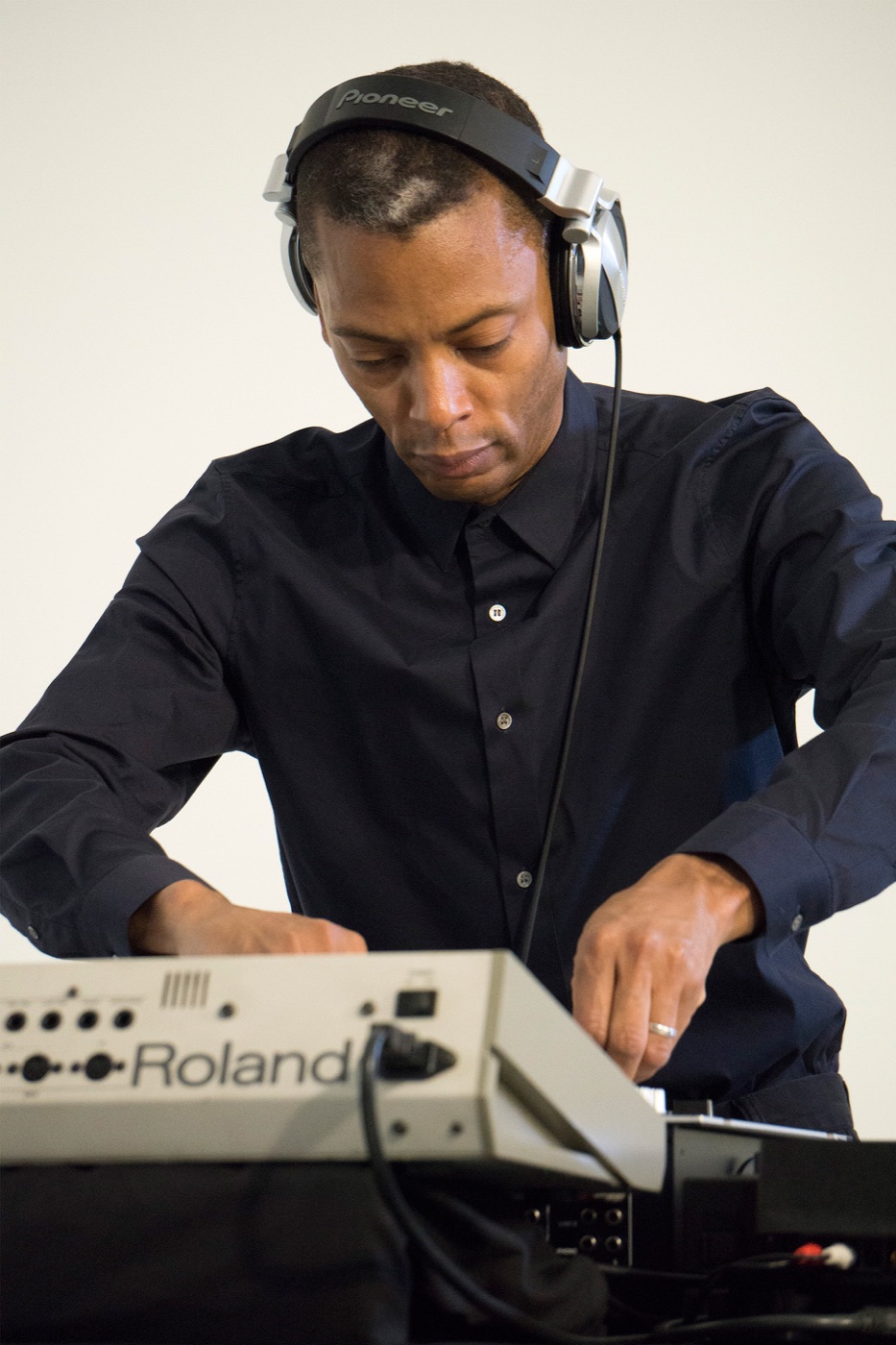
Jeff Mills — official performance film. Named original-machine performance reference; not attribution of a separate studio master. Read source for Jeff Mills ↗
Underworld — participant account. Smith explicitly identifies a TR-909 driven through a console and processed on Born Slippy .NUXX. Read source for Underworld ↗
Model 500 — No UFOs — participant account. Atkins describes MIDI linking DrumTraks and TR-909 for No UFOs, with manual start alignment. Retrieved through indexed source text. Read source for Model 500 — No UFOs ↗
Underworld — Born Slippy .NUXX — participant account. Smith explicitly identifies a TR-909 driven through a console and processed on Born Slippy .NUXX. Read source for Underworld — Born Slippy .NUXX ↗
THE BIG BEAT COLLECTION // ROLAND TR-909 RHYTHM COMPOSER
THE HYBRID MACHINE IS BUILT AROUND REACH.
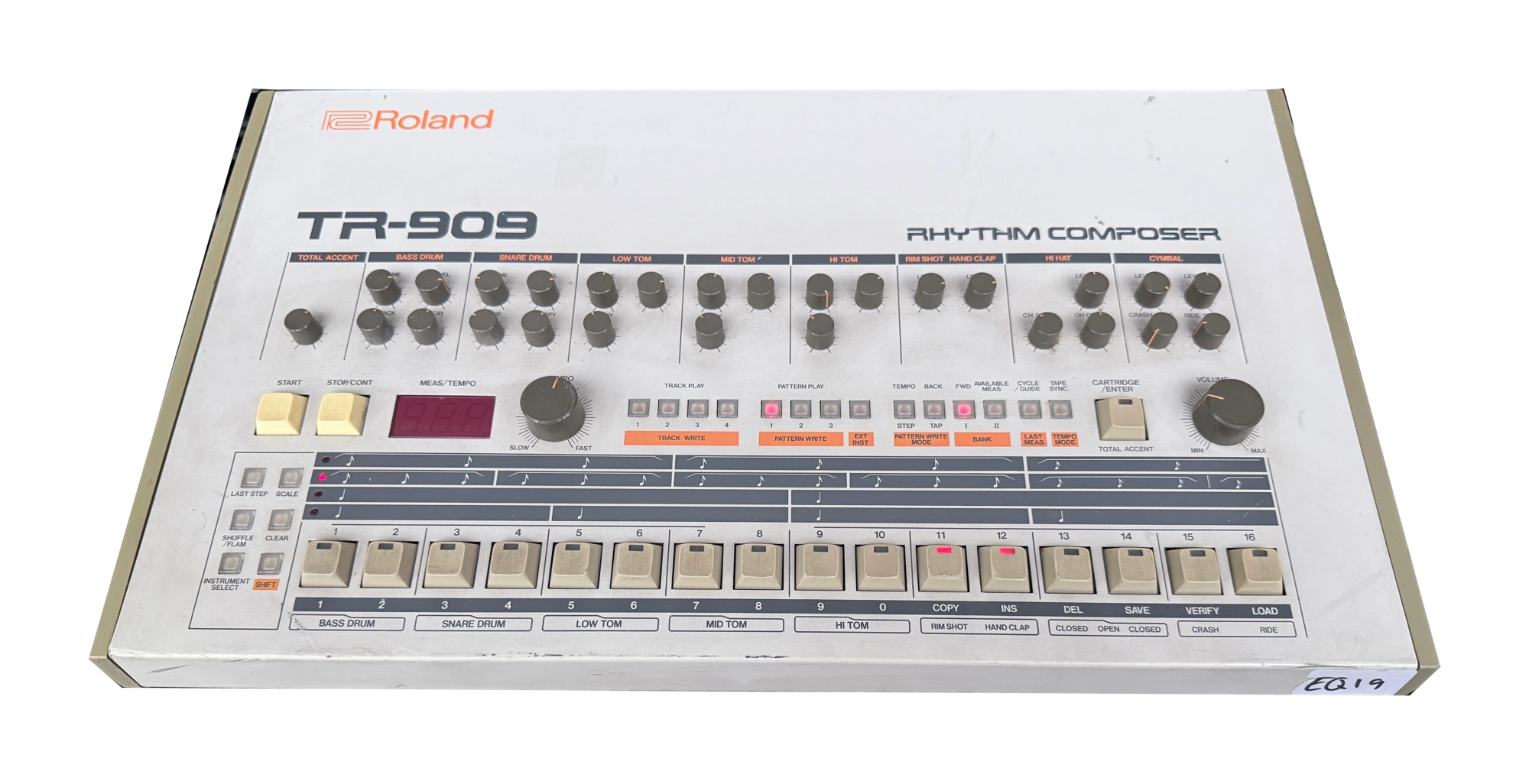
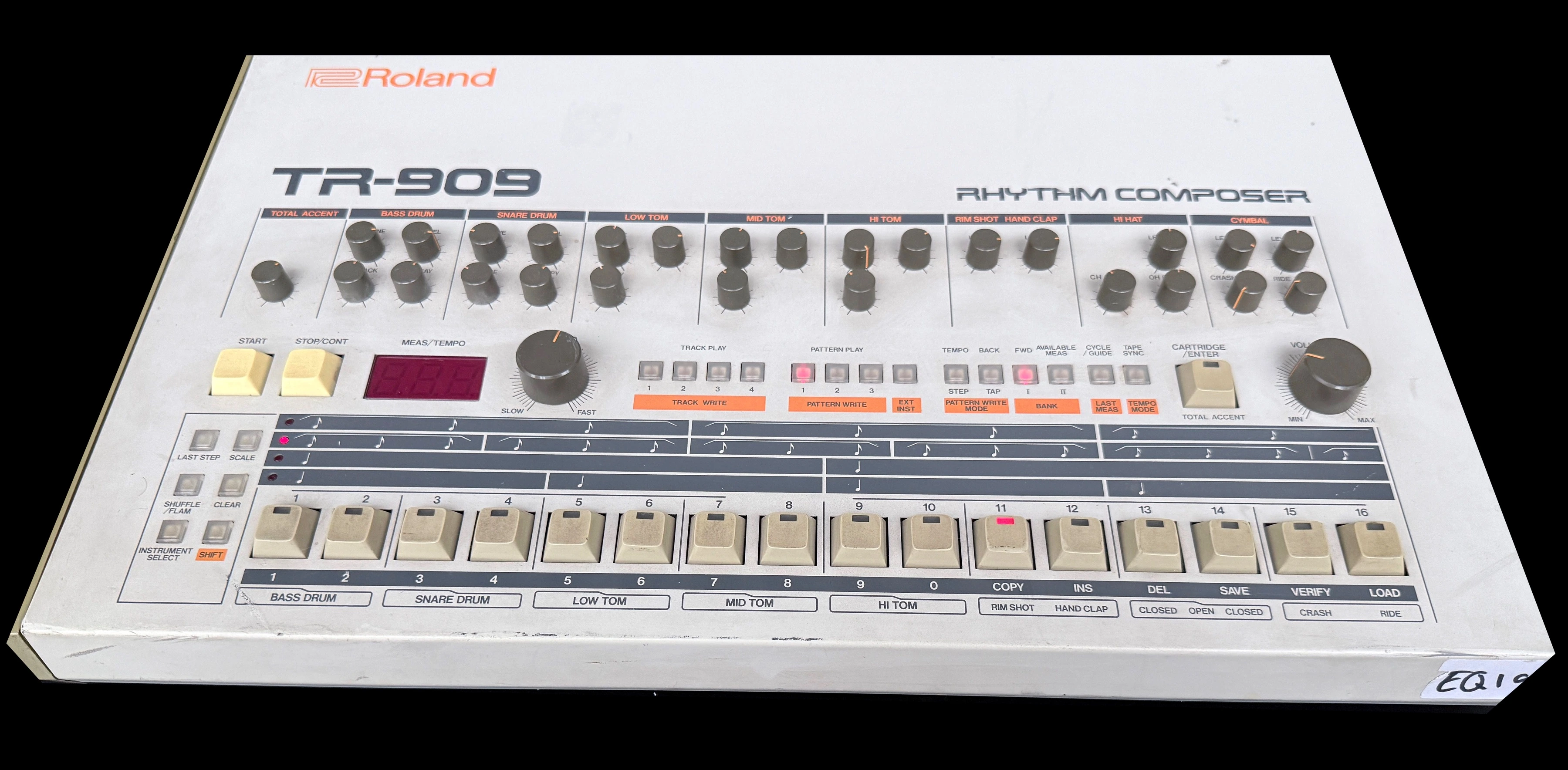
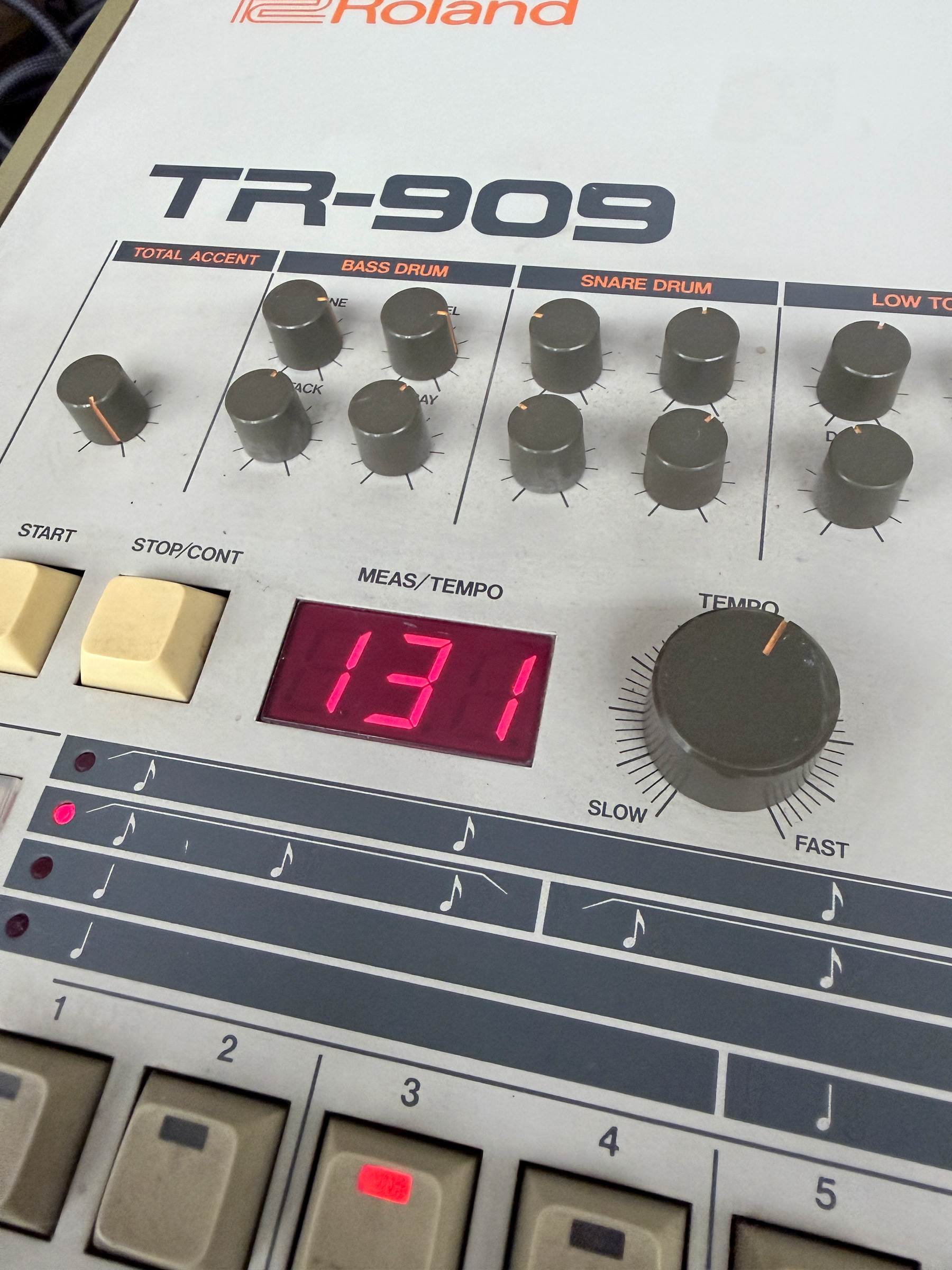
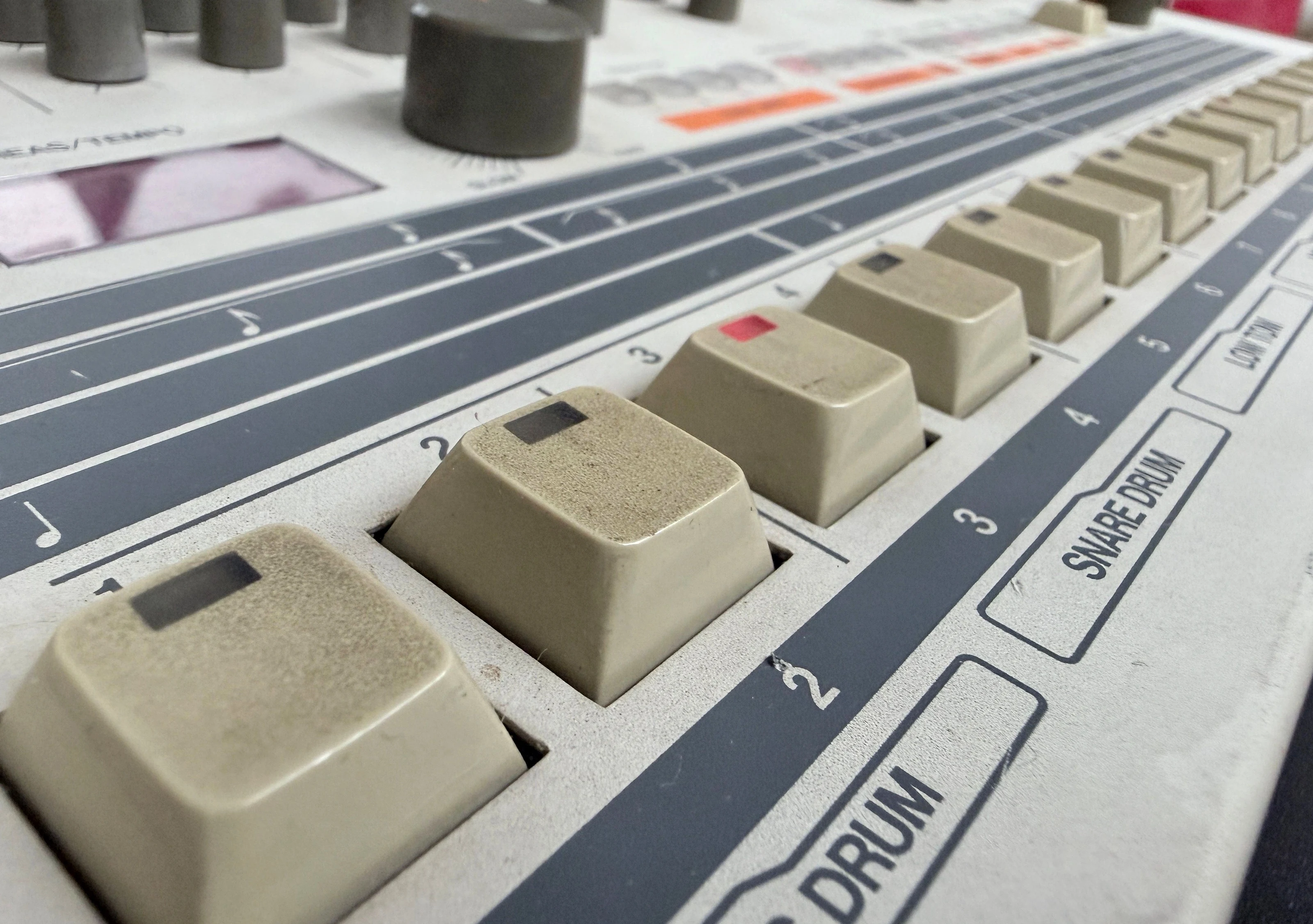
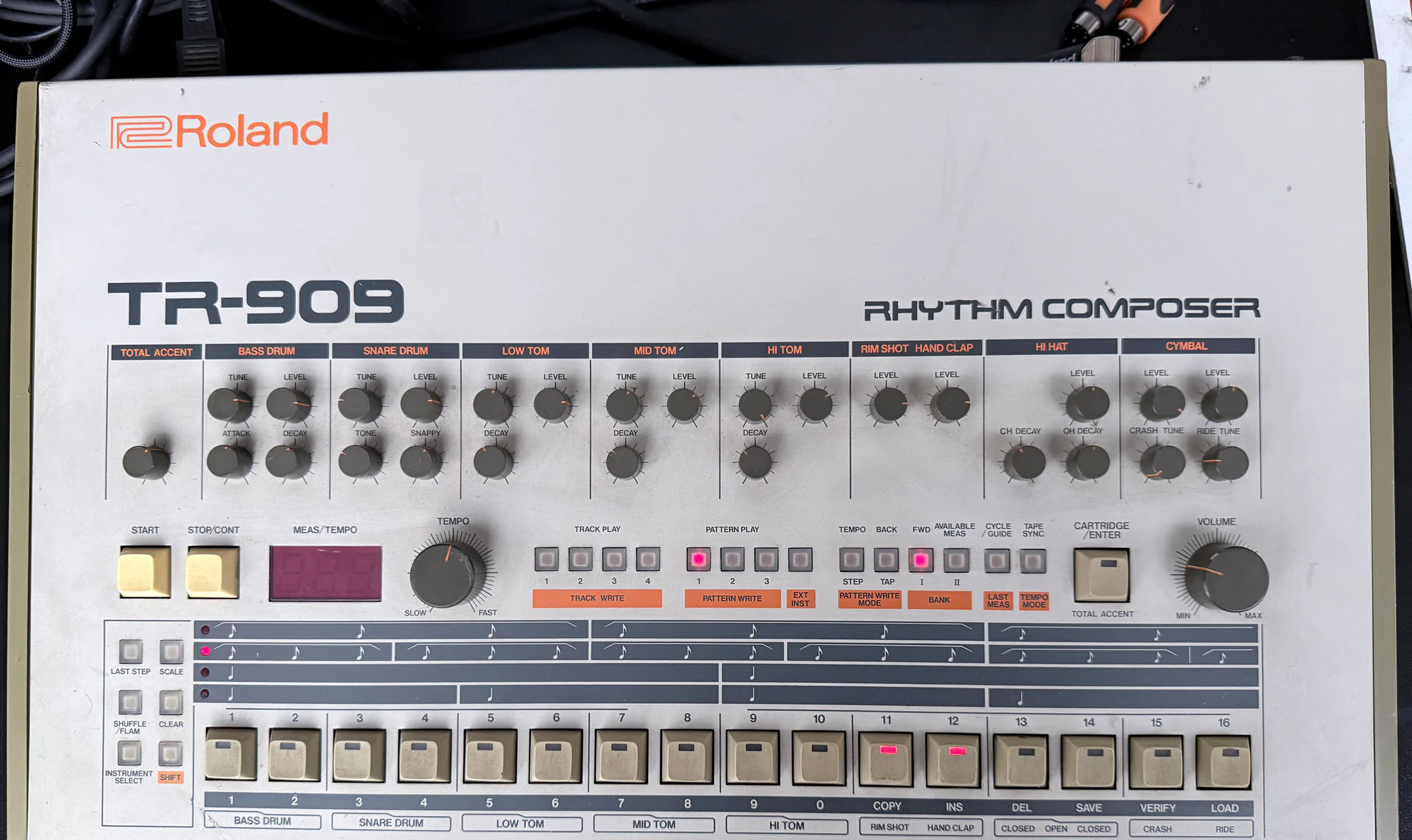
The complete three-quarter object shows the physical hierarchy of the TR-909: voice controls across the upper panel, pattern and track functions at the left, and sixteen step keys stretched along the player's edge.
THREE-QUARTER OBJECT VIEW // VOICES, MEMORY AND SIXTEEN STEPS
PAGE 01 // ORIGIN, 1982—1984
THREE ENGINEERS AND AN UNFINISHED CYMBAL
The TR-909 was not designed to invent house or techno. It was designed under pressure as the successor to the TR-808, while sampled drum machines were making “realism” a powerful sales argument and MIDI was beginning to reorganise the studio.
The machine came from a team. Tadao Kikumoto’s authorised account places the work inside a wider development programme and attributes the analogue drum development to Yoshiro Oe. Atsushi Hoshiai describes his own work on the microcomputer program, digital circuitry and metallic voices. Product planning, analogue design, digital circuitry and software were separate forms of authorship inside one instrument. [S01][S02]
“The success of this instrument has been made by all the artists.”— Atsushi Hoshiai
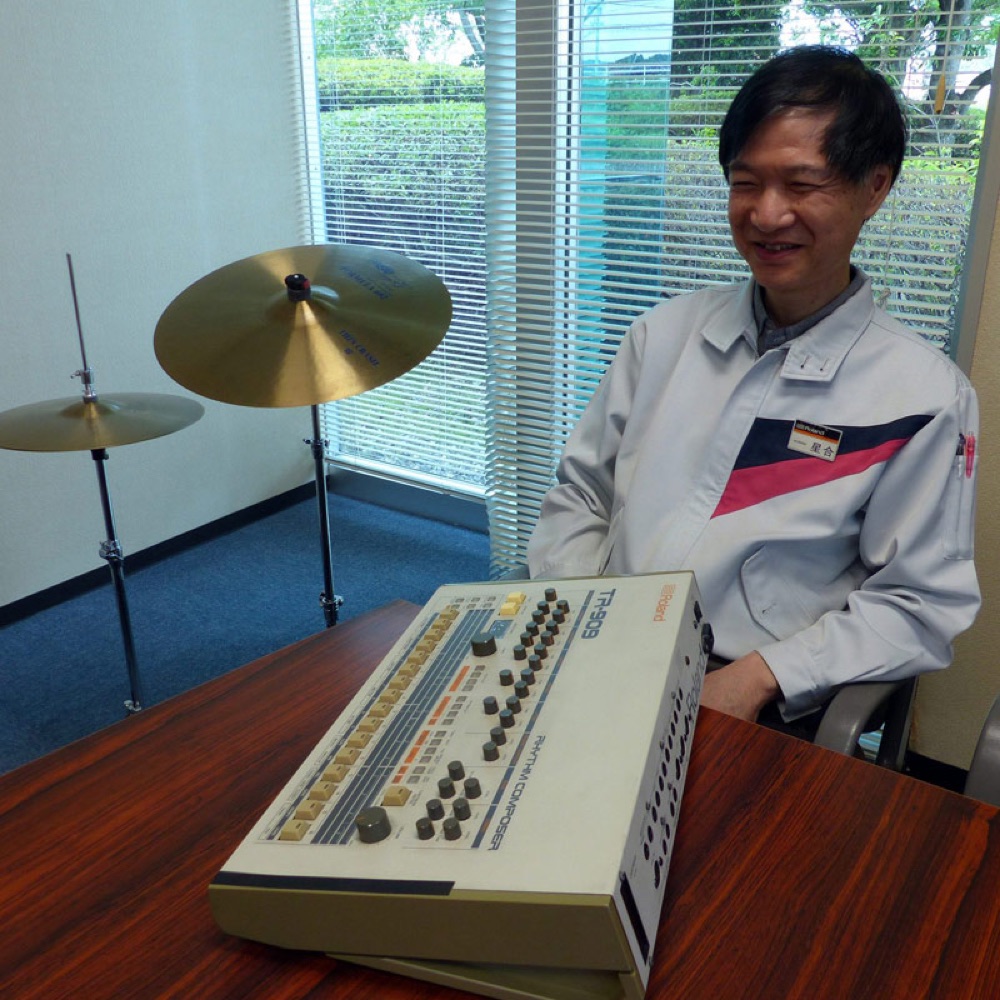
Atsushi Hoshiai with the TR-909 // Roland [S01]One Two Testing // April 1984 [S03]
OPEN THE FULL STORY // THREE ENGINEERS, ONE DIFFICULT CYMBAL
Hoshiai joined Roland in 1982 and received the 909 as his first development assignment. The names TR-880, TR-880D and TR-909D show the product identity changing while the engineering changed beneath it.
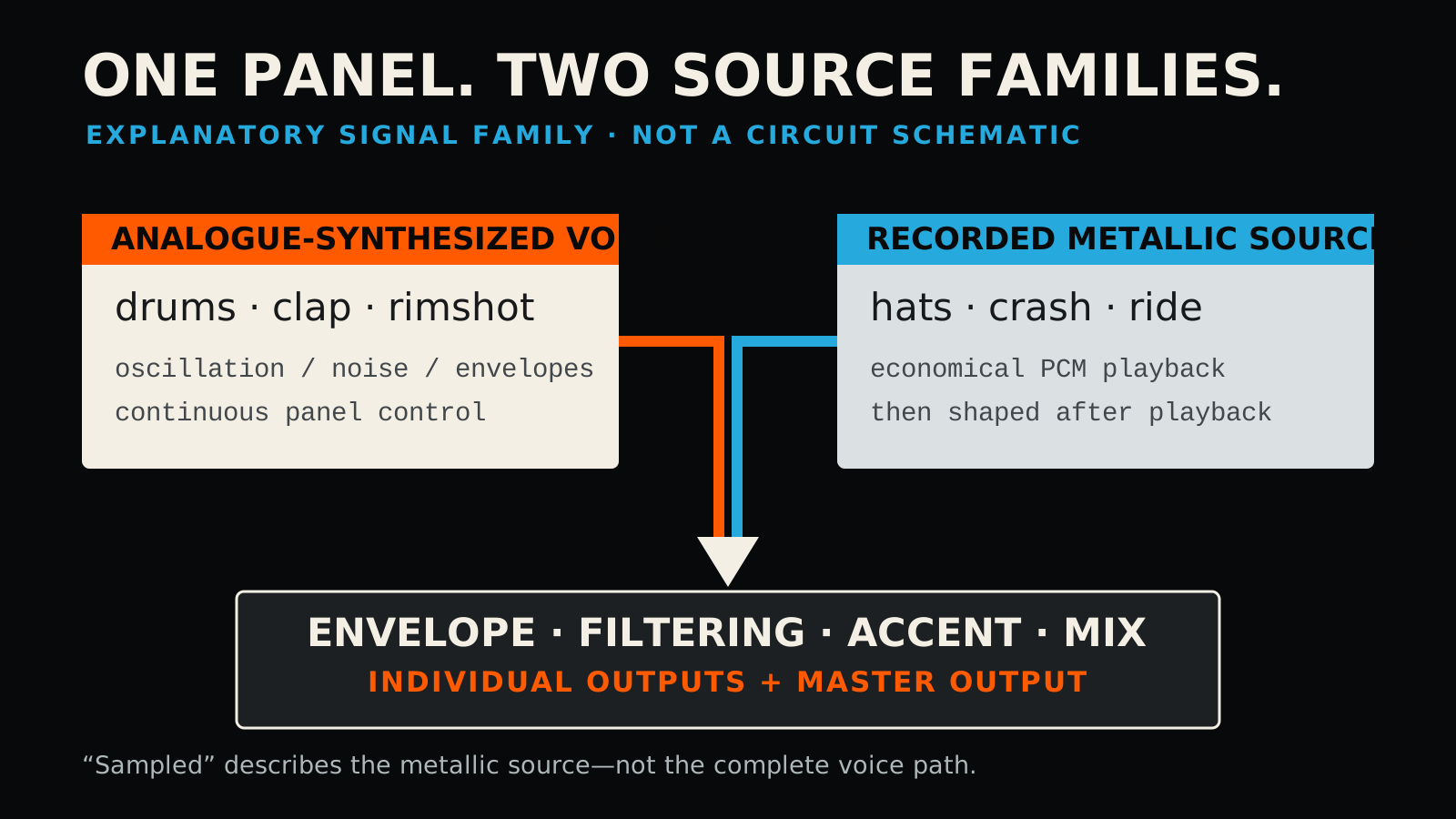
The first intention was an all-analogue drum synthesizer. The bass drum, snare and other analogue voices reached a musical result, but the cymbals did not. The team kept the adjustable analogue drums, recorded the metallic voices, and used electronic envelopes, filtering and accent to turn those recordings back into playable instruments.
Hoshiai supplied a mismatched 14-inch Paiste and Zildjian hi-hat pair and an 18-inch Paiste Thin Crash. At night he moved a Sony C-38 microphone around the Roland office until the room sounded right near another employee’s desk, then recorded to reel-to-reel.
After conversion to economical six-bit data, he edited the attack on a customised CP/M-80 computer. Watching another person strike the cymbal revealed a perceived delay; eye, hand and timing guided the edit. The hybrid compromise became the identity.
PERIOD DESK // 1984
BEFORE IT WAS A CLASSIC, IT HAD TO MAKE A CASE.
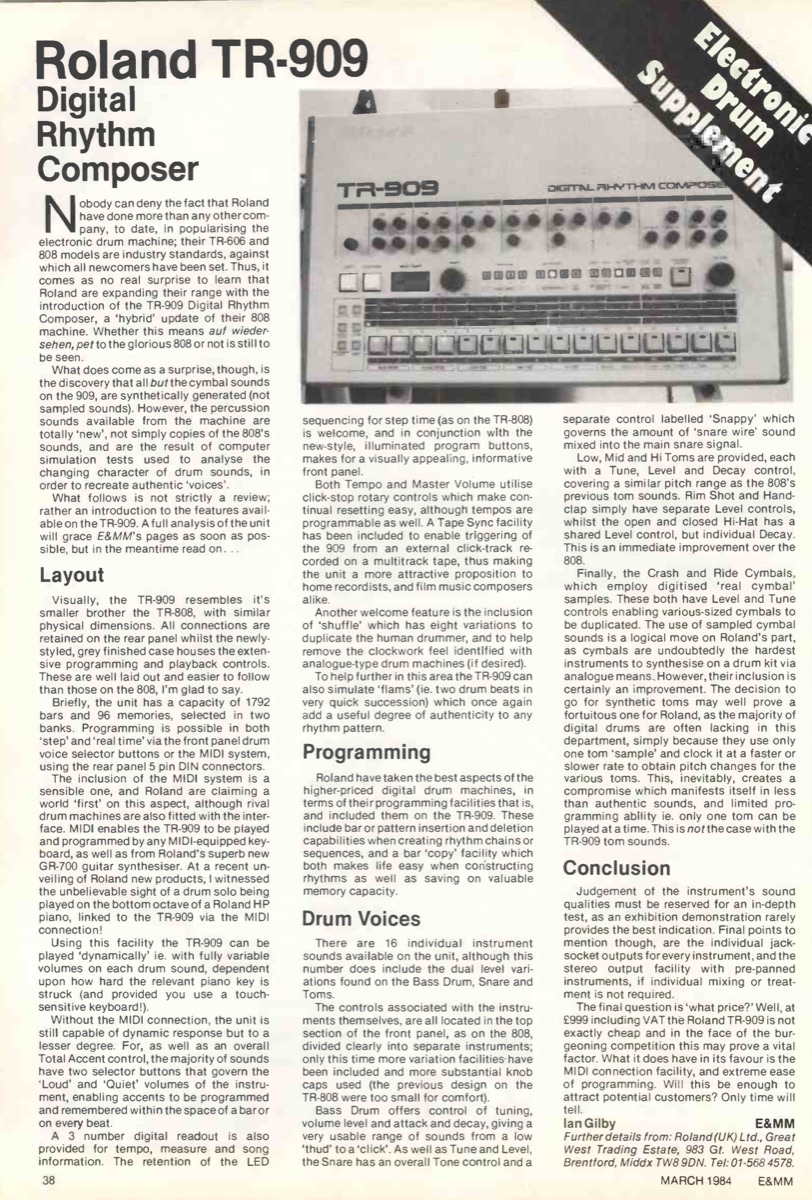
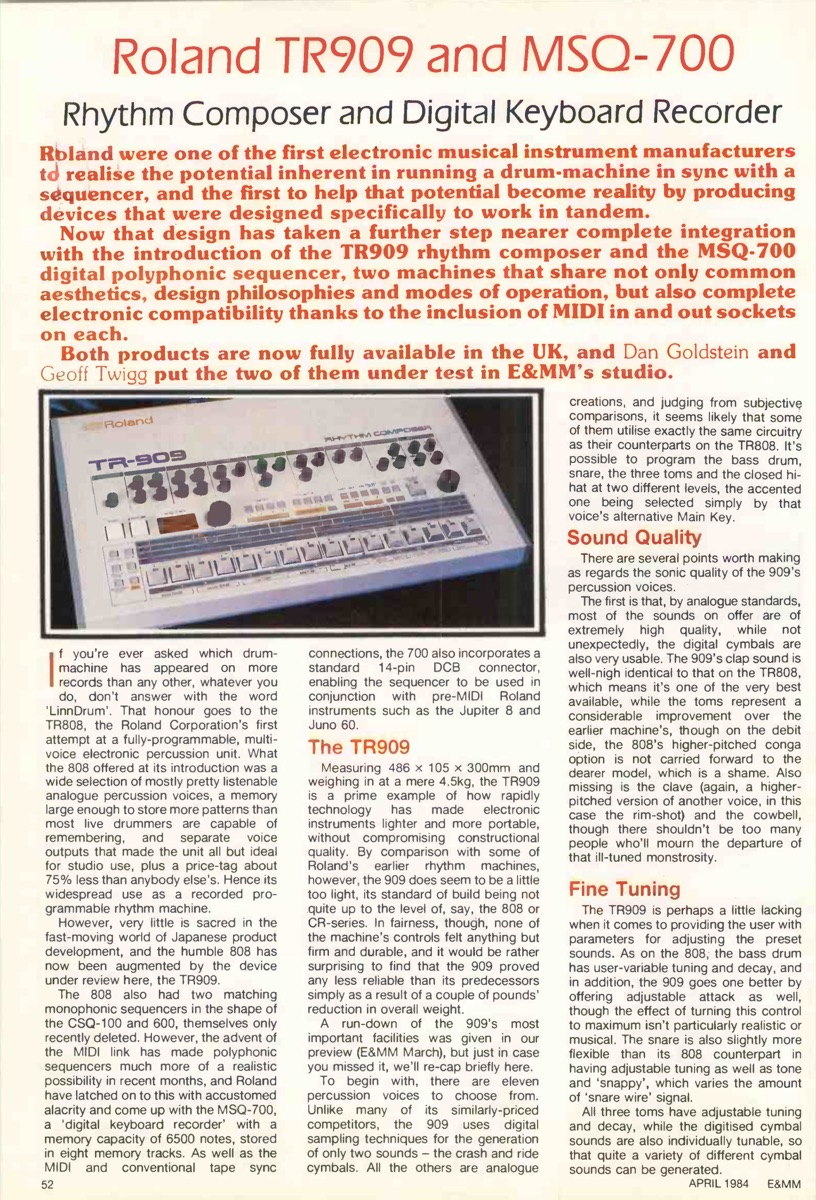
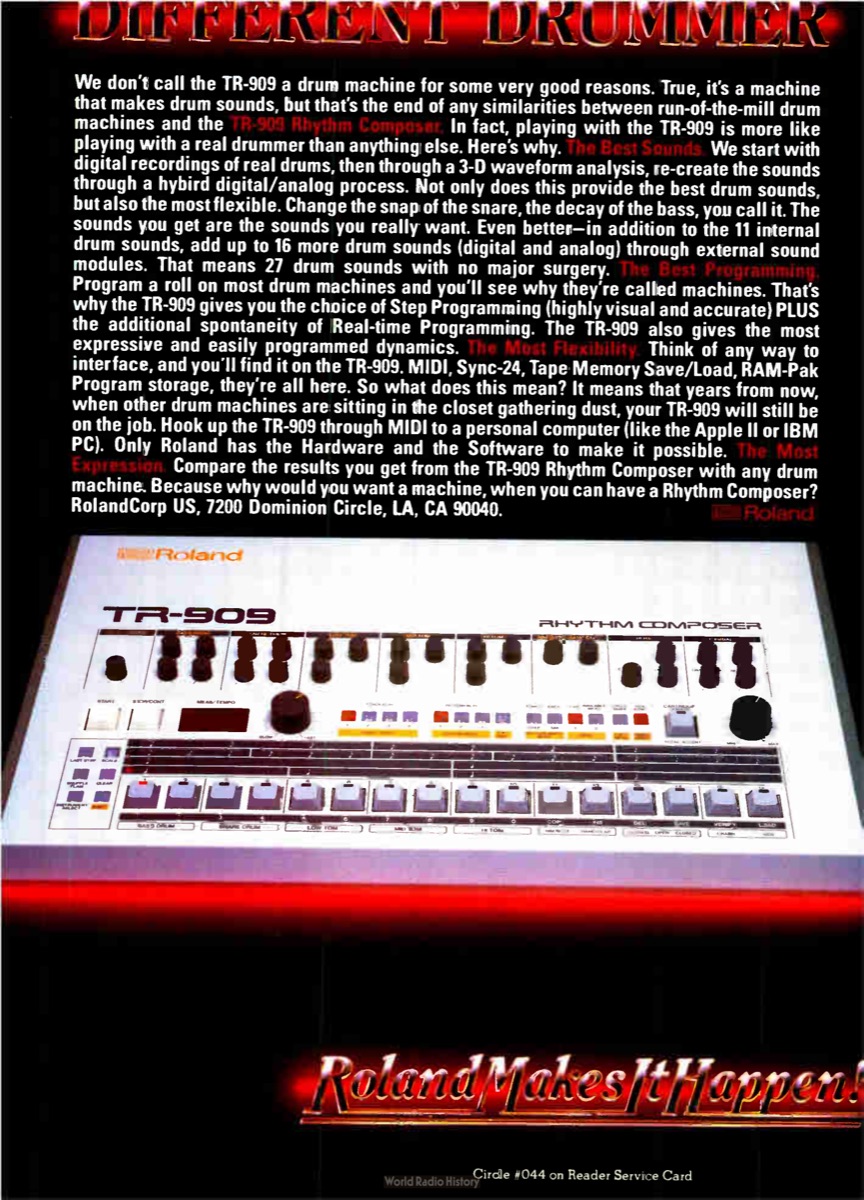
Preview, review and advertising reveal how Roland and the press explained the machine before hindsight took over.
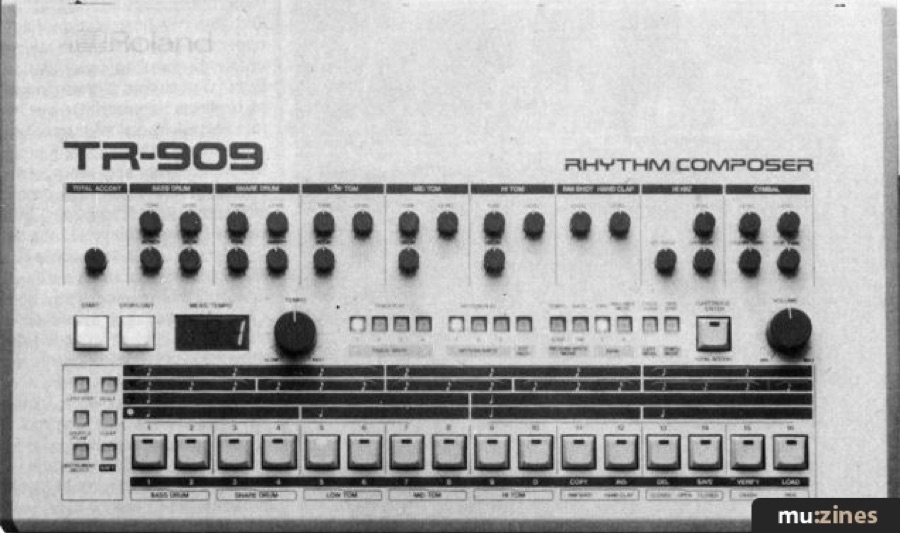
E&MM preview // March 1984 [S05]E&MM system test // April 1984 [S06]Roland “Different Drummer” ad // August 1984 [S07]
PAGE 02 // THE SURVIVING OBJECT
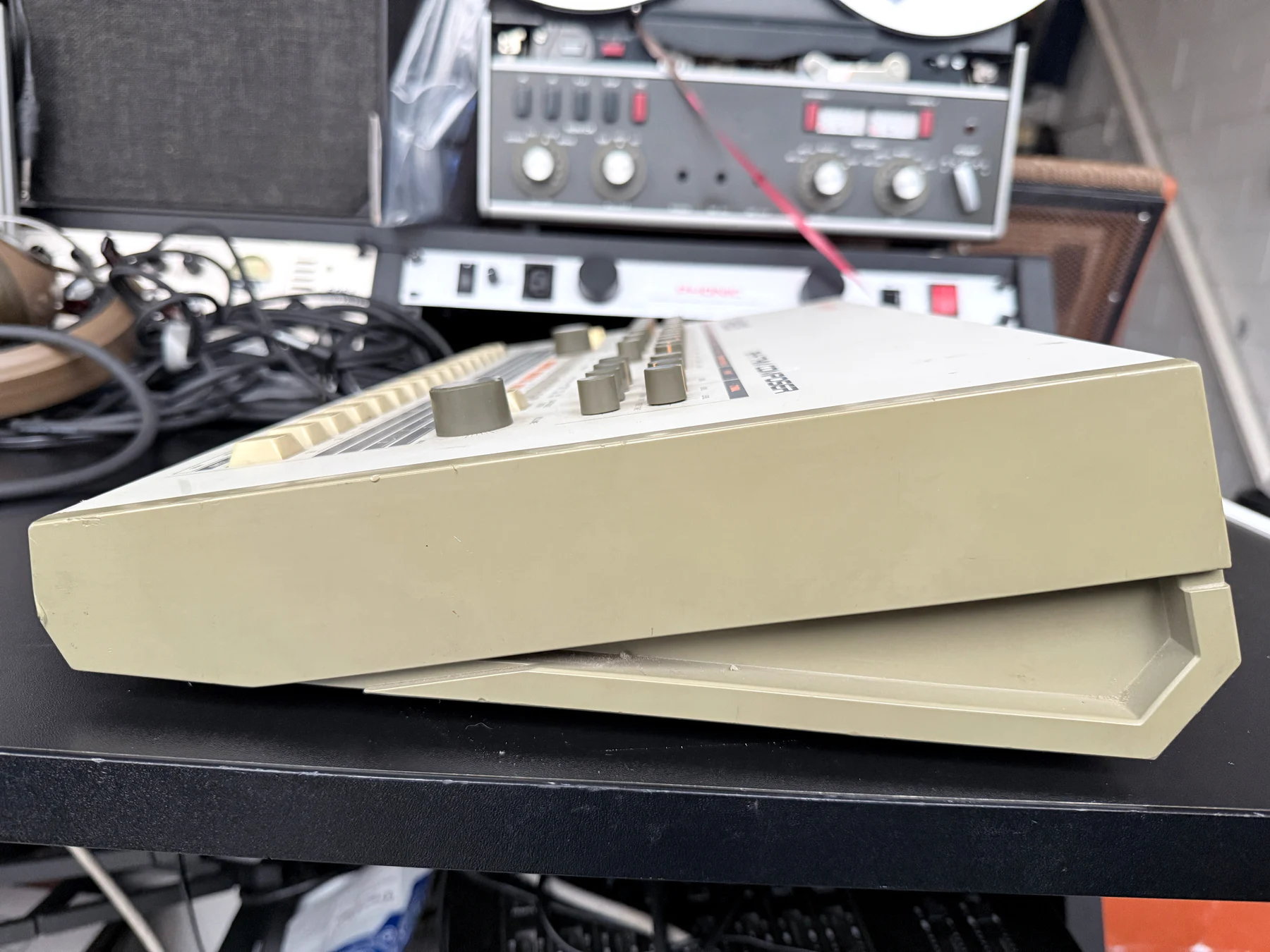
THE OBJECT KEEPS ITS OWN HISTORY
WORKING OBJECT // SIDE PROFILE AND CABINET DEPTH
The faceplate tells the shared design story; this particular TR-909 records years of individual use. Wear, repairs, memory, sockets and controls show how an instrument travelled through studios rather than simply how it left a factory.
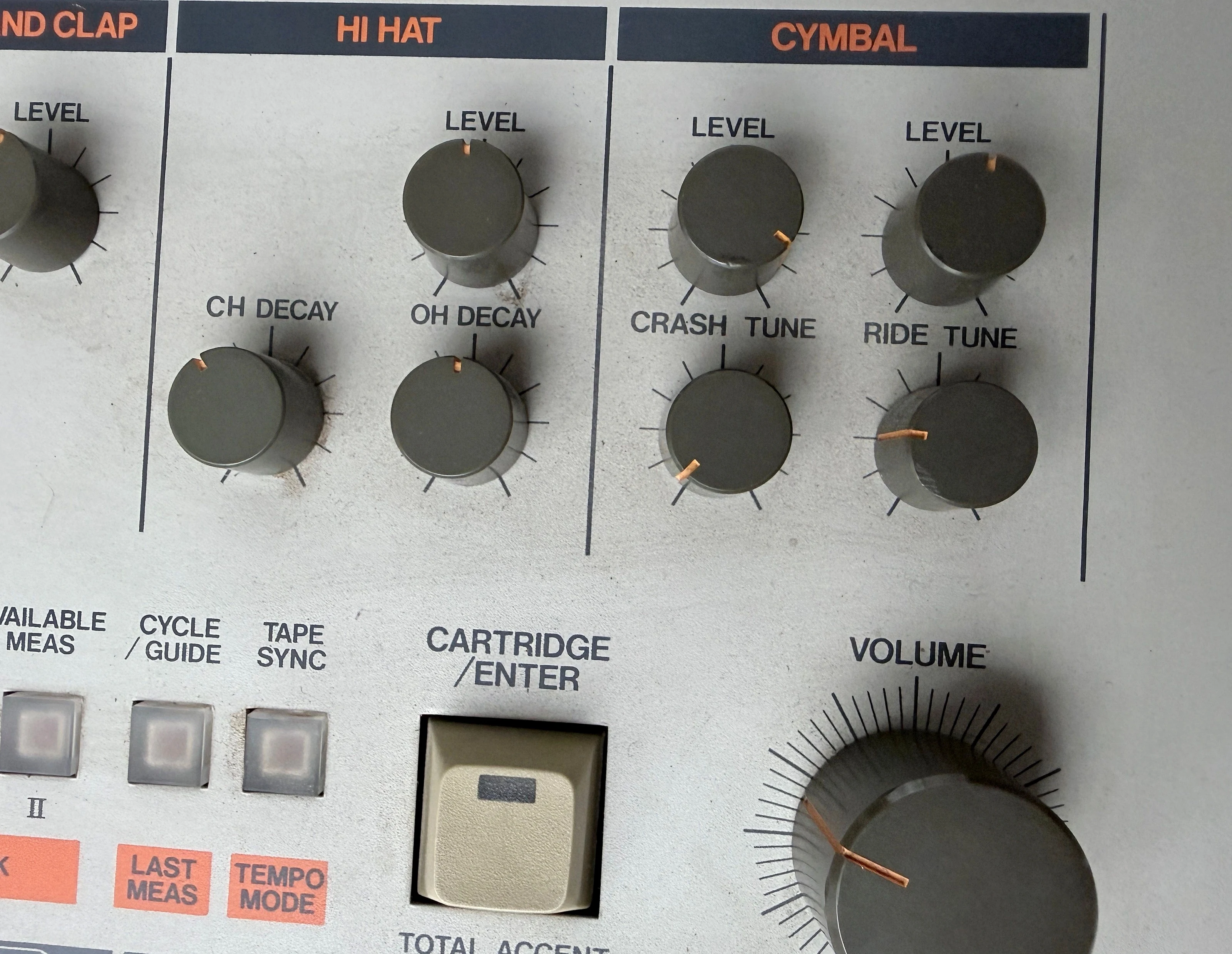
The close views below move from identity to operation: the serial plate locates the object, the cartridge slot extends its song memory, and the voice controls show the places a player repeatedly touched. Together they make a working machine legible without turning it into a museum specimen.
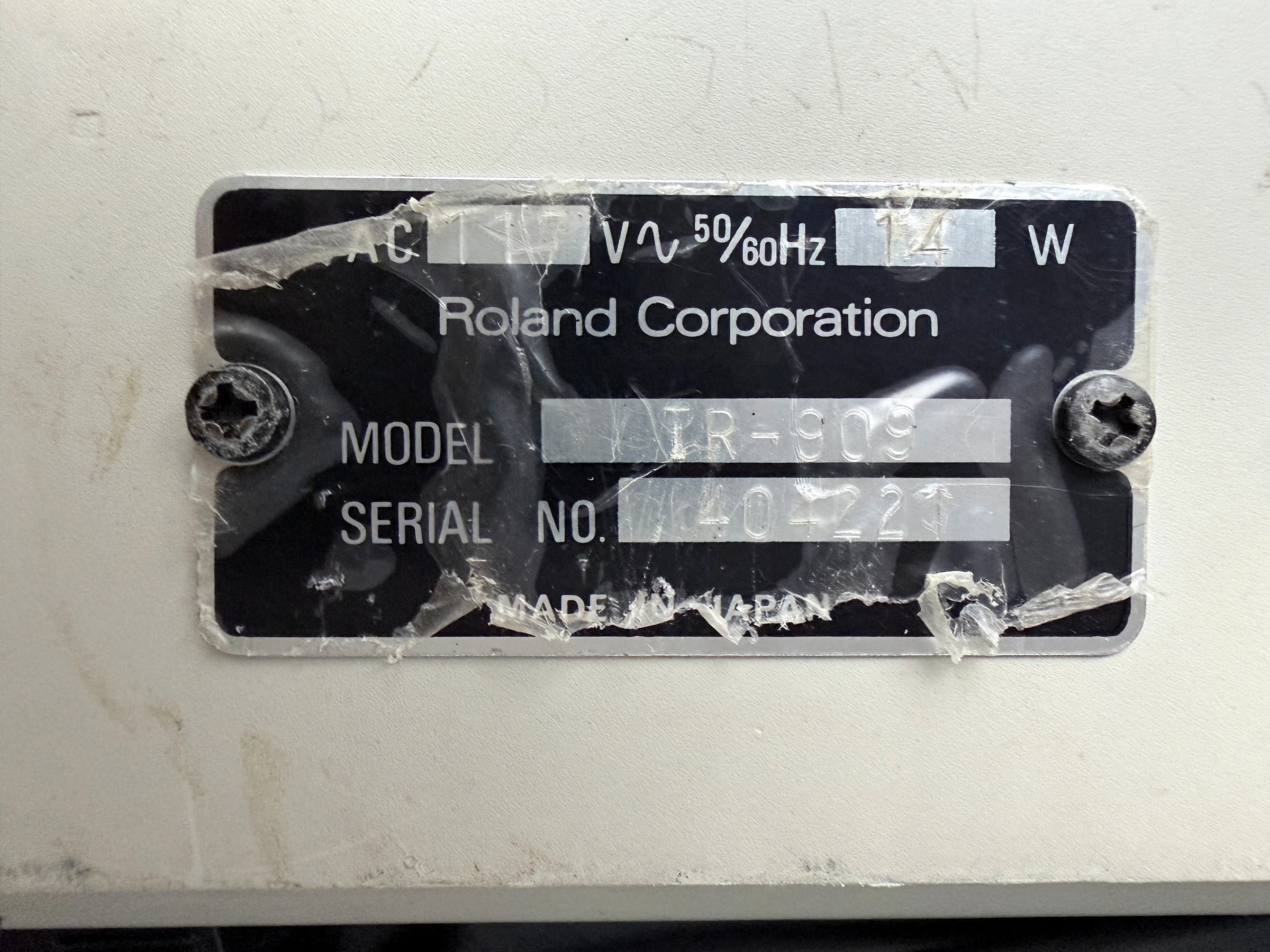
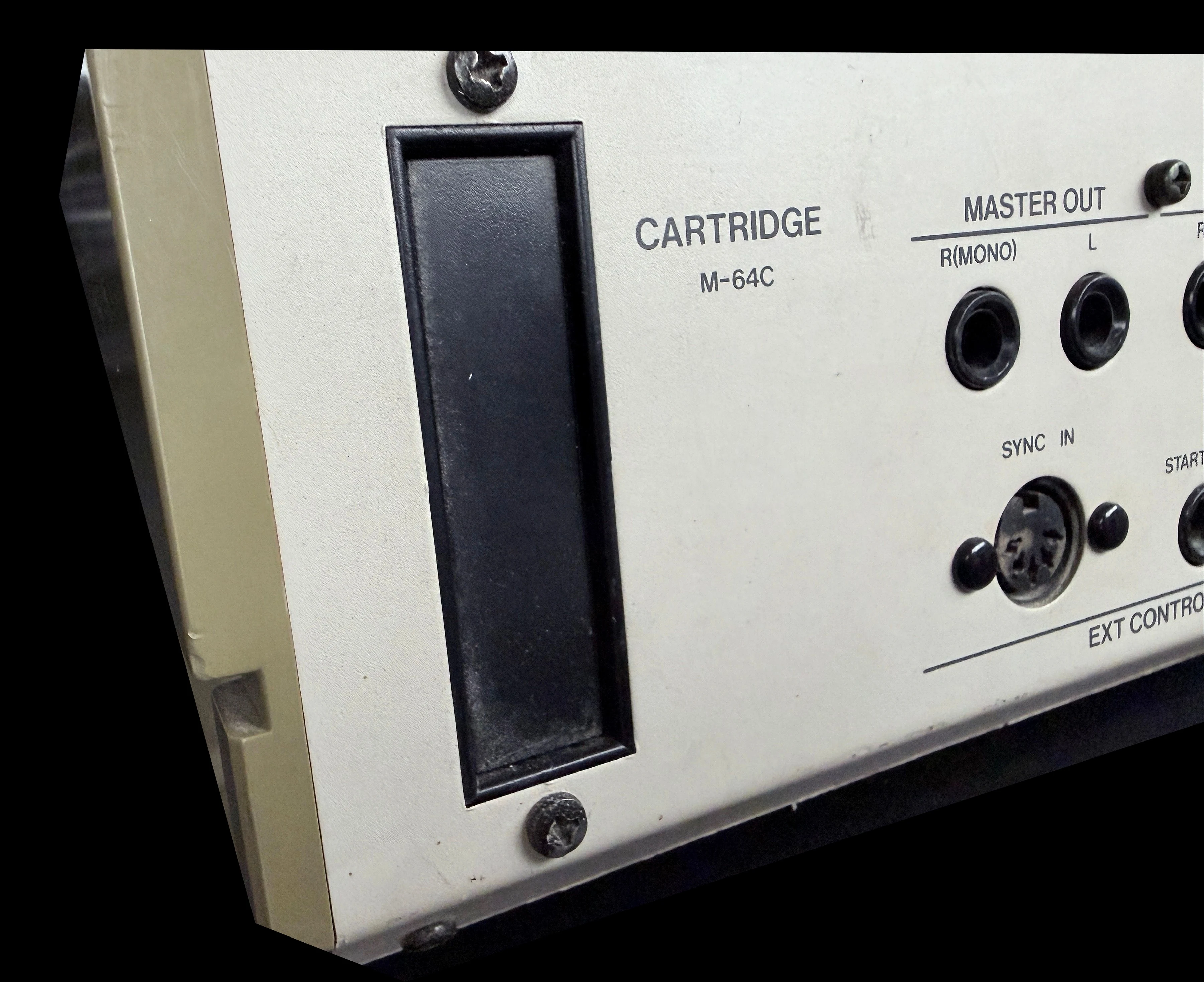
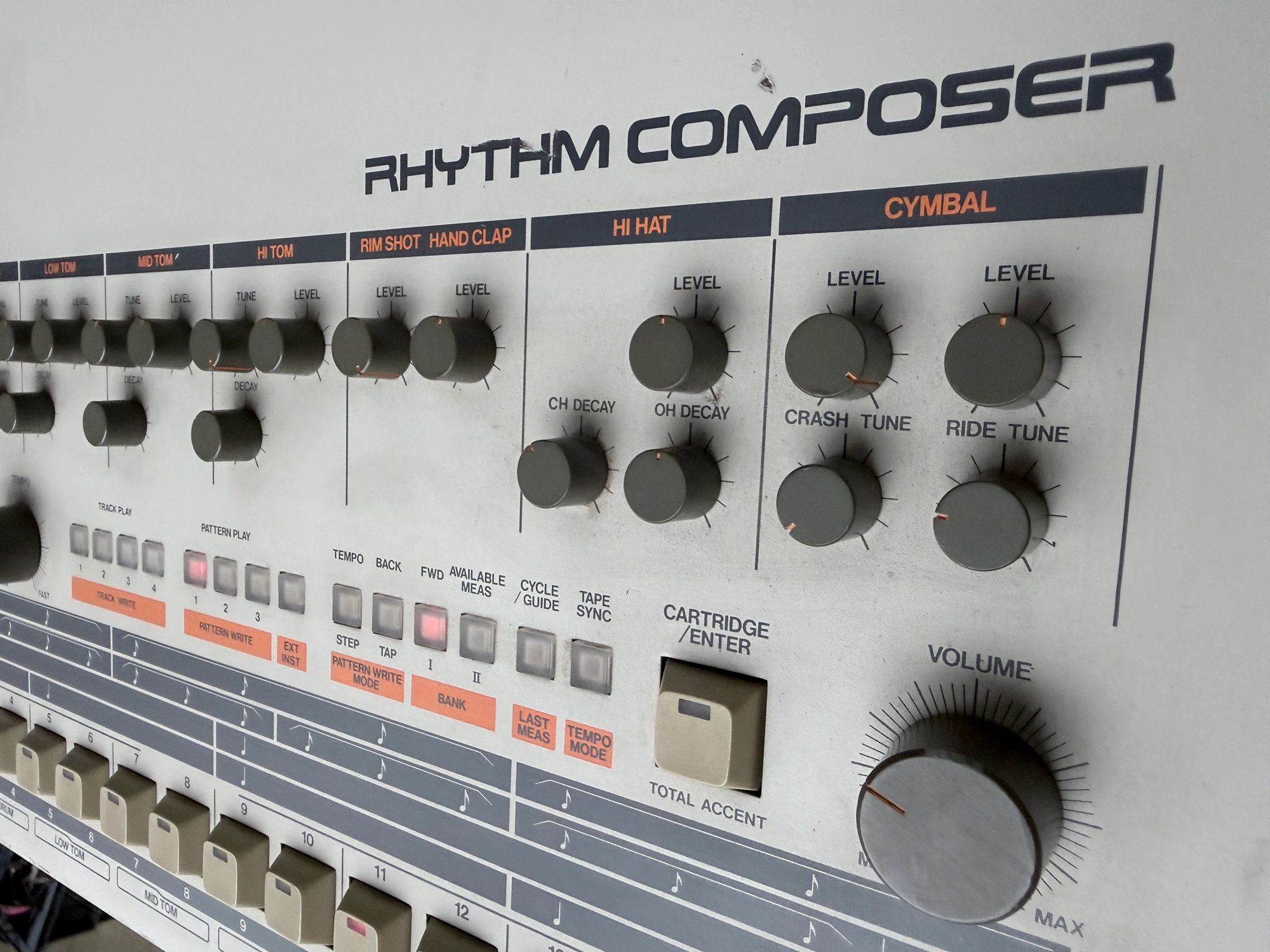
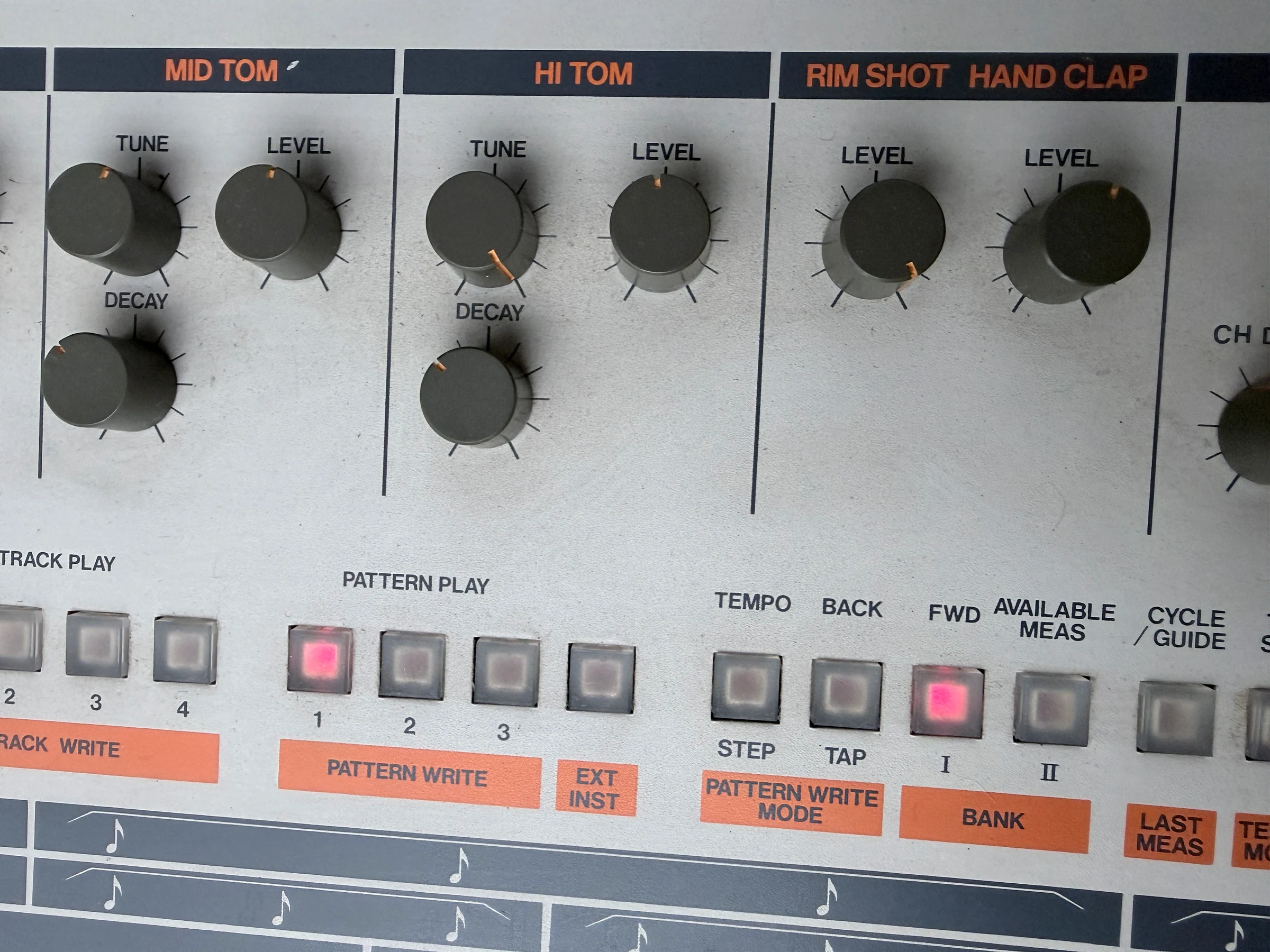
IDENTITY // MAINS AND SERIALMEMORY // M-64C CARTRIDGE SLOTCONDITION // CONTROLS AND WEAR
OPEN THE CLOSE LOOK // FOUR DETAILS THAT CHANGE HOW THE MACHINE IS READ
Identity plate: model, mains voltage and serial belong to the physical object. They help locate a machine within service information, but a serial alone is not a complete production history.
Memory: the M-64C slot reveals that a 909 could carry more than the patterns stored inside it. A cartridge could move complete track memory between working situations.
Voice panel: Tune, Decay, Attack, Tone and Snappy keep the drum kit open to performance. Repeated wear around them records use more directly than a pristine publicity photograph.
Individual outputs: each connected jack removes its voice from the stereo mix. The rear panel therefore changes the arrangement before a signal reaches a console or effect.
PAGE 03 // SOUND ARCHITECTURE
ANALOGUE BODY. RECORDED METAL.
ELEVEN SOUNDS, TWO ORIGINS, ONE PLAYABLE SYSTEM
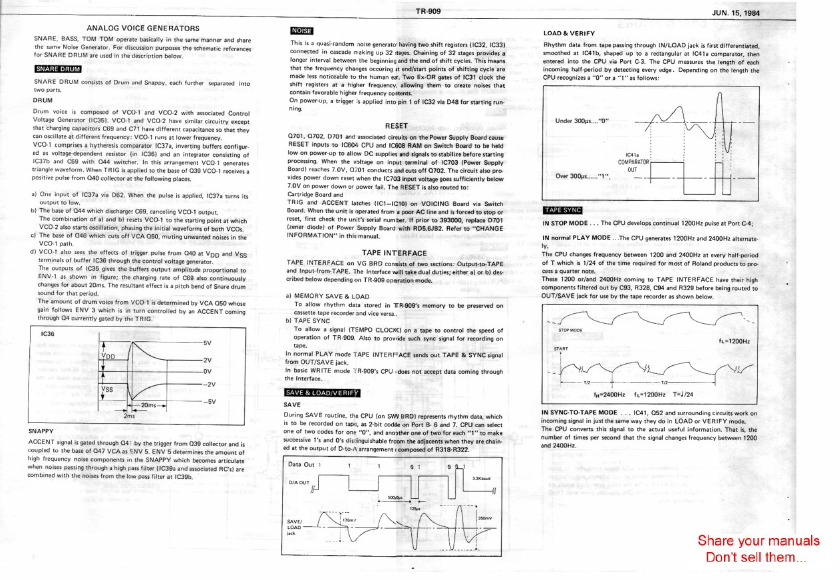
Seven analogue instrument channels make the bass drum, snare, three toms, rimshot and handclap. Four metallic sounds—closed hat, open hat, crash and ride—begin as short six-bit recordings. Every sound is then shaped by trigger, accent, level and output circuitry. “Sampled” describes the metallic source, not the whole audible path. [S01][S09]
HYBRID VOICE PATH // FROM TRIGGER TO OUTPUT
BASS DRUM // EXCITE, BEND, RING
A trigger launches a brief attack event and disturbs a tuned resonant network. The pitch begins above its resting point, falls rapidly and then rings down. Tune changes the resonant region; Decay changes how long energy remains; Attack adds a harder transient. Because these controls meet inside one changing envelope, the 909 kick can act as percussion, bass note or both.
SNARE + CLAP // BODY AND NOISE
The snare combines tuned resonant bodies with a filtered noise path. Tune moves the body; Tone changes its balance; Snappy raises the noise contribution. The handclap uses the noise source differently: several quick envelopes suggest the first cluster of hands, followed by a broader tail. A missing snare-noise layer therefore points to a different functional area than a missing snare body.
TOMS + RIM // TUNED ANALOGUE EVENTS
Low, mid and high toms are separate tunable resonant voices with Decay controls, not pitch-shifted samples. Their three ranges can become a second melodic sequence inside the rhythm. The rimshot is shorter and deliberately spare; its timing can outline subdivisions without filling the spectrum.
HATS + CYMBALS // DATA BECOMES AN INSTRUMENT
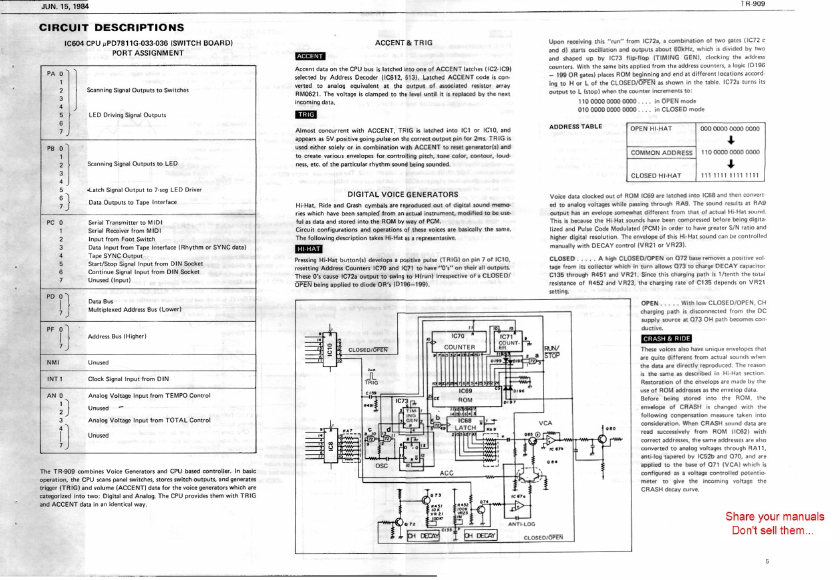
Digital memory supplies recorded metal, but playback rate, conversion, filtering, envelopes and switching determine the result. Closed and open hats share a family while their envelope and choke behaviour make different time functions. Crash and ride originate as different strikes on Hoshiai’s 18-inch cymbal, then become separately addressable voices.
ACCENT // MORE THAN A LOUDER SAMPLE
Instrument Accent marks selected hits; Total Accent stores a second pattern lane that changes the kit’s response at chosen steps. Analogue paths do not all react identically, so accent can change attack and apparent tone as well as level. Compare ordinary and accented hits one voice at a time before drawing conclusions.
MIX + OUTPUT // THE LAST CIRCUIT IS OUTSIDE
Voice levels feed the stereo master unless an individual-output plug opens that channel’s switching contact. From there a console, compressor, room, tape path or distortion stage can become part of the played instrument. Many famous 909 sounds are settings and routes, not a single immutable factory hit.
LISTENING BENCH // CONTROLS BEFORE COMPONENTS
HEAR ONE RELATIONSHIP AT A TIME.
A useful inspection begins with a short, repeatable pattern and one changing control. It lets a player understand the circuit by ear before a technician reaches for a meter.
Bass drum: write four equal hits, keep Decay fixed and sweep Tune. The opening bend and the settled ring move together; now return Tune to centre and lengthen Decay to hear the resonator continue after the attack.
Snare: alternate ordinary and accented hits. Turn Snappy down to expose the tuned body, then bring the noise layer back. Tone changes the balance; it does not simply pitch the whole drum.
Hi-hats: place an open hat before a closed hat. The closed event cuts the open envelope short. That choke is a designed time relationship, not a fault or missing polyphony.
Total Accent: put it on only one step and listen across several voices. The stored accent lane changes the kit at that moment, while each instrument responds according to its own circuit.
THE CYMBALS BEFORE THE MACHINE
AN OFFICE FLOOR AFTER EVERYONE WENT HOME
Hoshiai brought his own drummer’s objects to work, found the useful room position at night, recorded to reel-to-reel and edited the perceived delay from the attacks. The instrument’s most apparently digital voices therefore retain a cymbal pair, a microphone, an office and a listening decision. [S01][S02]
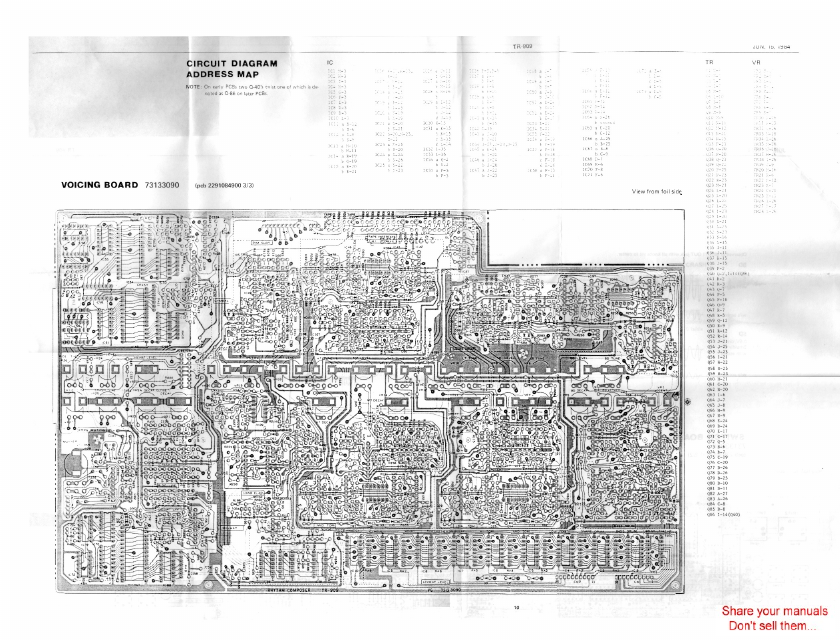
FACTORY SERVICE NOTES // ANALOGUE VOICES [S09]FACTORY SERVICE NOTES // DIGITAL VOICES [S09]
PAGE 04 // PATTERN MEMORY
THE SIXTEEN-STEP GRID BECOMES A PLAYABLE SURFACE
01
Write
Step entry makes positions visible; tap entry captures a played rhythm into the same memory.
02
Read time
Four scale readings and Last Step decide what sixteen keys mean and where the cycle turns.
03
Move weight
Instrument Accent, Total Accent, Shuffle and Flam make repetition breathe without adding a new voice.
04
Build form
Ninety-six pattern locations and eight tracks turn short loops into arrangements with up to 896 measures available in each bank.
PLAY THE NATIVE INSTRUMENT // FROM EMPTY BAR TO COMPLETE TRACK
Start with the address. Choose bank, pattern group and location. Set Scale and Last Step before writing; otherwise the same lamps may represent a different metre from the one you intend.
Write a foundation. Enter bass drum, snare and closed hat first. Use the voice selector and the sixteen main keys, then compare Step and Tap Write as different physical routes to the same pattern memory.
Give repetition shape. Add Total Accent as its own lane, then apply individual accents. Shuffle changes the bounce of the selected scale. Flam gives the bass drum, snare or any of the three toms a second strike; it is not available on every voice. Its eight interval choices stay fixed as tempo changes, so the same double strike occupies more or less of the beat. Writing it replaces the ordinary event at that position rather than adding an effect above it. Both tools become clearest in a sparse pattern. [S08]
Move from loop to form. Chain patterns by function—foundation, lift, break, transition, ending—then write the chain into one of eight tracks. Front-panel tune, decay and levels remain performable after the memory has done its work.
These four browser-generated voices separate analogue-body roles from metallic subdivision on a sixteen-step 909 teaching surface.
Practice patterns built to demonstrate the machine’s controls; they are not transcriptions of released recordings.
Quarter-note bass drum, backbeat and offbeat hats establish the clear division of labour behind a club pattern.
EDITING: Bass drum
AUDIO STARTS AFTER YOUR FIRST PRESS
96patterns
48 locations in each of two banks: three groups of sixteen.
8tracks
Each of the two banks has four tracks sharing 896 measures; the capacity is per bank.
M-64Ccartridge
External track memory can be played directly. The factory documentation identifies the M-64C for this role.
PAGE 05 // CLOCK, CONTROL AND AUDIO
THE DRUM MACHINE JOINS THE NETWORK
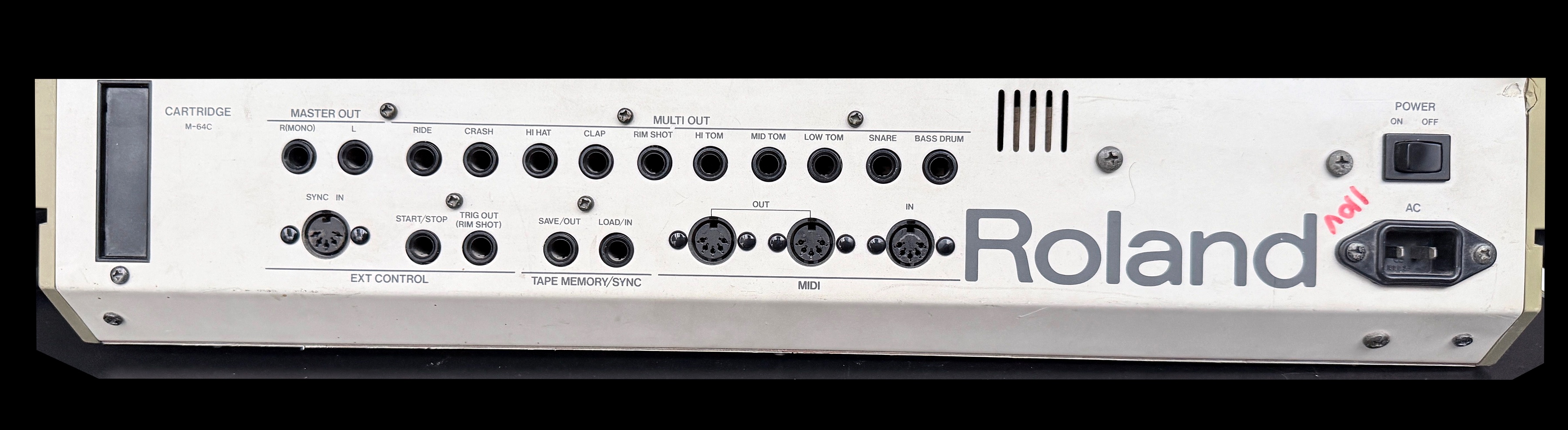
REAR PANEL // ARRANGEMENT BY CABLE
TEN INDIVIDUAL OUTPUTS
Ten individual outputs let the room around each voice change independently. Insert a cable and that voice leaves the stereo mix. MIDI In/Out, DIN Sync, tape save/load, tape sync, Start/Stop footswitch and the rimshot Trigger Out solve different jobs; a stable system chooses one timing master and documents who supplies clock, transport and position. [S08] The photographed rear panel shows all ten sockets, including High Tom, which is omitted from both the owner manual’s printed specification list (page 39) and Roland’s later web list. [S10]
MIDINote and timing communication with other instruments; early firmware makes transport/version context important.
DIN SYNCClock plus run/stop for compatible pre-MIDI Roland systems; connector shape alone does not guarantee compatibility.
TAPEMemory save/load and sync functions use audio-like signals for data or timing; label files and verify a restore before relying on them.
TRIGGER OUTThe rimshot lane produces an approximately +14 V, 20 ms pulse for external equipment; it is control voltage, not audio.
INDIVIDUAL OUTSBass, snare, three toms, rim, clap, hats, crash and ride can each leave separately; the hat pair shares one output.
OPEN THE FIRMWARE NOTE // CLOCK IS NOT THE SAME AS TRANSPORT
Factory service information separates at least two behaviours: the Version 2 STOP/CONTINUE problem and the Version 4 first-clock-after-Start correction. Treat them as different symptoms rather than one generic “bad MIDI” story.
A device can receive tempo pulses yet fail to start, start from the wrong position, or resume differently. When diagnosing a network, write down the master, connection type, transport command and receiving program version before changing equipment.
The original workflow could remain manual. Juan Atkins describes starting and aligning the 909 while a Sequential Circuits DrumTraks supplied MIDI on “No UFOs.” The concentration required by the connection became part of the performance. [S11]
The TR-909 was already a complete instrument. The records reveal what different players asked it to do: exploit the timing differences between machines, lock two early MIDI instruments together, split a kit across a console, withstand extreme processing, or hold an arrangement under moving hands.
These are not nine claims that the artists somehow finished Roland’s design. They are nine practical answers to the same question: what can this machine become inside a particular room, system and performance?
TOKYO // 1984
Hiroshi Sato — Sweet Inspiration
Hiroshi Sato used a physical TR-909 beside a Sequential Circuits DrumTraks, with an MC-4 supplying the timing reference. On “Sweet Inspiration” he treated the two machines almost as a doubled drum part: the 909 arrived tightly against the reference while the DrumTraks followed with its own small, stable delay.
Instead of correcting that difference away, Sato used it to shape attack, width and motion. Sato’s own account preserves the method in detail and places this connected pair at the beginning of the 909’s record life: a Japanese musician was already composing with the timing personality of a system. [S26]
DETROIT // 1985
Model 500 — No UFOs
A Sequential Circuits DrumTraks sent MIDI to Juan Atkins’s TR-909, but the cable did not turn the pair into a seamless modern timeline. Atkins still had to call up the correct pattern, start the Roland by hand and bring it into alignment with the master machine.
The performance therefore began before any filter or fader move: he listened, watched the bar position and released one sequencer into another. “No UFOs” shows why the 909’s early MIDI mattered. It could join a larger studio while keeping its own pattern memory and voice architecture, so the producer had to conduct the agreement between two independent boxes.
Dave Ogilvie describes a real 909 sent through separate outputs, crossovers, rooms and a console driven beyond polite use. The harshness belongs to routing and processing as much as to the source voices.
Kurtis Mantronik identifies “Johnny the Fox” as “909 all the way.” The phrase places the Rhythm Composer at the centre of the record, but the more revealing story is how Mantronik understood the box: as both a drum instrument and a source of MIDI instructions.
He had discovered that the 909’s keys could program notes for equipment beyond its own kit, including a TB-303 passage. That makes the sequence a form of arrangement. Internal drums, recruited sounds and the rapper’s phrasing answer to the same terse grid, leaving the low end and backbeat enough space to strike with authority.
Kevin Saunderson separates the roles clearly: the TR-909 supplies the beat, while a TR-707 adds percussion. That division leaves room for Paris Grey’s melody and phrasing instead of asking one machine to fill the entire arrangement.
Listen to the firm floor underneath the vocal and then to the lighter percussion moving around it. The record’s authority comes from allocation: two rhythm machines, a singer and the rest of the production each keep a distinct job. [S23]
LONDON / SPAIN // 1997
Björk — Hunter
Björk remembers giving Mark Bell Ravel’s Bolero as a rhythmic reference. Bell answered by programming the “Hunter” 909 beat in one take—a restless mechanical counter-current beneath the slowly moving strings.
The story preserves both sides of the collaboration: Björk supplied the direction and chose the relationship she wanted; Bell translated it into a performed machine part. It is a precise track-level 909 account, not a claim that every drum on Homogenic came from the same box. [S24]
FRANKFURT // 1995
Pilldriver — Pitch-Hiker
“Pitch-Hiker” begins with only the kick from Marc Acardipane’s TR-909. He drove it through a microphone preamp and console gain, two EQ stages, compression, gating, delay and reverb, then moved gains, EQ and effects returns as the track ran. The machine supplied one strike; the studio turned that strike into rhythm, pitch, distortion and scale.
Acardipane recorded the performance directly to DAT in a first take, without later edits, and recalls that the piece came together in roughly fifteen to twenty minutes. Years later he sampled twelve different kicks from the finished record onto an MPC-3000 for live performance. The path had reversed: an original 909 became a record, and the record became a new playable instrument.
Rick Smith says Underworld bought its TR-909 in 1984 and kept using it. When the group returned to live performance in 1992 it was the first drum machine connected, and the first three albums of the new Underworld were built around it.
On “Born Slippy .NUXX,” the familiar impact is not a dry factory preset. Smith identifies a 909 driven hard through a console and processed until the machine, gain structure and room become one sound. Long ownership matters because it preserves a working method as well as a chassis. [S25]
LIVE // CONTINUING
Jeff Mills — Exhibitionist 2
Pattern changes, mutes, tune, decay, level and accent turn a compact memory into a physical performance. The audience sees decisions occurring on the same surface that wrote the rhythm.
Mark Bell programmed the restless 909 beat in one take after Björk described the rhythmic movement she wanted. The machine works against the long orchestral line instead of simply supporting it.
The official remastered film provides an immediate route into Marc Acardipane’s one-kick construction. Listen for the gaps around each transformed impact: silence is part of the weight.
The finished pulse is an original 909 driven hard through the studio rather than a pristine factory sound. Listen for the machine as a continuously pressured part of the mix.
Listen for different jobs: original hardware inside mixed studios, one voice under extreme processing, early MIDI, and a panel used as a live instrument.
01
Hiroshi Sato
Sweet Inspiration
An original 909 and DrumTraks share the arrangement.
FIND OUT WHICH PART OF THE 909 IS ACTUALLY FAILING.
A missing sound, broken pattern or stubborn clock does not point to the same circuit. The useful first distinction is functional: does the fault follow one voice, the master mix, pattern memory, transport, sync or the equipment connected around the machine?
VOICE MISSING FROM MASTER
Remove the individual-output cable first. Its switching jack is designed to take the voice out of the stereo mix.
PATTERN FEELS WRONG
Check Scale, Last Step, pattern address and chain before blaming the clock or rewriting memory.
CLOCK BUT NO START
Separate clock from transport. Record the master, cable standard, start/continue behaviour and program version.
SNARE BODY, NO SNAPPY
The tuned body and noise contribution are different paths. A partial snare narrows the search.
HATS BEHAVE STRANGELY
Check the shared source family, envelope switching and choke relationship before treating them as two unrelated voices.
MEMORY DISAPPEARS
Stop writing. Document the loss, battery/retention history and current contents before any destructive test.
OPEN THE DIAGNOSTIC ROUTE // FOUR USEFUL DIVISIONS
1. Voice or mix. If a sound leaves its individual output but not the stereo mix, the voice generator is working and the fault lies later in the route. If it is absent from both, follow that voice from trigger to generator and output amplifier.
2. Pattern or trigger. A correctly stored step should create a trigger before it can create a drum sound. Comparing one failing voice with a working neighbour separates sequencer logic from the analogue or sample-derived circuit that follows.
3. Clock or transport. Tempo pulses, Start, Stop and Continue are different events. A machine can receive clock while failing to enter the expected pattern position, particularly when early MIDI program revisions are involved.
4. Memory or performance state. Scale, Last Step, pattern chain and accent can change what the bar sounds like without a component failure. Preserve any wanted patterns before battery or clear/load work; powered component-level diagnosis belongs with a qualified technician and the factory Service Notes.
FACTORY DOCUMENT REGISTER
REVISION, CALIBRATION AND EVIDENCE ARE DIFFERENT QUESTIONS.
PROGRAM REVISIONS
Version 2 addresses STOP/CONTINUE behaviour. Version 4 addresses the first clock after Start. A machine can therefore receive tempo yet mishandle transport; identify the installed program before merging the symptoms.
VOICE CALIBRATION
The Service Notes specify test points, controls, instruments and conditions for adjustments. Those conditions are part of the value. Do not turn an internal trimmer merely to make one survivor match a sample, spectrum plot or another machine.
SERIAL GUIDANCE
Factory bulletins may use serial ranges to identify service applicability. A serial is useful evidence for a particular change, but it does not by itself reconstruct the full production chronology or every earlier repair.
BEFORE / AFTER CAPTURE
Record ordinary and accented hits from the master and individual outputs separately, with identical level and control settings. The insert jack changes routing, so master and individual captures answer different questions.
1998
ReBirth RB-338 v2
Version 2 adds a software 909 to ReBirth’s existing 303 and 808 instruments. [S27]
2014
TR-8
Roland’s ACB modelling brings 909 behaviour into a contemporary performance machine.
2016
TR-09
A compact Boutique instrument retains the original front-panel logic while adding modern connection. [S13]
2018—
TR-8S + Roland Cloud
Circuit modelling and software keep the 909 as an adjustable system rather than only a folder of one-shots. [S14]
THE BIG BEAT POSITION
THERE IS NO SINGLE FINAL 909 SOUND.
Two working machines can differ because components age, repairs change values and players develop their own tuning, accent and routing habits. A sample preserves one strike. The instrument keeps pitch, decay, dynamics, pattern and processing available for the next decision.
SOURCE DESK // MANUALS, PERIOD PRESS, INTERVIEWS AND FILMS
Analogue drums and recorded cymbals share one kit while MIDI, shuffle, flam and extensive outputs place the Rhythm Composer at the centre of a connected studio.