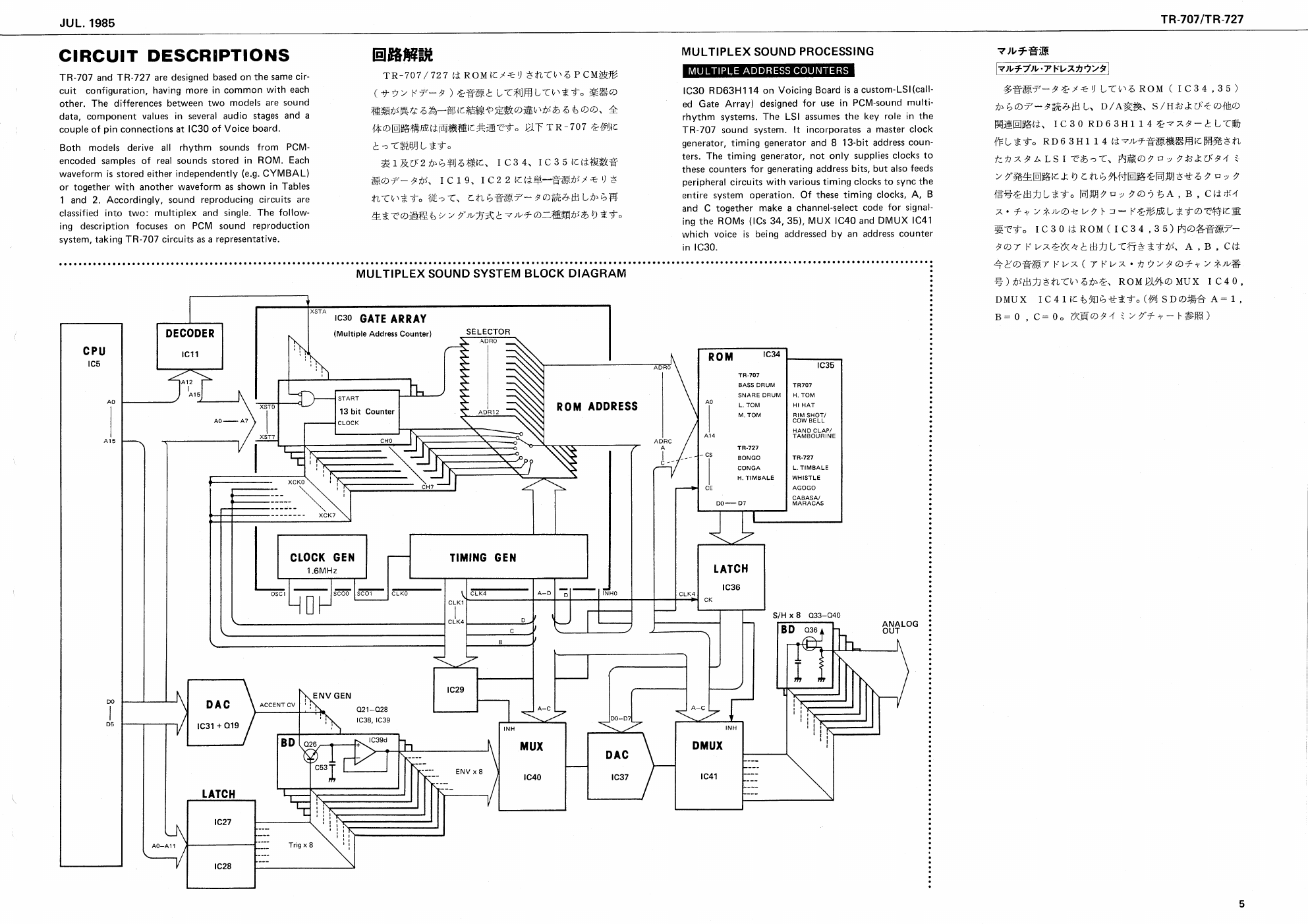
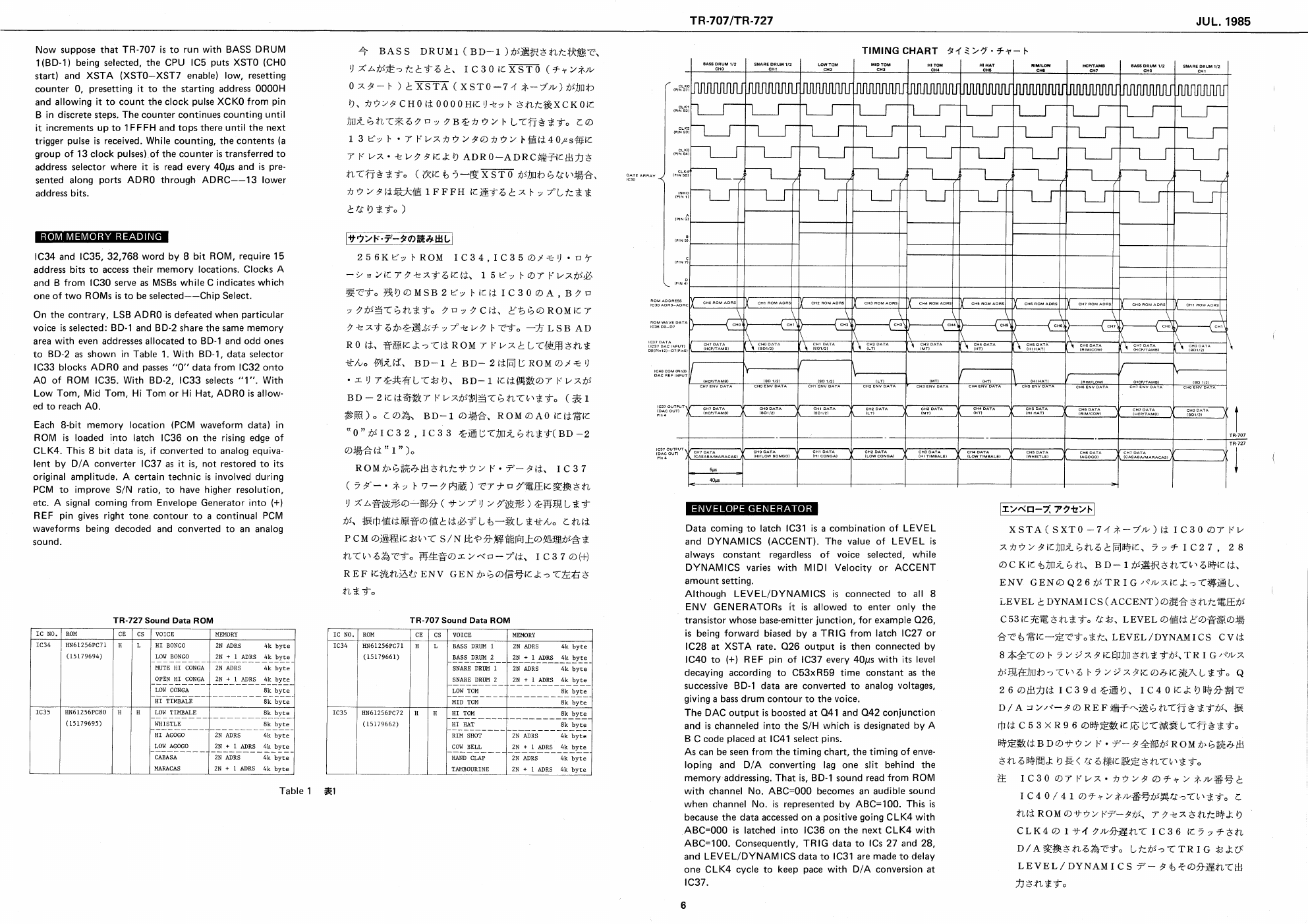
1. The clock and address engine. IC30 is Roland's RD63H114 custom gate array. Its master clock, timing generator and eight 13-bit counters let eight shared channels read separate places in the sound ROMs. A selected channel begins at address 0000H; its counter advances every 40 microseconds until it reaches the sample's final address or the voice is triggered again. That 40-microsecond interval is a 25 kHz playback rate.
2. Two ROMs, several sounds. IC34 and IC35 are each 32,768-word by 8-bit ROMs. IC30 supplies thirteen address lines, while two further selection bits choose the ROM and the portion being read. The samples do not all occupy equal space: bass and snare alternatives use interleaved 4 KB areas, toms and several shorter voices use 8 KB, and the service table assigns the remaining groups around them.
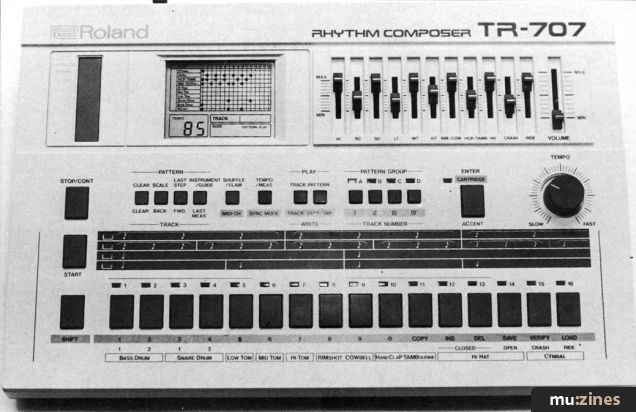
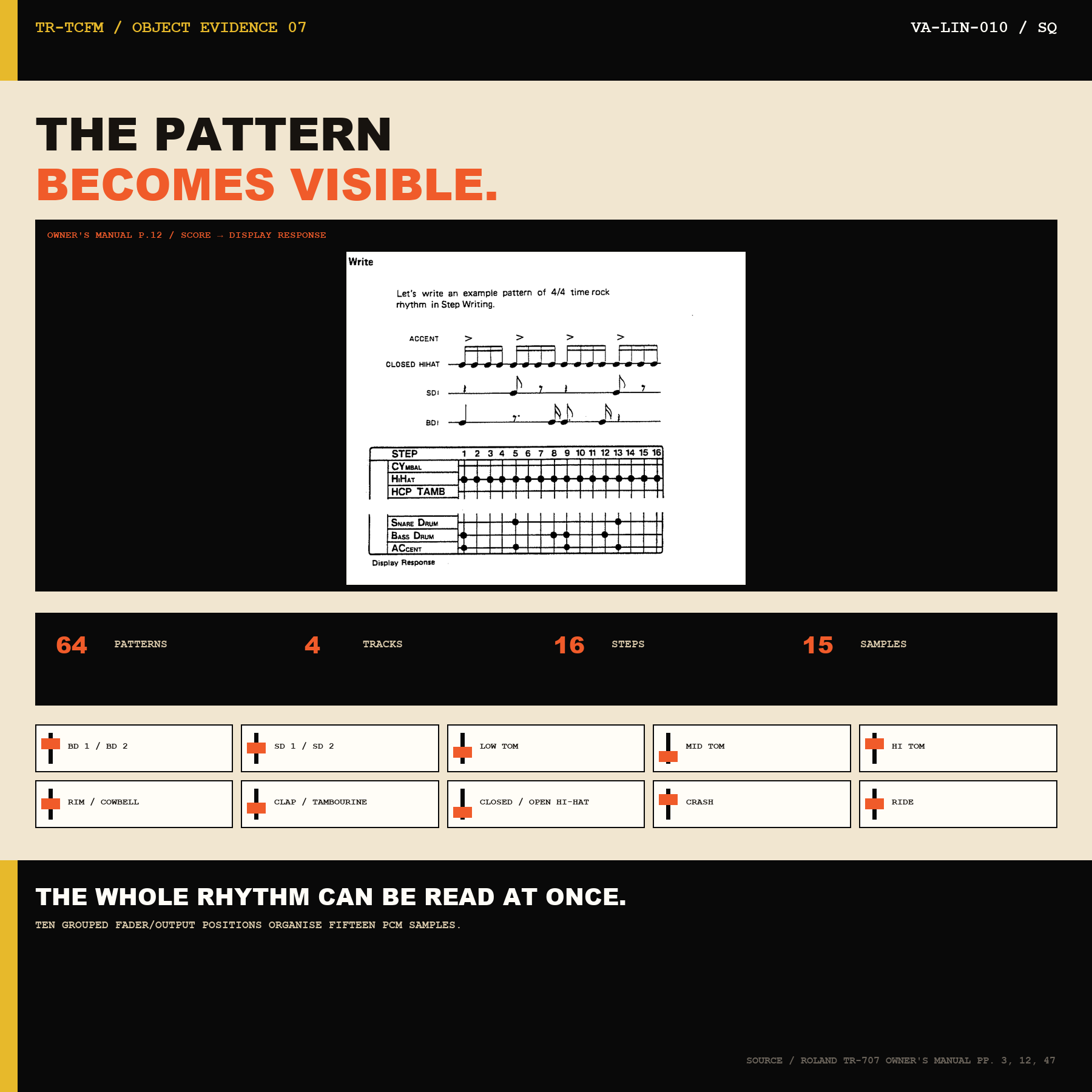
3. How one channel holds two drums. Bass Drum 1 and 2 occupy alternating addresses in one memory area. IC32 and IC33 force the least-significant address bit low or high, selecting the even- or odd-addressed waveform. The same economy is used for other paired voices. The front panel therefore names fifteen sounds, but the hardware organizes them as ten independently sounding groups.
4. Multiplexed conversion. ROM words are caught by latch IC36 on the rising edge of CLK4, converted by IC37 with an envelope reference selected through IC40, then distributed to the sample-and-hold lanes through IC41. Each voice is reconstructed in its own sample-and-hold and envelope lane. The system is time-shared before those lanes, not a single mono sample player after them.
5. Level, accent and decay. IC31 converts six-bit control data into a voltage combining fixed voice level with Dynamics. Dynamics follows MIDI velocity during external playing or the programmed Total Accent amount in a pattern. Latches IC27 and IC28 select the active envelope transistor; its resistor-capacitor time constant sets the fall of that channel before the next analogue stages.
6. Closed and open hat. The hat sample leaving Q35 is common to both articulations. The distinction is made afterwards: an open/closed selection changes the decay contour and VCA path. In other words, the two hat labels are not two different recordings; they are two analogue treatments of one PCM source.
7. Crash and ride are separate. IC19 and IC22 each hold one 32 KB cymbal waveform and each receives a dedicated address counter, D/A converter and envelope circuit. Their conversion path is not part of the eight-channel multiplex shown for the shorter kit voices. This is a documented architecture choice; the service notes do not identify who recorded the source cymbals.
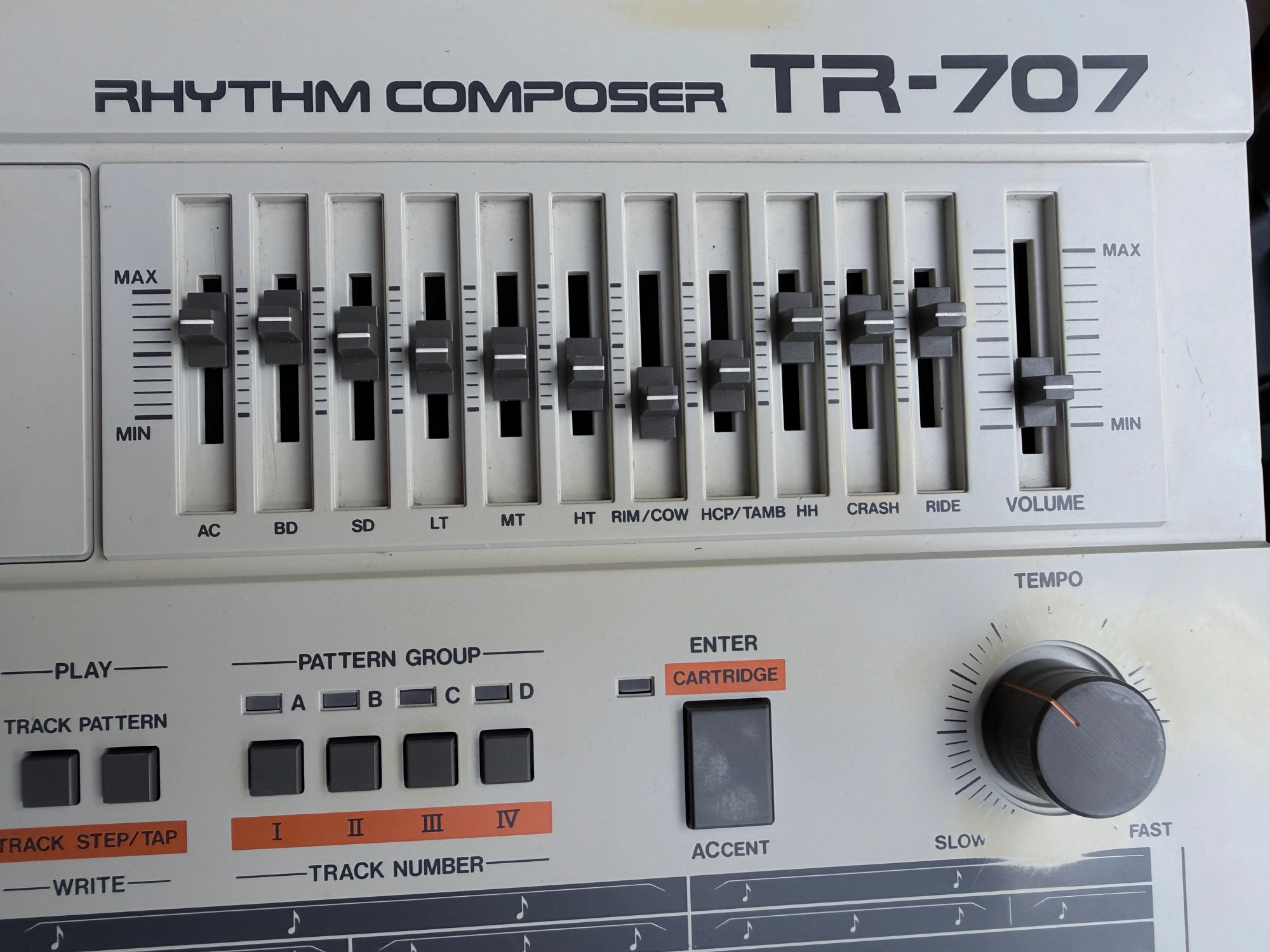
8. From group fader to jack. After filtering and level control, the voice groups reach the ten front-panel faders and the switched output network. Inserting an individual-output plug removes that group from the master mix. A missing voice at the main output can therefore be an output-contact problem even when ROM, conversion and the individual output remain healthy.