Small enough to carry.
Serious enough to compose.
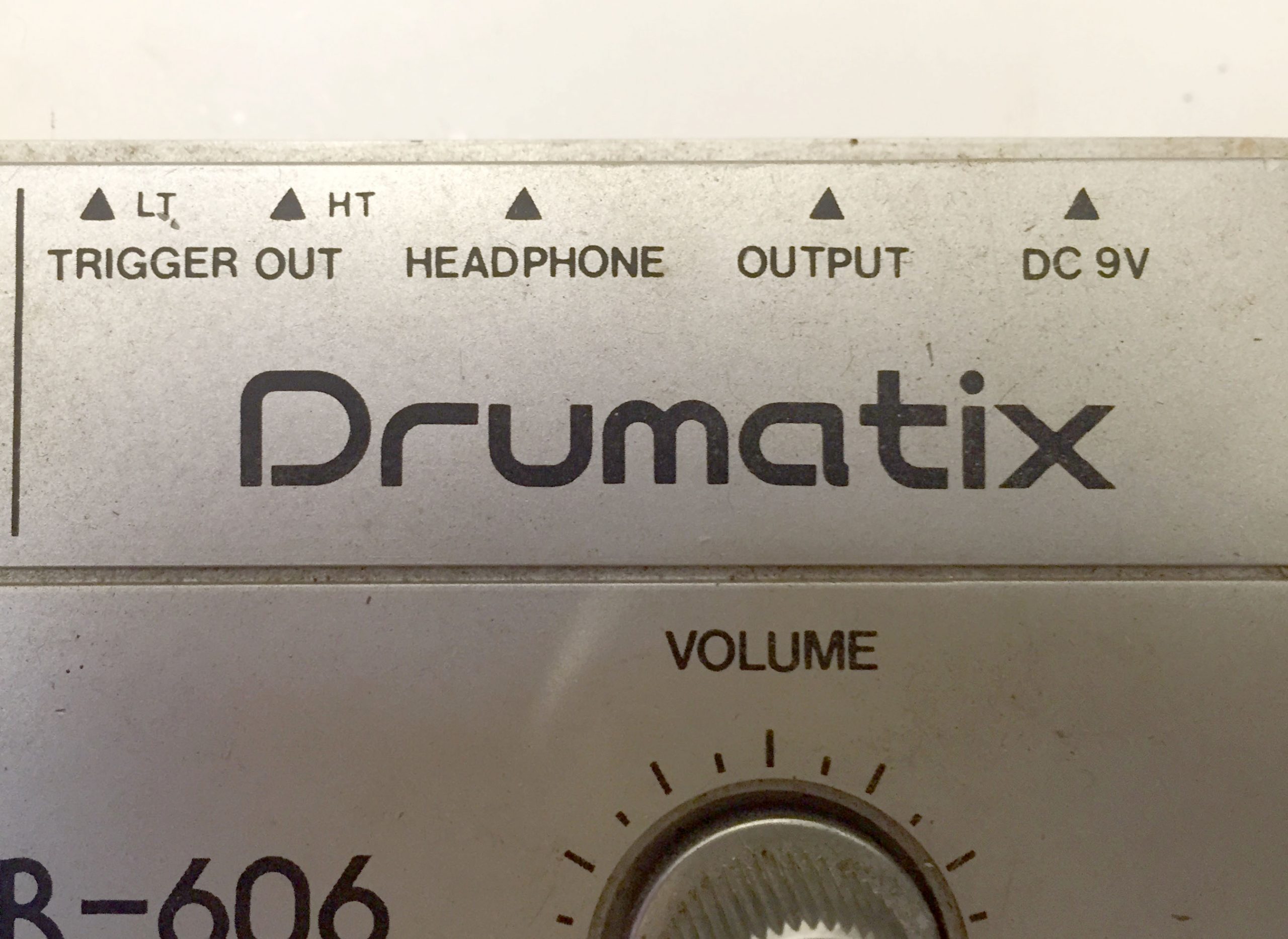
Put the Drumatix on a table and its scale can be deceptive. The silver case looks like a portable accompaniment box. Below the level knobs sits a row that can write a beat, choose its next bar and build an arrangement. The little machine is carrying the work of a drummer and a score.
Roland introduced it alongside the TB-303 Bass Line. The two cases matched; each could run on batteries and remember its own part. Their DIN connection shared timing and transport while drums and bass remained separate performances. The 1982 Japanese catalogue offered the 606 for ¥49,800 and the 303 for ¥53,000.
That partnership is a useful place to begin, but it is only the beginning. The Drumatix could make a complete track without its sibling. Two of its percussion lanes could also send control pulses out of the case. The compact rhythm section contained the beginnings of a wider studio.
Sixteen keys.
More than one bar.
The row changes jobs with the mode selector. While writing, choose an instrument and place its strikes with the numbered keys. While playing, those keys recall patterns. In Track mode they help arrange the calls to memory. The panel stays small because the same surface carries several stages of composition.
There are 32 pattern locations in two groups. Adjacent patterns can be chained inside four-key blocks; eight tracks supply a longer arrangement. Seven can hold up to 64 measures and the eighth extends to 256. D.C. and D.S. borrow the economy of written music: repeated form can be remembered without storing every bar afresh.
Sixteen positions do not always mean sixteen semiquavers. Pre-Scale changes the relationship between a position and a beat, while Last Step determines when the cycle returns. Roland’s manual moves from its Basic Course into named rhythms, triplet divisions, unequal cycles and examples that change scale between bars.
Tony Bacon’s February 1982 review puts a reader back beside a new machine. At £199 including VAT, it rewarded preparation: work out the rhythm, enter it, then develop its form. The paper score and the repeating LEDs belonged to the same writing process.
THE MANUAL, MADE EXPLORABLE
Follow a rhythm.
One instrument at a time.
Choose a printed score and a lane. The keys reveal its events; the source page stays with the rhythm.
Play and edit all 31 manual studies ↗Seven circuits.
One shared accent.
The sounds begin as electrical events. Bass drum rings down from its oscillator network. Snare joins a tonal body to noise. Two tom voices sit at different pitches. Cymbal and both hats draw on a common bank of six oscillators, then separate through their own filters, envelopes and amplifiers.
Open and closed hats share a level control. A closed-hat event cuts off the open hat, so the two lanes have a relationship beyond their positions in the score. Accent reaches the voices already sounding at that step; its placement can give a collision of instruments a common emphasis.
The original panel offers balance rather than an array of tuning and decay knobs. Once the events are written, a performance develops through levels, accent, pattern changes and treatment of the mono output. Small choices can remain clearly audible because the vocabulary is compact.
RECORDED REFERENCE / ALEX BALL
Meet the kit.
Choose a voice to hear its recording.
Seven recorded reference voices from the existing Studio library. These recordings and the manual-score teaching lab are separate listening experiences.
A tom can be a drum.
It can also be an instruction.
High-tom and low-tom events have a second destination: their rear-panel trigger outputs. Turn the tom down inside the mix and the written lane can still command a compatible external instrument. Leave it up and one step can make a drum strike and an external event together.
DIN Sync does a different job. It coordinates the clock and run/stop state; it does not transmit a drum sound or a pattern. Each connected instrument still reads its own memory. Audio has to take its own route to an amplifier or mixer.
This is where the compact box opens out. A pattern can drive a sequencer or arpeggiator, bass can follow the shared clock, and each audio output can be processed separately. The arrangement lives in the wiring as well as in the bar.
The box travels.
The job changes.
The Sisters of Mercy
Alice / 1982
The band gave its rhythm apparatus a name: Doktor Avalanche. Roland’s history identifies the 606 with “Alice”. The machine’s repeated pattern becomes part of a group’s identity, rather than an invisible substitute for a missing drummer.
Drexciya
Rublick’s Cube / 1996
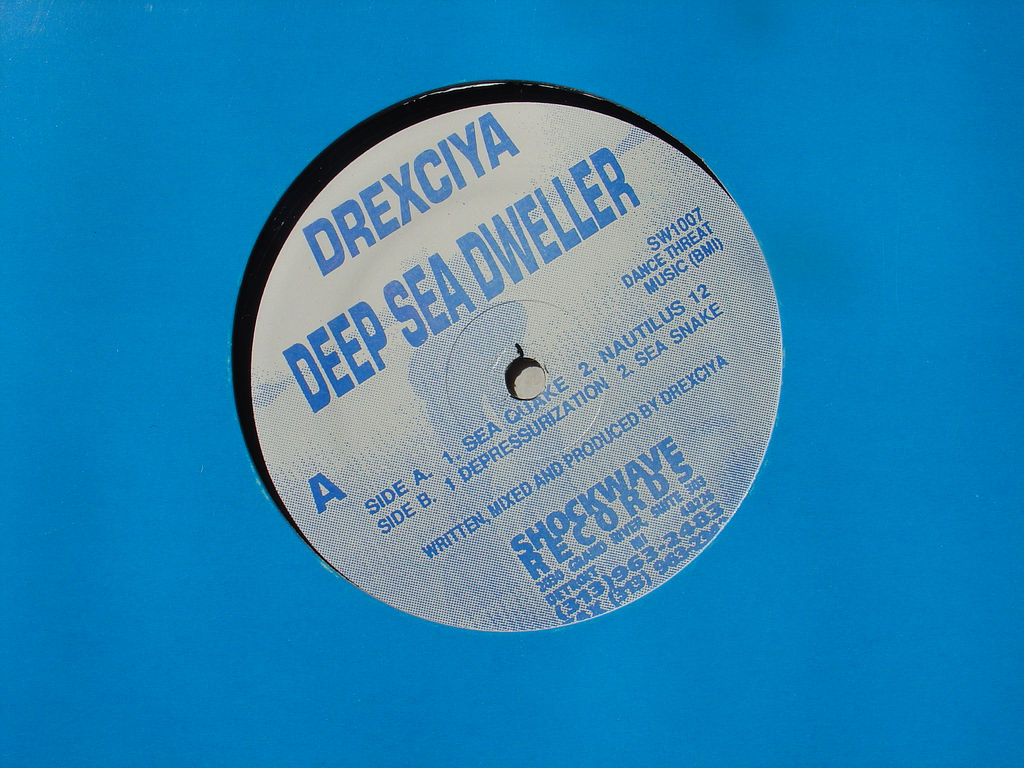
Roland’s focused account attributes this rhythm to the TR-606. The listening path moves from Leeds to Detroit: a compact drum vocabulary becomes part of an electro world. The attribution comes from the manufacturer’s later account.
Plastikman
Sheet One / 1993
Richie Hawtin describes a connected system of 303s, 606 and 808, shaped through live mixing and effects. “Plasticity” and “Helikopter” offer two routes into it. Follow how the instruments share a piece of music; the whole drum part need not belong to one model.
Erika
An instrument to learn on
Erika remembers the 606 as her first piece of equipment and the instrument on which she learned drum programming. Her later Ectomorph story makes that apprenticeship visible as a continuing performance practice. Fluency accumulates: a small panel can stay useful while the musician’s world expands.
Kurtis Mantronik
The pair before the studio
Mantronik recalls learning to program with a DIN-synchronized 606 and 303. His account gives Roland’s paired proposition a personal working life. The later studio 808 on “Fresh Is the Word” is a separate story; the early setup does not become a 606 record credit by association.
Depeche Mode
Ghosts Again / 2023
Marta Salogni’s production account places a TR-606 beside Martin Gore’s demo loop and a Eurorack drum voice. It is a layered arrangement, with the little analogue machine contributing to a much larger recording process.
A survivor has
a history inside it.
The service notes record engineering changes during production. Clocks, reset behaviour, metallic oscillator tuning and noise amplification were revised. Those pages give the surviving object another chronology, distinct from the dates on the records made with it.
Battery-backed patterns and tracks are part of that object’s working life. Preserve their notation and audio before service. A replacement part, added output or modification should enter the object record as a change, rather than quietly becoming an original specification.
The browser laboratory lets a reader explore the manual’s relationships with approximate teaching audio. The reference bank above supplies recordings. Neither is a measurement of this photographed collection unit. Keeping those experiences named makes room for future recordings of the actual survivor.
OBJECTS / PRINT / ENGINEERING