
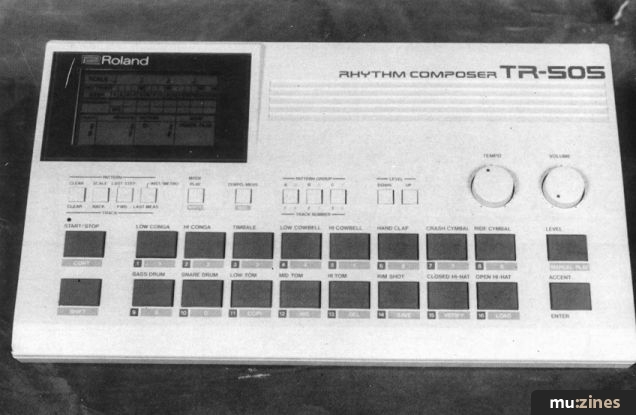
Peter Gleadall reviewed the TR-505 in the May 1986 issue of One Two Testing, where it was listed at £220.
A portable kit with drums and percussion
Write a beat with bass drum and snare, then add congas, timbale or cowbells from the same sixteen-voice kit. The TR-505 ran on six AA batteries and offered headphones for working away from the studio. Peter Gleadall’s May 1986 review quoted £220 and welcomed its combination of drums and percussion.
Drums and percussion in the same pocket
Gleadall liked the bass drum and long crash cymbal, and found that accented congas and timbales could make a pattern forceful. Those are the reviewer’s listening judgments. The working palette also included 48 fixed patterns and 48 writable locations; a factory pattern could be copied into a writable location and altered.
Roland TR505 ↗ RhythmCheck: Roland TR-505 Rhythm Composer ↗ Roland TR-505 Technical Specifications ↗ TR-505 Owner’s Manual ↗
Writing one line, hearing the pattern
In Step Write, select a voice and use the numbered keys to add or remove its hits while the pattern runs. Tap Write records played hits instead. The kit has limits: the toms and timbale share a mutually exclusive group, as do several pairs, including open and closed hi-hat.
The line drawn by MIDI
MIDI In and Out provided synchronisation and note communication, but there was no older Roland Sync connection. Gleadall missed that socket and separate voice outputs. The stereo pair served the whole kit; cassette transfer stored data rather than supplying tape sync. Six tracks shared a total capacity of 423 measures.
Roland TR505 ↗ RhythmCheck: Roland TR-505 Rhythm Composer ↗ Roland TR-505 Technical Specifications ↗ TR-505 Owner’s Manual ↗
The machine in the record
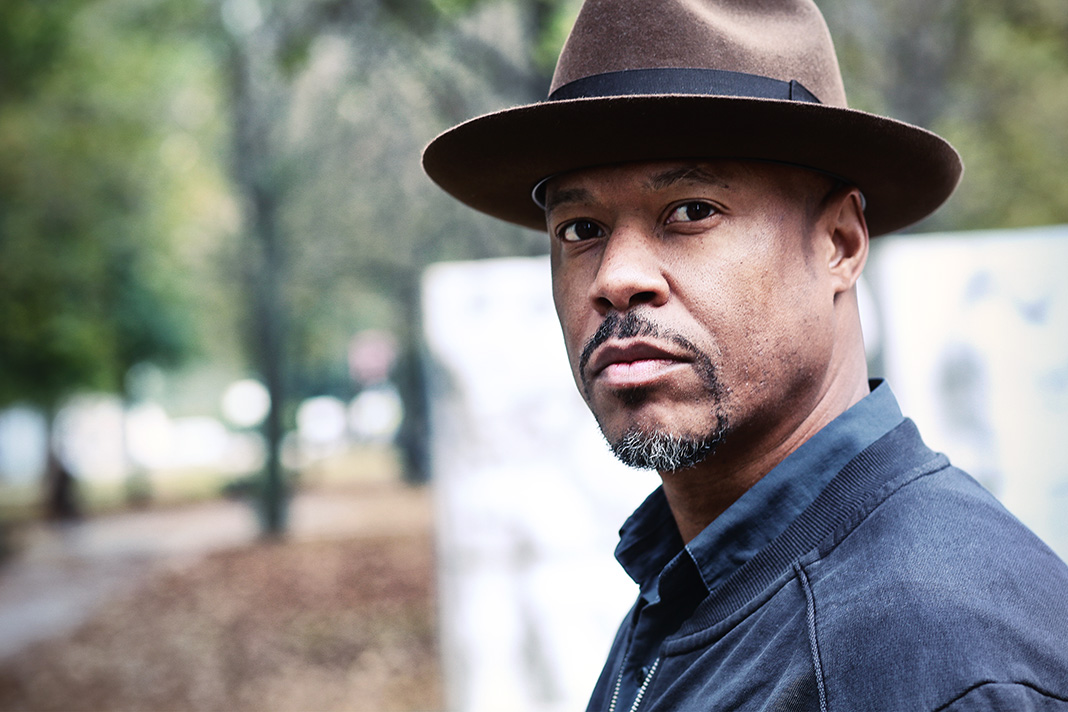
Robert Hood / learning to make a pattern.
Robert Hood recalled paying about $100 for a second-hand TR-505 at a Detroit pawnshop. With help from a music store, he learned to program it and began making demos: a small machine becoming the start of a working method.
Read Robert Hood Is Paying It Forward ↗A modest box in working rooms
Paul Roberts recalled buying a TR-505 with redundancy money during K-Klass’s early years. Robert Henke described a different job in Monolake’s first live performance in summer 1996: Gerhard Behles mainly set and deleted sequencer steps while Henke handled effects and mixing. Henke says their early drum sounds came from a Yamaha TG77, not the 505’s internal kit.
Learning a second-hand machine
Robert Hood recalled paying about $100 for a TR-505 at a Detroit pawnshop. It had no manual; a music-equipment store showed him how to program it. He began making demos and passed one to Mike Clark, who took it to Mike Banks. Hood describes this as the beginning of his electronic-music career.
From delay-pedal loops to studio drums
John Bergin’s early Fear And Bullets recordings used two delay pedals to loop short passages of recorded drums. In his 2018 account, he dates the studio reworking to 1992, when Brett Smith and Patrick Hopewell joined him and he acquired a TR-505, followed by an Alesis SR-16. The later drum-machine work belongs to the reconstruction, not the 1990–91 demos presented on that release page.
Trust Obey / John Bergin / Fear And Bullets studio reconstruction ↗
A programmed part and an external reverb
LOWMOON’s Mikey Wilson describes beginning “Monochrome” with a bass part, then following the developing arrangement rather than a fixed verse-and-chorus plan. He programmed the drums on a TR-505 and sent its snare through an inexpensive Eighties outboard reverb. The album was released on 28 June 2024; Wilson is credited with performance, production, mixing and mastering.
Playing the machine by hand
Aldi Aliens describe a manually played TR-505 alongside bass, guitar and a Casio SA-20 on their self-titled album, released on 10 April 2026. Their German-language account calls the rhythm modified but does not explain a hardware alteration. It documents a played approach to the machine, without specifying every voice or pattern.
Recording and working accounts
Explore 15 source accounts
- K-Klass — Universal
- Monolake — Hongkong and early Monolake tracks
- Shake / Anthony Shakir — Model 500 — “No UFOs”
Shakir recalled learning the bass line of Model 500’s “No UFOs” on a Korg Poly-800, then exchanging instruments with Jay Denham and learning drum programming on Denham’s TR-505.
- Trust Obey / John Bergin — Fear And Bullets studio reconstruction
Read this account in the story ↑
Trust Obey / John Bergin / Fear And Bullets studio reconstruction ↗
- LOWMOON — Monochrome
- Aldi Aliens — Aldi Aliens
- The Royal We / DNA and Animas — Samizdat
- Wasted Pido — homesick songs
- Robert Hood — Early Detroit production practice
- Special Cases / Martin Avendaño — Celestial Famly
- Virgil Work Jr. — Ease Into It
- SysEx Emporium — 2,081 Ultimate Vintage Drum Samples
- Paradise Is a Frequency — The Style of Life
- Malin Genie — Superposition
- Robert Hood — Early demo tracks
Read the longer TR-505 story
Browse records and working lives
More records in the archive
The machine keeps turning up.
Robert Hood / Early demo tracks
Robert Hood says a Roland TR-505 was his first real machine for learning drum programming and making the demo tracks that began his electronic-music career.
Read Robert Hood Is Paying It Forward ↗
Monolake / Hongkong and early Monolake tracks
Robert Henke identifies the TR-505 as a basic sequencer in Monolake’s early setup and explicitly separates that role from the Yamaha TG77 sounds used as drums.
Read Monolake on Hongkong ↗Reported association
K-Klass / Universal
K-Klass recall using redundancy pay to buy a TR-505 before the group reached the charts; the account appears in their retrospective discussion of Universal.
Read K-Klass on Universal ↗
Trust Obey / John Bergin / Fear And Bullets studio reconstruction
Bergin recalls acquiring a TR-505 while rebuilding Fear And Bullets for its later studio version.
Read Trust Obey / John Bergin / Fear And Bullets studio reconstruction ↗
LOWMOON / Monochrome
LOWMOON’s Mikey Wilson says he programmed the drum machine on “Monochrome” with a Roland TR-505 and ran its snare through an Eighties outboard reverb.
Read LOWMOON / Monochrome ↗
Aldi Aliens / Aldi Aliens
Aldi Aliens describe their manually played Roland TR-505 as carrying the modified rhythm that defines their self-titled album.
Read Aldi Aliens / Aldi Aliens ↗The Royal We / DNA and Animas / Samizdat
The Royal We’s account says the 2004–05 Samizdat recordings were made with a Roland TR-505, a microphone and records.
Read The Royal We — Samizdat ↗
Wasted Pido / homesick songs
Wasted Pido’s credits name a Roland TR-505 among the drum machines used on homesick songs.
Read Wasted Pido — homesick songs ↗
Robert Hood / Early Detroit production practice
Robert Hood recalls buying a Roland TR-505 from a Detroit pawnshop and using its direct, practical workflow as part of his early production practice.
Read Red Bull Music Academy / Robert Hood lecture ↗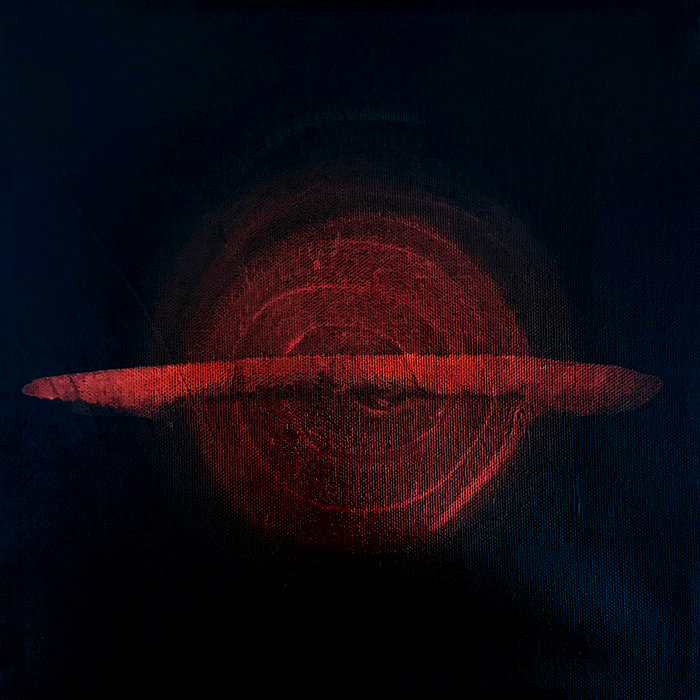
Special Cases / Martin Avendaño / Celestial Famly
Special Cases credit Martin Avendaño with Roland TR-505 alongside Octopad, ride and drums on Celestial Famly.
Read Special Cases — Celestial Famly ↗
Virgil Work Jr. / Ease Into It
Virgil Work Jr.’s track equipment list names a Roland TR-505.
Read Virgil Work Jr. — Ease Into It ↗Archive source
SysEx Emporium / 2,081 Ultimate Vintage Drum Samples
SysEx Emporium lists Roland TR-505 samples in 2,081 Ultimate Vintage Drum Samples.
Read SysEx Emporium / 2,081 Ultimate Vintage Drum Samples ↗
Paradise Is a Frequency / The Style of Life
Paradise Is a Frequency list the Roland TR-505 in the record’s instrumentation.
Read Paradise Is a Frequency / The Style of Life ↗
Malin Genie / Superposition
The track credit names a Roland TR-505.
Read Malin Genie — Superposition ↗Sources
- Roland TR505
- RhythmCheck: Roland TR-505 Rhythm Composer
- Roland TR505 review
- Roland TR-505 Technical Specifications
- TR-505 Owner’s Manual
- Robert Hood: Paying It Forward
- K-Klass on Universal
- Monolake on Hongkong
- Trust Obey / John Bergin / Fear And Bullets studio reconstruction
- LOWMOON / Monochrome
- Aldi Aliens / Aldi Aliens
The visual archive
Further visual evidence.
Sources for images shown earlier (15)
- Roland TR505 ↗
- Robert Hood — 5 Magazine, 2019 ↗
- K-Klass — MusicRadar Universal feature ↗
- Robert Hood / Red Bull Music Academy ↗
- Trust Obey — Fear And Bullets (1991 Demo), cassette-cover image ↗
Demo edition released 26 October 2018 · Trust Obey / John Bergin / release artwork via Bandcamp · Official Bandcamp release-page artwork (Open Graph image) - LOWMOON — Monochrome ↗
28 June 2024 · LOWMOON / release artwork via Bandcamp · Official Bandcamp release-page artwork (Open Graph image) - Aldi Aliens — Aldi Aliens ↗
10 April 2026 · Artwork: Eva Nüßlein · Official Bandcamp release-page artwork (Open Graph image) - Wasted Pido — homesick songs ↗
Release date not stated on source page · Wasted Pido / release artwork via Bandcamp · Official Bandcamp release-page artwork (Open Graph image) - Special Cases / Martin Avendaño — Celestial Famly ↗
2025-01-01 · Special Cases / Martin Avendaño / release artwork via Bandcamp · Official Bandcamp release-page artwork (Open Graph image) - Virgil Work Jr. — Ease Into It ↗
2024-08-30 · Virgil Work Jr. / release artwork via Bandcamp · Official Bandcamp release-page artwork (Open Graph image) - SysEx Emporium — 2,081 Ultimate Vintage Drum Samples ↗
2023-02-20 · SysEx Emporium / release artwork via Bandcamp · Official Bandcamp release-page artwork (Open Graph image) - Paradise Is a Frequency — The Style of Life ↗
2024-12-06 · Paradise Is a Frequency / release artwork via Bandcamp · Official Bandcamp release-page artwork (Open Graph image) - Malin Genie — Superposition ↗
2019-08-23 · Malin Genie / release artwork via Bandcamp · Official Bandcamp release-page artwork (Open Graph image) - K-Klass — Universal ↗
1993-11-29T12:00:00Z · K-Klass / release artwork via Apple Music catalog artwork · Universal album cover visibly identified; retained catalogue link points to “What You’re Missing” - Monolake — Hongkong Remastered ↗
Remastered · Monolake / release artwork via Apple Music catalog artwork · Hongkong Remastered cover visibly identified; retained catalogue link points to “Occam”
Additional visual sources (7)
Original publications and related image sources.
- Roland TR505 ↗
May 1986 · One Two Testing · Roland TR-505 Rhythm Composer product photograph with TR-505 marking clearly visible. - Roland TR505 ↗
May 1986 · One Two Testing · Roland TR-505 Rhythm Composer with TR-505 marking clearly visible. - Roland TR505 ↗
May 1986 · One Two Testing · Roland TR-505 Rhythm Composer with Roland and TR-505 markings clearly visible. - Roland TR505 ↗
Apr 1986 · Making Music · Colour Roland TR-505 product photograph with Roland and TR-505 markings visible, restored to the originating April 1986 Making Music review. - Roland TR505 ↗
May 1986 · One Two Testing · Roland Rhythm Composer TR-505 product photograph with Roland and TR-505 markings clearly visible. - Drum Machine Survey ↗
Mar 1987 · Sound On Sound · Roland TR-505 product photograph from the Drum Machine Survey; its model marking is visible. - Model 500 — No UFOs ↗
1985 · Model 500 / release artwork via Cover Art Archive · MusicBrainz release record and Cover Art Archive front artwork