
Manfred Fricke’s MFB 512, sold in Britain as the Syco Digital Drum Machine, was a compact early digital percussion machine built around an unusually determined idea: make stored drum sound affordable without making the instrument disposable.Sources (11)
Silent retrospective engineering study
Storage, then shaping.
Manfred Fricke recalled one-bit stored sound data passing through voltage-controlled filtering and amplification, allowing eight instruments on one chip. This labels his retrospective account; it is neither a recovered schematic nor an audio reconstruction.
One-bit stored data
Fricke describes a memory-saving stored-sound decision, not a published coding specification.
VCF
Voltage-controlled filtering belongs between stored data and the outgoing drum voice in his account.
VCA
Voltage-controlled amplification completes the recalled route to output.
Open count
Fricke recalled eight instruments per chip; the Würzburg specimen lists eleven sounds. The relationship remains unresolved.
The machine in the record
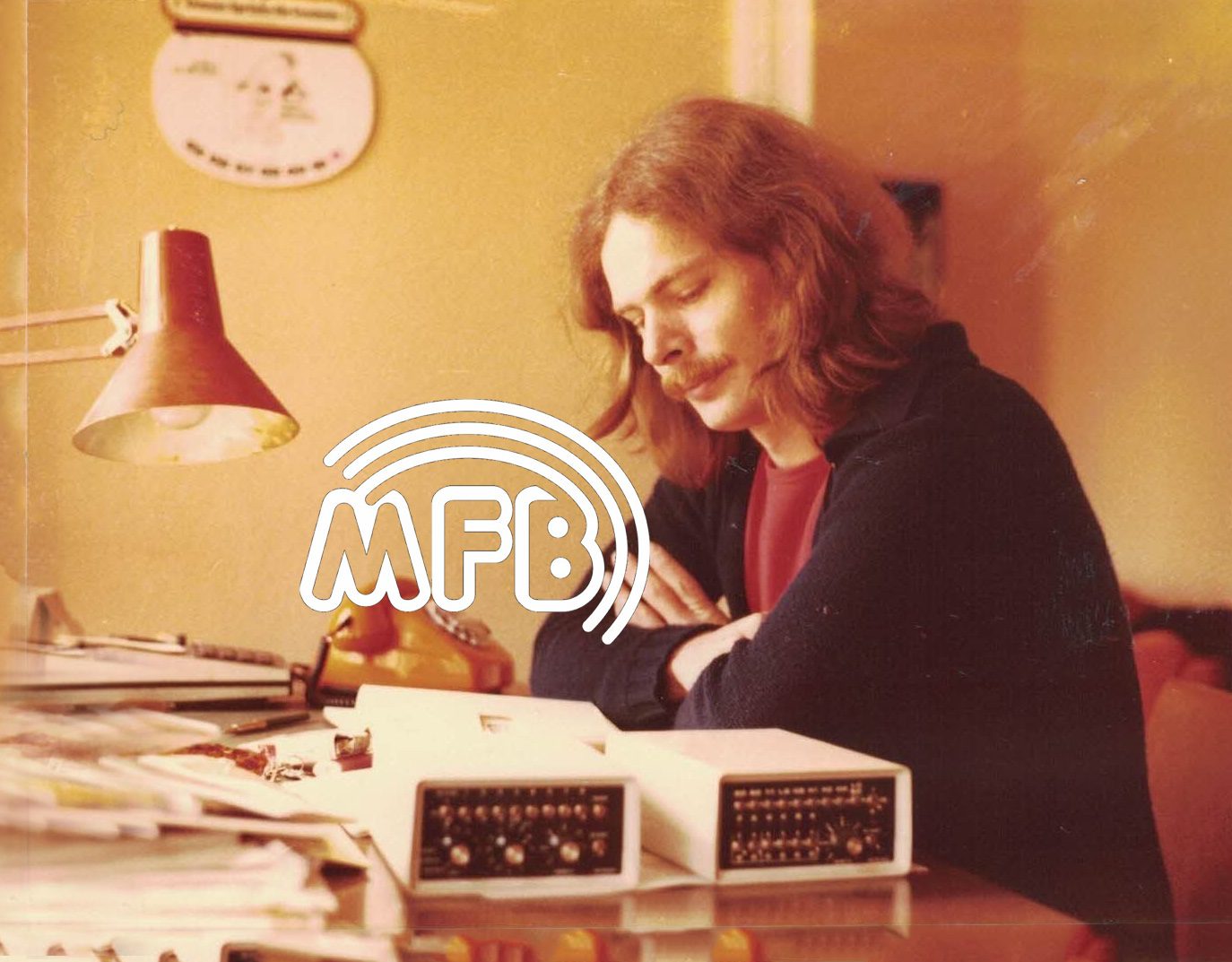
Asmus Tietchens / the Litia period.
Asmus Tietchens connects the MFB 512 with the period around Litia. It is a small trace, but a revealing one: an inexpensive German drum machine inside a rigorously personal electronic practice.
Read Asmus Tietchens — Absolute Music ↗More records in the archive
The machine keeps turning up.
yppasswdd daemons / Artist working setup
The official yppasswdd daemons profile names the MFB 512 in its equipment lineup.
Read yppasswdd daemons: artist profile ↗
Jesse Osborne-Lanthier / Athenaeum of Unedited, Superannuated, Incomplete, Unreleased, Intimate Works, 2011–2013
Jesse Osborne-Lanthier lists an MFB 512 Drum Machine in the gear inventory for Athenaeum of Unedited, Superannuated, Incomplete, Unreleased, Intimate Works, 2011–2013.
Read Jesse Osborne-Lanthier / Athenaeum of Unedited, Superannuated, Incomplete, Unreleased, Intimate Works, 2011–2013 ↗
Jesse Osborne-Lanthier / Athenaeum of Unedited, Superannuated, Incomplete, Unreleased, Intimate Works, 2011–2013
Jesse Osborne-Lanthier lists the MFB-512 drum machine among the gear used for this collection.
Read Jesse Osborne-Lanthier / Athenaeum of Unedited, Superannuated, Incomplete, Unreleased, Intimate Works, 2011–2013 ↗
yppasswdd daemons / traceroute_to_207.46.131.13
The release personnel identifies the MFB-512 as rhythm box.
Read yppasswdd daemons — traceroute_to_207.46.131.13 ↗Asmus Tietchens / Litia period; track assignment unverified
Artist associates MFB 512 purchase with Litia.
Read Asmus Tietchens — Absolute Music ↗A German machine behind the Syco badge
British reviews recognised the MFB panel beneath the Syco name, while a 1983 American notice presented the related Samson Digital Drum Machine at $650 with an AC adaptor. The MFB 512 travelled through several commercial faces, but the underlying ambition remained Fricke’s.
Making digital memory do more
Fricke later explained the engineering pressure directly: natural decays need memory, and memory costs money. His solution stored one-bit sound data and shaped it through voltage-controlled filtering and amplification, producing a distinctive route to digital percussion.
A serious machine in a modest shell
Period coverage described a low-cost plastic case around a surprisingly focused drum-machine idea, with British coverage putting it at £299. That contrast is part of the 512’s character: an accessible package that asked clever engineering to carry the musical weight.
A voice kept in collections and records
An institutional specimen catalogue preserves the MFB 512 as a Fricke-Box, while artist and label material keeps it present in individual music histories. These records make the machine more than a technical curiosity: it is an object people kept, used and remembered.
The appeal of the constraint
The MFB 512 gives its user a particular kind of freedom: a small, economical digital machine whose limits are part of its sound. That is why it still speaks to musicians who hear invention in a restricted palette.
At the edge of Asmus Tietchens’s *Litia*
Asmus Tietchens associates buying an MFB 512 with the period around *Litia*. That is not a claim to isolate its signal on a particular track, but it puts this small machine in the orbit of a composer whose records turned limited electronic resources into their own spaces.Source (1)
In the market
- 1984-06: GBP 299 — UK contemporary review RRP. MFB 512 imported by Syco Systems Source ↗
- 1983-12: USD 650 — US product notice list price. MFB-512 with AC adapter; text separately states DIN connection cables supplied, but price sentence imprecisely calls outputs included Source ↗
On record
- Documented machine history. Artist associates MFB 512 purchase with Litia. Source ↗
- Jesse Osborne-Lanthier — Athenaeum of Unedited, Superannuated, Incomplete, Unreleased, Intimate Works, 2011–2013. Jesse Osborne-Lanthier lists an MFB 512 Drum Machine in the gear inventory for Athenaeum of Unedited, Superannuated, Incomplete, Unreleased, Intimate Works, 2011–2013. Source ↗
- Jesse Osborne-Lanthier — Athenaeum of Unedited, Superannuated, Incomplete, Unreleased, Intimate Works, 2011–2013. Jesse Osborne-Lanthier lists the MFB-512 drum machine among the gear used for this collection. Source ↗
- yppasswdd daemons — traceroute_to_207.46.131.13. The release personnel identifies the MFB-512 as rhythm box. Source ↗
In the studio and on stage
- yppasswdd daemons — Artist working setup. The official yppasswdd daemons profile names the MFB 512 in its equipment lineup. Source ↗
Sources
- Syco Digital Drum Machine
- MFB Digital Drum Machine
- Interview: Manfred Fricke MFB, 40 Jahre Drummaschinen & Synthesizer
- Hats Off — Syco MFB Digital Drum Machine
- MFB-512 product description
- Asmus Tietchens — Absolute Music
- Drum Computer MFB 512 (Fricke-Box), StW 20
- Fricke MFB-512 manual download listing
- Litia
- yppasswdd daemons: artist profile
- Samson Digital Drum Machine — Modern Recording & Music, p. 54
The visual archive
Further visual evidence.
These displayed records are labelled by their documented role, date and source; source-only records are listed separately below.
Sources for images shown earlier (5)
- Manfred Fricke with drum machines, captioned 1984 ↗
- Syco Digital Drum Machine ↗
- yppasswdd daemons — official profile graphic ↗
- Jesse Osborne-Lanthier — Athenaeum of Unedited, Superannuated, Incomplete, Unreleased, Intimate Works, 2011–2013 ↗
Release date not stated on source page · Jesse Osborne-Lanthier / release artwork via Bandcamp · Official Bandcamp release-page artwork (Open Graph image) - yppasswdd daemons — traceroute_to_207.46.131.13 ↗
1999-01-01 · yppasswdd daemons / release artwork via Bandcamp · Official Bandcamp release-page artwork (Open Graph image)
Additional visual sources (9)
Original publications and related image sources.
- StW 20: MFB 512 panel detail ↗
Catalogue note 2019 · Universität Würzburg - MFB m512_bed.doc ↗
Linked in 2004 archive · MFB · Bedienungsanleitung link to m512_bed.doc - Cyborg Studio MFB-512 owner manual listing ↗
Undated · Cyborg Studio · Owner manual download - Samson Digital Drum Machine — December 1983 ↗
1983-12 · Modern Recording & Music · Printed p. 54; PDF page 56 of issue - Hats Off; Syco Digital Drum Machine ↗
Aug 1984 · Electronic Soundmaker & Computer Music · Syco/MFB digital drum machine front panel from the dedicated MFB-512 review, with the model marking visible at lower right. - Hats Off; Syco Digital Drum Machine ↗
Aug 1984 · Electronic Soundmaker & Computer Music · MFB-512 control/rear unit from the dedicated Hats Off and Syco Digital Drum Machine article contexts; exact only within that bounded source context because the low-resolution marking is not independently legible. - Hats Off ↗
Aug 1984 · Electronic Soundmaker & Computer Music · Rear panel of the MFB-512 from its dedicated Hats Off review, exact through matching front-panel and bounded article context. - Hats Off ↗
Aug 1984 · Electronic Soundmaker & Computer Music · MFB-512 front panel with MFB 512 marking clearly visible. - Syco Digital Drum Machine ↗
May 1984 · One Two Testing · MFB-512 front/three-quarter product photograph with MFB 512 marking visible.