
Amazona’s retrospective company overview places the forty-sound, MIDI-controlled MFB-712 in the early MFB line. The sources here do not establish a factory launch date. The pictured survivor is an expander, not evidence of a self-contained pattern programmer. A September 2025 Matrixsynth listing relay calls it an ‘1980s’ machine and mentions roughly forty sounds; this records a later listing, not a precise introduction year or recording credit.
Forty sounds in a compact module
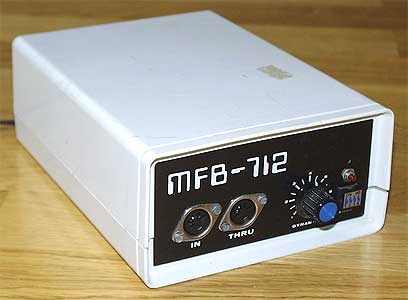
The MFB-712 puts its controls on one small face: MIDI In, Thru, a sound-selection button and a master level knob. Amazona’s company overview identifies a MIDI drum module with forty sounds. This is a sound source for another instrument or sequencer to address, rather than a row of steps on which to compose a pattern.
Amazona, “Alles über MFB, MFB-Synth, MFB-522, MFB-503” ↗ drummachines.de, “Fricke MFB 712” ↗
Surviving instrument
MFB 712, front three-quarter view
Front three-quarter photograph of the MFB-712. The model marking and MIDI In/Thru connections are visible.
The module is the instrument
The drummachines.de owner describes forty sampled acoustic-drum and percussion sounds with sixteen velocity levels. His sound-step button required a connected MIDI keyboard or sequencer, a qualification specific to his unit. He reports stereo output with fixed positions and ten outputs grouped by instrument family—not forty separately routed voices. That distinction matters when arranging the kit across a mixer.
Read the back as well as the front
The same specimen’s rear photograph shows stereo and grouped voice sockets beside Trig., A/B and CV markings. Its owner describes the latter two connections as controls for an MFB-2001 expander. These labels do not by themselves establish trigger voltage, polarity or compatibility with another sequencer. The front photograph introduces the box; the rear documentation explains why its connections deserve a closer read.
Fricke’s compact approach
In his 2019 interview, Manfred Fricke explains that more elaborate construction would have required investment he did not then want to make; there was already a market for the inexpensive approach. His account places the small module within a broader way of making instruments.
Matrixsynth, “MFB 712 1980s – MIDI vintage drum machine” ↗ Interview: Manfred Fricke MFB, 40 Jahre Drummaschinen & Synthesizer ↗
Sources
The visual archive