
Beat Instrumental’s May 1976 effects roundup placed the Maestro Rhythm Queen MRQ-1 in Selmer’s British-distributed range and described eight rhythms usable singly or together. That is a dated account of its accompaniment function, not a factory launch date.
Instrument photograph
A Maestro with its own character.
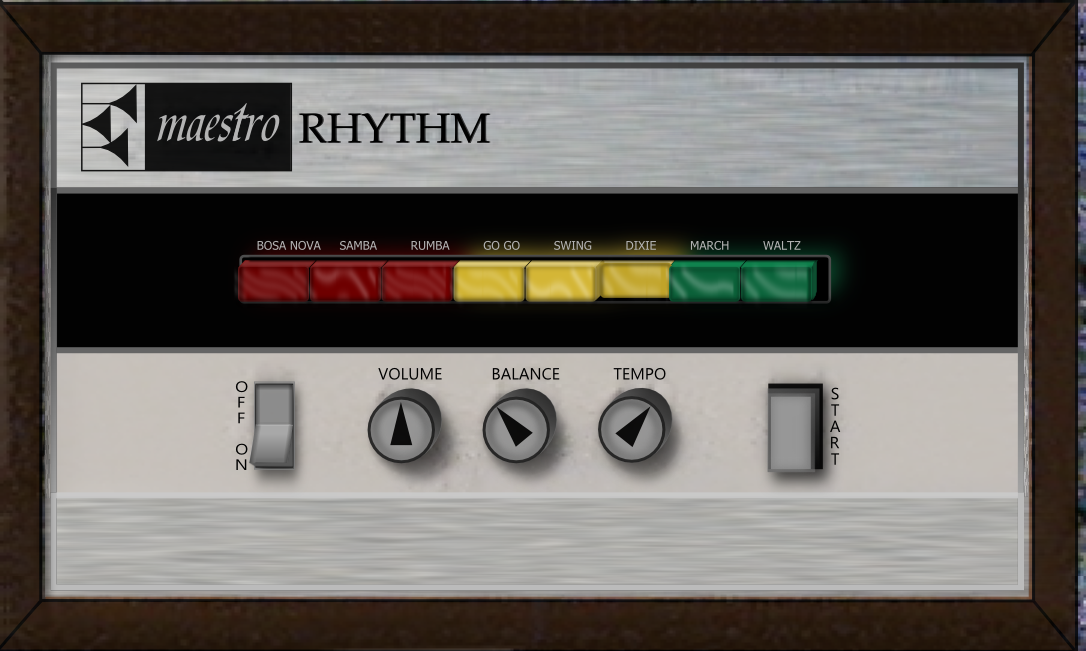
The MRQ-1 photograph keeps the conversation anchored to the actual instrument. Its visual design makes clear that this is not an abstract family name but a distinct rhythm machine with a particular face.
View the MRQ-1 photograph ↗The machine in the record
Jason Booth / the Rhythm MRQ-1 sample board.
Jason Booth’s published Maestro sample board preserves four Rhythm MRQ-1 sounds—kick, snare, hi-hat and effects—alongside the larger Rhythm King set. It records a modern sampling afterlife rather than a named song, but makes the rare machine audible again.
Read Maestro Rhythm King ↗More records in the archive
The machine keeps turning up.
Reported association
Paris Strother / KING / Studio use
Equipboard preserves an @weareking image-and-caption post that places Paris Strother with a Maestro MRQ1 (Rhythm Queen), Roland CR-78 and Roland TR-08.
Read Paris Strother with the Maestro Rhythm Queen ↗On record
- Jason Booth — Maestro Rhythm King sample board. Jason Booth’s published Maestro sample board preserves four Rhythm MRQ-1 sounds alongside the larger Rhythm King set: kick, snare, hi-hat and effects, a small but audible modern afterlife for the box. Source ↗
Rhythm in Selmer’s effects range
The May 1976 report placed the MRQ-1 among Maestro effects distributed by Selmer, alongside the Echoplex and other processors. Its promise was accompaniment for a musician already playing another instrument. This is evidence of British distribution and the product’s advertised purpose at that date, not proof that it had just been introduced. The report does not give a price or a complete technical specification.
Eight rhythms, freely combined
The report’s useful distinction is between choosing one of eight rhythms and combining them. A player was not confined to one preset at a time: the accompaniment could be assembled from existing patterns. That is a form of variation within a fixed vocabulary, not evidence of step entry or user memory. The report supplies no grids or explanation of how differently metered combinations behave, so those details should not be invented from the button names.
A collection record and four sample labels
Melbourne Electronic Sound Studio lists a Rhythm Queen MRQ-1 in its collection. Jason Booth’s Soundboard archive offers a different kind of preservation: four bonus tracks labelled MRQ-1 Kick, Snare, HH and FX beside seventeen Rhythm King tracks. The collection identifies an instrument; the board identifies samples offered under its name. Neither connects those recordings to a particular surviving unit, and four file labels do not establish a complete factory voice roster.
Maestro Rhythm MRQ-1 — reconstructed Commons derivative ↗ Rhythm Queen MRQ-1 collection record ↗ Maestro Rhythm King ↗
Reading a reconstructed panel
The Commons image displayed here is a retouched derivative of a shop photograph, not an untouched close-up. Its file history records parts drawn by hand and changes to button directions, panel texture, light and shadow. It presents eight rhythm labels—Bosa Nova, Samba, Rumba, Go Go, Swing, Dixie, March and Waltz—with Volume, Balance, Tempo and Start controls. It can help orient the reader, provided those alterations are disclosed. It cannot independently prove original materials, detailed geometry or the behaviour of the Balance control, and its furniture-like appearance is not evidence of a universal domestic setting.
Maestro Rhythm MRQ-1 — reconstructed Commons derivative ↗ Maestro Rhythm Queen MRQ-1 report ↗
A release credit and a studio association
The 22 June 2020 COiVIDos credits name Oscilación Planetaria, Gabriel Dellarosa, with a Maestro Rhythm Queen, Roland MKS-100 and Sony DRP-1. That is a release-specific Queen-name credit, but it supplies neither the MRQ-1 suffix nor an allocation of sounds. Separately, Equipboard reports an @weareking post placing Paris Strother with an MRQ1, CR-78 and TR-08. The indexed post is a studio association, not a named-track credit or reliable factory chronology. These later traces should retain their different evidential weights rather than being merged into an invented account of the machine’s sound.
COiVIDos — Interacciones / INMUNE Programa 3 ↗ Paris Strother with the Maestro Rhythm Queen ↗
Sources
The visual archive