Sampling drum machine

E-mu SP-1200

Record a short sound or load one from disk, trim it and play it from a pad.

The digital drum boom →
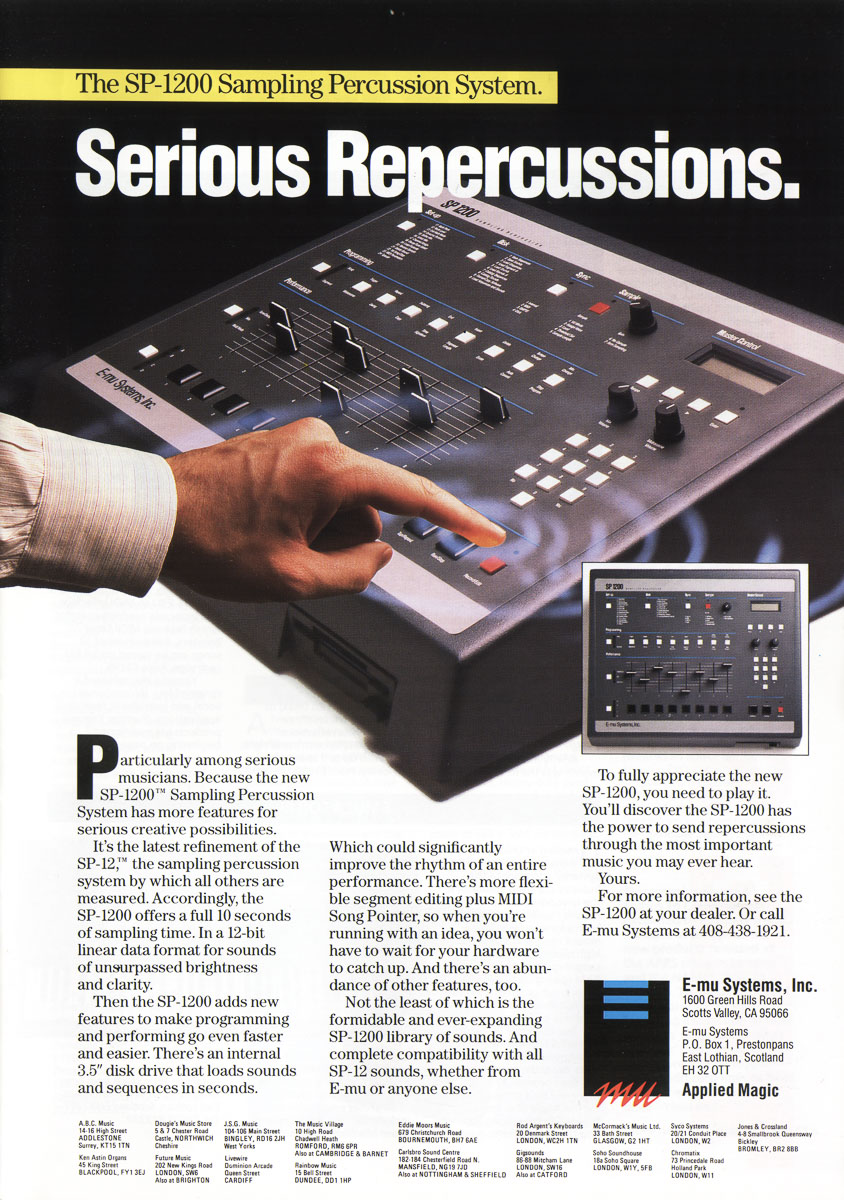
A hand plays the SP-1200 pads beneath the Serious Repercussions headline; a front-view inset accompanies the sales text.View full scan ↗
E-mu SP-1200 advertisementAugust 1987 · Sound On Sound / E-mu SystemsSource & credit ↗

The SP-1200 was shown at Chicago Summer NAMM in 1987 and reviewed that autumn.

Source-led exhibition chapter

E-mu SP-1200

Ten seconds, a world of decisions

Record a short sound, trim it, put it under a pad and write the rhythm. E-mu’s 1987 advertisement shows a hand at the playback controls beneath “Serious Repercussions.” Shown at Chicago Summer NAMM and reviewed that October, the SP-1200 combines user sampling, rhythm programming and a built-in disk drive. Its memory must be allocated before a sound can become part of a sequence.

NAMM Report, pp.63–69 ↗ E-mu SP1200, pp.22–28 ↗ What's New, p.16 ↗

There are no sounds until you choose them

The original SP-1200 did not open with a permanent internal drum kit. Sounds were loaded from a 3.5-inch disk or recorded into the machine. E-mu supplied disks of sampled instruments, but those were a starting collection, not sound chips fixed inside the case. There were thirty-two sound locations arranged as four banks of eight. Eight pads brought one bank under the fingers; each pad had a fader above it. The faders could serve different jobs, including level and a sound’s tuning or decay. The front panel brings sound selection and sound shaping within the same reach.

E-mu advertised ten seconds of 12-bit linear sampling at 26 kHz. The headline number is real, but it was not one ten-second recording space. The manual divides memory into four zones of up to 2.5 seconds each; a sound cannot spill from one zone into the next. A musician could have time left in several zones and still fail to fit a longer sound into any single one. Four separate zones make the constraint visible: a hypothetical duration fits only when it remains within one zone’s 2.5-second limit. This is an allocation rule, not sampling or a simulation of the hardware’s converters.

The sampling procedure had its own small choreography. Set the input gain, choose a sound location, decide the threshold and maximum length, then capture. A threshold could catch the start of a struck sound automatically. Too high, and it would miss the attack; too low, and background noise could start the recording early. The manual also offered forced sampling for a more continuous signal. Once a sound was in memory, truncating it could return scarce space. These are ordinary decisions that became musical ones: what belongs in the sound, what can be discarded, and what has room to remain.

E-mu SP1200, pp.22–28 ↗ SP-1200 Owners Manual, E-MU PN FI 332 Rev. E ↗ What's New, p.16 ↗

The segment, not just the bar

The SP-1200 asked its user to think in segments. David Mellor’s 1987 review describes building a two-bar segment quickly, then moving through banks and changing levels, decay and tuning while he worked. He reports both pleasure in the immediacy and some frustration with the sampling procedure. That mixed response is useful. It prevents the machine from becoming a retrospective myth in which every function was effortless.

A segment could become part of a longer song. Its length need not stop at a conventional bar line, and a song could call segments, alter tempo and recall stored mixes. The review notes an ability to store eight mixes and bring them back within a song, as well as tempo changes that specify both amount and duration. In a studio, the machine was therefore more than a box of captured sounds. It held instructions about when parts returned, how a passage changed pace and how different layers sat against one another. Segment A, a changed mix, segment B and a gradual tempo move describe that silent sequence logic; they do not reconstruct a historic SP-1200 song.

The floppy drive sits between all these decisions and their survival. It loads the sounds and sequences needed for a session and saves work from volatile memory. E-mu’s 1987 ad made that built-in drive a selling point, while the owner’s manual gave the practical warning: material left unsaved could be lost when memory was cleared or the power went away. The disk carried a set of choices from one session to another; it was part of the machine’s working archive, not simply an old-technology icon.

E-mu SP1200, pp.22–28 ↗ SP-1200 Owners Manual, E-MU PN FI 332 Rev. E ↗ What's New, p.16 ↗

Listen to the claims closely

The strongest music stories are the ones in which someone who was there says what the machine did. In a 2007 oral history, Pete Rock identifies the SP-1200 with “They Reminisce Over You (T.R.O.Y.)” and describes beginning from a Tom Scott record, then finding further sounds and building the beat. His account is about a particular act of selection and composition. It is not a multitrack log that lets us allocate every final sound or identify every revision of the machine. The account connects the finished record to an act of selection and composition, with that limit intact.

In the same oral history, Ski describes using an SP-1200 for “Dead Presidents,” including the sequence and drum sounds, and says a sample was run through the machine. The surviving testimony leaves version and routing questions open. That makes the case no less interesting: the SP-1200 could be an arranger and a processing route in the same piece of work. It means the caption must keep his words at their proper scope rather than presenting an unverified single or album mix as a complete technical reconstruction.

An object can tell a different kind of story. Sotheby’s 2023 catalogue describes a signed SP-1200 attributed to RZA as the unit used in producing Enter the Wu-Tang (36 Chambers). This is a named, surviving object with an album-level provenance claim. The catalogue does not assign individual beats, samples, sessions or mixes to that exact unit. The object record supports its album-level attribution, not a track-by-track session sheet.

Other entries in the recording register have their own grades: a production-history account involving Jimmy Jam and Terry Lewis, an artist release account from Ex-poets, a Third Sight album equipment credit, and a published list of Liam Howlett’s studio gear. These retain their exact source and scope. A record sleeve identifies a release, not the device on which every sound was made. An equipment list proves presence in a working inventory, not use on each track. The relationships are richer when their differences remain visible.

The Dirty Heartbeat of the Golden Age ↗ RZA's signed E-mu SP-1200 used to produce Enter the Wu-Tang (36 Chambers), lot 61 ↗ The Making of Janet Jackson’s Rhythm Nation 1814 ↗ Ex-poets / Too Much Future ↗ Third Sight — The Symbionese Liberation Album ↗ Liam Howlett / The Prodigy — Firestarter-era studio gear ↗

A machine with more than one lifetime

The SP-1200’s later story should not fold several versions into one timeless object. A 1993 Electronic Musician notice reports a reintroduction at a different US price from the 1987 launch notice. Rossum Electro-Music’s much later SP-1200 project is a reissue with its own specifications and production history. It is a later afterlife, not evidence that the first machine had every later feature. The 1987 advertising, 1993 return and modern reissue are distinct dated phases.

The original SP-1200 made space feel valuable. Ten seconds had to be divided, thirty-two locations had to be filled, and a sequence had to be played and revised until a small set of sounds carried a piece of music. Those limits are part of the history, but they are not a complete explanation of what anyone recorded. The artists’ own accounts, the period reviews, the surviving object and the original manual let us see the fuller instrument: a sampler, a rhythm programmer, a disk-based working archive and a set of decisions made by people with different reasons to use it.

What's New, p.16 ↗ What's New ↗ SP-1200 (2021–2025), manufacturer product archive ↗

Silent memory study

Four separate 2.5-second zones.

The 1987 manual divides the ten-second total into four independent zones: a sound cannot cross a zone boundary. Choose a hypothetical duration, then a zone, to see the documented allocation rule. This recreates neither converter nor audio.

Selected duration: 1.0 seconds. Choose a zone; no sound is played.

The machine in the record
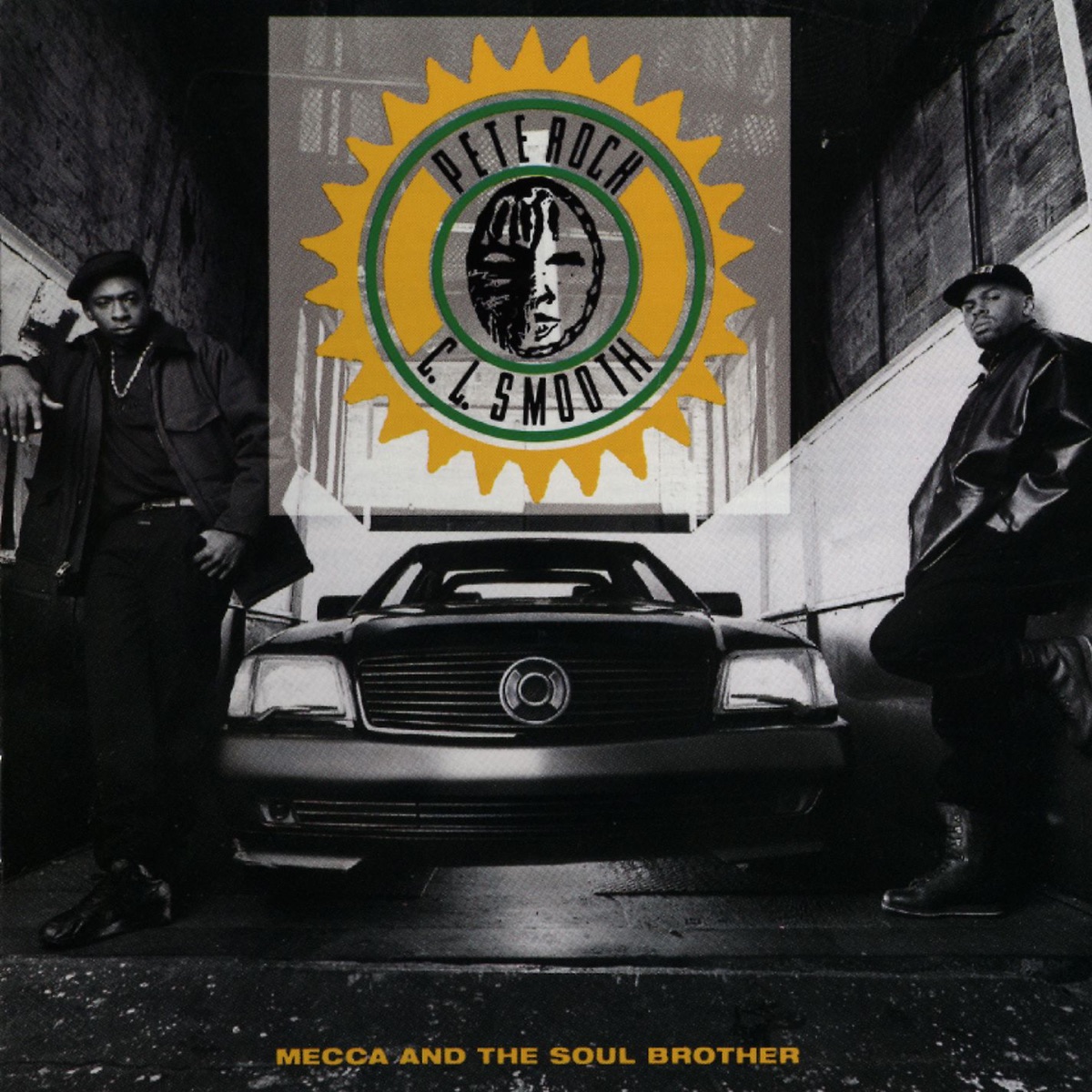
Cover artwork for Pete Rock & C.L. Smooth — They Reminisce Over You (T.R.O.Y.).
They Reminisce Over You gives Pete Rock’s SP-1200 account a record to hold onto; the cover identifies the release, not every part or hardware revision.

Pete Rock & C.L. Smooth / “They Reminisce Over You”.

Pete Rock explicitly identifies an SP-1200 in the making of “They Reminisce Over You (T.R.O.Y.)”. He does not allocate every part or specify a revision, but his own account puts the sampler inside one of hip-hop’s most enduring memorial records.

Read The Dirty Heartbeat of the Golden Age ↗

More records in the archive

The machine keeps turning up.
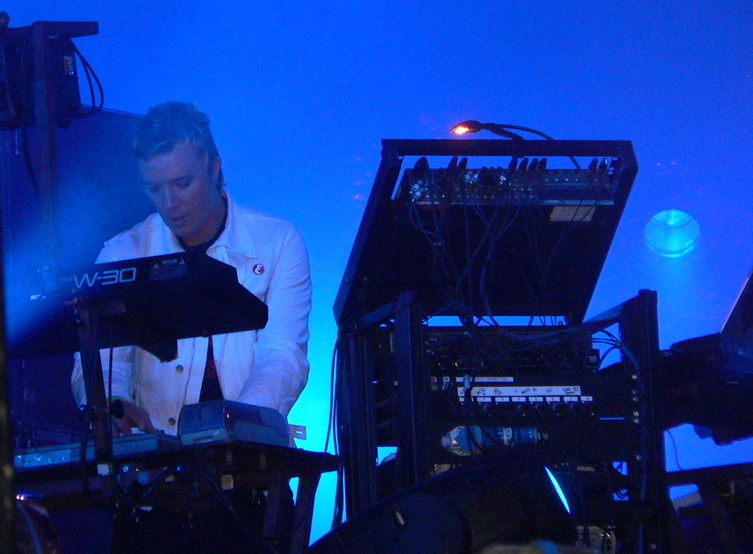
Liam Howlett performing with The Prodigy at SonneMondSterne Festival in 2005.
Liam Howlett performing with The Prodigy at SonneMondSterne Festival in 2005, photographed by Herr Stern. It identifies Howlett in the Firestarter-era studio story; it does not show the 1997 studio or the listed machines.

Liam Howlett / The Prodigy / Firestarter-era studio, no individual track allocation

Sound On Sound’s Firestarter-era studio feature lists a E-mu SP-1200 among Liam Howlett’s drum machines.

Read Liam Howlett / The Prodigy — Firestarter-era studio gear ↗
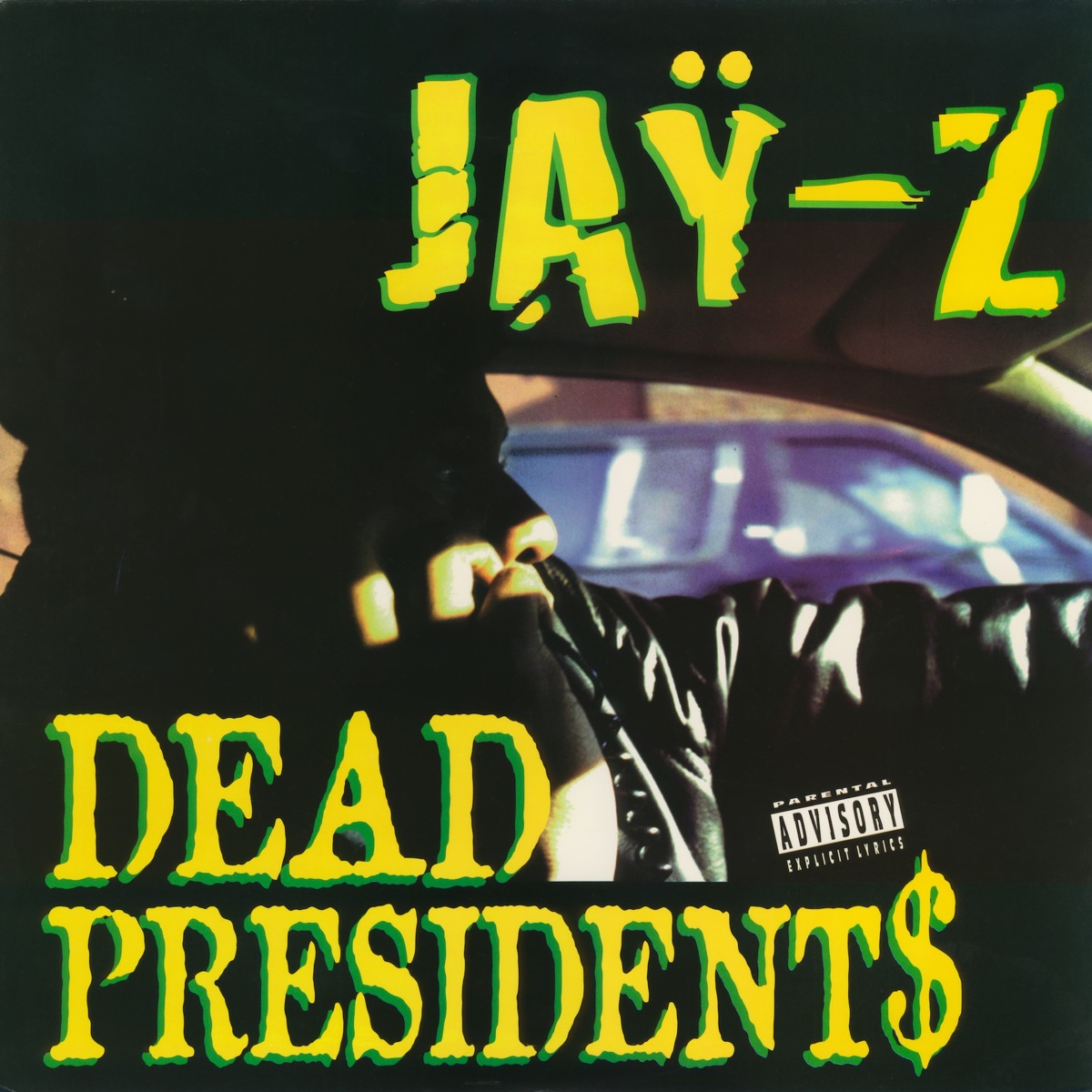
Cover artwork for Jay-Z — DEAD PRESIDENTS.
Dead Presidents gives Ski’s SP-1200 account a record to stand beside; the artwork identifies the release, not its exact version or routing.

Jay-Z / Dead Presidents

Producer identifies sequencing, drums and Nas sample; another sample passed through it.

Read The Dirty Heartbeat of the Golden Age ↗
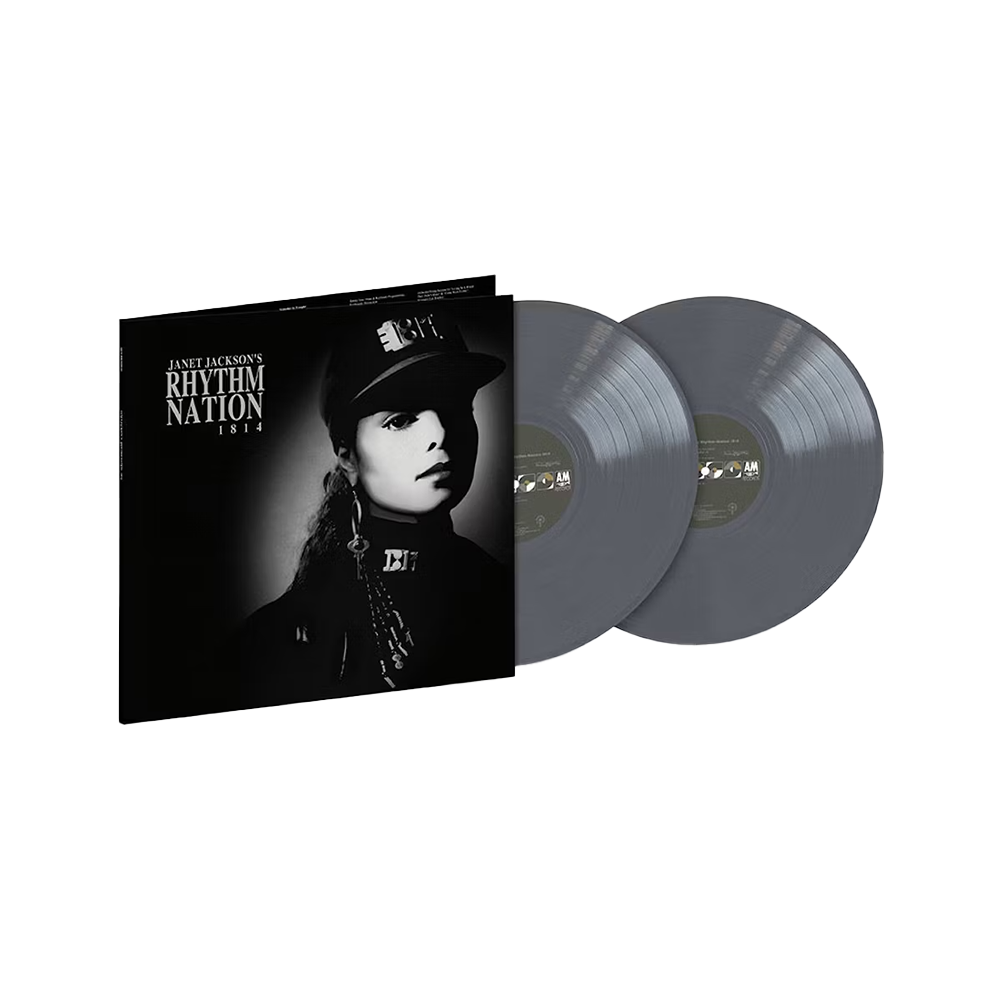
Janet Jackson’s Rhythm Nation 1814 official store artwork.
Janet Jackson’s official-store image for Rhythm Nation 1814. It identifies the record context, not the SP-1200 or a particular session.

Janet Jackson / Jimmy Jam and Terry Lewis / “Miss You Much”, “Escapade” and “Love Will Never Do (Without You)”

The published account identifies an E-mu SP-1200 on three Rhythm Nation tracks: “Miss You Much”, “Escapade” and “Love Will Never Do (Without You)”.

Read The Making of Janet Jackson’s Rhythm Nation 1814 ↗
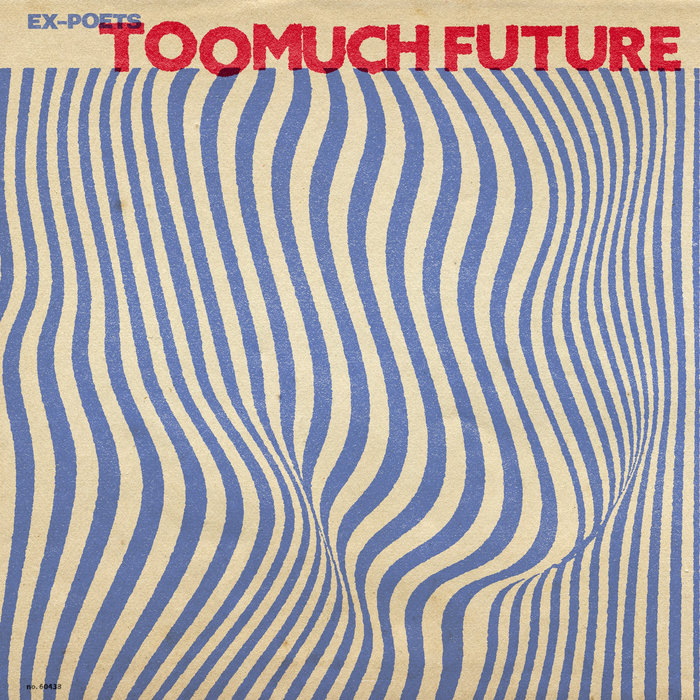
Cover artwork for Ex-poets — Too Much Future.
Ex-poets — Too Much Future: retained artwork identifies the release or source-recording context, not a machine, session or sound allocation.

Ex-poets / Too Much Future

Ex-poets say Jordan began their collaboration by emailing songs with grooves and beats mapped on an E-mu SP-1200 before Colin Killalea added melodic material.

Read Ex-poets / Too Much Future ↗
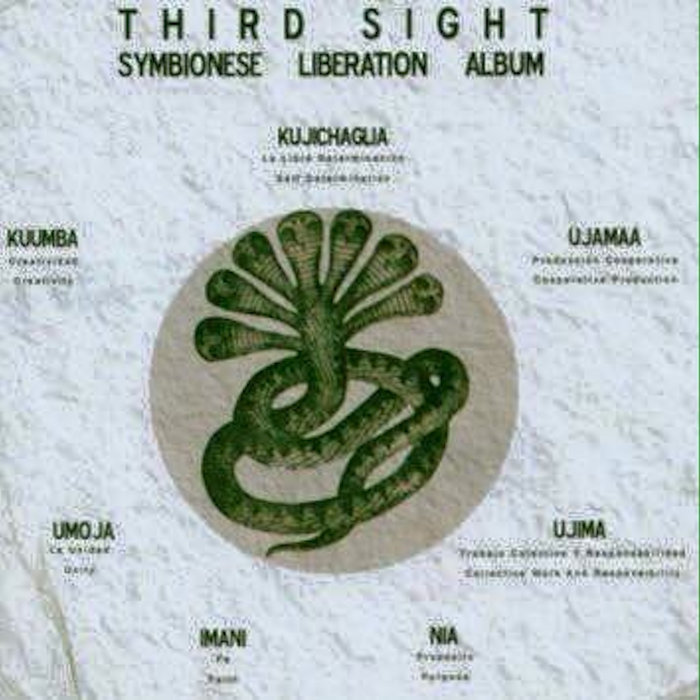
Cover artwork for Third Sight — The Symbionese Liberation Album.
Third Sight — The Symbionese Liberation Album: retained release artwork gives the documented machine story a record-world context; it does not depict the hardware, a session, or an individual track allocation.

Third Sight / The Symbionese Liberation Album

Third Sight’s album notes list the E-MU SP-1200 among the equipment used to make the album.

Read Third Sight — The Symbionese Liberation Album ↗
MUSIC HISTORY

In the market

  • 1987-10: GBP 2199 — UK contemporary review price. Original E-mu SP1200 reviewed Source ↗

On record

  • Pete Rock & C.L. Smooth — They Reminisce Over You (T.R.O.Y.). Producer explicitly identifies SP1200 use. Source ↗
  • Jay-Z — Dead Presidents. Producer identifies sequencing, drums and Nas sample; another sample passed through it. Source ↗
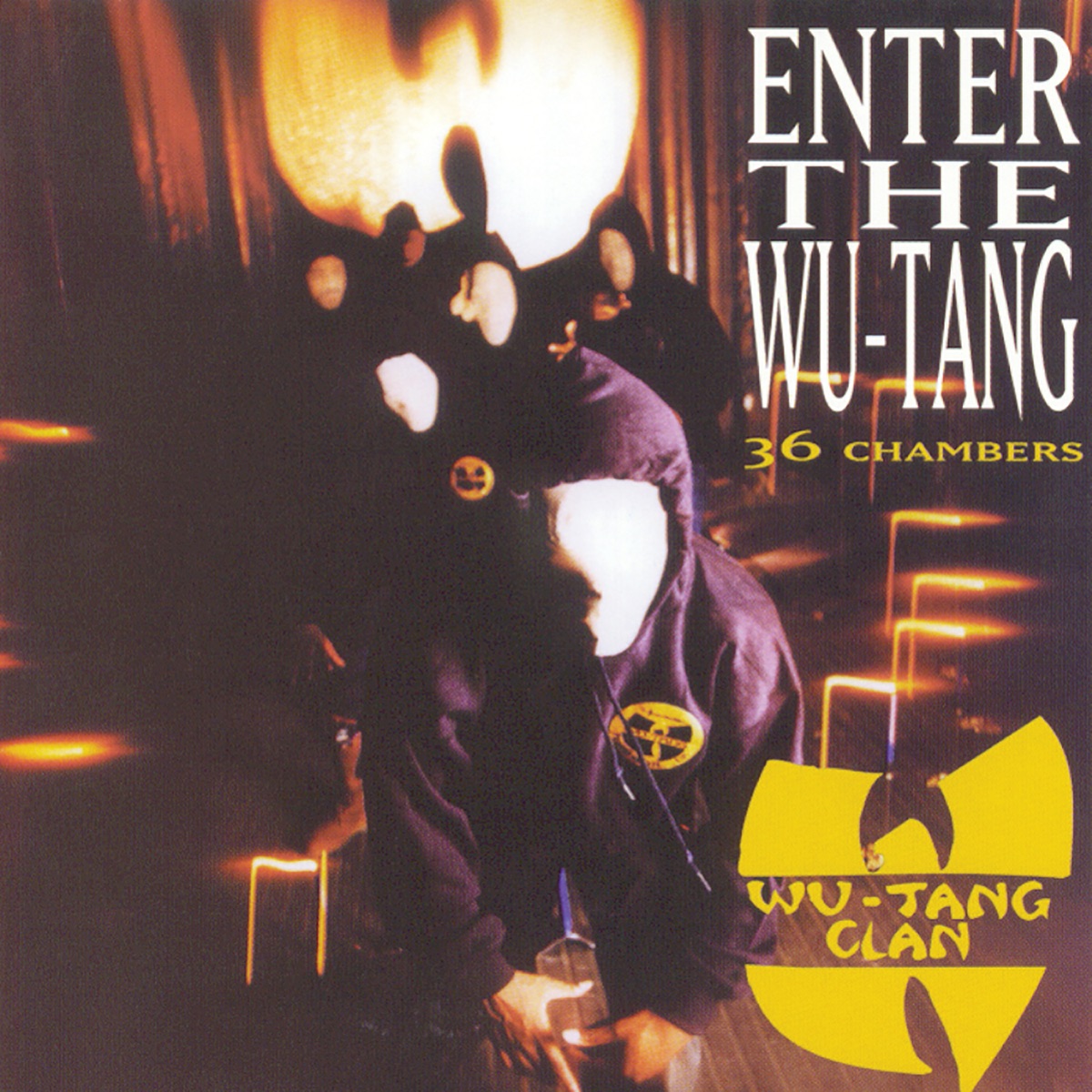
  • Wu-Tang Clan / RZA — Enter the Wu-Tang (36 Chambers). The catalogue identifies RZA's signed ca. 1991 SP-1200 as the unit used to produce Wu-Tang Clan's 1993 debut album. Source ↗
  • Janet Jackson / Jimmy Jam and Terry Lewis — “Miss You Much”, “Escapade” and “Love Will Never Do (Without You)”. The published account identifies an E-mu SP-1200 on three Rhythm Nation tracks: “Miss You Much”, “Escapade” and “Love Will Never Do (Without You)”. Source ↗
  • Ex-poets — Too Much Future. Ex-poets say Jordan began their collaboration by emailing songs with grooves and beats mapped on an E-mu SP-1200 before Colin Killalea added melodic material. Source ↗
  • Third Sight — The Symbionese Liberation Album. Third Sight’s album notes list the E-MU SP-1200 among the equipment used to make the album. Source ↗
01 // Landmark

Sample, trim and play

Record a short sound or load one from disk, trim it and play it from a pad. The SP-1200 has no permanent internal kit: the player supplies its sounds. Eight pads address one of four banks, with faders above them for level, tuning or decay. The same panel records the sounds and writes the rhythm.

SP-1200 Owners Manual, E-MU PN FI 332 Rev. E ↗ E-mu SP1200, pp.22–28 ↗

02 // Landmark

Ten seconds in four zones

The original machine’s ten-second total is divided into four independent 2.5-second zones. A sample must fit within one zone, even when unused space remains elsewhere. Trimming can return space for another sound. This allocation rule is more useful than treating ten seconds as one continuous recording slot.

SP-1200 Owners Manual, E-MU PN FI 332 Rev. E ↗ E-mu SP1200, pp.22–28 ↗

03 // Landmark

Segments, songs and a disk

Patterns are written as segments and assembled into songs, with mix recalls and tempo changes. The built-in 3.5-inch drive saves sounds and sequences between sessions. That storage belongs to the original SP-1200 workflow; it is a practical distinction from the earlier SP-12, not a reason to merge their recording histories.

E-mu SP1200, pp.22–28 ↗ SP-1200 Owners Manual, E-MU PN FI 332 Rev. E ↗

04 // Landmark

Pete Rock and Ski name their records

Pete Rock identifies the SP-1200 on ‘They Reminisce Over You (T.R.O.Y.)’, recalling a Tom Scott record as his starting point. In the same oral history, Ski names the sequence, drum sounds and Nas sample for ‘Dead Presidents’, while distinguishing another sample that passed through the machine. Their testimony identifies uses, not a complete routing sheet or hardware revision.

The Dirty Heartbeat of the Golden Age ↗

05 // Landmark

A surviving RZA instrument

Sotheby’s 2023 catalogue attributes a signed, circa-1991 SP-1200 to RZA’s production of Enter the Wu-Tang (36 Chambers). That is the auction house’s provenance claim for a particular object. It does not independently document every session or allocate every beat and sample to that unit.

RZA's signed E-mu SP-1200 used to produce Enter the Wu-Tang (36 Chambers), lot 61 ↗
06 // Landmark

The original and the later reissue

Later reintroduction reports and Rossum Electro-Music’s modern SP-1200 belong to separate phases of the instrument’s history. Rossum’s current documentation specifies twenty seconds of sampling and memory-card storage for its reissue. Those facilities should not be read into an original ten-second, floppy-based machine.

What's New ↗ The SP-1200 Sampling Percussion System ↗ SP-1200 (2021–2025), manufacturer product archive ↗

Sources

  1. NAMM Report, pp.63–69
  2. E-mu SP1200, pp.22–28
  3. SP-1200 (2021–2025), manufacturer product archive
  4. The Dirty Heartbeat of the Golden Age
  5. SP-1200 Owners Manual, E-MU PN FI 332 Rev. E
  6. Theo Parrish — Seattle 2005 lecture
  7. Sampling, music and the history of technology
  8. (Dis)locating Democratization: Music Technologies in Practice
  9. The SP-1200 Sampling Percussion System
  10. RZA's signed E-mu SP-1200 used to produce Enter the Wu-Tang (36 Chambers), lot 61
  11. What's New, p.16
  12. What's New
  13. The E-mu SP-1200: How one sampler ushered in a revolution
  14. SP1200 Service Manual

The visual archive

Further visual evidence.

Sources for images shown earlier (8)
Additional visual sources (3)

Original publications and related image sources.

  • The Shape of Things to Come ↗
    Aug 1987 · Sound On Sound · E-mu SP-1200 Sampling Percussion System product photograph with marking and image-specific caption;
  • E-mu SP1200 ↗
    Oct 1987 · Sound On Sound · E-mu SP-1200 product photograph with SP 1200 and E-mu Systems markings visible, restored to its dedicated review and separated from inherited SP-12 context.
  • E-mu SP1200 ↗
    Oct 1987 · Sound On Sound · E-mu SP1200 rear-panel photograph from the dedicated SP1200 review; it is not transferred to the earlier SP-12 dossier.

Machine Museum image viewer

Period image shown in the dossier.