
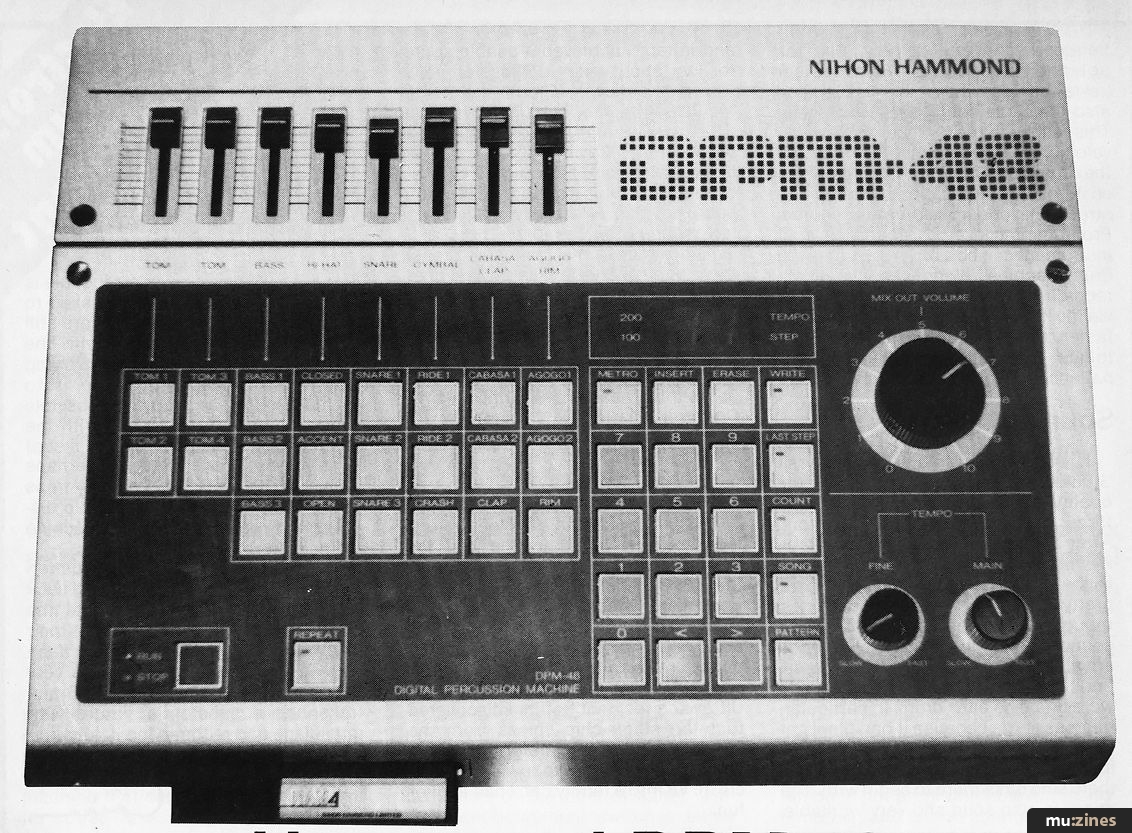
A December 1984 American product notice introduced the Sakata DPM 48 through Multivox. The DPM-48 manual describes twenty-two recorded voices, forty-eight patterns and arrangements kept on a removable RAM cartridge.
The machine in the record
Prince / a reported DPM-48 connection.
Collector accounts have linked Prince to the DPM-48, with one owner describing him as the only user they had encountered. It is a reported association, not a session credit, but it belongs on the page as a clearly labelled lead around an exceptionally obscure machine.
Read Sakata DPM48 ↗Tap it, then work through the steps
A part can start with the drum keys and the metronome. The DPM-48 manual then offers step entry for placing individual hits, and allows the two methods to be used together. That gives a player room to sketch a rhythm with the hands and work through its details afterward. Automatic correction follows the chosen Count and Last Step settings; it is part of how the machine turns a played gesture into a repeating pattern.
Recorded drums, separate playing keys
The manual presents twenty-two digitally recorded voices on a panel that separates voice selection from programming. It also describes recorded sympathetic drum sounds as part of its claim to realism. That is the manual’s explanation of the recordings, rather than evidence that the machine models acoustic interaction between voices. The immediate attraction is more tangible: the player has dedicated keys for the sounds and a distinct set of controls for putting them in order.
Keep the bars, build the arrangement
Forty-eight pattern locations form the material for three songs, each with 256 addresses. The RAM cartridge keeps the patterns and songs together; additional cartridges were offered as a way to build a library of arrangements. Insert and Erase allow revisions, while the normal and fine tempo controls make the pulse easier to adjust. The manual’s approximate one-year battery rating describes the original cartridge design, not a guarantee that an old cartridge will still preserve its contents.
A repeat under the foot
Repeat gives the arrangement a little room to move. The manual describes calling it from the panel key beside Run/Stop or an optional footswitch, and using it to repeat a section or move between patterns for a break or fill. For a musician already playing another instrument, that puts a useful change within reach without requiring another pass through the programming keys.
The Sakata name in America
Modern Recording & Music’s December 1984 product notice placed the Sakata DPM 48 with Multivox in the United States. It is the territorial anchor for this page. The English-language manual reproduced here names DPM-48 but has no confirmed issuer on its inspected cover, so its instructions are presented as the shared DPM-48 operating document. The contemporary British Hammond review provides a related account; it does not identify every component fitted to a Sakata example.
The Market Place: Sakata Digital Drum Machine ↗ DPM-48 Owner’s Manual ↗ Hammond DPM-48 ↗
On record
- Prince. Prince is sometimes linked to the DPM-48 in collector accounts: an owner writing under the name hinotori mortal called him the only user of the machine they had heard of. It is a tantalising lead, not a session credit. Source ↗
Sources
The visual archive
Further visual evidence.
Sources for images shown earlier (1)
Additional visual sources (1)
Original publications and related image sources.
- Sakata DPM48 distributed by Multivox ↗
December 1984 · Modern Recording & Music · Printed p.62/PDF64, lower-left photograph and adjacent column