
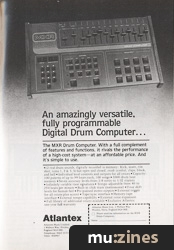
British reviews document the MXR 185 in August, September and October 1983. Rick Palmer tested an early unit with a draft manual; his £1,500 UK RRP included VAT. The reviews establish contemporary availability and operation, not an exact first-shipment date.
The machine in the record
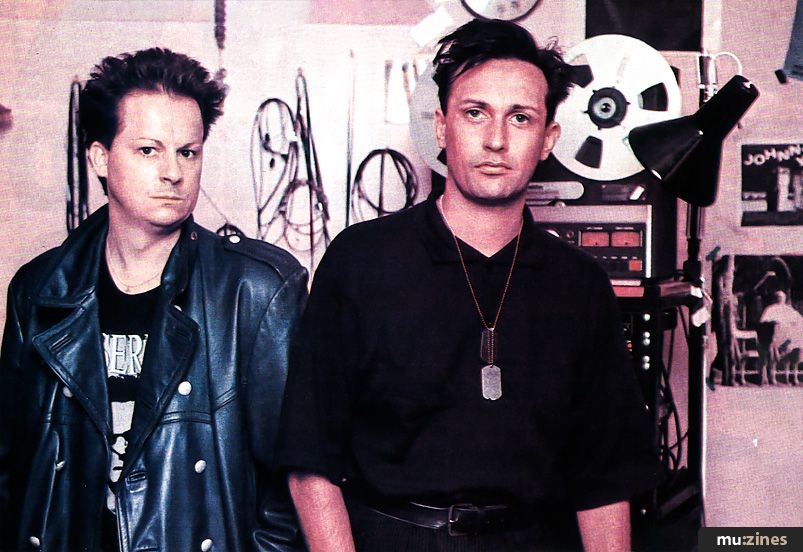
Cabaret Voltaire / the 1984 writing room.
Richard H. Kirk called the MXR Drum Computer Cabaret Voltaire’s main drum machine, preferring its sharper, clearer sounds to the LinnDrum. He described starting rhythm-led songs with the pattern, which makes the machine a genuine point of departure rather than a late studio ornament.
Read Life is a Cabaret ↗More records in the archive
The machine keeps turning up.
Cabaret Voltaire / Richard H. Kirk and Stephen Mallinder / 1984 working setup
A 1984 Cabaret Voltaire account describes the MXR Drum Computer as the group’s main drum machine and contrasts its sharper sounds with the LinnDrum.
Read Cabaret Voltaire on the MXR Drum Computer ↗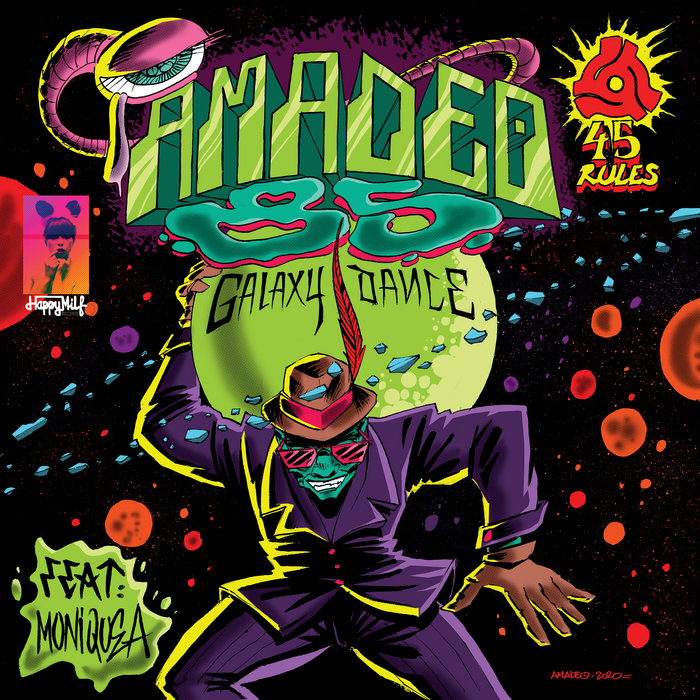
Amadeo 85 feat. Moniquea / Galaxy Dance / Play It Loud
The release credits the MXR 185 as the A-side drum machine.
Read Amadeo 85 feat. Moniquea — Galaxy Dance / Play It Loud ↗In the market
- 1983-08: GBP 1500 — UK review RRP. MXR Drum Computer; options unspecified Source ↗
- 1983-09: GBP 1400 — Approximate UK review price. MXR Drum Computer; options unspecified Source ↗
On record
- Cabaret Voltaire / Richard H. Kirk — Cabaret Voltaire’s 1984 writing and recording practice. Kirk calls the MXR Drum Computer the group’s main drum machine, says he preferred it to the Linn for sharper, clearer sounds, and describes starting rhythm-based songs with the drum pattern. Source ↗
- Amadeo 85 feat. Moniquea — Galaxy Dance / Play It Loud. The release credits the MXR 185 as the A-side drum machine. Source ↗
In the studio and on stage
- Cabaret Voltaire / Richard H. Kirk and Stephen Mallinder — 1984 working setup. A 1984 Cabaret Voltaire account describes the MXR Drum Computer as the group’s main drum machine and contrasts its sharper sounds with the LinnDrum. Source ↗
A rhythm part under the player’s hand
Select an empty pattern, enter its length and start recording against the click. The MXR repeated the loop while the player tapped its twelve voice buttons, adding parts on successive passes. Accuracy moved notes onto the chosen grid; Erase removed a voice at the unwanted beat. Setting length to zero cleared the pattern. The September 1983 reviewers advised slowing the tempo to enter complicated fills, then returning it to playing speed. This was real-time entry with correction, not a row of switches marking every step.
MXR 185 Drum Computer ↗ MXR Drum Computer ↗ MXR Drum Computer ↗
From a loop to an arrangement
Rick Palmer’s August review describes copying a pattern before altering it, or doubling its length without entering every hit again. In Song mode, pattern numbers were inserted in order; the display showed the current step and pattern, and Insert/Delete revised the sequence. He reported space for up to one hundred patterns and one hundred songs. Tape saving provided an external library, while battery-backed memory retained work after power-off.
A kit to mix, with limits
The twelve recorded voices included three toms, two hi-hat articulations and a crash. Open and closed hats shared their level slider and output. Ian Gilby’s October review documents a pre-panned stereo mix and fixed-level individual outputs; plugging into an individual socket did not remove that voice from the main mix. Pitch moved every sound together and was not stored with the rhythm. Gilby criticised the crash’s abrupt cutoff.
Starting with the rhythm at Western Works
In November 1984, Richard H. Kirk named the MXR as Cabaret Voltaire’s main drum machine. He preferred its sounds to the Linn’s and described starting rhythm-led pieces with the drum pattern before layering other parts on tape. The interview connects the instrument to a writing method, without isolating a named track. A later credit is more specific: Amadeo 85’s 2020 release lists the MXR 185 for the A-side, ‘Galaxy Dance’. Its B-side equipment list names other drum machines; the MXR credit must not spread across the whole release.
Life is a Cabaret ↗ Amadeo 85 feat. Moniquea — Galaxy Dance / Play It Loud ↗
Sources
The visual archive
Further visual evidence.
These displayed records are labelled by their documented role, date and source; source-only records are listed separately below.
Sources for images shown earlier (3)
- Atlantex MXR Drum Computer advertisement ↗
- Amadeo 85 feat. Moniquea — Galaxy Dance / Play It Loud ↗
2020-11-13 · Amadeo 85 feat. Moniquea / release artwork via Bandcamp · Official Bandcamp release-page artwork (Open Graph image) - Cabaret Voltaire in “Life is a Cabaret” ↗
November 1984 · Electronics & Music Maker / mu:zines · Article opening photograph, “Life is a Cabaret”, pp. 50–52
Additional visual sources (3)
Original publications and related image sources.
- MXR Drum Computer ↗
Aug 1983 · Music UK · MXR Drum Computer 185 product photograph with model marking clearly visible. - MXR Drum Computer ↗
Aug 1983 · Music UK · MXR Drum Computer 185 product photograph with MXR and Drum Computer markings visible. - MXR Drum Computer ↗
Aug 1983 · Music UK · Clearly marked MXR Drum Computer product photograph from the August 1983 review; the pictured unit matches the Museum Computer Rhythm 185 dossier.