
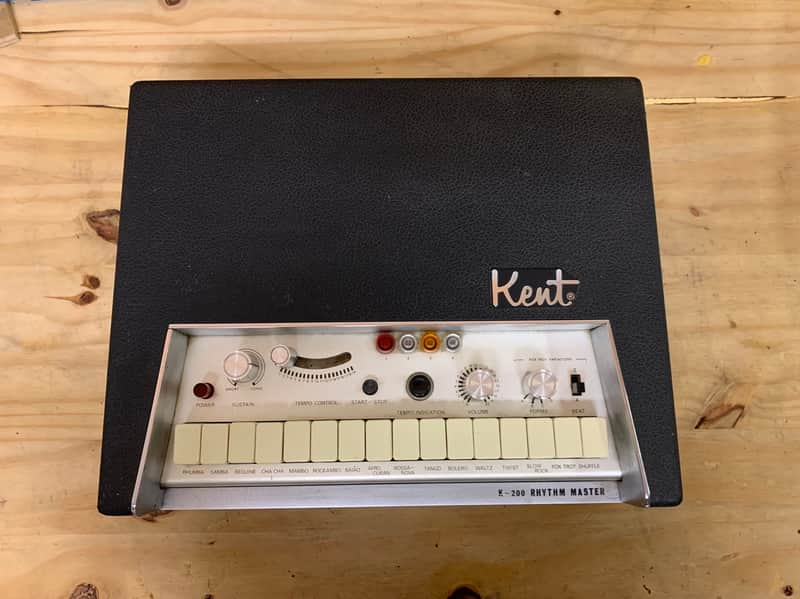
A surviving Kent K-200 Rhythm Master preserves the model name and its preset-button panel. The available listing and later indexes do not establish its original manufacturer or launch date.
Surviving instrument
The evidence begins with the box itself.
A surviving K-200 gives the Museum its most useful starting point: the Kent name, the control panel and the cabinet all in one view. The object is the story here, a compact Japanese rhythm machine whose identity deserves to be kept visible.
See the surviving K-200 ↗The machine in the record
BooTweak Sounds / Deconstructed2.
The Kent K-200 appears in the source-instrument list for BooTweak’s Kontakt work with NoDoughMusic’s Deconstructed2 library. It is sampled-library lineage, not a named song or hardware-session credit, and another way a scarce preset box became playable again.
Read BooTweak for Kontakt 4 ↗More records in the archive
The machine keeps turning up.
Reported association
Moby / Reported Kent K-200 mention
A Reverb seller listing a Kent K-200 remarked that Moby’s K-200 “looks different,” preserving a reported association between Moby and the model.
Read Kent K-200 Rhythm Master ↗On record
- BooTweak Sounds / NoDoughMusic — BooTweak for Kontakt 4. The Kent K-200 appears in the source-instrument list for BooTweak’s Kontakt work with NoDoughMusic’s Deconstructed2 library: another route by which a scarce preset box became a contemporary playable kit. Source ↗
Rhythm buttons across the front
The photographed K-200 has a black textured cabinet and a recessed silver-coloured panel. Its long row of ivory-coloured buttons carries rhythm names including Samba, Bolero, Cha Cha and Mambo. Above them are a curved tempo control, a Start–Stop button and Volume and Balance knobs. The photograph makes the layout legible; it does not establish how combinations work or how this specimen sounds.
A model name, not a factory history
The Reverb listing identifies the instrument as a Kent K-200 Rhythm Master and classifies it as made in Japan. Drummachines.de also lists that model name. Neither supplies a dated factory history. The seller’s remark that a K-200 associated with Moby looks different remains an uncorroborated comparison, not an ownership or recording credit for the photographed machine.
Twenty sample files
Drum Abuse lists a Kent K-200 sample set with twenty files and an approximate 1975 date. It also lists a Kent Rhythm Master set with twenty files under approximately 1972. These are modern archive labels, not evidence of two factory releases or twenty rhythms. The files preserve a route for further sound research, but their labels alone cannot settle the relationship between the entries or authenticate the original machines.
Sources
The visual archive