
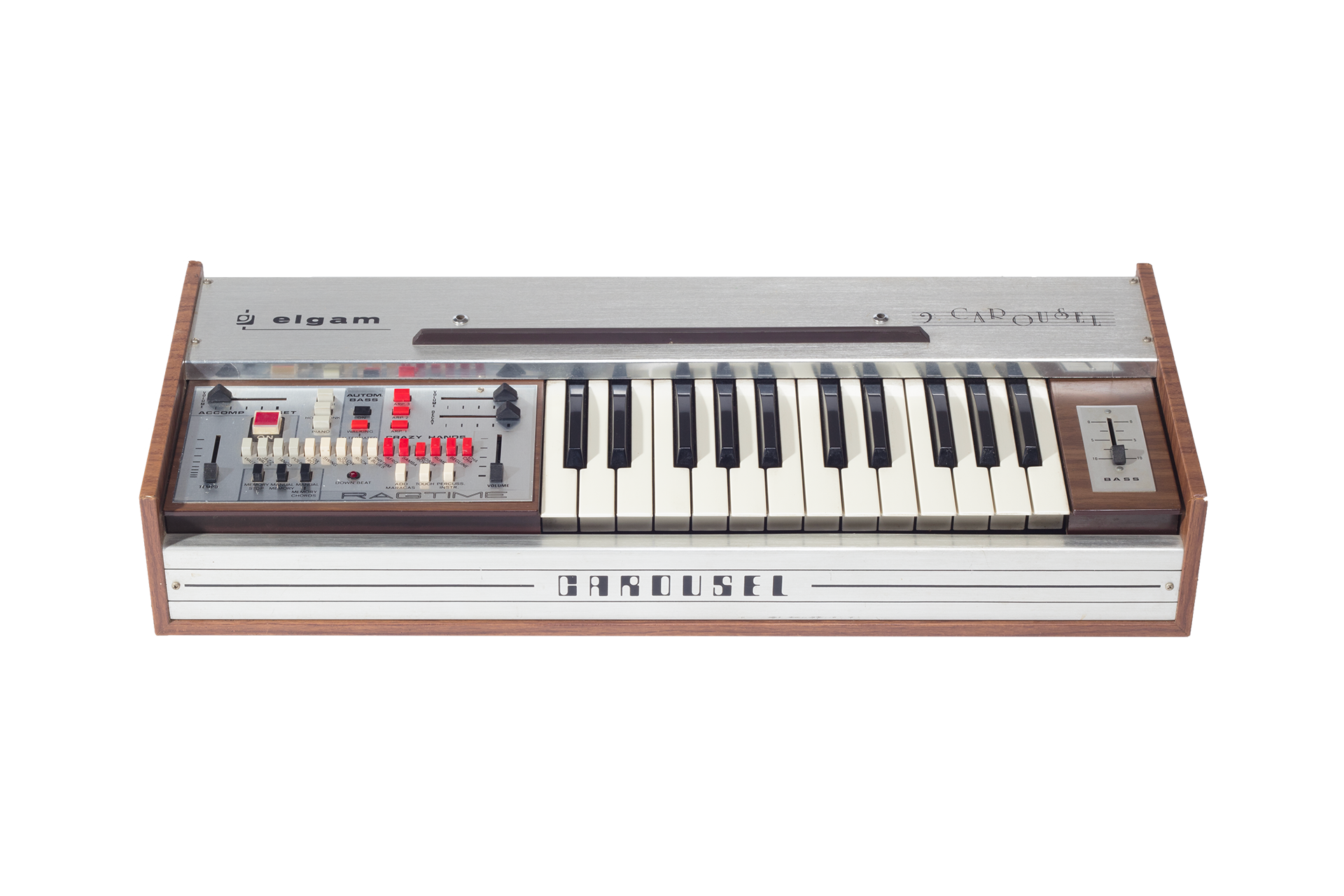
J. T. Coppock announced the Carousel in British trade coverage by August 1976 as a rhythm unit that could stand alone or be incorporated into an organ; it was priced at £295 including VAT in a December 1978 guide. A current Swiss museum collection record makes its 25-key automatic-accompaniment design inspectable while remaining retrospective evidence.
The machine in the record
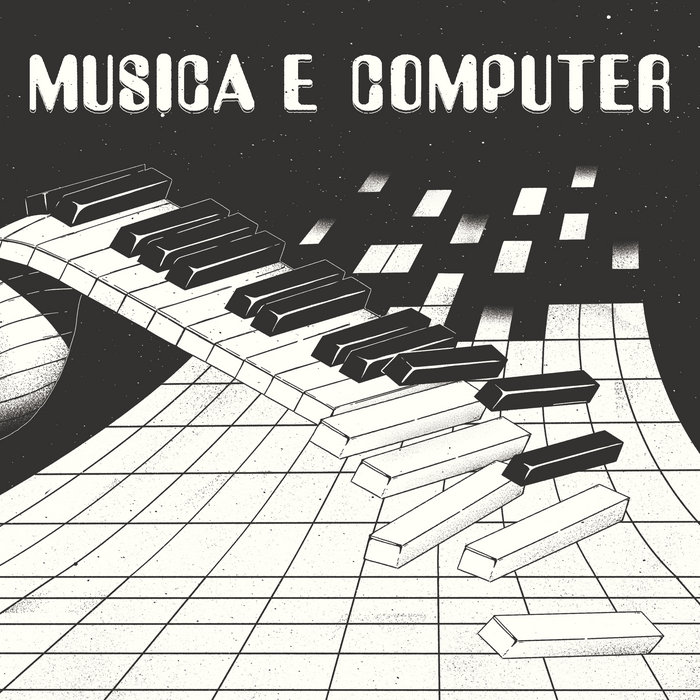
Rodion & Mammarella / Musica E Computer.
The Musica E Computer credits name Agostino Maria Ticino playing an Elgam Carousel. The album-wide credit does not establish that Carousel percussion appears in any particular passage, but it gives the unusual Italian instrument a properly bounded place in a contemporary record.
Read Musica E Computer: official release credits ↗More records in the archive
The machine keeps turning up.
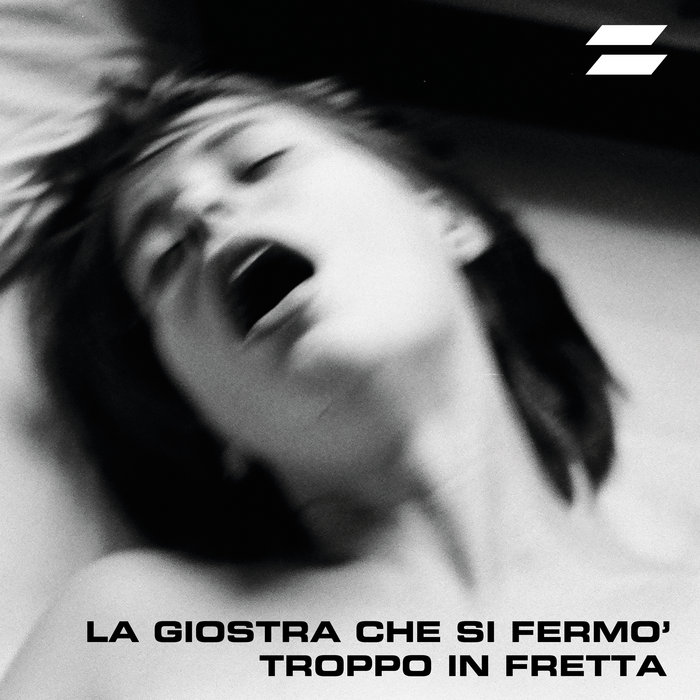
Vladimir Kabanov / La Giostra che si Fermo' Troppo in Fretta
The release credits Vladimir Kabanov with Elgam Carousel on the imaginary-giallo soundtrack.
Read Vladimir Kabanov / Elgam Carousel ↗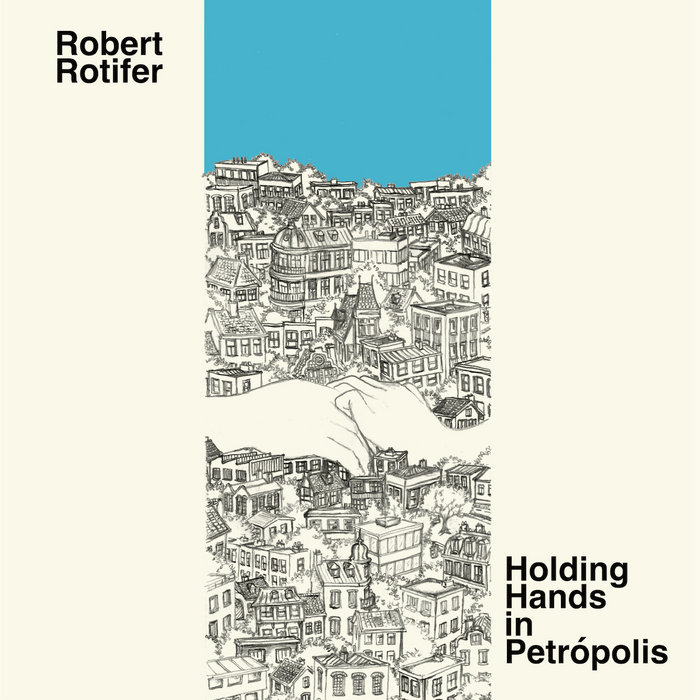
Robert Rotifer / “He’s Not Ill” from Holding Hands in Petropolis
Robert Rotifer’s direct credits name an Elgam Carousel among the instruments on “He’s Not Ill”.
Read Robert Rotifer — “He’s Not Ill” ↗A one-player band in a wooden case
The Carousel looks less like a drum machine than a compact automatic orchestra. The surviving museum specimen has a 25-key keyboard across its centre, a dense accompaniment section to the left and a dedicated bass control to the right. The rhythm unit is only one part of the proposition. A player could set a key, bring in bass, chords and arpeggios, then use fixed rhythm patterns to make the small keyboard behave like a much larger arrangement. This is why the Carousel matters in a drum-machine history: it makes rhythm the organizing pulse of a complete accompaniment system.Sources (2)
The announcement that fixes its arrival
A contemporary August 1976 Beat Instrumental fair survey supplies the firmest early public marker. Reporting from J. T. Coppock, it says Elgam hoped to show a new Carousel rhythm unit, available either separately or incorporated in an organ, and names memory chords and arpeggios as its defining additions.But it decisively places the Carousel in the British trade conversation by August 1976, earlier than later accounts that casually begin its story in 1977.Source (1)
Fifteen rhythms, but no step programming
The museum collection description and a hands-on surviving-unit account both identify fifteen fixed rhythms, with the latter describing them as a rhythm section that can be combined by pressing more than one choice. That is a different kind of freedom from a programmable sequencer. The Carousel does not ask its musician to place each drum hit; it makes a ready-made rhythmic grammar available, then lets bass, chord and arpeggio behaviour follow the selected tonality. Its interest lies in the coordination of roles, not in open-ended drum composition.Sources (2)
Crazy Hands and memory chords
The original trade description already named memory chords and arpeggios. Later accounts call the arpeggiator section Crazy Hands and describe three arpeggio patterns, adjustable decay and volume, while the museum record describes independently controllable drum, bass, chord and arpeggiator ranges. These reports agree on the central design: harmony is not merely held under a rhythm; it is translated into an animated accompaniment. The exact control implementation is documented best by the collection specimen and surviving-unit account, while the 1976 survey establishes that chords and arpeggios were part of the new unit's public identity from the start.
Separate unit, organ option, British price
The Carousel was not locked to one form. The 1976 survey explicitly says it could be supplied separately or incorporated into an organ. A 1978 Beat Instrumental price guide lists the separate Carousel rhythm unit at £295 including VAT. Together, the two sources show an accompaniment architecture designed to migrate between a dedicated keyboard-like package and the organ market from which much automatic-rhythm technology grew.Sources (2)
The Carousel in a collection
A current Swiss museum collection record gives a clear view of the Carousel’s twenty-five-key layout and wood-cased presence. It shows the instrument as a surviving object: a substantial automatic-accompaniment unit built to be seen as well as heard.Sources (2)
Back in a contemporary studio
Slow Motion Records credits the Elgam Carousel on Rodion & Mammarella’s 2024 Musica E Computer, played by Agostino Maria Ticino. It is a fitting return for an instrument whose original purpose was to turn one player into a small ensemble.
The Carousel returns to a record
Slow Motion Records credits Agostino Maria Ticino with Elgam Carousel on Rodion & Mammarella’s Musica E Computer.Source (1)
In the market
- 1978-12: GBP 295 — UK magazine recommended-retail price guide. Carousel rhythm unit Source ↗
On record
Sources
- BMITF survey: J. T. Coppock, p.84
- Trade report: J. T. Coppock, p.72
- Equipment price guide introduction p.84 and Elgam keyboard listing p.91
- Elgam Carousel: owner description
- Swiss Museum for Electronic Music Instruments: Elgam Carousel
- Elgam Carousel: retrospective origin and designer claims
- Musica E Computer: official release credits
- Carousel schematic listing
- Carousel owner manual wanted: archive exchange list
The visual archive
Further visual evidence.
Sources for images shown earlier (3)
- Elgam Carousel — front collection view ↗
- Vladimir Kabanov — La Giostra che si Fermo' Troppo in Fretta ↗
Release date not stated on source page · Vladimir Kabanov / release artwork via Bandcamp · Official Bandcamp release-page artwork (Open Graph image) - Robert Rotifer — “He’s Not Ill” from Holding Hands in Petropolis ↗
2023-09-15 · Robert Rotifer / release artwork via Bandcamp · Official Bandcamp release-page artwork (Open Graph image)
Additional visual sources (3)
Original publications and related image sources.
- BMITF survey: J. T. Coppock, p.84 ↗
1976-08 · Beat Instrumental · Printed p.84; PDF page 84; cover PDF page 1 - Trade report: J. T. Coppock, p.72 ↗
1977-03 · Beat Instrumental · Printed p.72; PDF page 72; cover PDF page 1 - Price guide: keyboards, J. T. Coppock/Elgam, p.91 ↗
1978-12 · Beat Instrumental · Printed/PDF pp.84 and 91; cover PDF page 1