
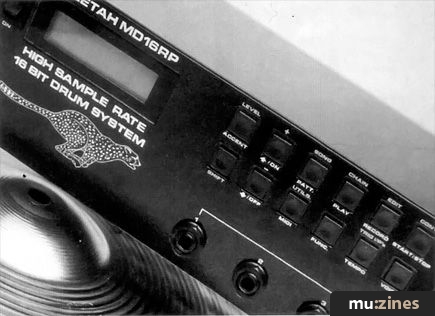
Cheetah’s MD16RP put sixteen digital drum voices into a rack-mounted system for the MIDI studio. It traded a large desktop surface for a compact, expandable module that could sit behind the mixer and respond to pads, sequencers and keyboards.
Factory manual
The rack system is the story.
The MD16RP manual shows the expanded Cheetah as a practical system, built to work with the MIDI furniture of its moment. Its rack format tells us as much about the intended studio as any sales slogan.
Open the MD16RP manual ↗The machine in the record
Alex Tronic / an MD16RP in the room.
Paul Croan explicitly identifies a Cheetah MD16RP in his studio equipment. There is no claimed track or signal path, so the account stays modest: a rack rhythm machine still present in a producer’s practical working environment.
Read Show Off Your Studio: Alex Tronic’s sonic attic is a vintage synth treasure trove ↗Drum pads at the front of the rack
Connect up to eight drum pads or piezo triggers to the MD16RP’s front-panel inputs. A strike calls up an assigned percussion sound; gain and threshold settings help the module respond to the player’s touch. The RP’s two-unit rack case makes room for those inputs, distinguishing it from the single-unit MD16R.
Cheetah MD16R & MD16RP ↗ MD16RP Digital Drum System manual, issue 2.0 ↗
Patterns, sounds and cartridges
The MD16 family joins editable percussion with pattern and song programming. MIDI and programmable footswitches let the rack work with other instruments and the performer’s feet. Sound cartridges extend the material available, although cartridge coverage of the family does not establish every rack-specific compatibility detail.
Cheetah MD16R & MD16RP ↗ Cheetah MD16 Sound Cartridges ↗ MD16RP Digital Drum System manual, issue 2.0 ↗
Learning the small panel
Nigel Lord’s May 1992 review welcomed direct pad entry but found the programming system demanding: many functions sat behind relatively few buttons. The RP had no trigger LEDs to show which input had fired. Setting its response meant working through the trigger menu rather than watching a row of activity lights.
An RP in Alex Tronic’s studio
Paul Croan, working as Alex Tronic, explicitly names an MD16RP in his studio equipment. Nicholas Rowland’s later retrospective and C. Y. Kong’s owner account describe other working rack machines. These accounts follow the instrument into later studios, without assigning it to a particular track.
Show Off Your Studio: Alex Tronic’s sonic attic is a vintage synth treasure trove ↗ Cheetah MD16: Drum Machine (Retro) ↗ MD16R / MD16RP and Me ↗
Sources
- MD16RP Digital Drum System manual, issue 2.0
- MD16R / MD16RP and Me
- Cheetah MD16R & MD16RP
- MD16RP: Rackmount Digital Drum Synthesizer with Pad Inputs
- Cheetah MD16 Sound Cartridges
- Synthesized 2026: Bob Pearson exhibitor biography
- Cheetah MD16: Drum Machine (Retro)
- Show Off Your Studio: Alex Tronic’s sonic attic is a vintage synth treasure trove
The visual archive
Further visual evidence.
Sources for images shown earlier (1)
Additional visual sources (4)
Original publications and related image sources.
- MD16RP Digital Drum System manual, issue 2.0 ↗
1991 copyright · Cheetah International Ltd · All 18 PDF pages inspected: cover, contents, printed pp. 1–15 and final guarantee page. Factory panel drawings p. 5; trigger-response diagrams p. 10. - MD16RP panels, interior and modifications ↗
Includes modifications dated July 2005 · C. Y. Kong · Front panel, rear panel, inside and modifications sections - MD16RP: Rackmount Digital Drum Synthesizer with Pad Inputs ↗
December 1991 · Cheetah International · PDF index 14, unnumbered full-page advertisement - Cheetah MD16R & MD16RP ↗
May 1992 · Music Technology · Cheetah MD16RP rack unit with acoustic toms; the MD16RP marking and dedicated R/RP review establish the revision.