
Specialist histories place the Model 100 Rhythmate around 1948–49, before Chamberlin’s later tape keyboards.
The machine in the record

Dirty Beaches / “Tarlabaşı”.
Dirty Beaches credits Alex Zhang Hungtai on Chamberlin Rhythmate drum machine for “Tarlabaşı”. The release credit is limited to that one track, but it gives the old accompaniment machine a precise, intimate return: a named object in a named song.
Read Dirty Beaches — Tarlabaşı ↗More records in the archive
The machine keeps turning up.
Phil Elverum / The Microphones / The Glow Pt. 2
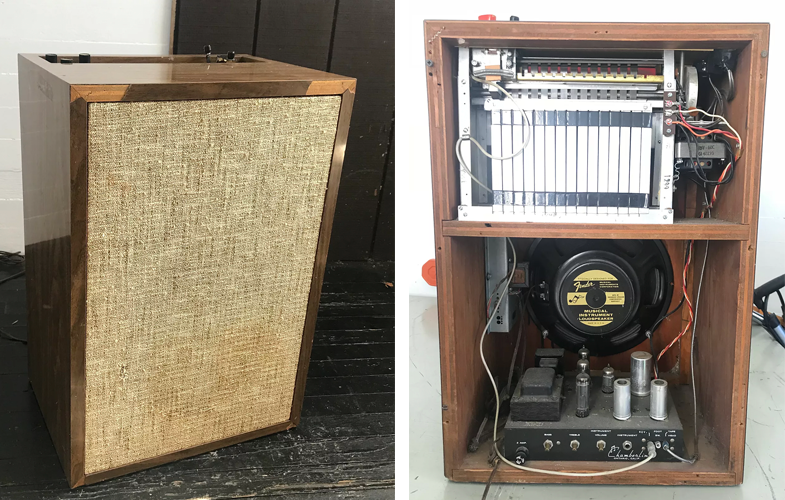
Phil Elverum says he used a Chamberlin Rhythmate Model 40 on Microphones records including The Glow Pt. 2, where the machine was credited as “Karl Blau”.
Read Phil Elverum’s Chamberlin Rhythmate 40 ↗Tape loops in a living-room machine
A recorded drum performance runs around a tape loop, ready to accompany somebody playing beside it. Harry Chamberlin’s Model 100 Rhythmate puts that repeating drummer inside a cabinet with its own amplifier and speaker. Specialist histories date the small-run Upland, California instrument to around 1948–49.
Atomic Age Drum Machines: the Ghost Orchestras of Harry Chamberlin ↗ Chamberlin Rhythmate ↗ Chamberlin history and Rhythmate model chronology ↗
Fourteen tape-loop programmes
Specialist descriptions identify fourteen prerecorded rhythm loops, selected by moving the playback head. Tape speed sets the tempo. The same mechanism that changes the pace also changes the playback of the recorded performance: the accompaniment is carried by moving tape.
Atomic Age Drum Machines: the Ghost Orchestras of Harry Chamberlin ↗ Chamberlin history and Rhythmate model chronology ↗
The beginning of a larger story
The Rhythmate preceded Chamberlin’s Model 200 keyboard of 1951 and the later tape instruments connected with Mellotron history. The National Music Centre describes Chamberlin recordings made with Lawrence Welk Orchestra members in the late 1940s and early 1950s. Those company recordings are not an inventory of the Model 100’s loops, whose individual performers and session dates remain unidentified.
Chamberlin history and Rhythmate model chronology ↗ Chamberlin Instruments Company, Inc. ↗
A photographed survivor
The Smithsonian’s National Museum of American History Archives catalogues photographs titled ‘Photographs of model 100’. The record preserves a route back to the instrument’s appearance, although it does not date the photographed unit or establish the production total.
“Karl Blau” in the credits
Phil Elverum’s later Rhythmate was a Model 40, not a Model 100. He says it appeared on Microphones recordings including The Glow Pt. 2, credited as ‘Karl Blau’ after his absent friend. The later instrument brings the tape-loop idea into another musical setting; its story does not identify a Model 100 used on those sessions.
Recording and working accounts
Explore 2 source accounts
- Phil Elverum / The Microphones — The Glow Pt. 2
- Alex Zhang Hungtai / Dirty Beaches — Tarlabaşı
Dirty Beaches’ track credits identify Alex Zhang Hungtai on Chamberlin Rhythmate drum machine for “Tarlabaşı”.
Sources
The visual archive
Further visual evidence.
Sources for images shown earlier (2)
- Phil Elverum’s Chamberlin Rhythmate Model 40 ↗
- Alex Zhang Hungtai / Dirty Beaches — Tarlabaşı ↗
Release date not stated on source page · Alex Zhang Hungtai / Dirty Beaches / release artwork via Bandcamp · Official Bandcamp release-page artwork (Open Graph image)
Additional visual sources (1)
Original publications and related image sources.
- Smithsonian — Photographs of model 100 ↗
Undated collection record · Smithsonian National Museum of American History Archives · Archival collection component titled ‘Photographs of model 100’