
The Bontempi HF-222 is documented as an electronic organ with rhythms rather than a freestanding drum machine. A service-manual index names the HF-222 directly, and survivor records show the Bontempi-badged instrument with rhythm and chord controls built into its left-hand panel. Michael Paradinas—later known as µ-Ziq—remembers an HF222 with rhythms as the main workhorse in his early group Short Circuit.
Before µ-Ziq
Michael Paradinas’s first piece of gear was a Bontempi HF222 organ with rhythms. In a 2023 studio interview, he calls it the main workhorse in Short Circuit, the school group that preceded Blue Innocence and his later electronic work as µ-Ziq. That is the machine’s real point of entry here: not a faceless domestic accompaniment box, but the instrument through which a young musician began arranging songs with friends.
Surviving instrument
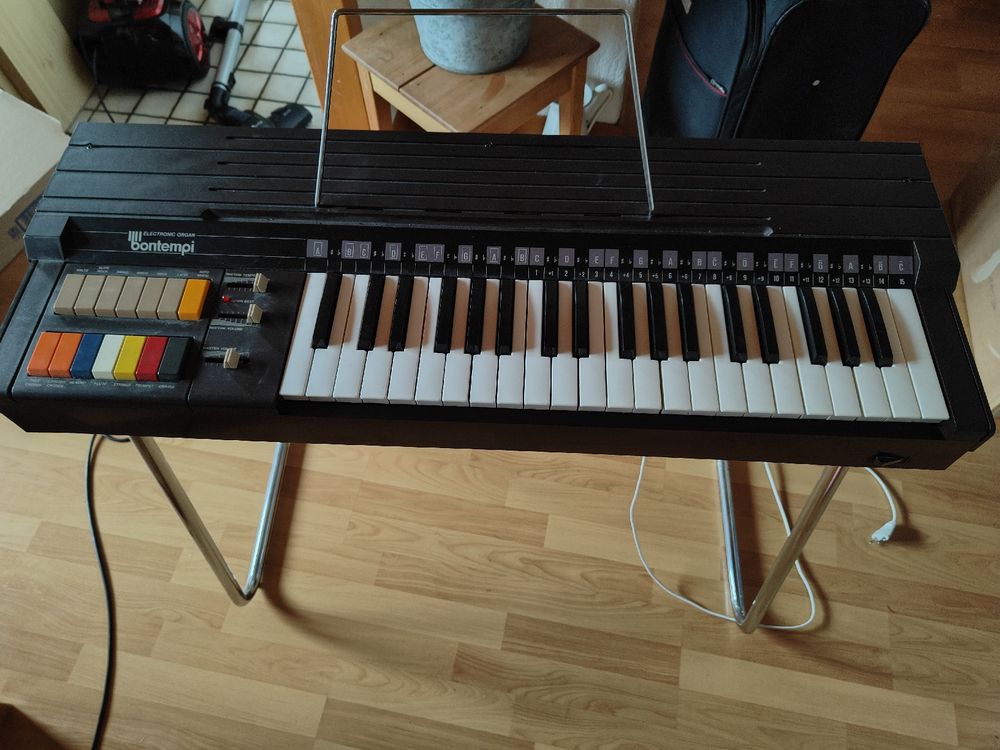
Bontempi HF-222.21, front view
Front view of a Bontempi electronic organ identified by its listing as HF 222.21. The Bontempi badge and the integrated rhythm/chord control panel are visible.
Rhythm in the left hand
The HF-222 keeps keyboard, chord accompaniment and rhythm controls in one compact body. Its automatic rhythm section belongs to the same practical world as the preset rhythm box, but it is inseparable from the player’s organ: a pulse under the left hand, harmony within reach, and a small self-contained setup for a bedroom, rehearsal room or living room. The service record and surviving examples establish the named model; the music comes from the way Paradinas recalls putting it to work.
Bontempi HF-222 service-manual index ↗ Bontempi HF222 electronic organ survivor listing ↗ Headphone Commute, “In the studio with µ-Ziq” ↗
The survivor record
The HF-222 survives in several cabinet revisions. The retained photograph shows an HF-222.21, with the Bontempi electronic-organ badge and its rhythm/chord control area visible on the same instrument. It is a later survivor photograph, not an advertisement and not Paradinas’s own machine; it lets the object sit beside his account without collapsing the two kinds of evidence into one.
A first machine, remembered
There is a particular dignity in the name “main workhorse.” It is not a collector’s verdict or a retroactive mythology. It is a musician remembering the machine that made early group work possible—rhythm, chords and a keyboard gathered into one portable proposition. That is enough to keep the HF-222 in the Museum.
Sources
The visual archive