
A surviving SR-55 retains its Univox/Unicord box, cover and wood-cased machine; the public evidence establishes a distinct Univox product identity, while its original launch date remains unverified.
More records in the archive
The machine keeps turning up.
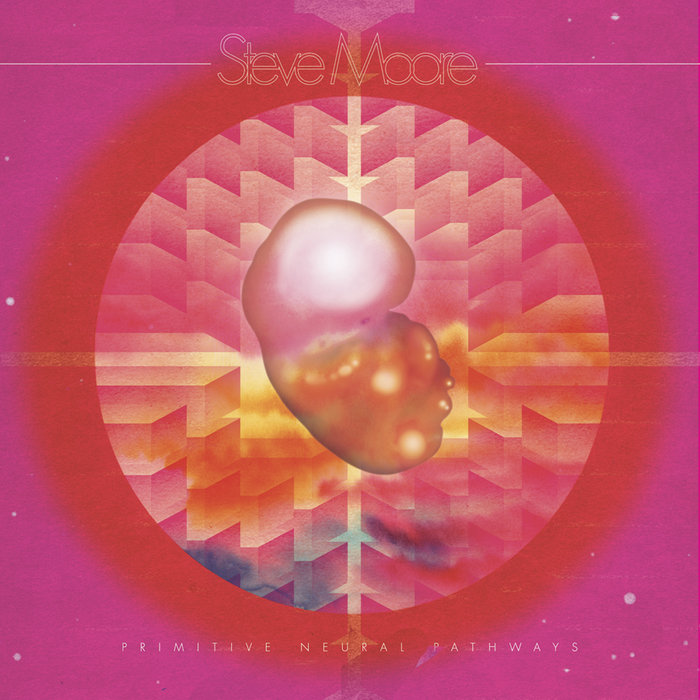
Steve Moore / Primitive Neural Pathways
Steve Moore lists a Univox SR-55 Super Rhythmer among the instruments used for Primitive Neural Pathways.
Read Primitive Neural Pathways ↗The name is on the box
The SR-55 survives as a small, wood-cased Univox rhythm instrument with the original carrying cover and a battered shipping box that still says “UNIVOX Electronic Rhythm Instrument,” “Unicord Incorporated,” and “Made in Japan.” That ordinary cardboard is unusually useful evidence: it keeps this machine from dissolving into a generic Mini Pops lookalike. It is a Univox product in its own right, with its own domestic American badge and its own physical trail.
Period press
Univox SR-55 with original Univox/Unicord box and cover
Gallery image 1: SR-55, original Univox/Unicord carton and cover together.
A ready-made rhythm section
The SR-55 is a preset player, not a programmable sequencer. Its face is built for immediate accompaniment—choose one of the named dance and rock rhythms, set the tempo and tone, then let the box carry the pulse. A detailed surviving-unit listing describes a choice of patterns that can be combined, nine percussion colours and separate high- and low-impedance outputs. Those are dealer-recorded operating details, but they match the practical proposition visible in the machine’s compact, handle-ready form.
Univox SR55 Super Rhythmer “Computer” sale listing ↗ Uhlik Music: Univox SR-55 with original box and cover ↗
The family resemblance, stated carefully
Modern technical documentation places the SR-55 beside Korg’s Mini Pops 3 and the Aria Diamond SR-55. The front-panel family resemblance is persuasive, and restorers have treated the three as close relatives. The Museum keeps that relationship as technical attribution, not as a claim that a surviving sales page has proved the original licensing or distribution arrangement. The Univox deserves its own entry precisely because the badge, box and later musical life are its own.
Korg MiniPops 3 MIDI installation documentation ↗ FK13 virtual Korg Mini-Pops 3 announcement ↗ Uhlik Music: Univox SR-55 with original box and cover ↗
Steve Moore’s two Univox boxes
Steve Moore’s official credits for Primitive Neural Pathways name both the Univox SR-55 and SR-95 Super Rhythmer among the instruments he played. The credits do not assign either machine to a particular track or sound, but they turn the pair into more than catalogue archaeology: two small accompaniment boxes deliberately brought into a 2011 electronic record.
Recording and working accounts
Explore 1 source accounts
- Steve Moore — Primitive Neural Pathways
Sources
The visual archive