
Solton showed the Disco 64 at the London Music Trade Show in 1982 and listed it in a German recommended-price catalogue effective July 1983.
The machine in the record
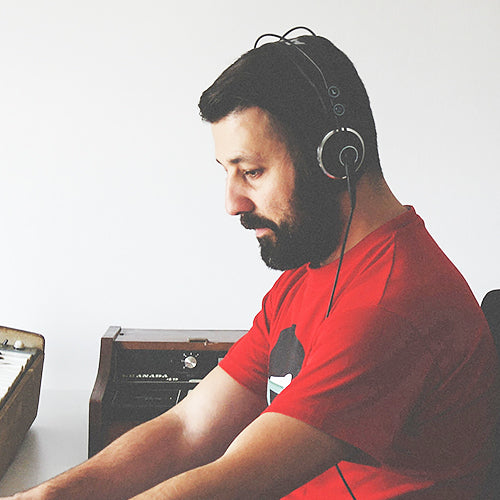
John Valasis / preserving the Disco 64.
John Valasis recorded a Solton Disco 64 for Soundiron’s Disco6000 library, preserving loops and pitched voices for a new generation of users. This is a later sampling session, not a period hit record, but it is a real act of musical preservation.
Read Disco 6000 ↗More records in the archive
The machine keeps turning up.
Sneaker / Holistical (Solton Beat)
The Holistical track note says Sneaker used a drum workout from an Italian Solton Disco 64 machine.
Read Sneaker — Holistical (Solton Beat) ↗A disco organ reduced to its essentials
The Disco 64 is an automatic-accompaniment system with a rhythm section at its centre and bass, chord and string parts gathered around it. Solton’s catalogue kept it separate from its home and portable organs, and that makes sense when the object is in front of you: the machine was built to put a full backing arrangement under a player’s hands and feet.
Sixty-four routes into a backing band
Electronics & Music Maker photographed the Disco 64 at the 1982 London Music Trade Show and described sixty-four preset rhythms, twelve voices or effects, six keyboard presets and a programmable pedalboard. The player did not program a new drum pattern from scratch; the pleasure was in moving through ready-made accompaniment parts, shaping their levels and deciding when each section entered or fell away.
What the price list reveals
A German Solton price list effective 1 July 1983 set the Disco 64 at DM4,197 including sales tax. Keyboard, bass pedal, swell pedal and stand appeared separately, making the full setup a collection of choices rather than one anonymous all-in-one object. Those accessories help explain the machine’s mixed identity: part rhythm box, part keyboard accompaniment system, part small performance rig.Source (1)
The sound of a survivor
John Valasis later recorded a Disco 64 for Soundiron’s Disco6000 library, capturing percussion and loops as well as its pitched voices. Repair documentation for another machine shows why surviving examples can differ: failed selectors, corroded contacts and later-added outputs turn a historic object into a particular individual. The museum story is therefore best told from the original panel and dated documents, with each altered survivor credited for its own life.
In the market
- 1983-07-01: DEM 4197 — German non-binding recommended retail price. Disco64 item900 Source ↗
- 1983-07-01: DEM 401 — German non-binding recommended retail price. D64 keyboard including bag, item901 Source ↗
- 1983-07-01: DEM 427 — German non-binding recommended retail price. D64 bass pedal, item902 Source ↗
- 1983-07-01: DEM 115 — German non-binding recommended retail price. D64 swell pedal, item903 Source ↗
- 1983-07-01: DEM 239 — German non-binding recommended retail price. D64 stand including bag, item904 Source ↗
On record
- John Valasis / Soundiron — Disco6000 sample-instrument recordings. John Valasis recorded a Solton Disco 64 for Soundiron’s Disco6000 library, preserving its percussion loops and pitched voices for a new set of users. Source ↗
- Sneaker — Holistical (Solton Beat). The Holistical track note says Sneaker used a drum workout from an Italian Solton Disco 64 machine. Source ↗
Sources
The visual archive
Further visual evidence.
These displayed records are labelled by their documented role, date and source; source-only records are listed separately below.
Sources for images shown earlier (2)
- John Valasis for Soundiron Disco 6000 ↗
- Sneaker — Holistical (Solton Beat) ↗
Release date not stated on source page · Sneaker / release artwork via Bandcamp · Official Bandcamp release-page artwork (Open Graph image)
Additional visual sources (2)
Original publications and related image sources.
- Solton Preisliste83/II — Disco64 and accessories ↗
Effective 1983-07-01 · Solton music GmbH · PDF1 date/tax; PDF8 Disco64 and accessory prices - Solton Disco64 at London Music Trade Show ↗
1982-09 publication · Electronics & Music Maker · Printed28/PDF30, right column; issue cover PDF1