
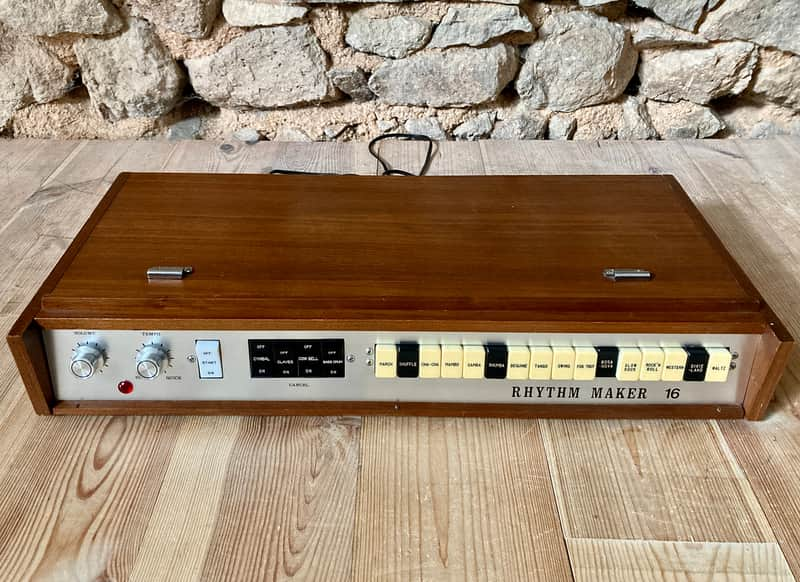
A surviving Farfisa-badged Rhythm Maker 16, documented in a 2024 listing and operating video, shows a compact analogue rhythm machine with 16 labelled preset buttons, tempo and volume controls, and a row of instrument-cancellation switches. The listing places the machine in the 1960s and Italy; those dates are retained as seller metadata while the Farfisa identity and control layout are visible on the object itself.
The evidence, in view
A Farfisa rhythm box, front and centre.
The nameplate, 16-button rhythm strip and the cancellation row are visible without reconstruction. This is a later surviving-unit record, presented as that: a direct look at the Farfisa-badged object rather than a substitute for the missing original advertisement.
Sources (5)
Sixteen buttons, not one fixed beat
The front panel is the invitation. Sixteen labelled rhythm buttons run across the machine, and the demonstrated unit permits more than one to be selected together. That gives the box its small but important element of play: a preset accompaniment machine can become a layered rhythm by pressing into neighbouring buttons rather than accepting one named dance style as a finished arrangement.
The cancellation row
The black rocker switches beneath the presets make subtraction part of performance. They mute individual percussion elements, so the player can thin an established pattern, let a part back in, and change the feel without building a rhythm from scratch. The listing and video establish the visible control method; they do not need an invented origin story to make it interesting.
One circuit, several names
The seller describes the machine as closely related in circuitry to the Ace Tone FR1/FR2L and Farfisa CER-60, and names NDK, Nomad and Goya as alternate badges with similar pattern and cancellation controls. Matrixsynth republished that account alongside the same video and photographs. A 2005 specialist index also places “Farfisa (?) Rhythm Maker 16” among its complete analogue machines, separately from the FR-2L and Goya Melodic Rhythmer. That question mark matters: it corroborates the circulation of the Farfisa association without settling a definitive manufacturing relationship.
A Farfisa machine in full view
The twelve retained views matter because the Rhythm Maker 16 is no longer only a name in a cross-reference. The Farfisa badge, the 16-button strip, the cancellation switches, cabinet, controls and connectors are all visible together. The photographs are of one later surviving unit, not period advertising; they give the archive an honest way to show the machine while the earlier commercial record is still being recovered.
Sources
The visual archive
Further visual evidence.
These displayed records are labelled by their documented role, date and source; source-only records are listed separately below.