Source-led exhibition chapter
Elektron Machinedrum SPS-1UW MKII
This model
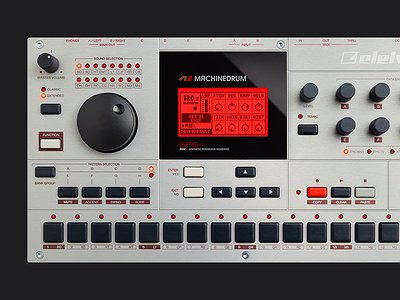
The SPS-1UW MKII combined the Machinedrum's UserWave branch with the November 2007 hardware revision. Its patterns could reach 64 steps; the factory manual lists 48 ROM slots, four RAM machines and 2.5 MB for this generation. Stored sample playback and live capture remained distinct operations. Guava identifies this exact variant in his account of making Out of Nowhere. Hania Rani's testimony names an SPS-1UW without establishing MKII, so it provides related family context rather than an exact credit for this revision. [1][5][6][7]
The shared instrument idea
The Machinedrum looks like an invitation to press sixteen buttons. Its silver face holds a row of steps below a bright display, and its sound-selection wheel sits where a hand can reach it quickly. Yet the instrument was designed to do more than repeat a row of hits. Every track could be assigned a percussion “machine,” each machine offered parameters to shape it, and a step could hold its own parameter values. A pattern was a sequence of decisions about both when something happened and what that event became. [1][2]
Elektron presented the original SPS-1 in November 2001 as a sixteen-track percussion synthesizer and arranger. The company described families of machines with different starting points: some drew on drum-machine synthesis, some on FM, some on sampled percussion as a synthesis source, others on physical modelling. That last distinction matters. The original SPS-1's E12 machines were based on processed sample material, but the standard SPS-1 was not a user sampler. It did not have the later UW workflow for bringing your own recorded hits into its kits. [2][3]
Assigning a machine to a track determined the kind of percussion it could make. A parameter could then change at one trigger. The next time the pattern comes around, that event can be different while the surrounding hits remain. Elektron's later OS manual calls these step-specific snapshots parameter locks. It says the locked value returns to the kit's default on the next trigger unless another lock intervenes. The kit supplied a starting state; individual steps could depart from it. [1]
The panel also made absence playable. Muting a track withheld later triggers while sounds already ringing could finish. Swing could be placed across a pattern or on selected tracks. A player could keep the pattern running and intervene in its structure. A rhythm could change while it was running, with a track taking on a different character at selected steps before returning to its kit setting. [1]
2005: a second kind of machine
The SPS-1UW, announced in April 2005, added UserWave sampling to the original synthesis environment. The UW suffix is an actual boundary in the family. The standard SPS-1 could synthesise and sequence percussion; the UW could also place user audio into sample-playing ROM machines and use RAM machines to capture and replay sound while music ran. The later factory manual describes ROM content as persistent and RAM recording content as lost at power-down unless copied. Bringing stored audio into the kit and capturing sound during a performance were distinct sample roles. [1][4]
The UW did not turn the Machinedrum into a keyboard multisampler. The 2005 announcement pitched single hits and loops within a drum-composition setting. UserWave added a sample path alongside the synthesis tracks. That path belonged to the UW models; it was absent from the standard SPS-1. [1][4]
2007: the case changes, and so does the length of a thought
Elektron announced MKII versions of both the standard SPS-1 and the SPS-1UW in November 2007. The thinner case and revised power supply are visible or measurable changes, but the expanded pattern length is the decisive editorial comparison: the MKI manual's limit was 32 steps; MKII could reach 64. The official manual also separates UW memory: 32 ROM slots, two RAM machines and 2.0 MB in MKI, versus 48 ROM slots, four RAM machines and 2.5 MB in MKII. Those are model-specific specifications, not an excuse to describe every Machinedrum as though it had the final configuration. [1][5]
The four variants mark two separate changes. UserWave added incoming audio and live capture. MKII changed the case and extended pattern length. The standard MKII carried the second change without the first; the UW MKII combined them. Those differences matter when a musician names a particular model.
Musicians did not all use the same branch
Hania Rani has described using an SPS-1UW on many of the recordings for Ghosts and bringing it into her touring setup. That is her direct account of a sampling-capable Machinedrum in a body of work built around piano, voice and other instruments. It is not evidence that a particular drum on a particular song came from that machine. [6]
Guava identifies his own instrument as an SPS-1UW MKII and speaks directly about using it on Out of Nowhere. His testimony is direct evidence for his own instrument and work. His testimony is most useful for the physical side of the story: a machine that became easier for him through jamming than through reading its long manual. [7]
Gundelach has said that the Shifter half of Shapeshifter was made mostly with a Machinedrum. The interview does not establish the exact model variant; that account belongs to the family story until a reliable model identification appears. This restraint is important. Four similar silver instruments do not give us licence to move a musician or a recording between their pages. [8]
The Machinedrum lasted long enough for its capabilities and its users to change. Its synthesis machines, parameter locks, UserWave branch and longer MKII sequences gave musicians different ways to revise a rhythm while it was still playing.
Sources
1. Elektron, Machinedrum user's manual, OS 1.63 ↗, especially printed pp.2–3, 44–49, 71–72, 87 and Appendix A; later manual applies primarily to MKII and identifies MKI differences.
2. Sonicstate's November 2001 launch report ↗, reproducing Elektron product copy and recording a review unit in hand.
3. Elektron SPS-1 OS 1.12 manual, existing source key `machinedrummanual112`, for original-generation context.
4. Sonicstate's April 2005 UW announcement ↗, planned availability, not proof of first customer delivery.
5. November 2007 MKII announcement ↗, publishing Elektron specifications.
6. Hania Rani interview ↗, MusicRadar.
7. Guava interview ↗, 15 Questions; artist testimony about his own UW MKII.
8. Gundelach interview ↗, Wonderland; model variant not established.