
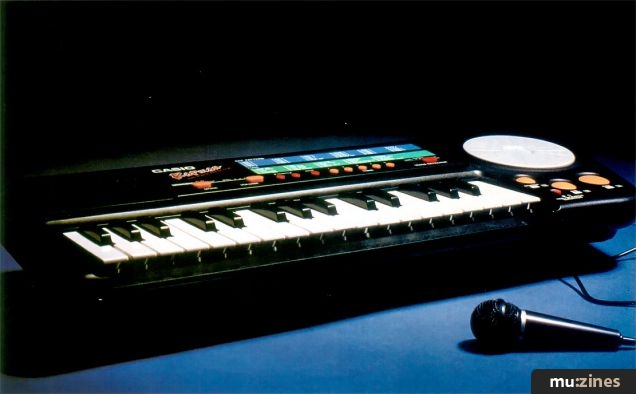
By October 1991, Music Technology had reviewed Casio’s RAP-1 Rapman as a compact personal rhythm instrument. The review describes a keyboard-led Play mode alongside a Rap mode that put 30 preset accompaniment patterns, three trigger pads and a turntable-style controller within reach of a single player.
Source (1)
A rhythm box made for a hand at the controls
The Rapman did not follow the usual desktop drum-machine script. In Play mode it acted as a small three-voice keyboard; in Rap mode, its panel gathered rhythm patterns, pads, microphone input and a turntable-style controller into one deliberately playful instrument. The appeal was not studio programming depth. It was the immediacy of changing the beat while performing it.
Thirty ways in
Music Technology lists 30 preset patterns: 14 drum-only patterns and 16 with bass or chord accompaniment. That split explains the Rapman’s character. Some settings were a beat to play against; others were a pocket-size backing band. The review’s “80-something quid” wording belongs to that specific British review context, not to a universal list-price claim.
A small visit to a large studio
The reviewer reported taking the Rapman to Real World Studios, where he described interest from musicians including Manu Katché and Peter Gabriel. It is a contemporary reporter’s observation rather than evidence that either artist owned one or used it on a recording. What it does preserve is the odd charm of the object: a toy-like rhythm instrument compelling enough to be passed around in a serious studio.
Freedom, with a few awkward edges
The Rapman invited performance without offering a studio machine’s connections. Robinson noted that it had no MIDI and that its tempo adjustments jumped unevenly. He also found the turntable’s scratch effect frustratingly brief. Those limits belong beside the playful controls: a voice-changing microphone effect, pads and a little wheel gave the performer things to try, while precise synchronization remained outside the instrument’s brief.
Source
The visual archive