
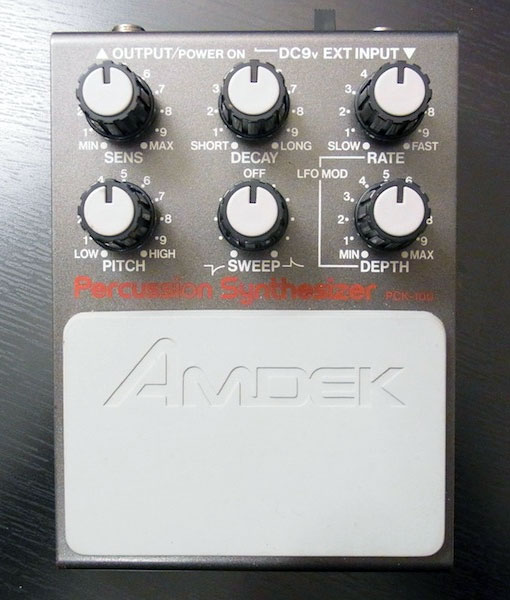
The PCK-100 was being advertised and constructed in Britain by December 1982. It was a build-it-yourself percussion synthesizer: a struck pad or external signal could fire one adjustable electronic voice. Contemporary listings place it at £46–£51, depending on seller and offer, making it a small, unusually accessible way into shaped analogue percussion.
The evidence, in view
The finished kit, in view.
This exact PCK-100 photograph is a later specialist reference, placed alongside the 1982 construction and sales evidence rather than presented as launch photography.
The drum voice that arrived in parts
Amdek sold the PCK-100 as a bubble-packed kit with the parts, wire, spanner and assembly material needed to turn a compact case into a playable percussion synthesizer. Electronics & Music Maker described a pre-assembled PCB, leaving the builder to wire the controls, fit the pad and finish the enclosure. Its December 1982 offer was £51 including VAT and postage; a contemporary dealer listing put the kit at £46. The PCK-100 belongs to the moment when a drum sound could be a weekend construction project rather than a sealed appliance.
Sources (2)
Strike it, or make something else strike it
The instrument contained its own sensor, but Amdek also provided an external trigger input. The period advertisement explicitly proposed signals from a microphone, guitar or sequencer in place of the hitting board. That turns the PCK-100 from a tabletop pad into a small drum voice that could be folded into a larger system.
Sources (2)
One voice, a wide territory
The assembly feature describes a voltage-controlled oscillator, sweep and modulation controls, and a variable-decay amplifier. In use it found everything from a heavy bass-drum shape to fast, ring-modulator-like effects. The front panel makes the invitation plain: sensitivity, decay, rate, pitch, sweep and depth are all there to be moved while the sound is still in the room.
Sources (2)
The little Amdek beside the Boss
Later specialist documentation treats the PCK-100 as the DIY counterpart to Boss’s PC-2 percussion synthesizer. That relationship explains the familiar compact-pedal silhouette, but the Museum keeps the Amdek in focus: this was the version that asked its owner to make the instrument before making the noise.
Sources (2)
Sources
The visual archive