
By 15 December 1976, Stedman’s in Lewisporte, Newfoundland, advertised the RD-9844 as an optional Rhythm Unit with Panasonic’s RF-888C radio. Separate RF-1150 instructions also name a connection for it. These establish a place among Panasonic’s portable listening equipment, without settling its launch date or price. Ingus Baušķenieks later credited the machine in a solo recording made in summer 1984; the release page’s displayed 1984 date should not be mistaken for a proven public issue that year.
The machine in the record

Ingus Baušķenieks / Reportāža.
Ingus Baušķenieks’s official Reportāža page names a Panasonic RD-9844 Rhythm Machine among the equipment used in summer 1984. It is an album-wide credit, yet it holds the modest Panasonic inside a specific Latvian recording world instead of letting it disappear into a generic equipment list.
Read Reportāža ↗More records in the archive
The machine keeps turning up.
Reported association
Crash Course in Science / Cardboard Lamb
Posts in the Minimal Wave discussion attribute Crash Course in Science’s Cardboard Lamb to a Panasonic RD-9844, naming its Rock preset.
Read Panasonic RD-9844 discussion and artist posts ↗On record
- Ingus Baušķenieks — Reportāža. Ingus Baušķenieks credited the Panasonic RD-9844 Rhythm Machine among the equipment used on Reportāža. Source ↗
- Crash Course in Science — Cardboard Lamb. Posts in the Minimal Wave discussion attribute Crash Course in Science’s Cardboard Lamb to a Panasonic RD-9844, naming its Rock preset. Source ↗
A rhythm source for the room
The RD-9844 put an automatic beat and three hand-played drum sounds in a small box that needed an amplifier to be heard. A radio could do that job. The RF-1150 instructions name the unit at the radio’s Rhythm In/Rec socket and explain that the radio’s volume and tone controls adjust the incoming sound. In the 1976 Canadian advert, the RD-9844 appears as an optional extra beside a different radio, the RF-888C. It belonged to the domestic audio setup, but its output could become material for a tape recording too.
Stedman’s Panasonic radio advertisement with RD-9844 option ↗ Panasonic RF-1150 operating instructions ↗ The Bare Minimum Beats: Panasonic’s RD-9844 Rhythm Machine ↗
Four beats and three buttons
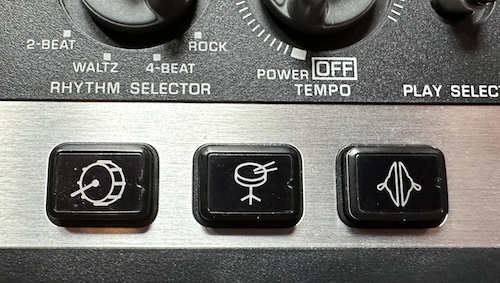
The panel offers 2-Beat, Waltz, 4-Beat and Rock on a rotary rhythm selector, a tempo dial with a power-off position, and a Manual/Auto switch. Below them sit bass-drum, snare and cymbal buttons. The player can choose a repeating preset or trigger the three sounds by hand; there is no user pattern-writing system. Nicole Express’s 2024 inspection describes a 9V battery and a captive mono minijack lead. The surviving service diagram labels the manual switches and separate bass, snare and cymbal circuits. Here, changing rhythm or playing a button was the immediate musical action, rather than editing a stored sequence.
The Bare Minimum Beats: Panasonic’s RD-9844 Rhythm Machine ↗ Schematic Diagram — Model RD-9844 (circled A), sheet 3 ↗
Reportāža: rhythm, flanger and tape
Baušķenieks’s account of “Reportāža” brings the small machine into a specific working setup: Panasonic RD-9844, Ibanez FL9 flanger and reel-to-reel recorders, with tape used for echoes. He dates the recording to summer 1984 in Riga, probably June, while acknowledging that no written notes survive. His description also mentions sound-effect playback entering the second and third pieces and a brief Casio VL-1 appearance recorded with changing tape speed. That is a richer account than an equipment list, but it does not identify which Panasonic preset he chose. The original tape was mastered in 2016; the later page describes previously unpublished material, so its displayed 30 June 1984 date does not establish the first public release.
Later accounts, different kinds of evidence
The RD-9844 also appears in a 2006 Minimal Wave forum discussion, where user “seth” attributes Crash Course in Science’s “Cardboard Lamb” to the machine and tentatively suggests its Rock rhythm. The posts do not identify the writer as a participant in that session. IK Multimedia names the model in UNO Drum’s third Drum Anthology library, but describes the collection as an homage with added elements, not one-to-one recreations. A resale listing offers another kind of survival: a unit said to retain its box, manual and paperwork. These sources preserve connections and research leads; they do not establish one definitive RD-9844 sound, a production date or every claimed recording use.
Panasonic RD-9844 discussion and artist posts ↗ UNO Drum Drum Anthology Library 3 instrument list ↗ Panasonic RD-9844 surviving unit with original manual ↗
Sources
- Panasonic RF-1005 advertisement
- Panasonic RF-1150 operating instructions
- The Bare Minimum Beats: Panasonic’s RD-9844 Rhythm Machine
- Reportāža
- Panasonic RD-9844 discussion and artist posts
- UNO Drum Drum Anthology Library 3 instrument list
- Panasonic RD-9844 surviving unit with original manual
- Schematic Diagram — Model RD-9844 (circled A), sheet 3
The visual archive
Further visual evidence.
Sources for images shown earlier (2)
- Panasonic RD-9844 control-panel detail ↗
- Ingus Baušķenieks — Reportāža ↗
1984-06-30 · Ingus Baušķenieks / release artwork via Bandcamp · Official artist Bandcamp release-page artwork and album credits
Additional visual sources (1)
Original publications and related image sources.
- Panasonic RF-1005 advertisement with RD-9844 option ↗
15 December 1976 · Panasonic · Panasonic RF-1005 advertisement